-
-
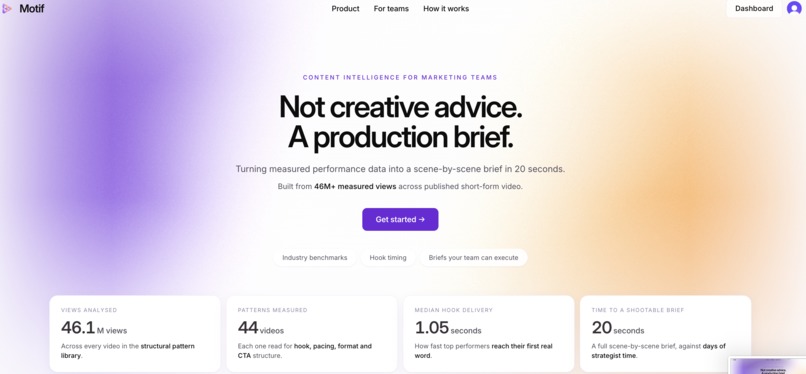
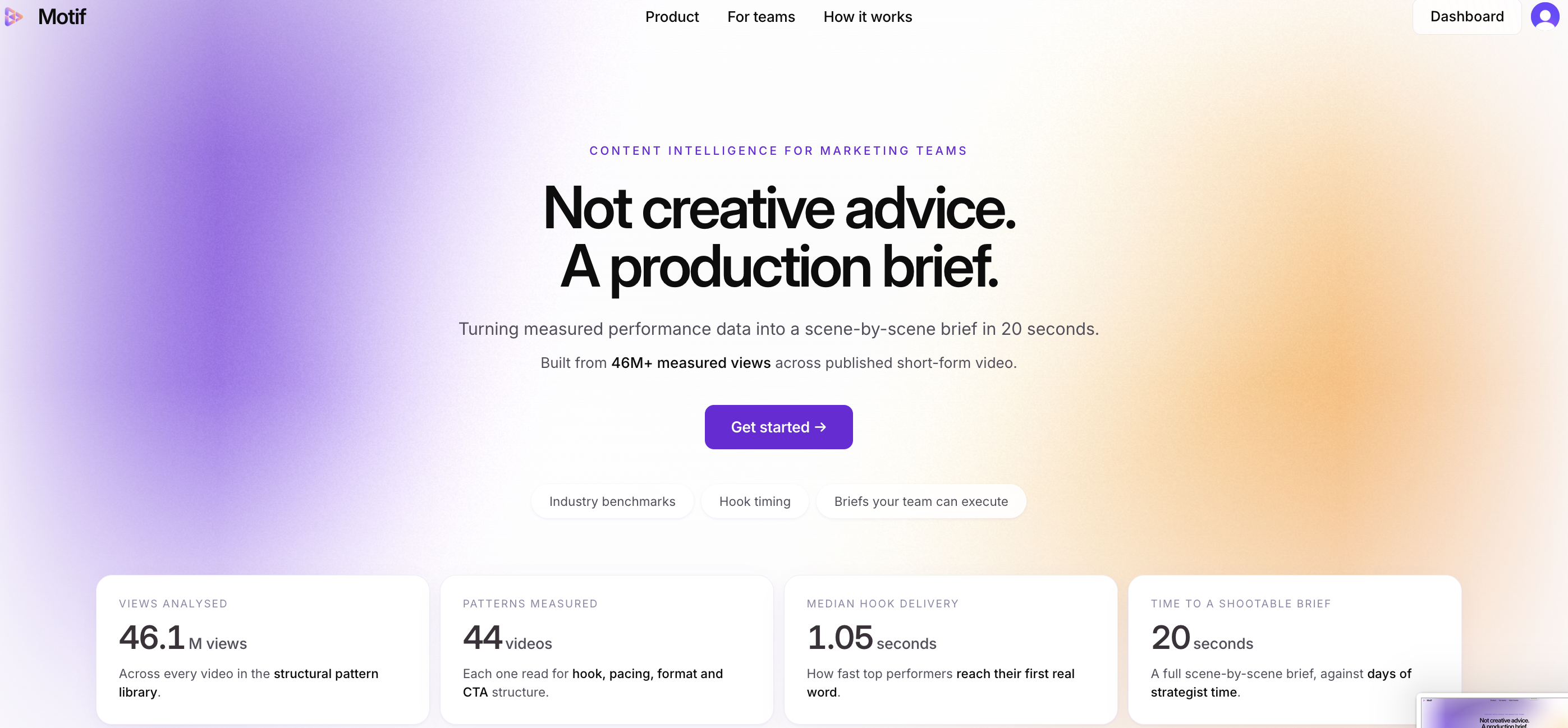
Motif Homepage
-
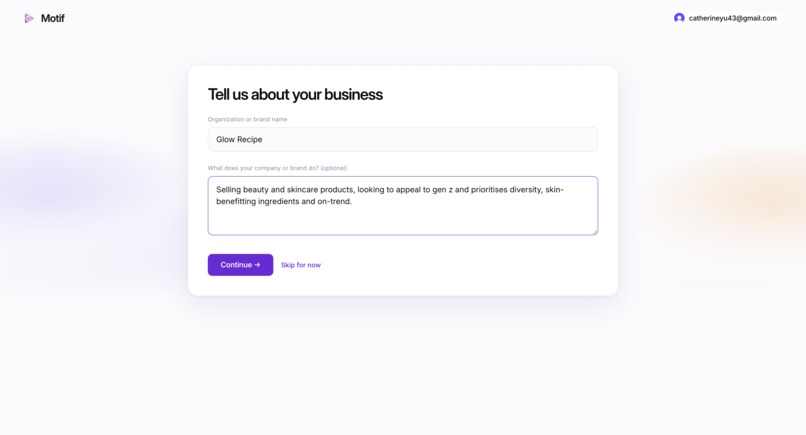
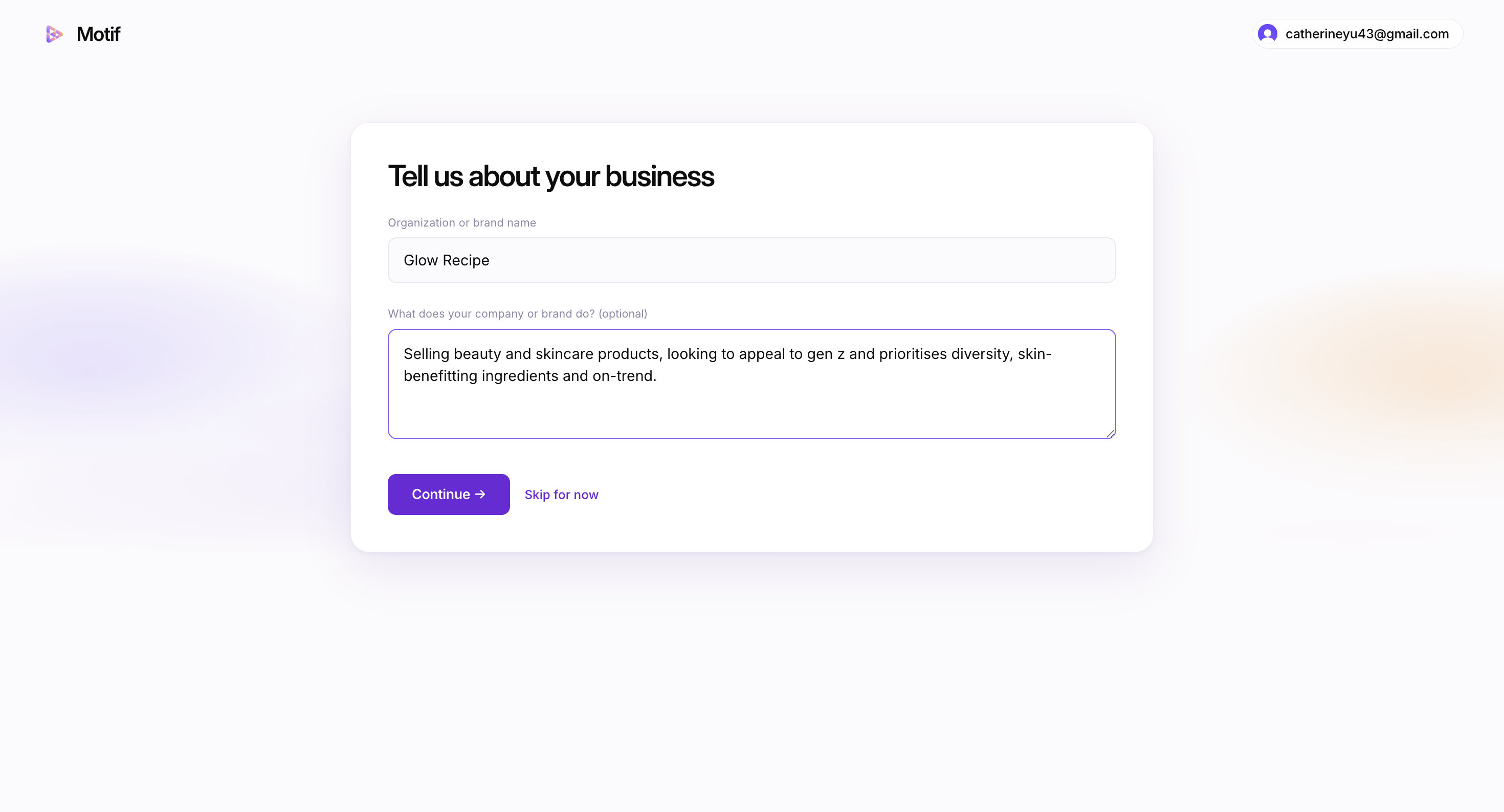
Short summary of business needs
-
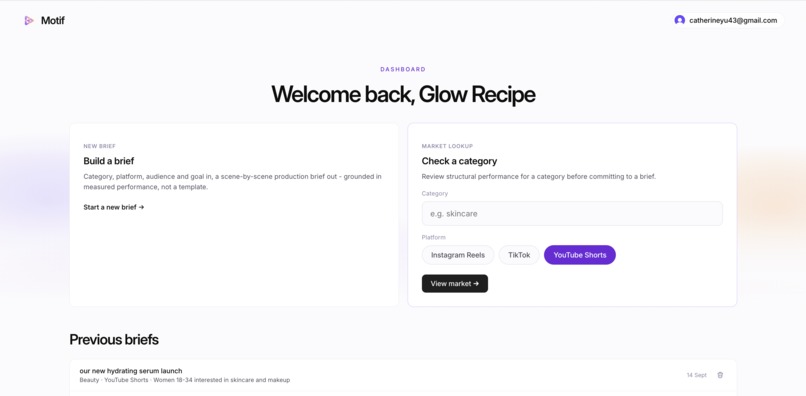
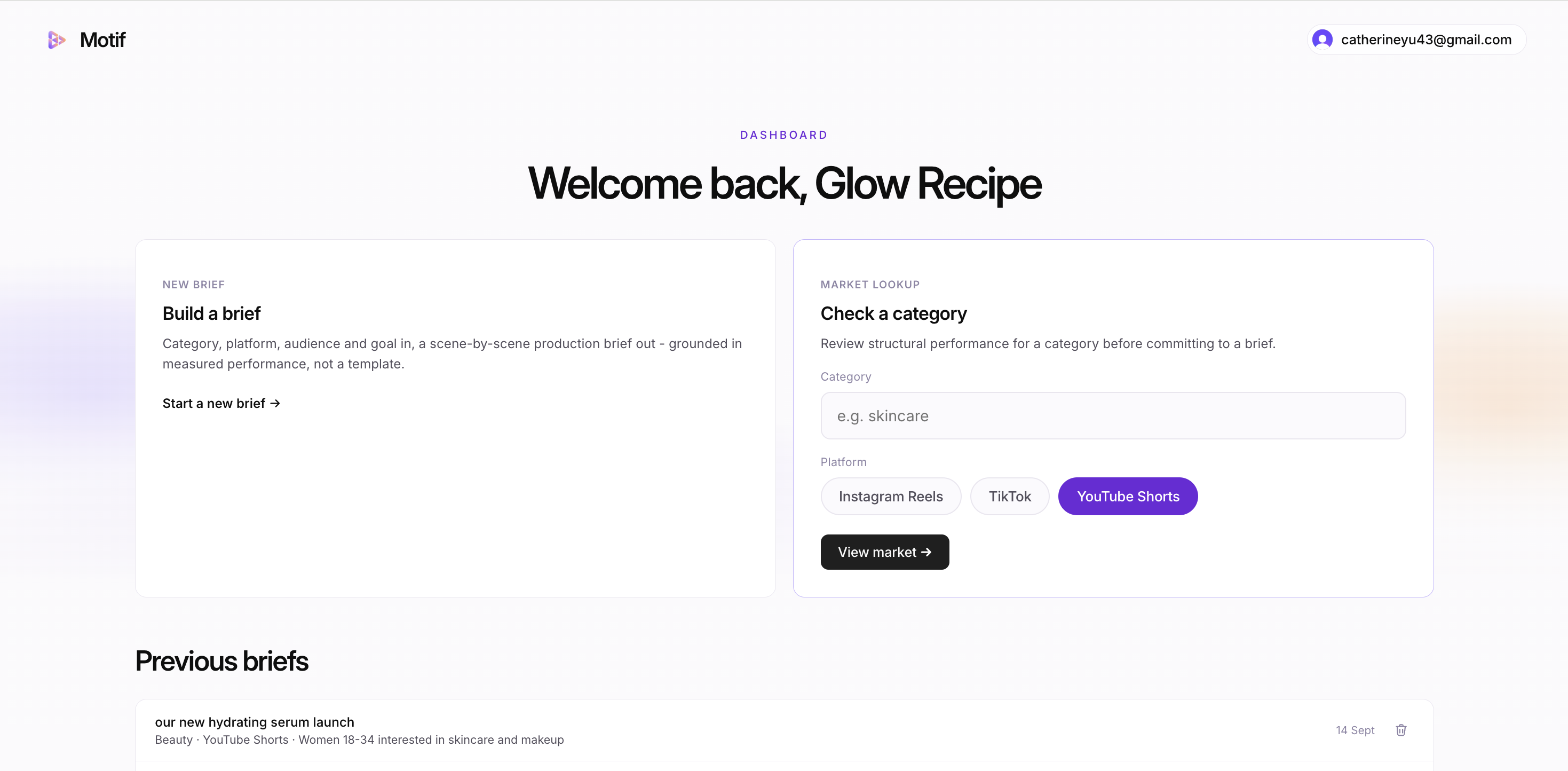
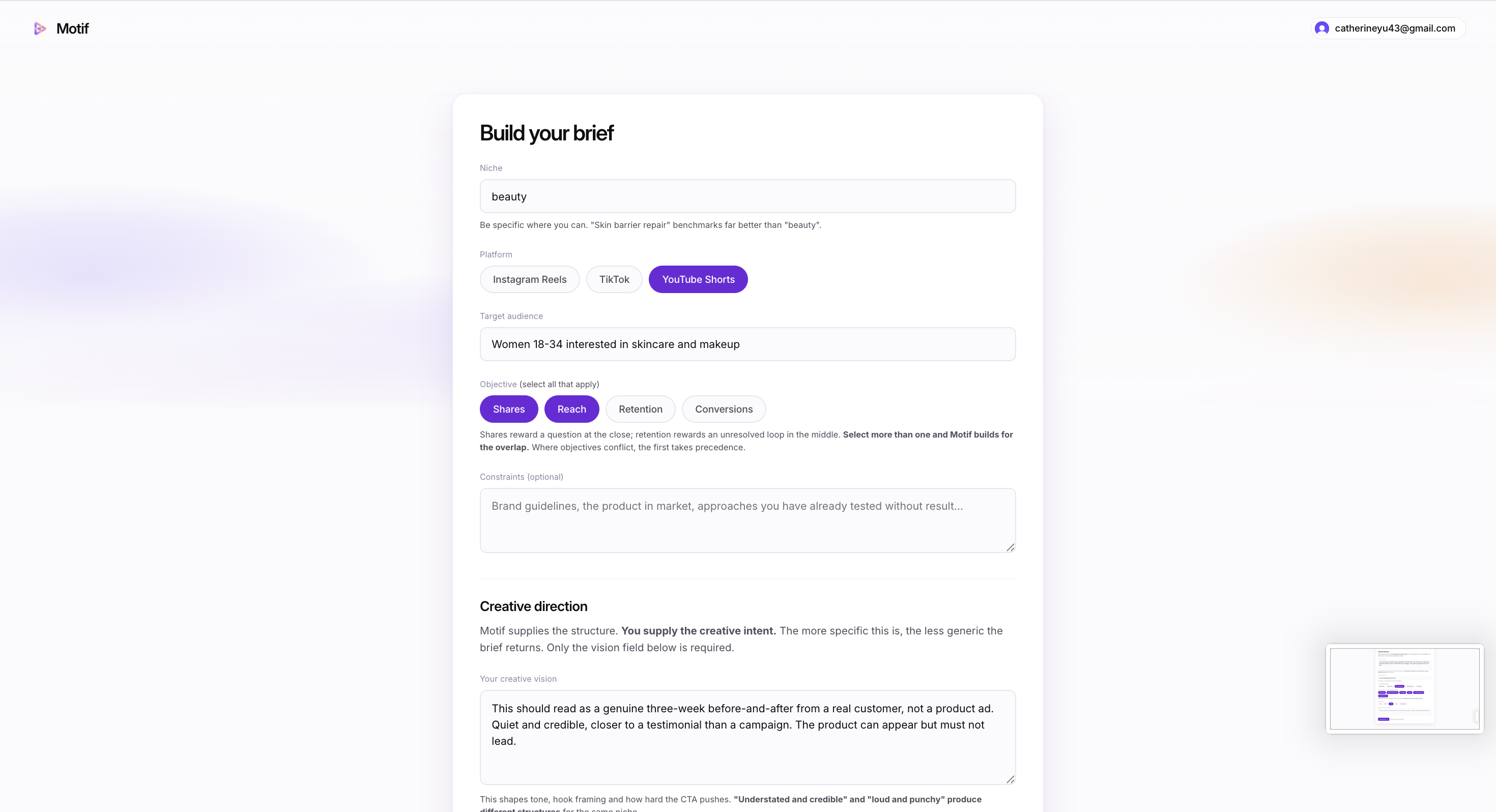
Your company's dashboard with the option to build a brief or research into the market
-
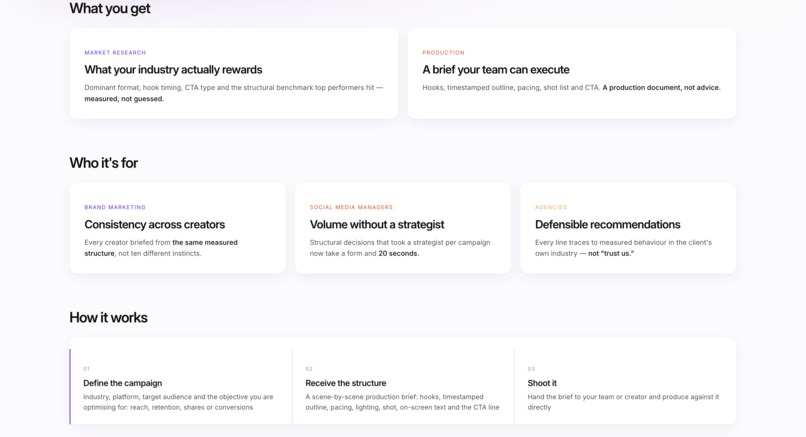
Dashboard information for consumer convenience
-
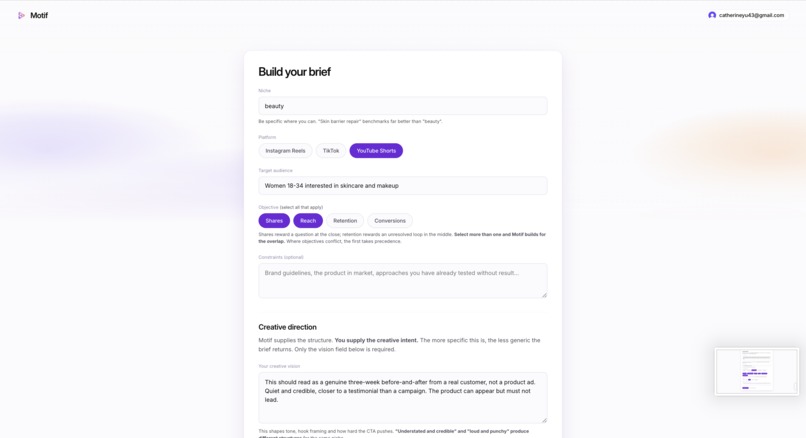
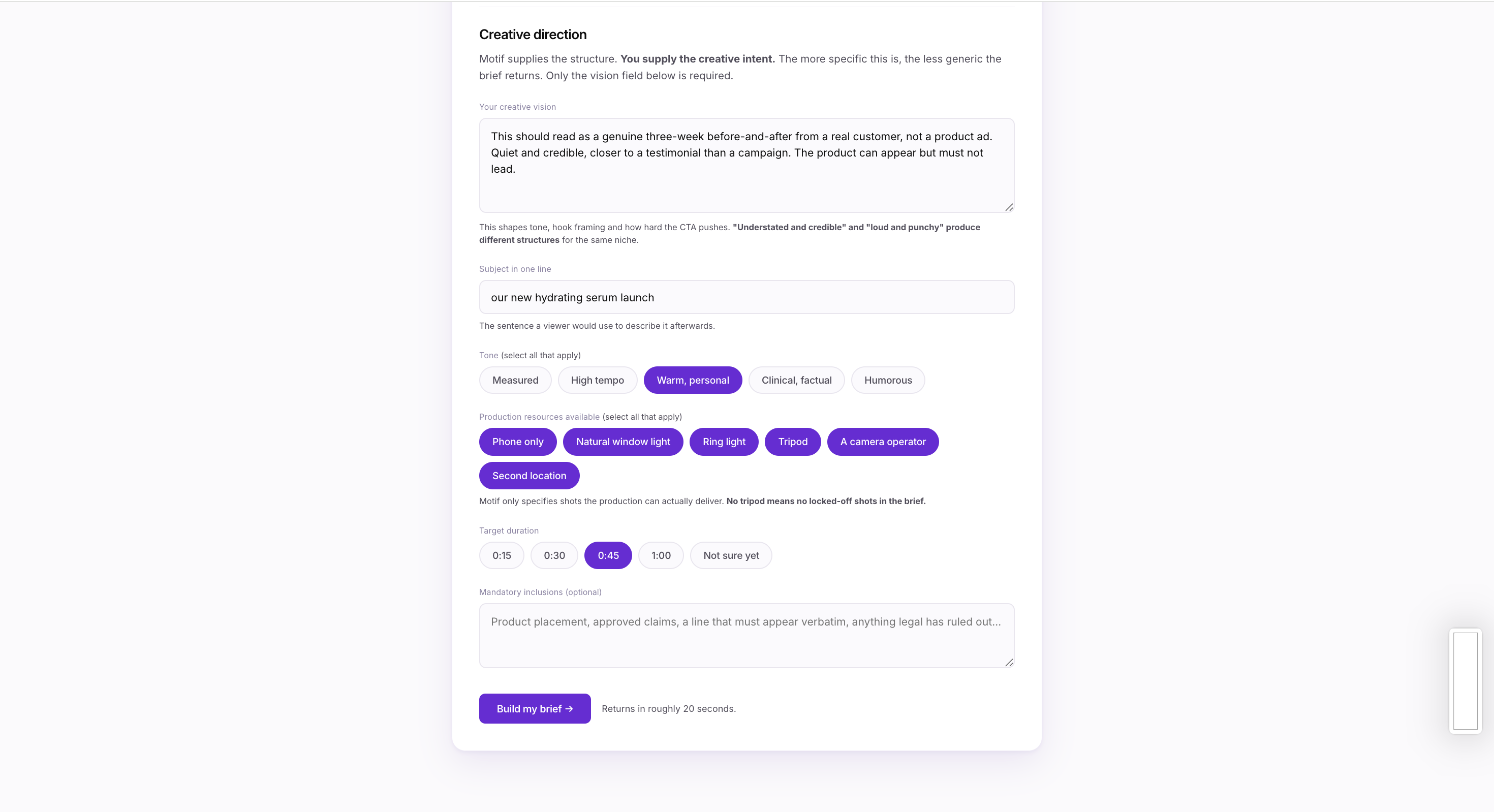
Curated questions that tailor to company's needs/values for marketing
-
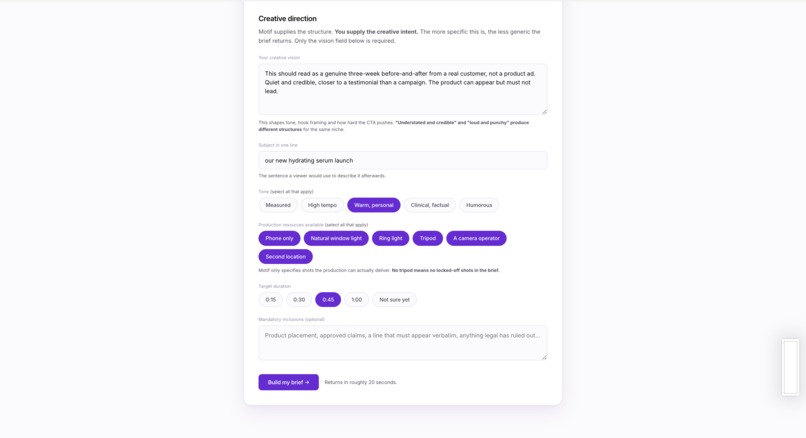
Curated questions that tailor to company's needs/values for marketing
-
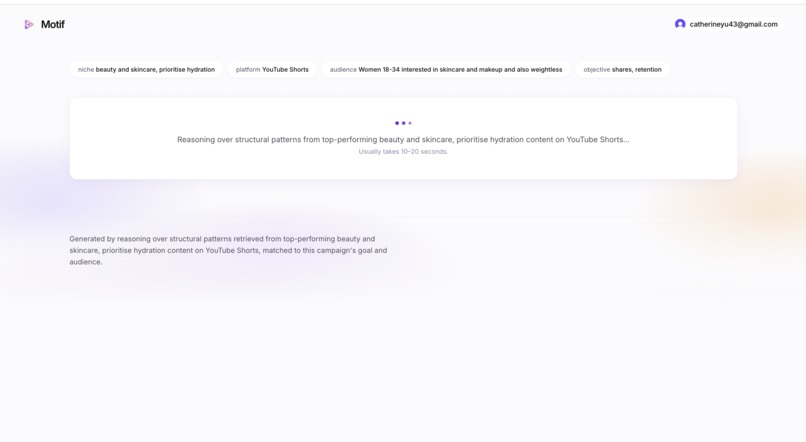
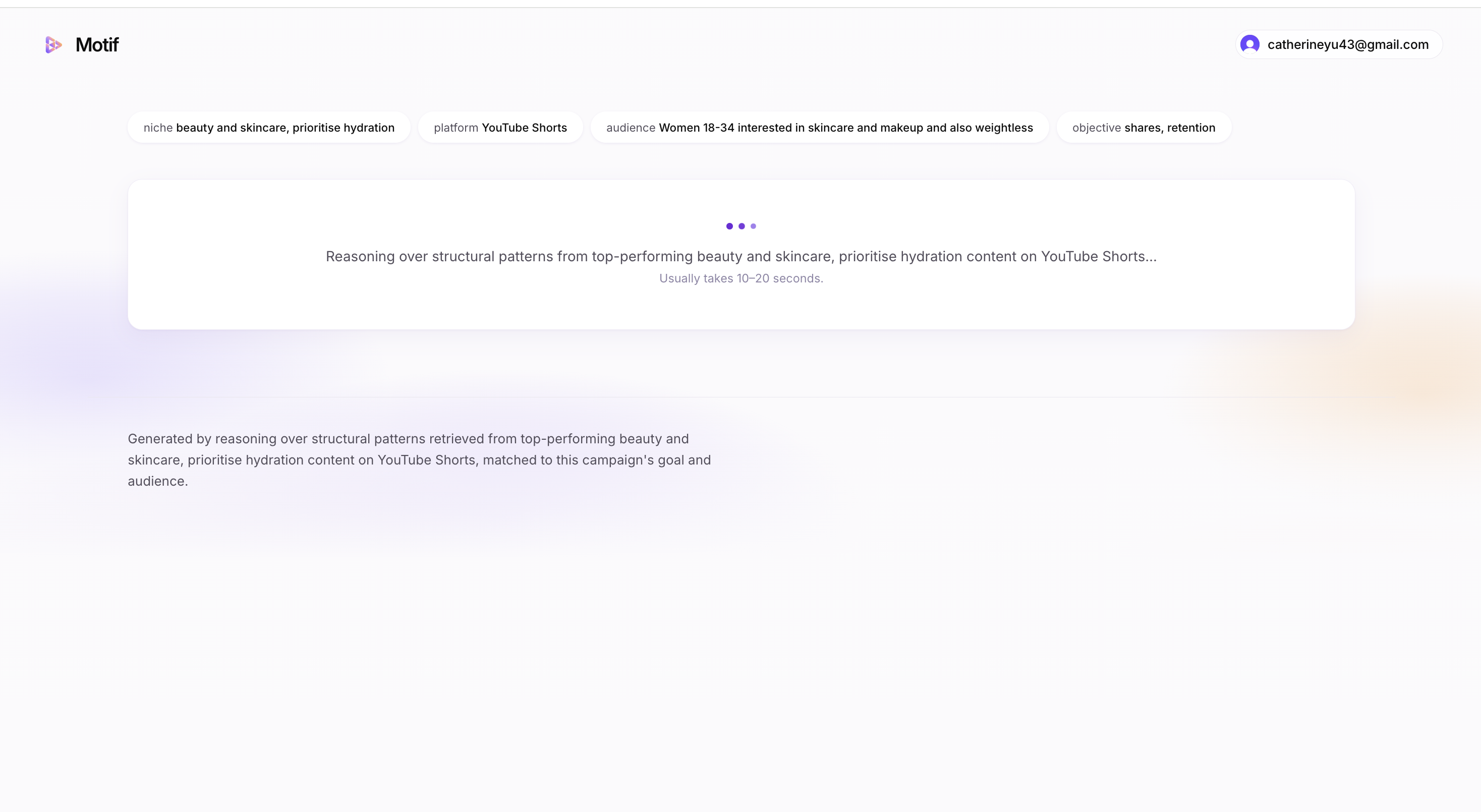
Generating a marketing brief
-
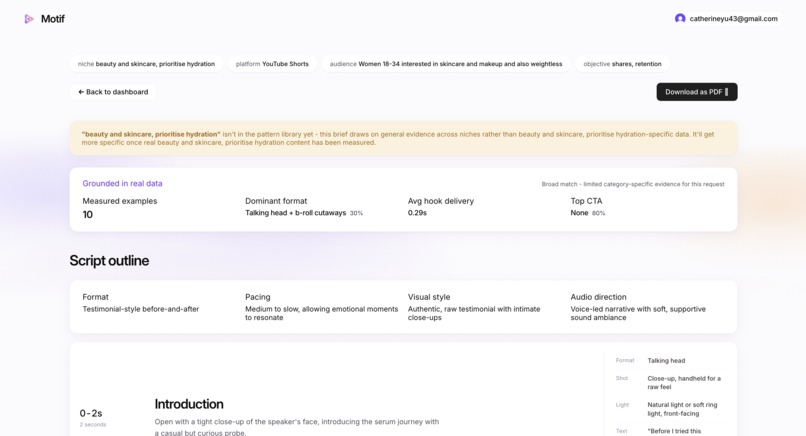
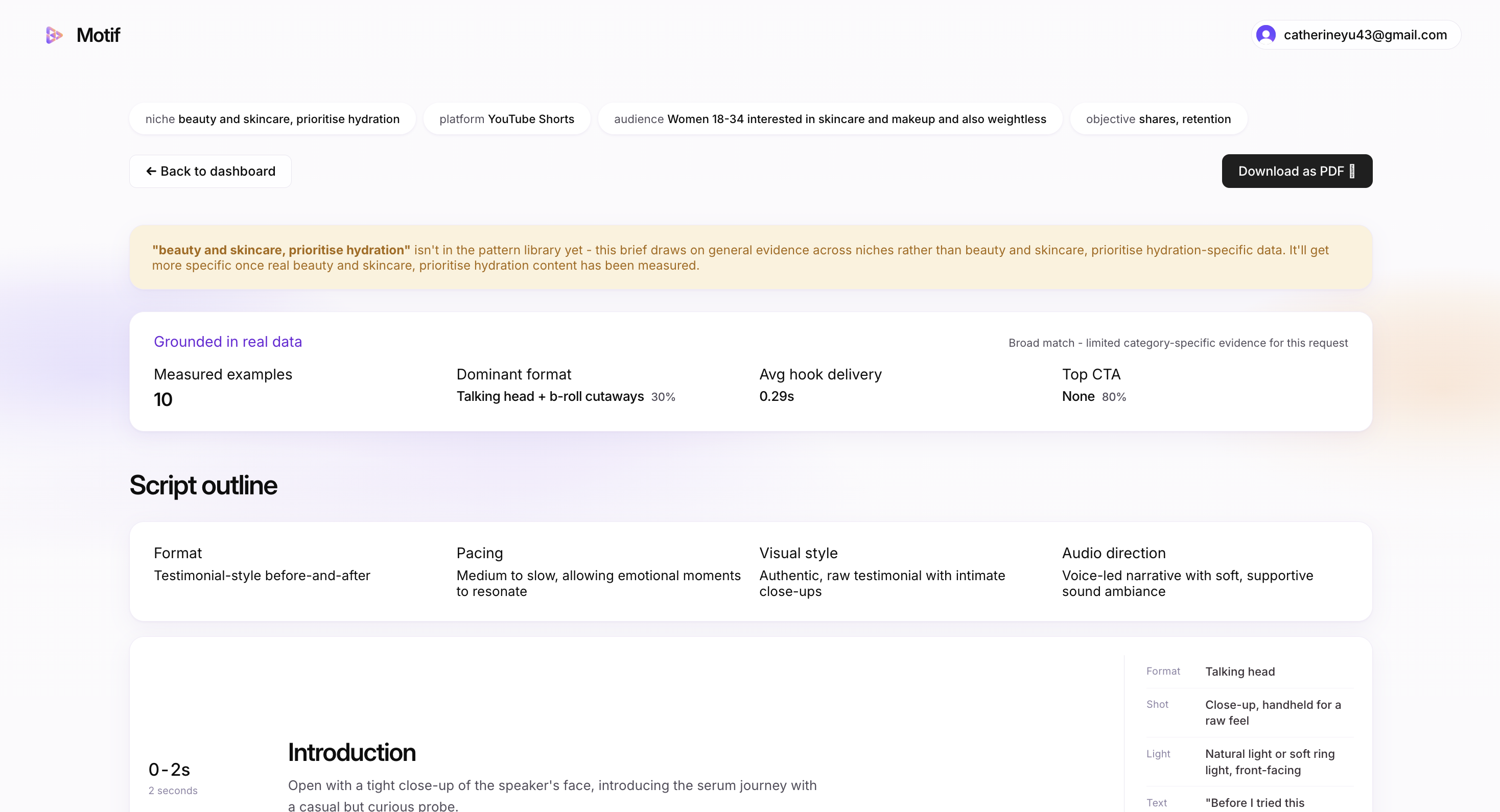
Detailed and clear director for marketing content
-
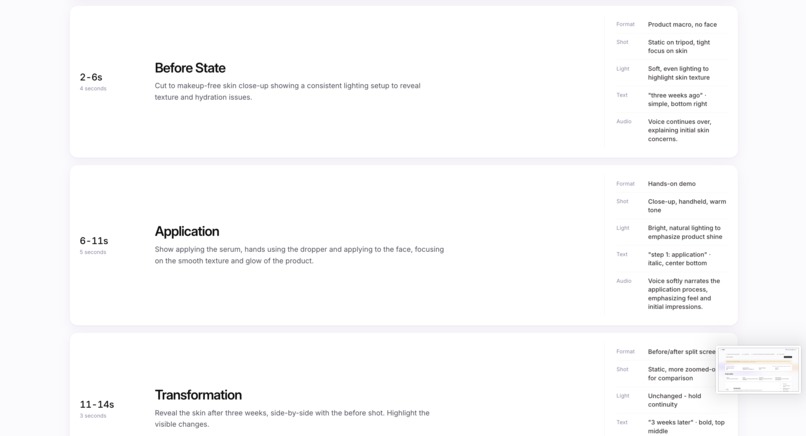
Detailed and clear director for marketing content
-
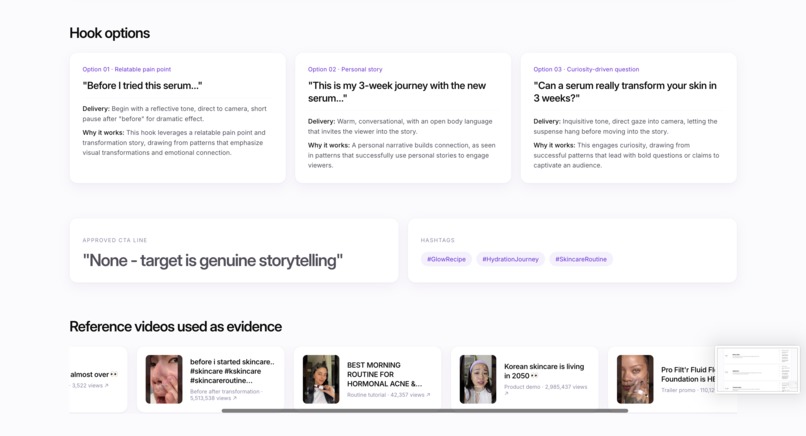
Includes features like "inspiration samples"
-
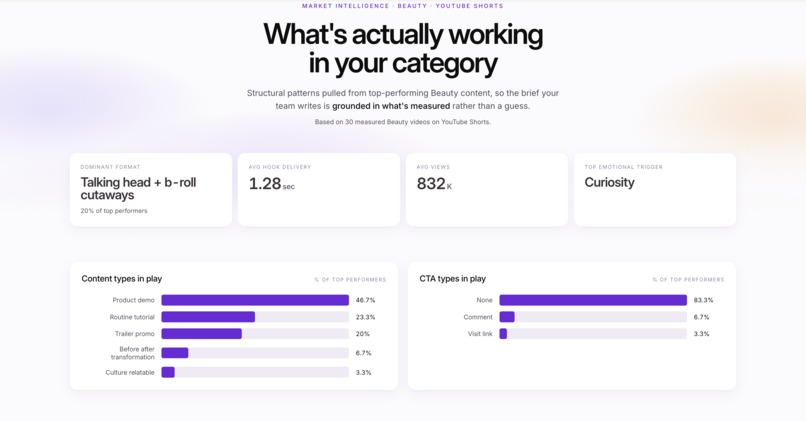
Market benchmarks and industry research done for you
-
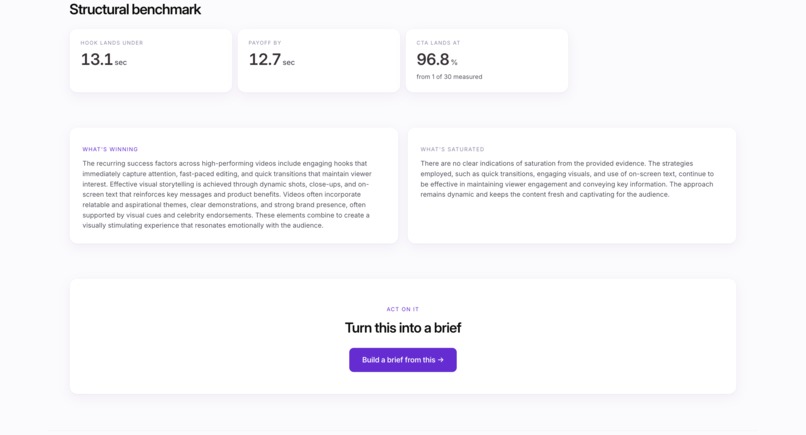
Market benchmarks and industry research done for you
Inspiration
Every industry has already shown you what works in short-form video: hook timing, cut rhythm, reveal order, CTA placement. The problem? It's buried across thousands of videos, and the answers keep moving. What worked last month doesn't work today.
So teams do it the hard way. A good strategist can find the pattern, but it means hours of manual teardown per video, and by the time they've done it, the trend's already shifted. Most teams don't have that time, or a strategist for every campaign. And the AI tools meant to help skip the hardest part entirely. They generate scripts and ideas but never decode structure: the actual sequence of hook, reveal and payoff that decides whether people stay or scroll. They'll tell you to "use a strong hook" without ever telling you what a strong hook looks like in your niche, for your goal, on your platform.
That's the gap Motif closes, for the people living in it: marketing teams and social media managers who brief creators, run content programs, and need to move at the speed their content calendar demands. Take a startup like Kinso launching a product. Instead of days of strategist time, they open Motif, see exactly what's winning in their niche right now, and get a director in their pocket telling them precisely which frames to shoot. Motif was built with the business in mind from day one: it turns hours of manual teardown into a production-ready brief, and grounds every call in what's measurably working, not what worked last quarter.
What it does
Motif is structural intelligence as a product. It doesn't hand you ideas. You bring the idea; Motif brings the structure to build it around, and the evidence to prove the structure works.
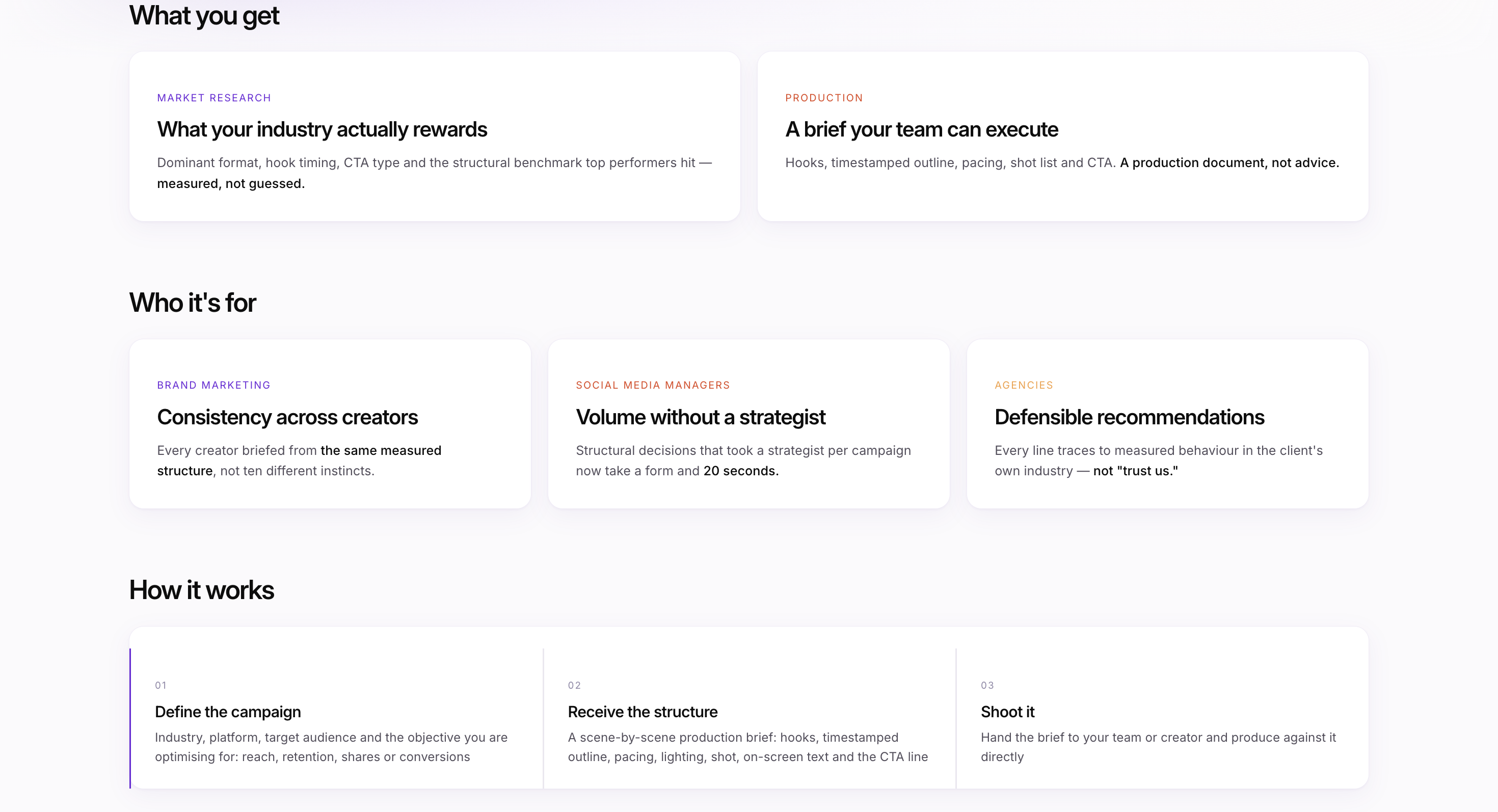
It reverse-engineers top-performing content in your exact niche for the signals that actually move views (hook delivery speed, pacing, information-reveal order, CTA placement, loop mechanics), and puts them to work in two places:
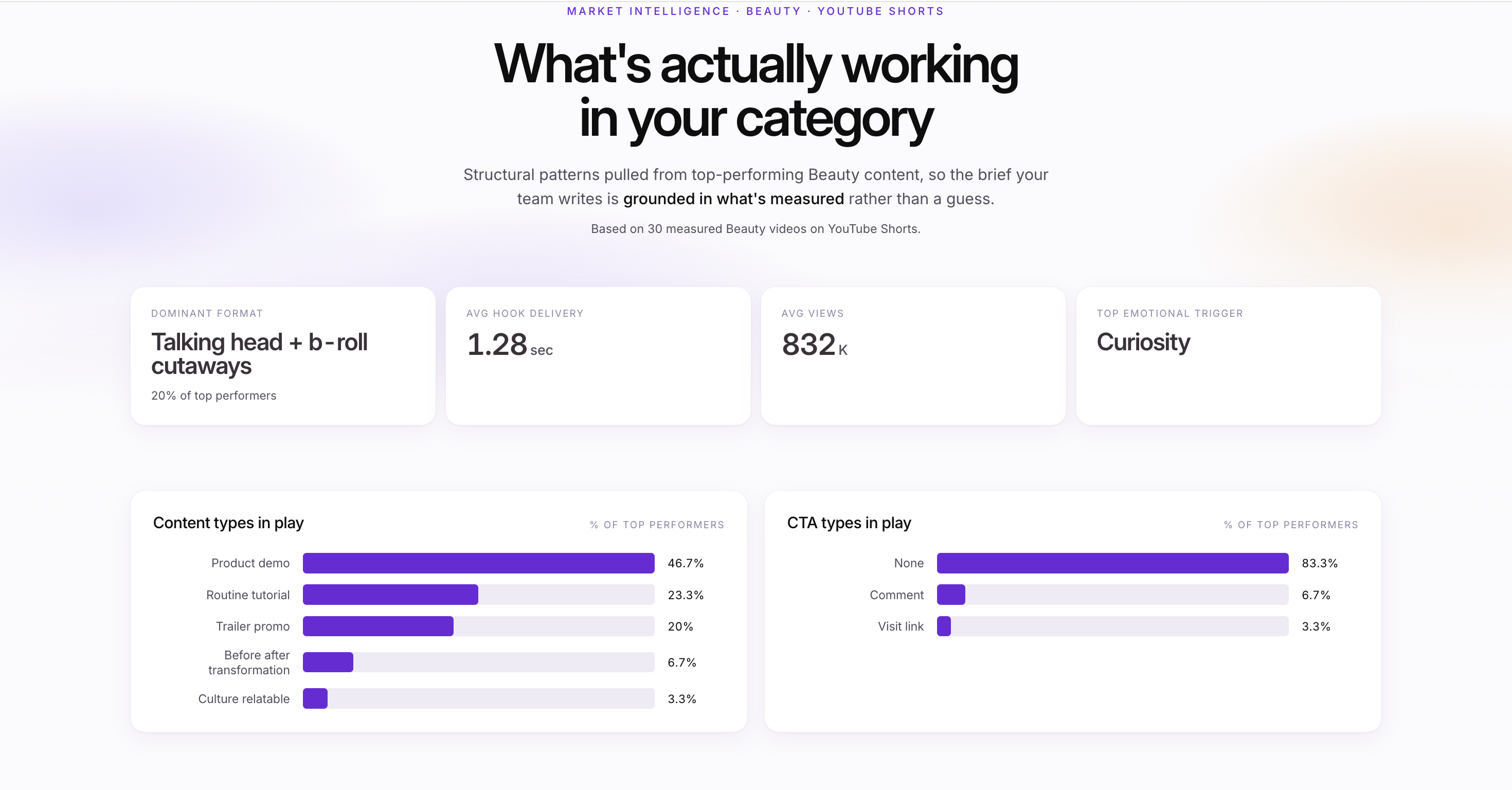
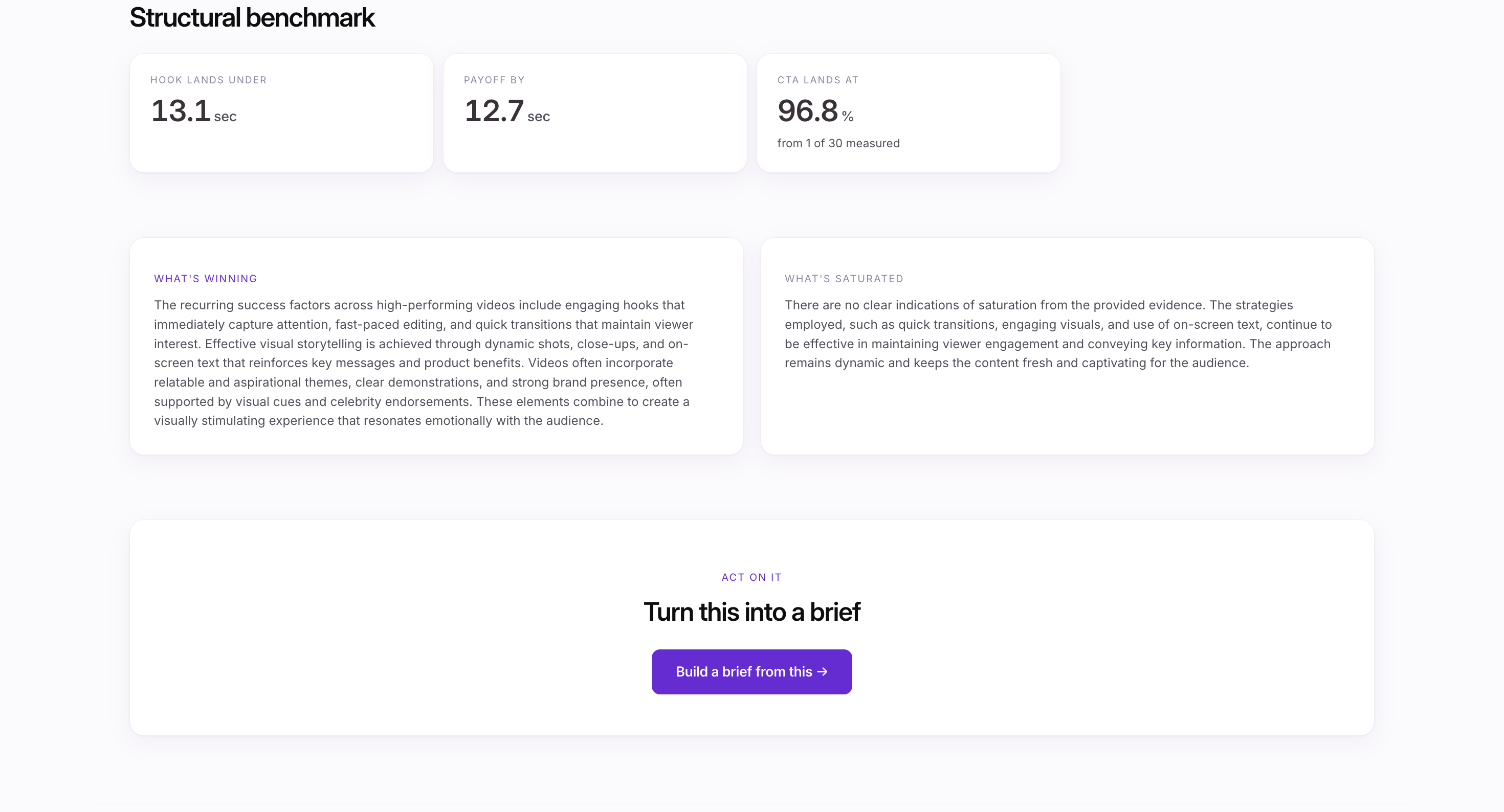
See the market first. Enter a niche, audience, platform and goal (reach, retention, shares, conversions). Motif surfaces the dominant format, hook timing, content-type and CTA mix, and the structural benchmark top performers hit in your industry, all measured from real published content, not a generic trend list.
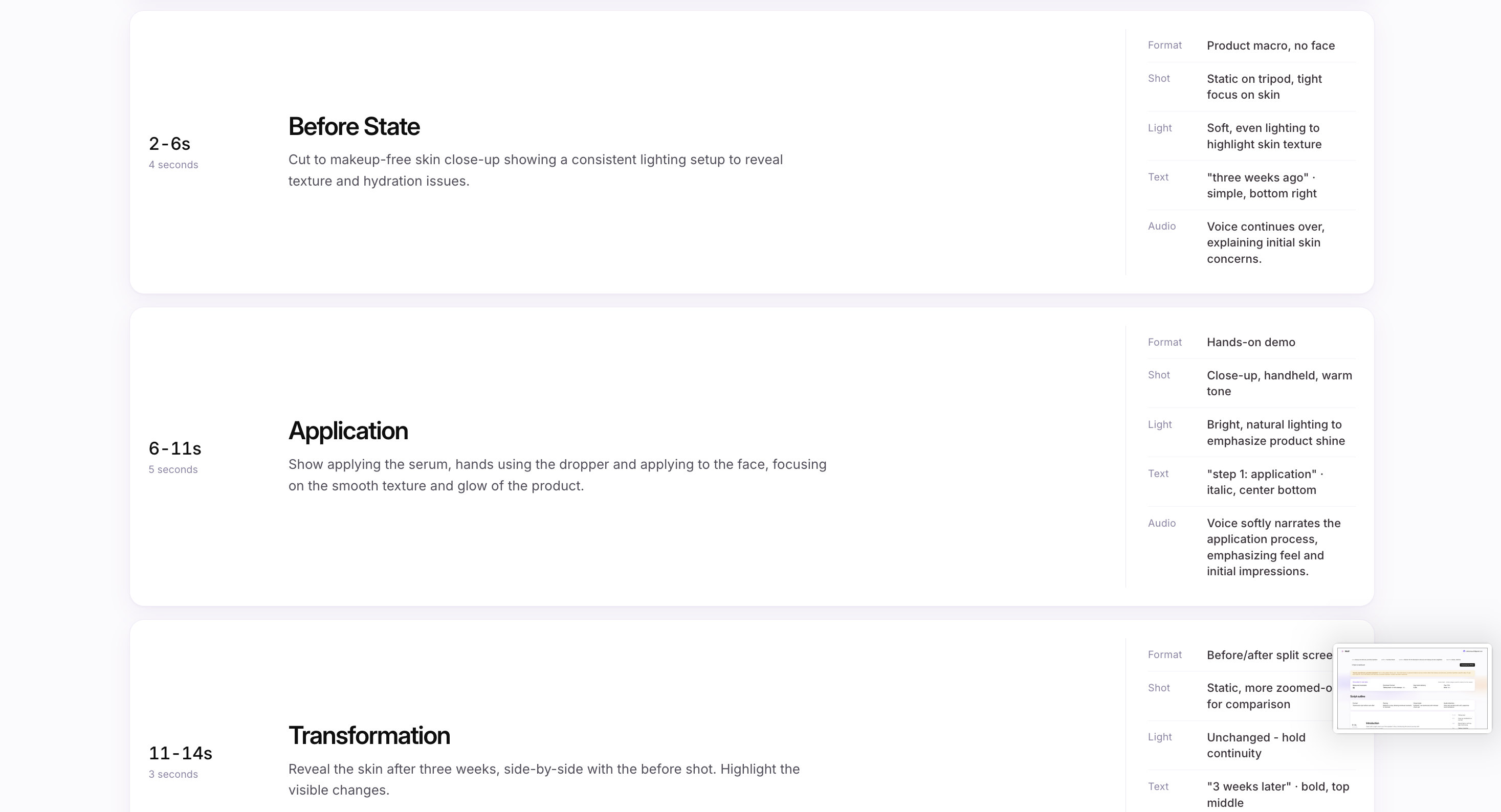
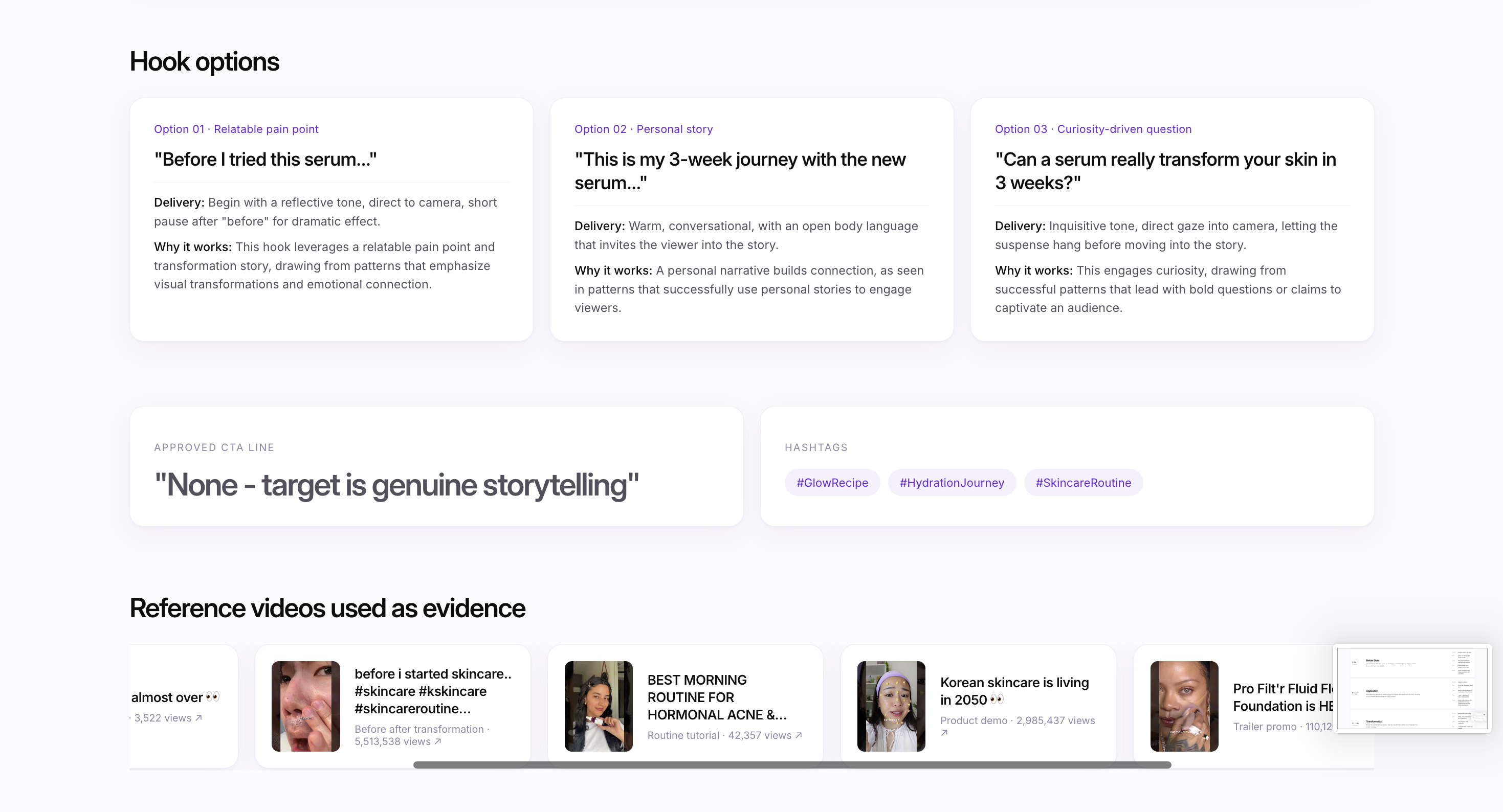
Get a brief your team can shoot from. A scene-by-scene production document: hooks, a timestamped outline, pacing, shot list, lighting, on-screen text and the exact CTA line. What it returns looks like this:
Beat, 0–2s — Result first. Close-up, handheld push-in. Soft window key light. On-screen text: "3 weeks," lowercase, bottom third. Hook option — Result first. "Three weeks ago, this wouldn't have worked." Delivered deadpan, straight to camera, no pause before the payoff word.
That's not advice. It's a production brief. And every brief shows its work: how many real videos backed it, how targeted the match was, and links to the actual reference videos it drew on. Nothing a plain LLM prompt could fake.
The result: every creator on your roster briefed from the same measured structure, not ten different instincts, with every recommendation traceable to real behaviour in your own industry, not "trust us."
Why it's different
- VidIQ and TubeBuddy optimise metadata: titles, tags, thumbnails.
- Opus Clip and its clones cut and repurpose footage you've already shot.
- Script generators hand you words.
None of them diagnose narrative structure, the one thing that decides whether a video holds attention or loses it. Motif is the only tool built to decode structure as a dedicated product and apply it before you shoot. Most AI tools tell you what to post. Motif decodes the structural patterns behind what actually goes viral in your niche, then hands you the blueprint to build it.
The business model that makes it defensible
Motif is a subscription with a free trial built to prove itself before you pay. Run real briefs against your own category during the trial and see the evidence yourself — the reference videos, the structural benchmark, the match confidence — before committing to anything. Instead of asking a team to take "another AI tool" on faith, we let the evidence make the case first. You see the receipts before you pay for them.
How we built it
We scoped the MVP to what's genuinely computable live in 48 hours, and built it as a real pipeline, not a demo shell.
The ingestion pipeline. Given a video, Motif pulls metadata and transcript (YouTube Data API plus transcript tooling), computes timing signals in code, then classifies the video's niche against already-verified examples. Only on a confident match does it sample frames and call GPT-4o for multimodal structural extraction, so the pattern library stays clean and trustworthy, never noisy.
Retrieval-augmented, for structure. Every extracted pattern is embedded with text-embedding-3-small and stored in Supabase Postgres with pgvector. When you request a brief, Motif retrieves the most relevant measured evidence by vector search and generates against it. That's full RAG, which is exactly why every brief can cite the real videos behind it. We match each model to its job: GPT-4o handles multimodal extraction and brief generation, where reasoning quality matters most, while the niche-disambiguation step runs on GPT-4o-mini — the highest-volume, lowest-stakes call in the pipeline.
A real application, not a toy. Clerk authentication, per-user rate limiting, and a live end-to-end stack: our /api/brief/generate and /api/intelligence endpoints are authenticated and served from the live pattern library, not mocked.
Behind it today: 46.1M views analysed across 44 videos, each read for hook, pacing, format and CTA structure.
Stack in prose: React and Vite frontend, FastAPI/Python backend, Supabase (Postgres and pgvector) for vector search, OpenAI (GPT-4o, GPT-4o-mini, text-embedding-3-small) for extraction and generation, Clerk for auth, deployed on Railway and Vercel.
Challenges we ran into
Keeping the evidence trustworthy. A structural library is only as strong as its inputs, so we built a confidence-gated classifier: a video only enters the library on a high-confidence niche match. Clean data, by design.
Making every claim traceable. We refused to ship black-box advice, so we engineered each brief to surface its own evidence: video counts, match strength, and the exact references. That "shows its work" layer became one of Motif's sharpest differentiators.
Moving fast without cutting corners on cost. Multimodal extraction isn't cheap, so we routed each task to the right-sized model, keeping cost per brief low enough to sit comfortably under a subscription.
Accomplishments that we're proud of
The moment it really clicked for us was seeing a brief cite the exact videos it had learned from. That's when it stopped feeling like a hackathon project and started feeling like a product.
- A live, full-stack, authenticated product with a real RAG pipeline, built in 48 hours.
- Motif behaving like a personal director: not just telling you what to post, but directing how to shoot and structure it, shot by shot.
- Every recommendation grounded in measured behaviour, so the brief a team writes is defensible, not a hunch.
- A dataset broad enough to read real trends per niche, the foundation the whole product stands on.
What we learned
- The value was never in generating content. It's in the structure underneath it, and no one was owning that layer.
- Transcript timing plus confident, selective multimodal extraction is a powerful proxy for narrative structure. You don't need to process every frame to read what makes a video work.
- Transparency sells harder than a guarantee we'd have to carefully word to defend. Showing the evidence before asking for payment builds more trust than any promise could.
What's next for Motif
- Automated, always-on ingestion: the same confidence-gated pipeline as a scheduled worker, continuously discovering and ingesting top performers per niche. The pipeline is already built; discovery just changes where the URL comes from.
- Multi-platform: point that worker at TikTok and Instagram Reels; our schema already supports all three.
- Deeper frame-level analysis: cut timing, on-screen graphics and camera changes as the next layer of structural depth.
- Post-performance loop: paste your posted link back in, and Motif measures how it really did, then feeds that into your next brief.
- Team community: shared campaigns and cross-team benchmarking.
Built With
- clerk
- css
- fastapi
- ffmpeg
- gpt-4o
- gpt-4o-mini
- javascript
- openai
- pgvector
- postgresql
- psycopg
- pydantic
- python
- railway
- react
- retrieval-augmented-generation
- supabase
- text-embedding-3-small
- vite
- youtube-data-api
- youtube-transcript-api
- yt-dlp


Log in or sign up for Devpost to join the conversation.