
Inspiration
We kept coming back to one question: how do you make time something you can move through, not just read about?
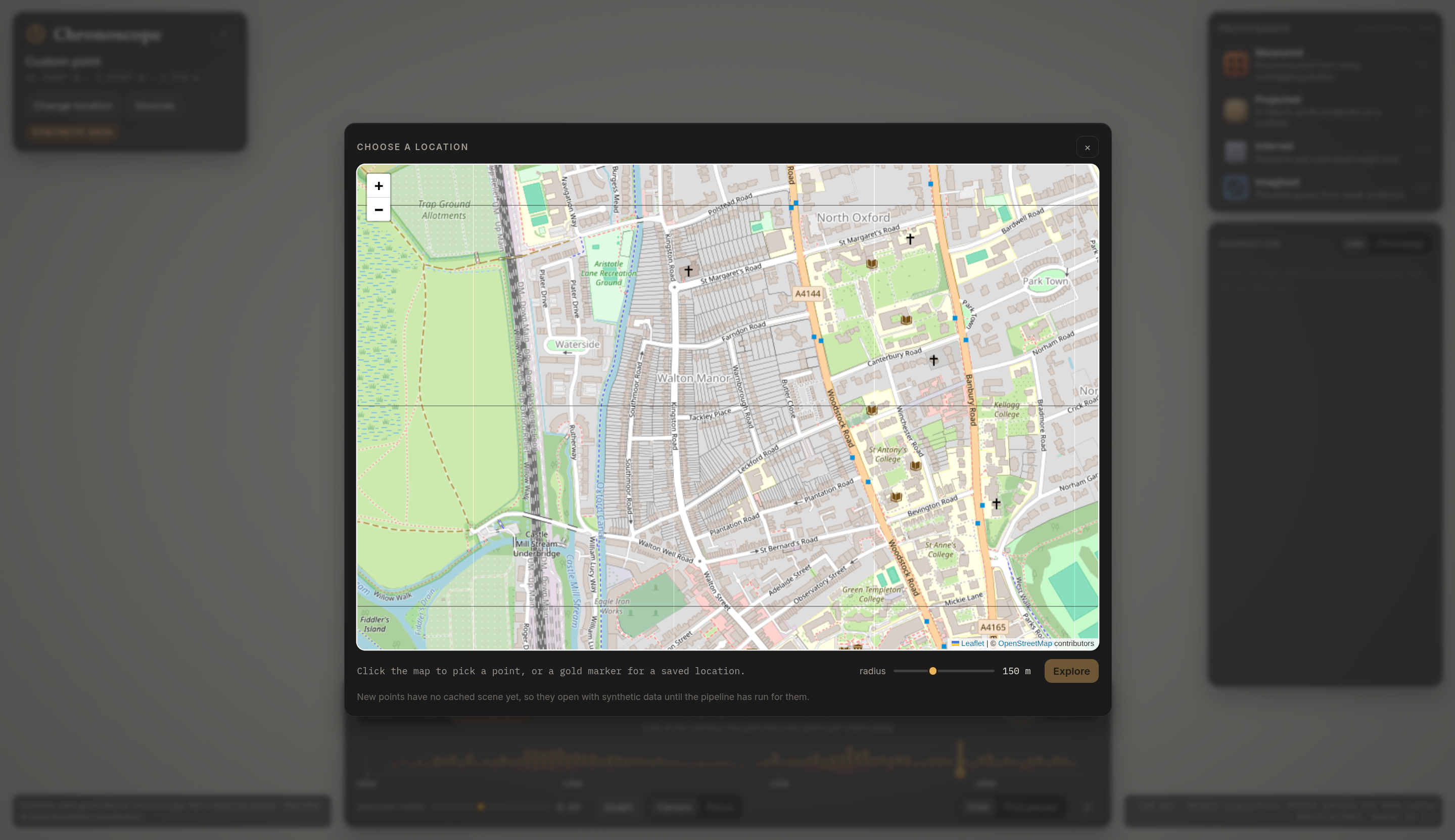
History usually lives on plaques and in textbooks. A sign might tell you a church nave was demolished in 1896, but it can't let you feel the space change around you. We wanted to close that gap. So we picked a single real place, Carfax, the historic crossroads at the heart of Oxford where Cornmarket, Queen Street, St Aldate's and the High Street meet.
Then we let people walk through its timeline the way they'd walk down the actual street, treating time as a fourth spatial axis rather than a caption under an old photo.
Most historical reconstructions quietly blend fact and guesswork into one smooth, confident render. We wanted the opposite. Every object on screen should openly show how much evidence backs it, so you can tell at a glance whether you're looking at something measured, a photo projected onto a rough shape, an inferred footprint, or an educated guess.
What it does
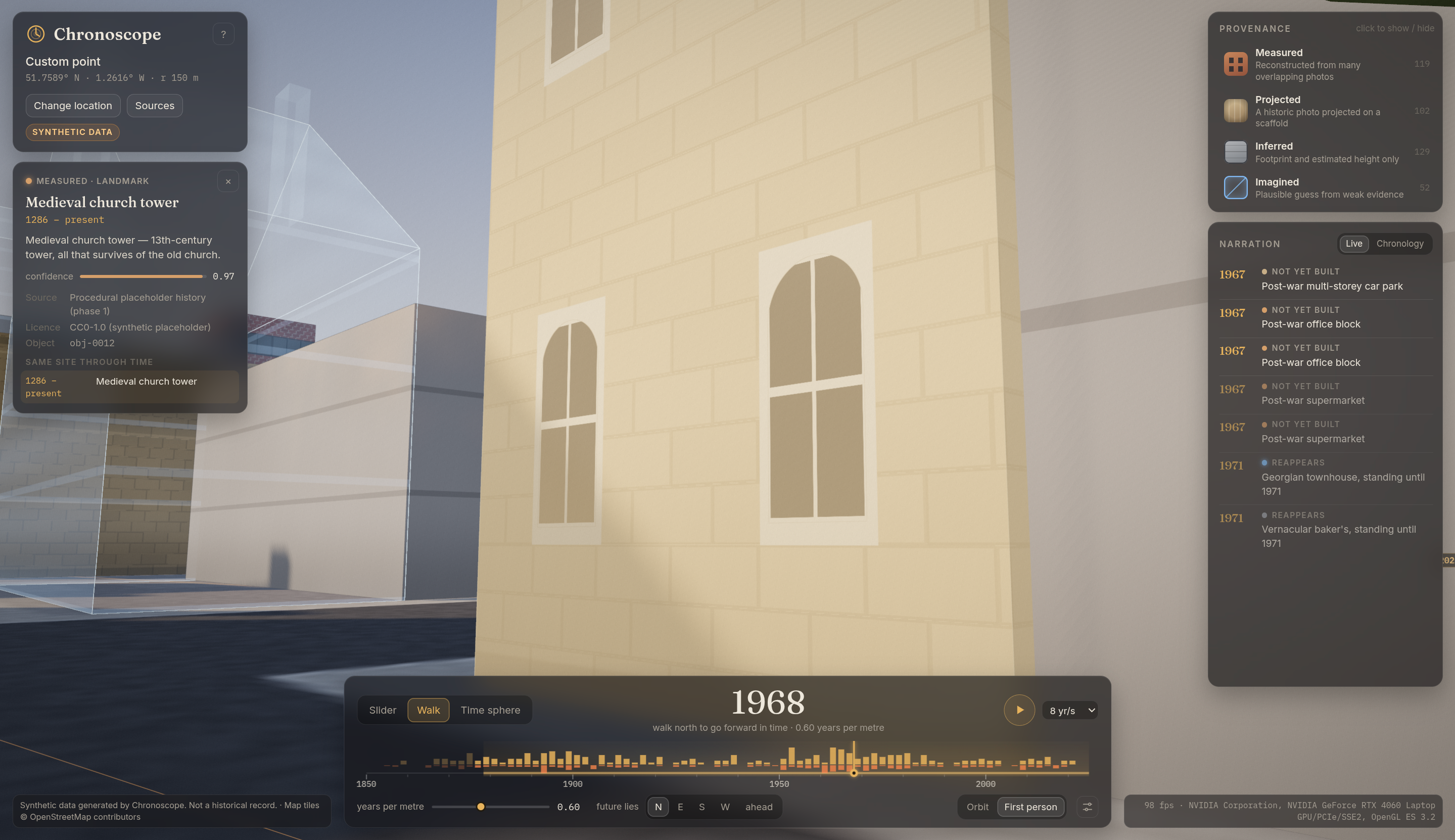
Moshi Moshi Explorer reconstructs Carfax in 3D in the browser, with time as a draggable fourth dimension. There are three ways to travel through it:
- Year slider: scrub a global timeline and watch the whole crossroads rebuild itself around you.
- Walk through time: pick a compass direction and every step forward carries you through the decades.
- Time-sphere mode: stand still and let the past ripple outward. What's near you is now, and the horizon is the past (or the future, if you invert it).
Every building and object carries a visible evidence tier:
- Measured: based on surveys or existing structures
- Photo-projected: historical photographs mapped onto approximate geometry
- Inferred: footprints reconstructed from maps and records
- Speculative: our best guess, clearly labelled as such
How we built it
- Rendering: three.js, with [custom shaders / per-object styling] so each evidence tier is visually distinct
- Time model: every object has a lifespan (built / altered / demolished), and the scene is evaluated as a function of (x, y, z, t), which lets the slider, walking and time-sphere modes share one engine
- Data: We use Ordance Survey OpenData to build a 3d map of space.
- Geometry pipeline: [how you turned sources into meshes, e.g. footprint extrusion, photo projection]
Challenges we ran into
- Sparse, conflicting sources: [e.g. maps from different eras disagreeing on footprints]
- Making uncertainty readable: showing four evidence tiers without the scene turning into visual noise
- Time-sphere rendering: blending different eras smoothly by distance [performance / transition issues]
Accomplishments that we're proud of
- Turning time into something you can walk through, with three distinct interaction modes on one shared engine
- An honest reconstruction: nothing pretends to be more certain than its evidence
What we learned
- Historical data is messy, and being upfront about that is a feature, not a weakness
- three.js is sometimes tricky to work with, and thinking carefully about rendering architecture is super important.
What's next for Moshi Moshi Explorer
- Expanding beyond Carfax to more of Oxford and stress testing on modern real buildings.
- AR mode so you can stand at Carfax and look through time on site
- Citations: click any object to see exactly what it's based on
Built With
- leaflet.js
- mcp
- python
- three.js
- vite
- vultr


Log in or sign up for Devpost to join the conversation.