-
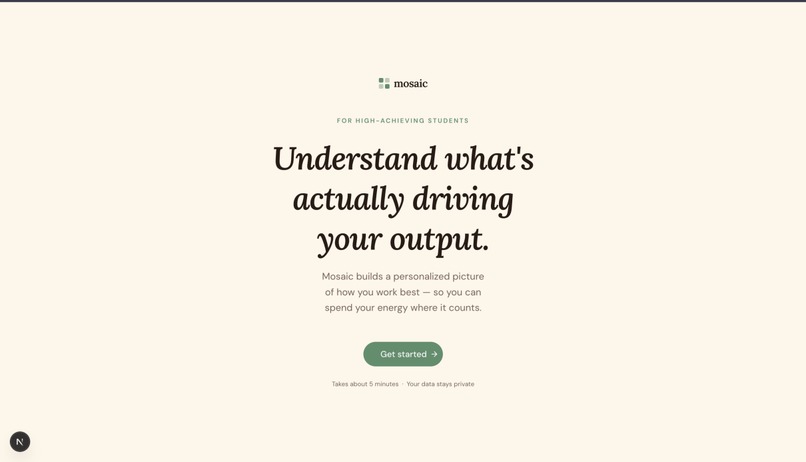
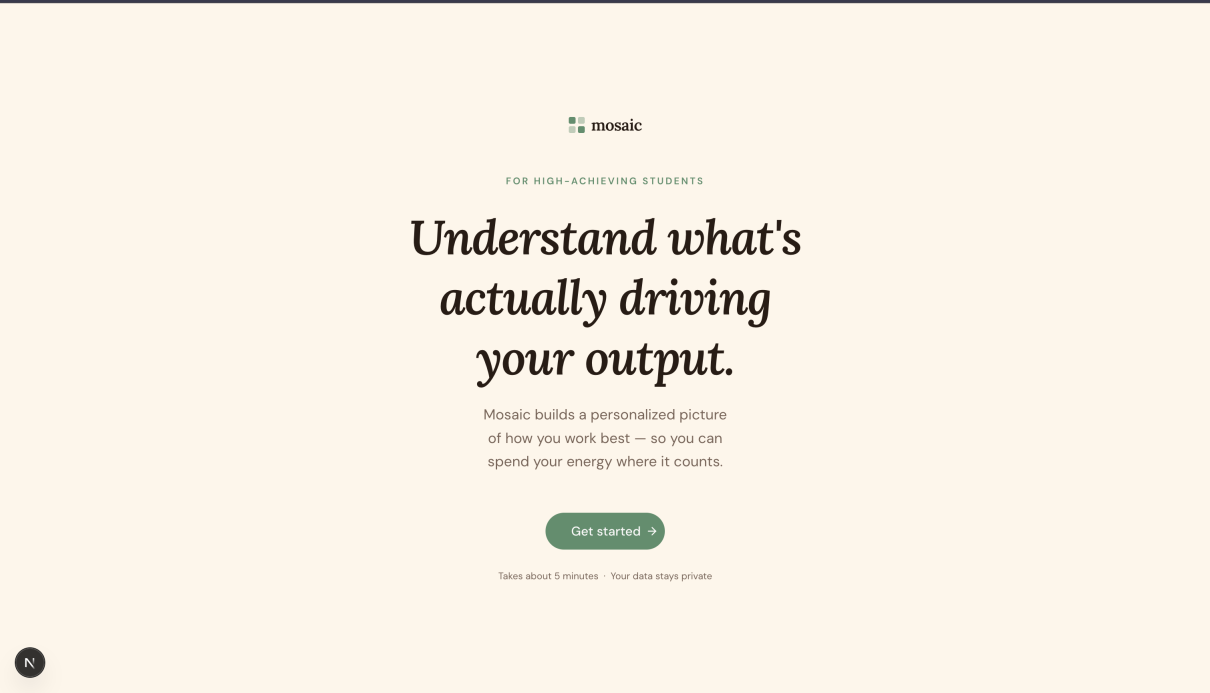
Main Page
-
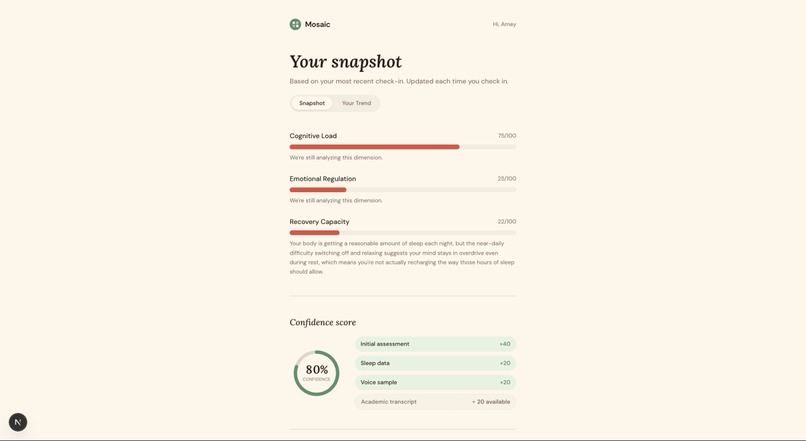
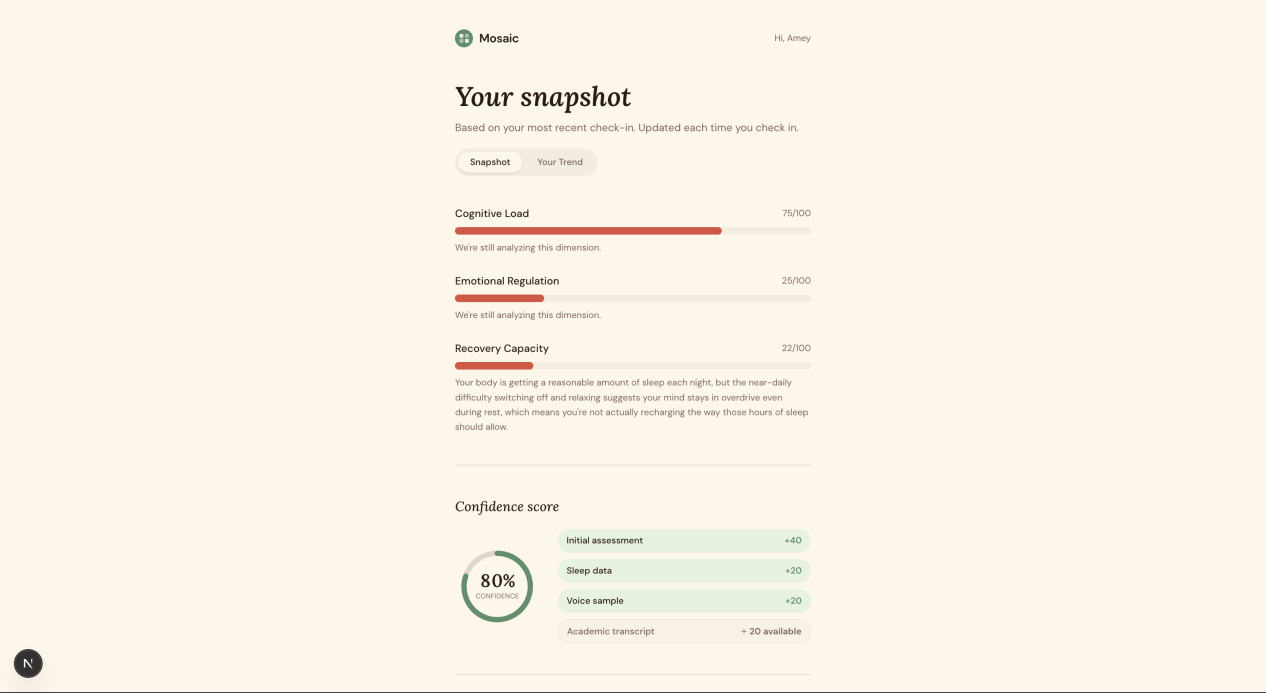
Confidence Score and Overall Analysis
-
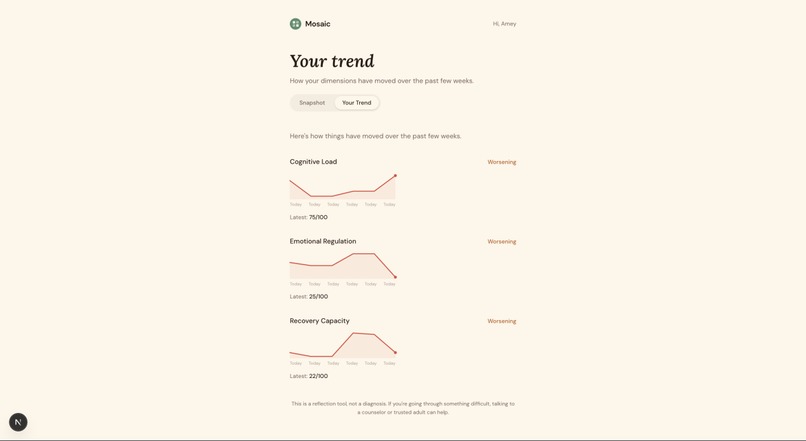
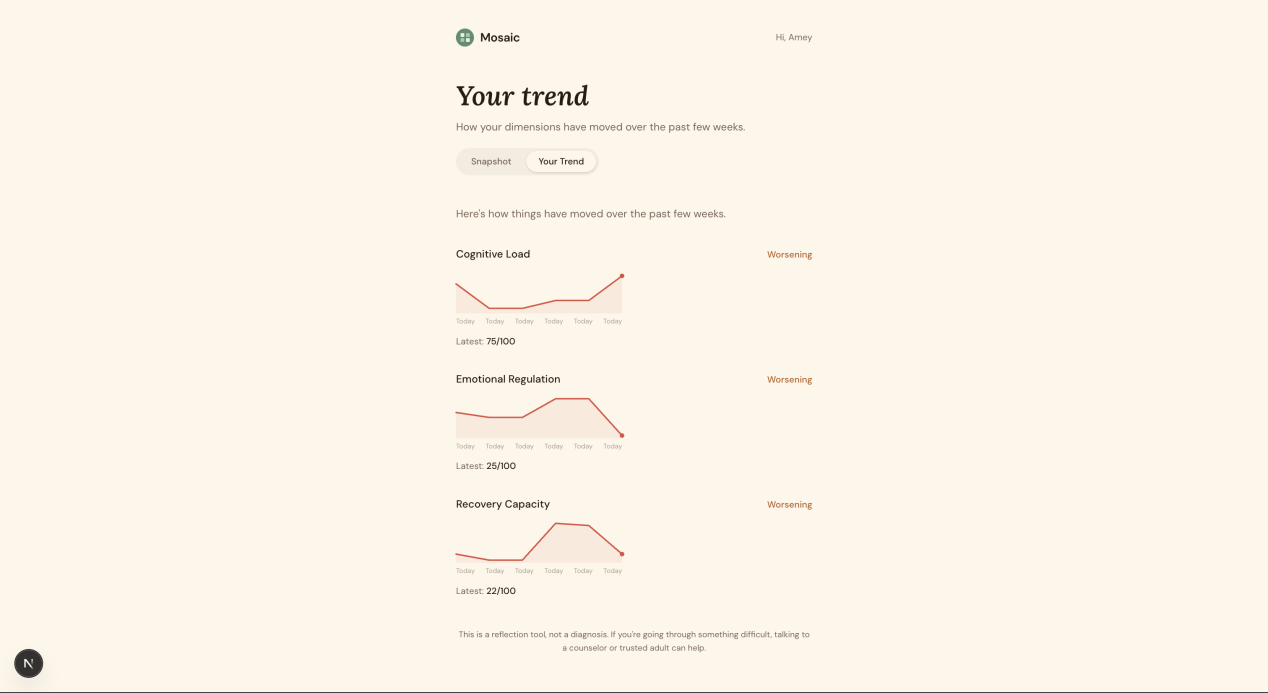
Analysis Page
-
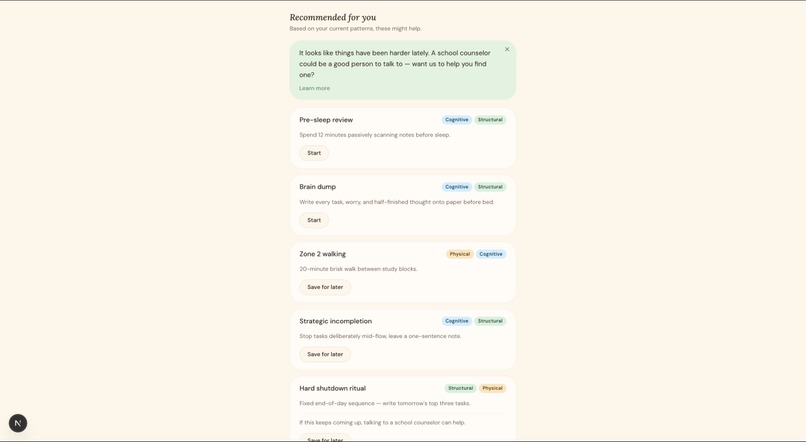
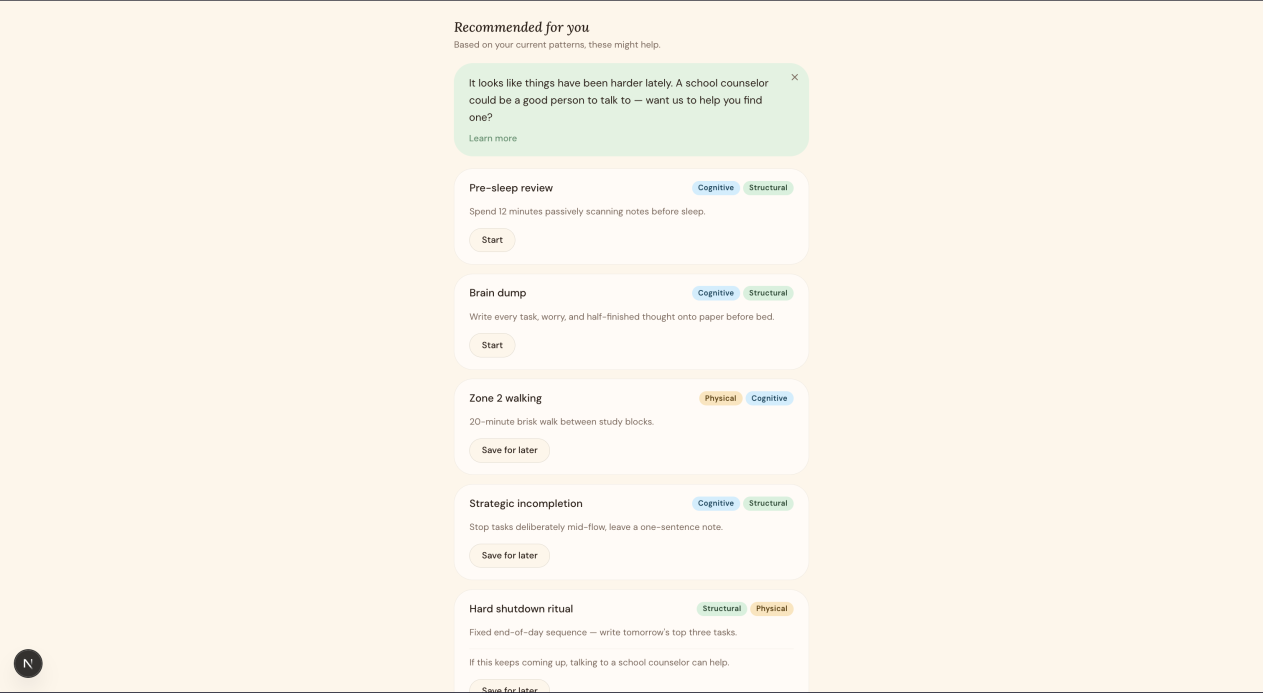
Recommended Exercises
-
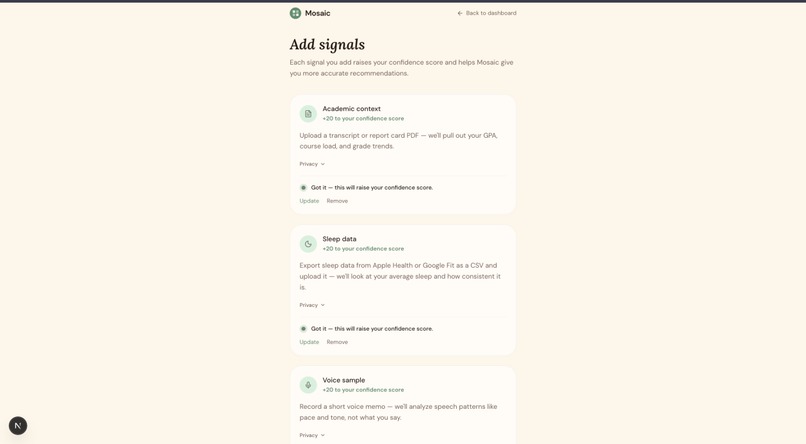
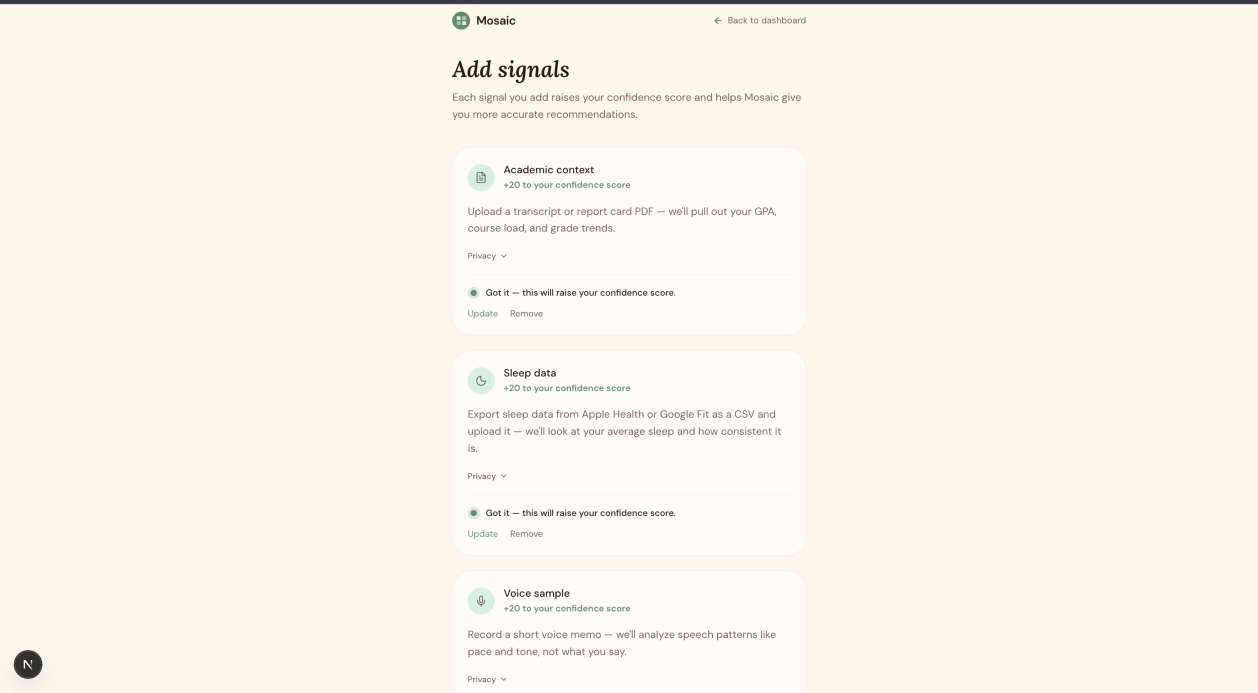
Additional Evaluation Material
-
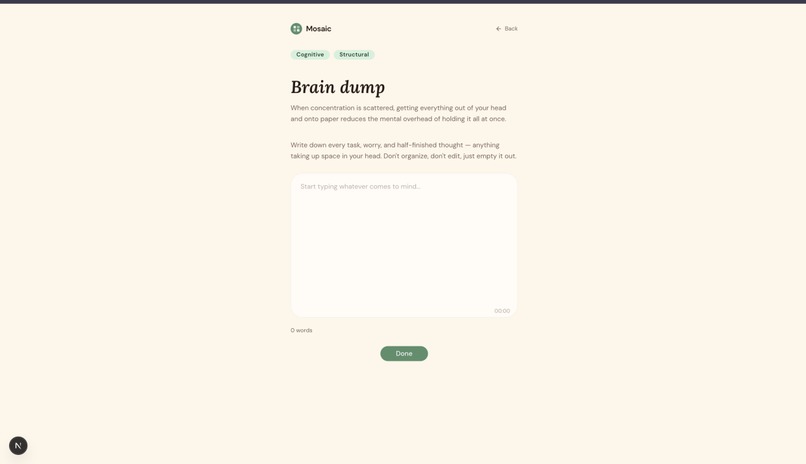
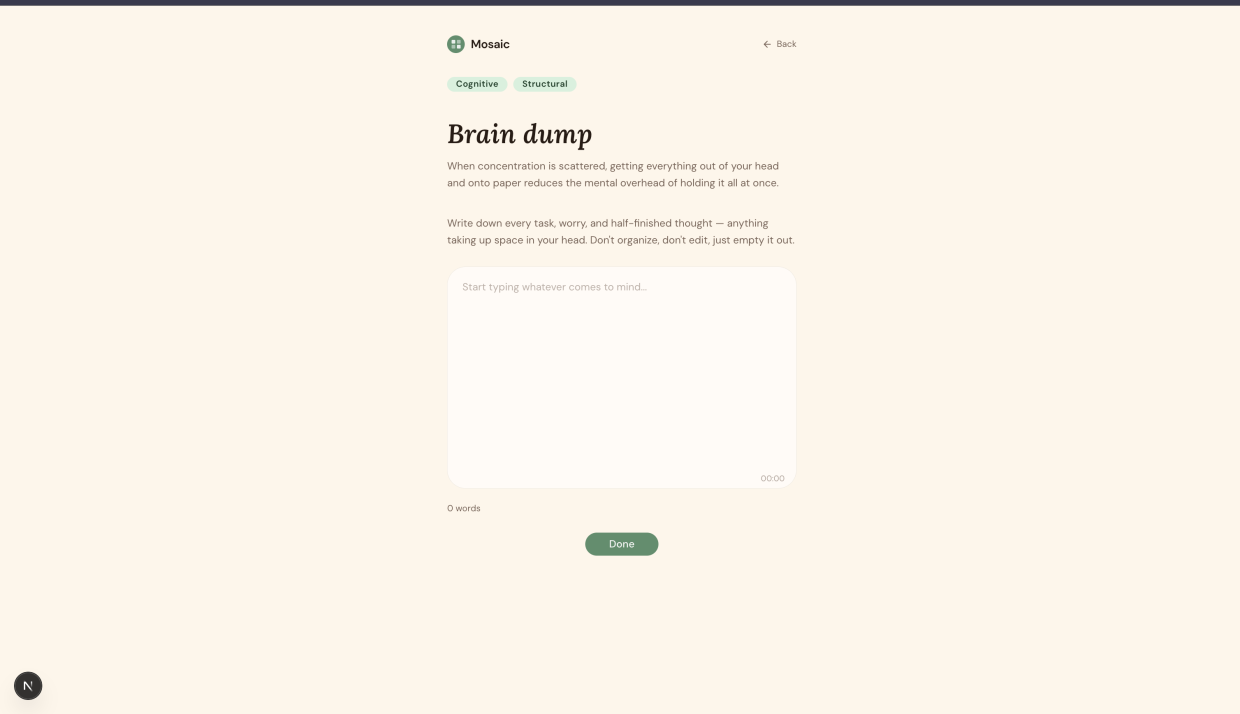
Example Exercise
-
Logo
Inspiration
In the Bay Area, there's a lot of pressure to perform at 100% all the time. The students who could most benefit from mental health support often don't seek it out, partly because a lot of tools out there ask them to slow down, do less, or accept some kind of tradeoff in output. With Mosaic, we tried to design around that, focusing on interventions that lower the cost of performing well, rather than asking students to perform less.
The idea came from weather forecasting. Meteorologists do not ask the atmosphere how it is doing. They combine pressure, humidity, wind, and temperature because no single signal tells the full story. Mental health works the same way, but every tool built for students today only looks at one signal at a time. We built the thing that listens to what students cannot say.
What it does
Mosaic predicts mental health across three dimensions (Cognitive Load, Emotional Regulation, Recovery Capacity) by combining a PHQ-A and GAD-7 survey, an academic transcript, sleep data from Apple Health or Google Fit, and a 60-second voice recording analyzed for pitch variance and flat affect. Each signal raises a visible confidence score. The output is a personalized dashboard with AI explanations tied to the student's actual data, and five curated exercises matched to their specific pattern.
How we built it
Node.js and Express backend in TypeScript, Supabase for the database, and all AI calls routed through Backboard.io using Claude Sonnet. The voice pipeline runs real acoustic analysis server-side (YIN pitch detection, adaptive noise threshold, 20ms frames at 44.1kHz) with no third-party audio dependency. The recommendation engine uses a two-stage approach: deterministic category pre-filtering followed by Claude selecting and explaining exactly five exercises. Backboard's memory API stores a snapshot after every submission, giving Claude longitudinal context on return visits.
Challenges we ran into
Building the voice pipeline from scratch without a third-party service. Getting confidence recalculation right when signals are deleted so the longitudinal history stays intact. And auditing every word of copy to ensure nothing ever implied diagnosis or suggested the student had a problem, because the product only works if it never says that.
Accomplishments that we're proud of
A voice analysis pipeline with no third-party dependency. A confidence score mechanic that makes the tradeoff of sharing data legible without guilt. A synthetic demo student showing a five-week decline that a survey-only tool would have missed. And 197 unit tests with zero failures.
What we learned
Framing is a product decision, not a marketing one. The choice to never use the words mental health in onboarding, to label dimensions by functional names, and to frame everything around performance had to be made at the architecture level. And the multimodal argument proved itself during building: every time we tested with one signal, the scores felt thin. With all four, the picture sharpened immediately.
What's next for Mosaic
Expanding the exercise library to 50 to 100 options, integrating Omi AI wearables for continuous passive signal collection, and building a counselor-facing dashboard showing anonymized aggregate trends across a school population so counselors can see where to focus attention before students hit a crisis.
Built With
- backboard.io
- claude-sonnet
- express.js
- node.js
- postgresql
- react
- supabase
- typescript
- v0

Log in or sign up for Devpost to join the conversation.