-
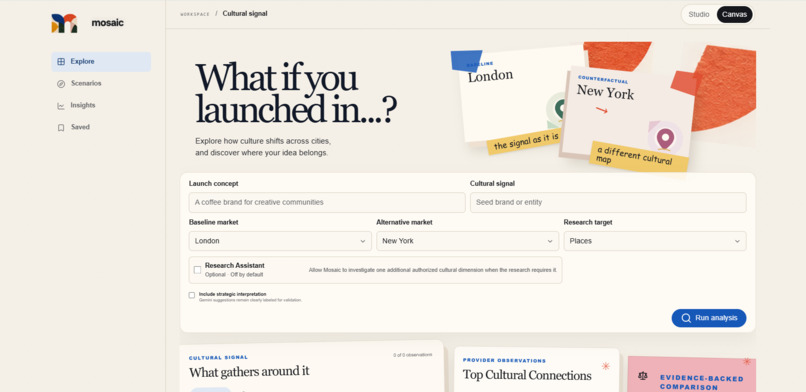
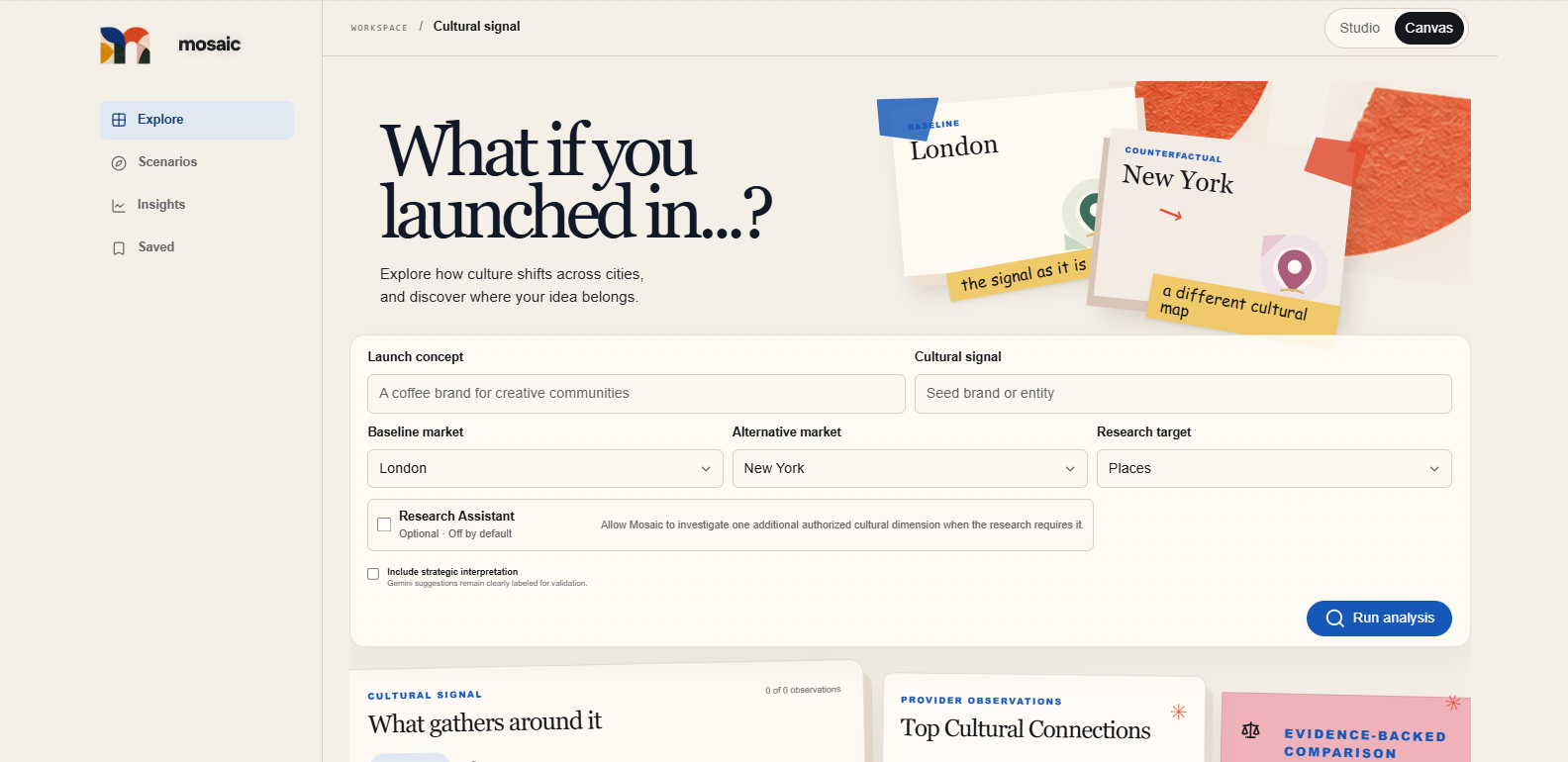
Canvas (Scenario Builder): Design and compare cultural scenarios through MOSAIC’s interactive visual workspace.
-
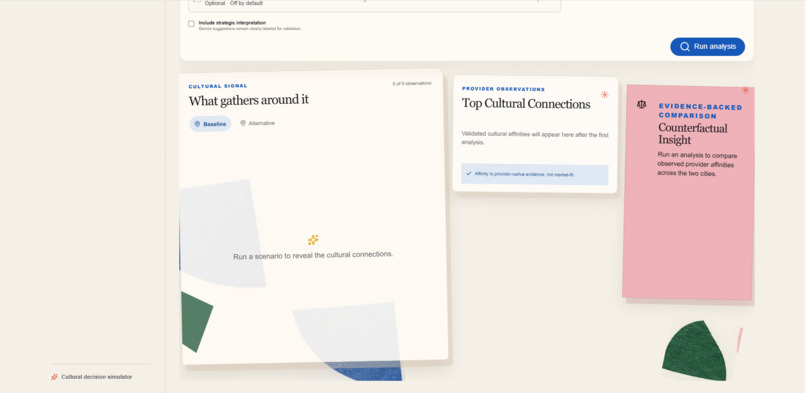
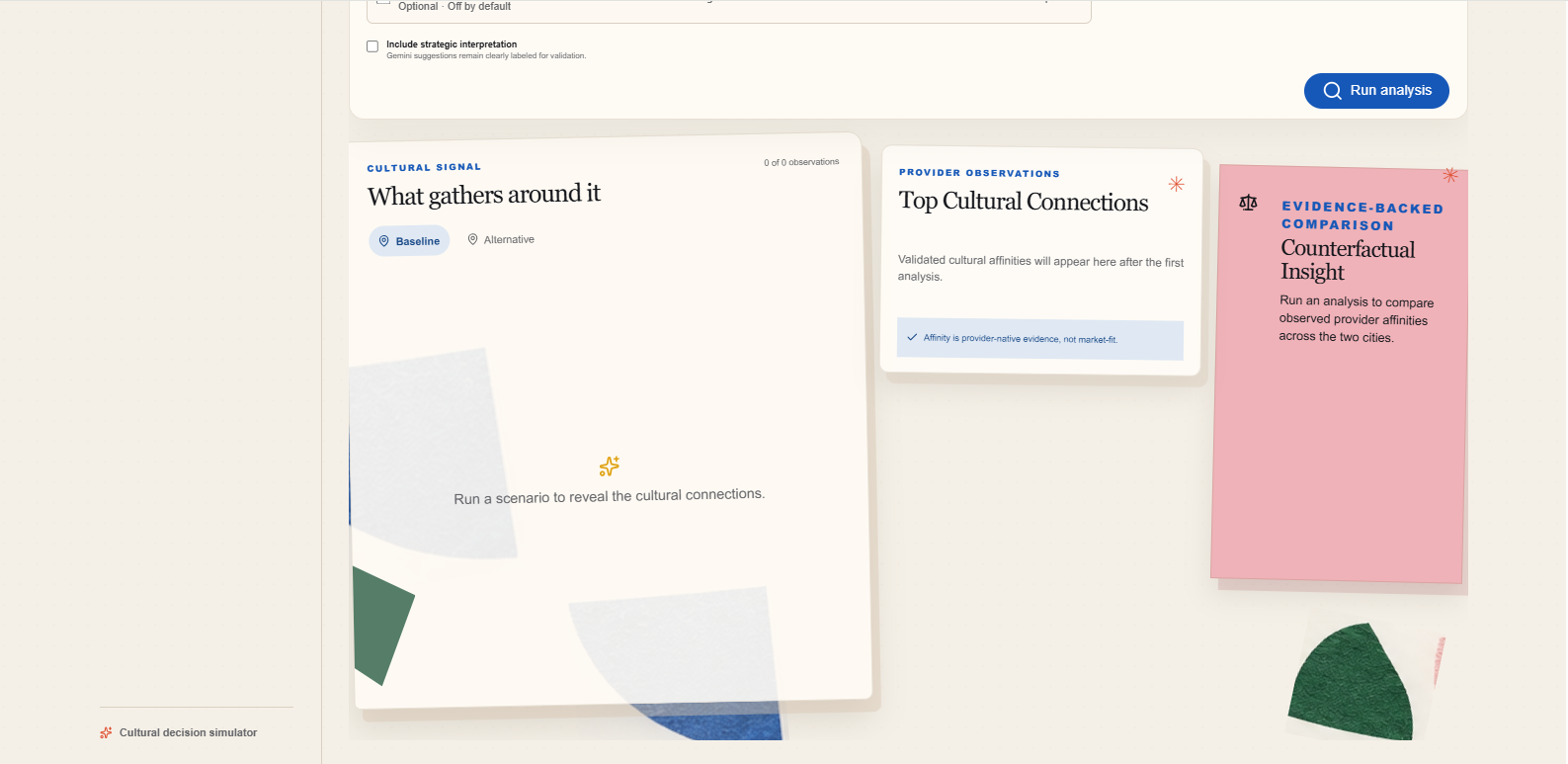
Canvas (Evidence Exploration): Visualize cultural connections, provider observations, and evidence-backed comparisons.
-
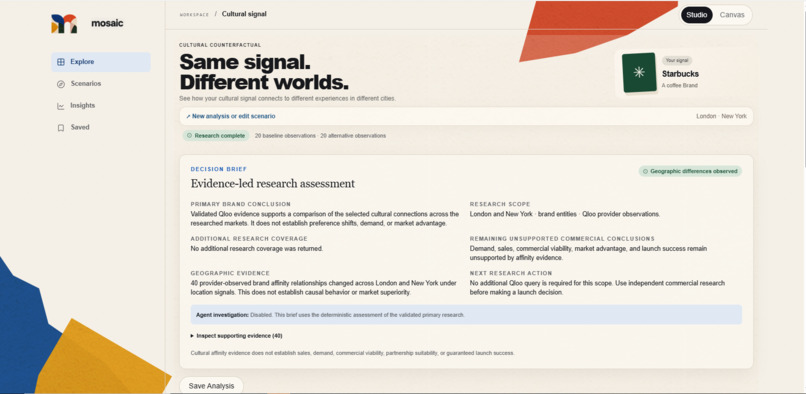
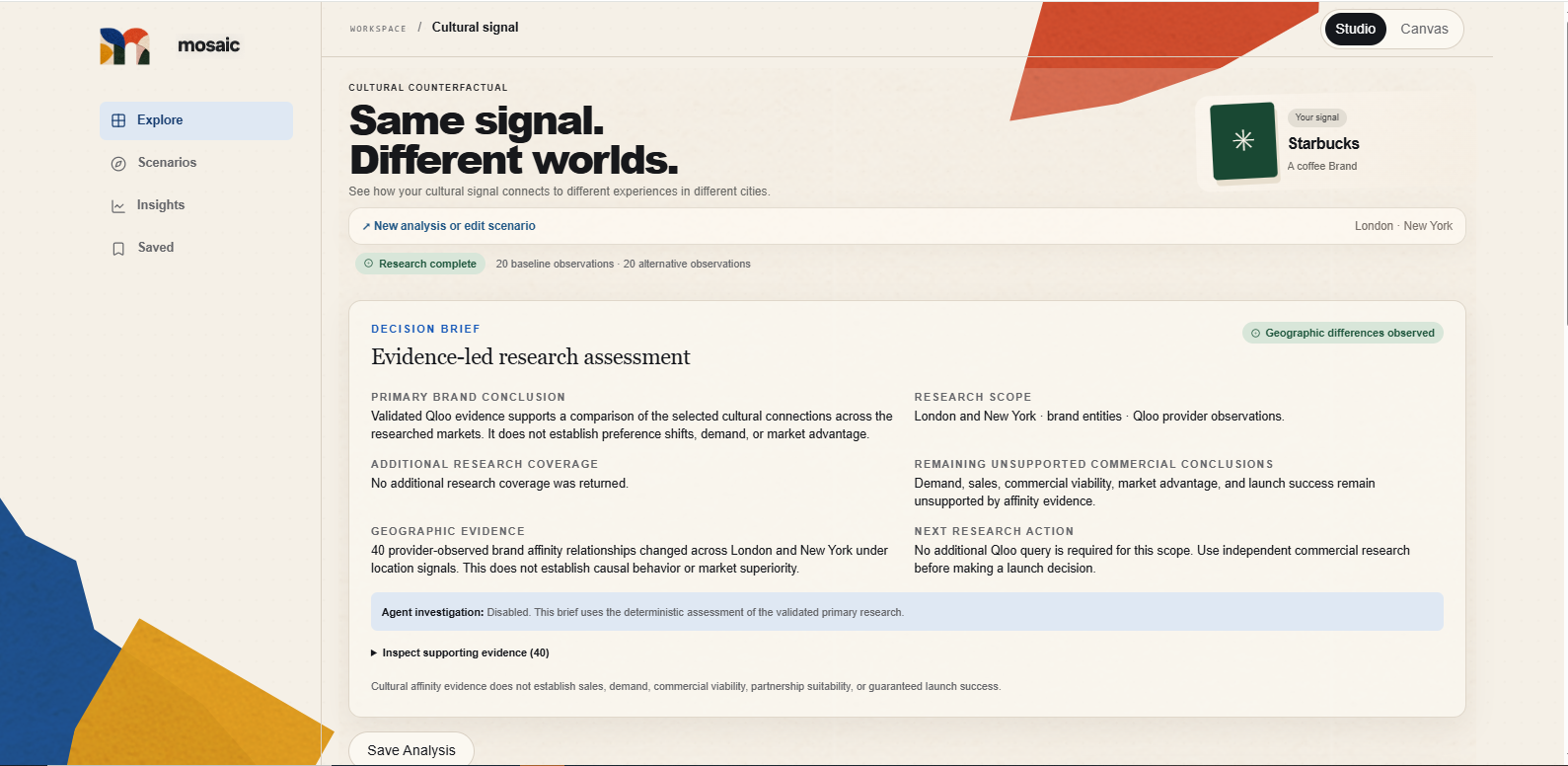
Decision Brief (Research Assessment): Visualize validated cultural connections.
-
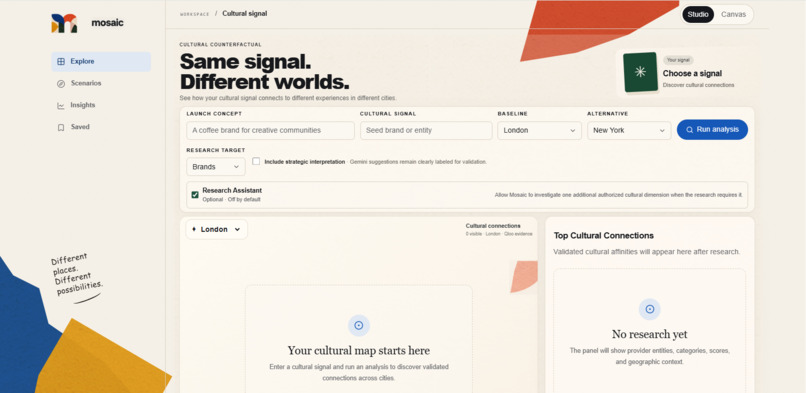
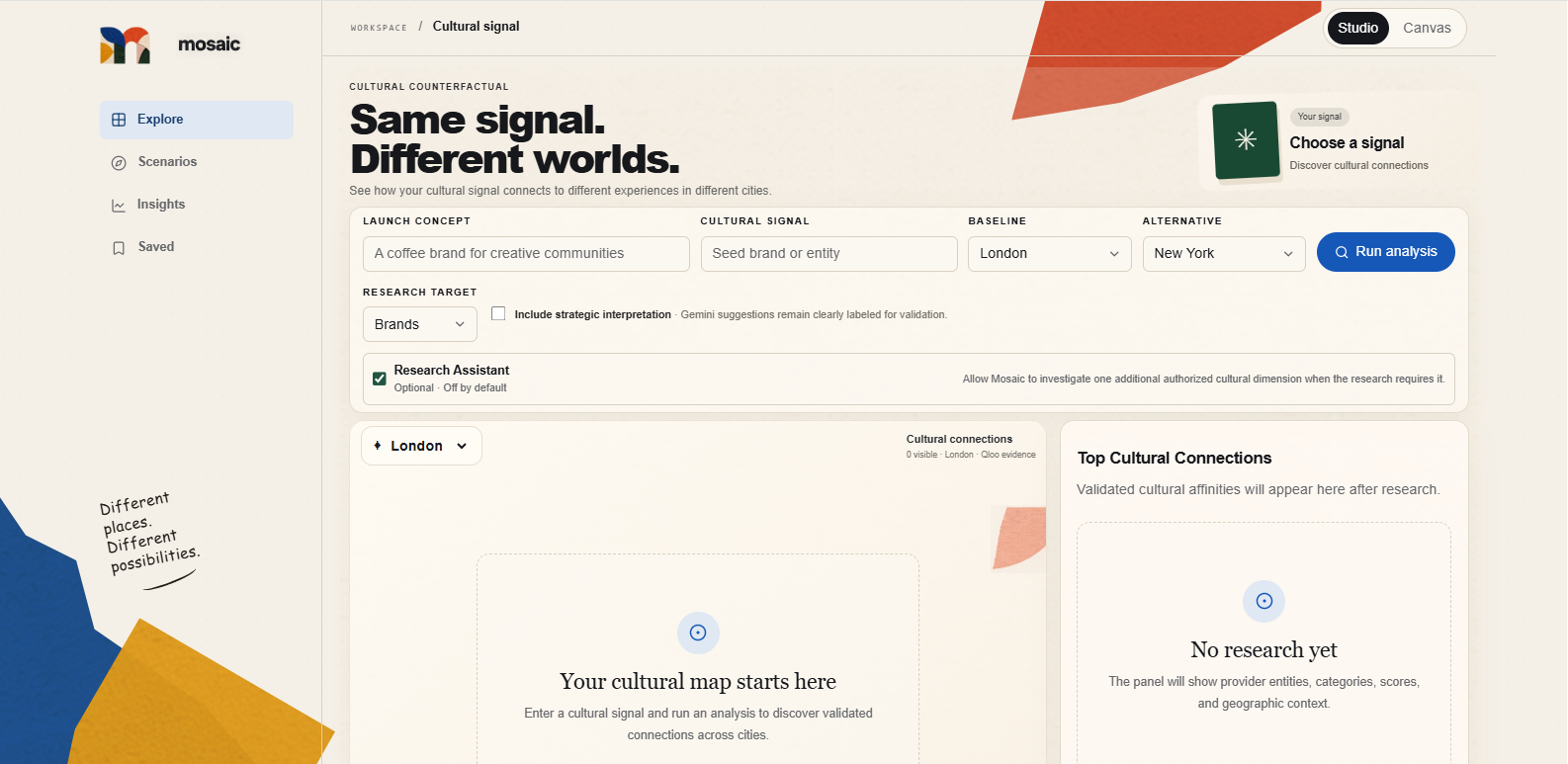
Studio (Cultural Research): Explore how the same cultural signal connects differently across cities using Qloo-powered research.
-
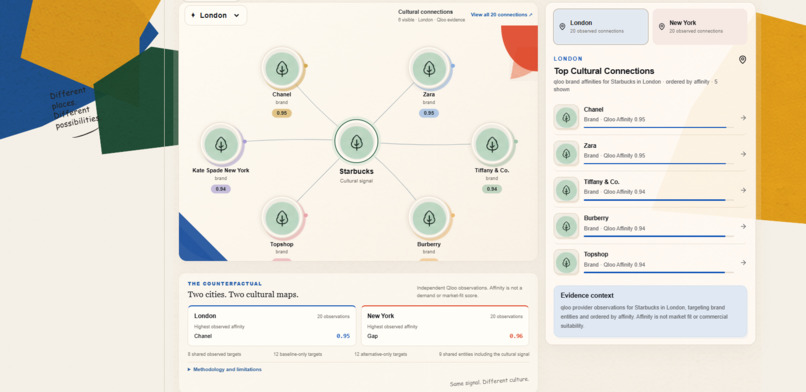
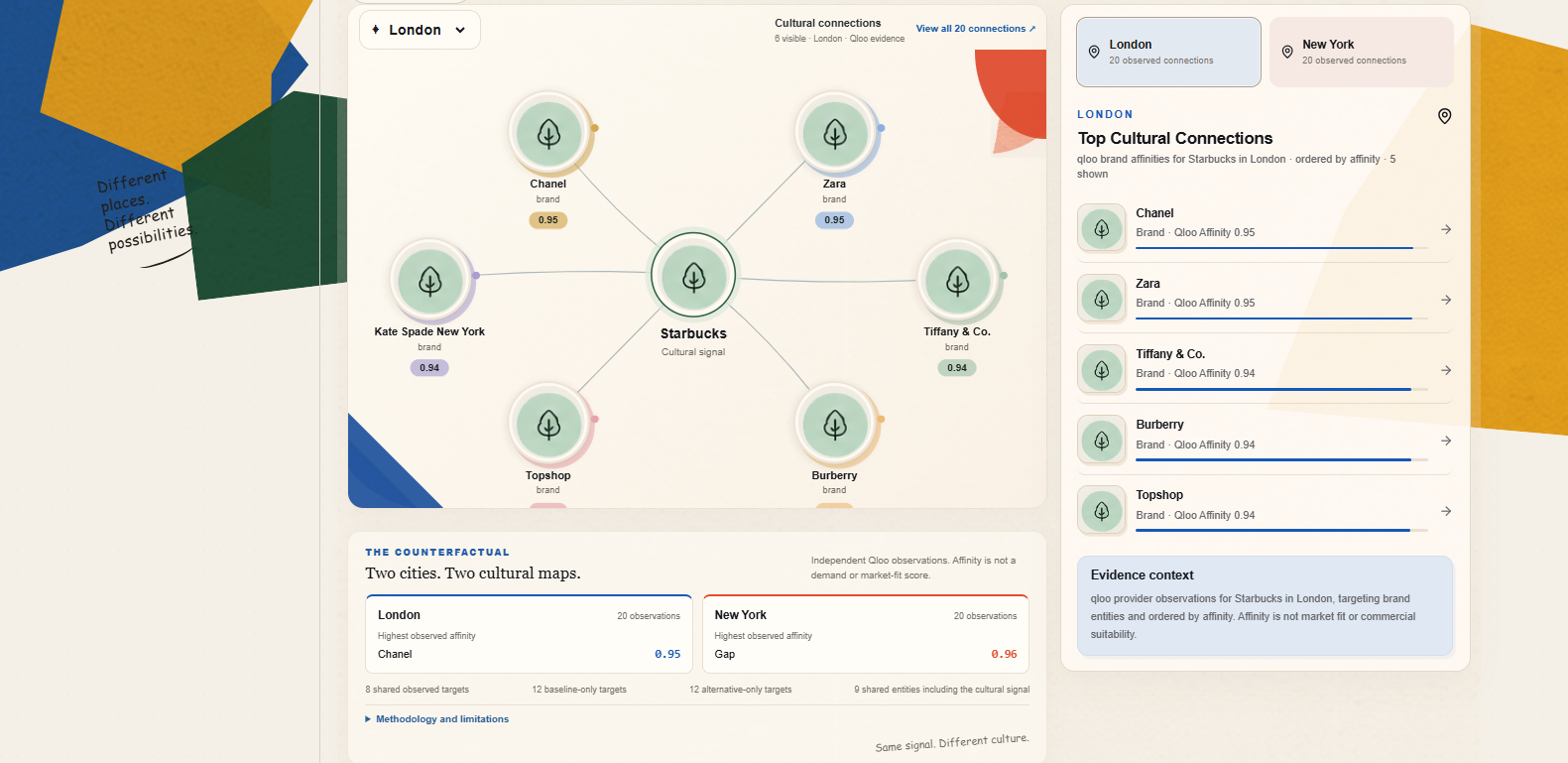
Cultural Network (London vs. New York): Starbucks’ cultural affinities in London vs. New York.
Inspiration
MOSAIC
An Agentic, Evidence-Backed Cultural Decision Simulator
Cultural intelligence should help us reason about decisions—not just generate recommendations.
Inspiration
Imagine a brand exploring two cities, a creative team investigating a new cultural direction, or a strategist trying to understand whether an idea resonates differently across geographic markets.
The challenge is not simply finding what is popular.
It is understanding the cultural relationships behind the available evidence, identifying what remains uncertain, and determining whether a conclusion holds when the evidence changes.
Traditional dashboards can display observations. Generative AI can produce persuasive explanations. But neither automatically guarantees that a recommendation is grounded in verifiable cultural evidence.
We built MOSAIC to address that gap.
MOSAIC combines Qloo's cultural intelligence with bounded agentic research and decision simulation, creating a workspace where users can explore cultural signals, inspect their evidence, and examine alternative scenarios.
The central idea: move from AI-generated answers to evidence-backed cultural reasoning.
What It Does
MOSAIC is an interactive cultural research and decision-support application.
Users can investigate Brands and Places, compare geographic contexts, examine cultural-affinity observations, and develop evidence-backed Decision Briefs.
Rather than treating cultural signals as definitive predictions, MOSAIC helps users understand what the available observations support, what they do not establish, and where additional research may be useful.
1. Qloo-Powered Cultural Research
MOSAIC integrates Qloo to investigate cultural relationships associated with Brands and Places.
Users can explore geographic comparisons and examine how observed cultural affinities differ between selected markets.
These are provider-backed observations—not invented audience preferences or generic LLM assumptions.
2. An Agentic Research Assistant
MOSAIC's Research Assistant can assess the available evidence and identify whether a meaningful research gap justifies additional investigation.
When follow-up is appropriate, the workflow requires explicit authorization before proceeding.
The assistant operates within defined limits, including provider-operation budgets and follow-up boundaries.
Its findings preserve the rationale for additional research, the evidence obtained, and the reason the workflow stopped.
This makes agentic behavior inspectable rather than invisible.
The agent does not simply keep searching. It must justify why more research is needed and know when to stop.
3. Evidence-Backed Decision Briefs
MOSAIC translates research findings into structured Decision Briefs.
These briefs help users understand the cultural evidence relevant to a decision while maintaining clear boundaries around what can reasonably be concluded.
Users can inspect supporting observations rather than relying exclusively on generated prose.
4. Decision Sensitivity
MOSAIC supports counterfactual exploration: what happens to a decision assessment when the underlying scenario or evidence changes?
Instead of presenting one answer as inevitable, Decision Sensitivity helps users examine alternative conditions and compare their implications.
5. Decision Stability
Decision Stability provides an additional perspective on whether a decision assessment remains consistent across the available comparison conditions.
Together, Decision Sensitivity and Decision Stability encourage users to examine uncertainty rather than overlook it.
6. Studio, Canvas, and Saved Analyses
MOSAIC provides multiple ways to work with research.
Studio supports structured investigation and decision analysis.
Canvas provides a visual environment for exploring cultural relationships and inspecting evidence.
Saved Analyses allow users to return to earlier research within the browser.
Together, these features turn MOSAIC into a cohesive research workspace rather than a single-purpose API demonstration.
Why Qloo Is Essential
MOSAIC is built around a simple distinction:
An LLM can explain a cultural hypothesis. Qloo provides cultural evidence with which to investigate it.
Qloo supplies the cultural-affinity observations and entity relationships that ground MOSAIC's research workflow.
MOSAIC then adds a decision-support layer: geographic comparison, evidence inspection, conditional agentic follow-up, counterfactual exploration, and structured interpretation.
Without Qloo, the application would lose the provider-backed cultural observations at the center of its analysis.
This is why Qloo is not an optional enhancement to MOSAIC. It is foundational to the product.
How We Built It
MOSAIC is built as a web application using Next.js, React, and TypeScript.
The application integrates Qloo through server-side research workflows and uses structured validation to help maintain the integrity of evidence passed through the system.
The architecture separates provider research, evidence handling, agentic orchestration, decision analysis, and presentation.
The Research Assistant follows a bounded workflow rather than an unrestricted sequence of tool calls. It evaluates the evidence available, determines whether follow-up is justified, requests authorization when necessary, and records its execution trace.
The product is deployed on Vercel, allowing judges to explore the application through a live browser experience.
We also developed automated tests and evaluation workflows to examine orchestration behavior, evidence integrity, and application integration.
Challenges We Faced
Making agentic research accountable
One of the most important challenges was ensuring that additional research was purposeful.
An agent that repeatedly calls an API is not necessarily making a better decision.
We addressed this by introducing explicit follow-up authorization, bounded provider operations, evidence validation, and traceable stopping conditions.
Preserving evidence throughout the workflow
It was essential that users could understand not only the final findings but also why additional research occurred.
We refined the orchestration and interface so that the original follow-up rationale remained visible alongside subsequent evidence and the completed research trace.
Handling uncertainty responsibly
Cultural-affinity observations are not equivalent to demand forecasts, sales predictions, or guarantees of commercial success.
We designed MOSAIC to preserve that distinction.
The application supports cultural investigation and decision exploration without presenting provider affinity signals as proof of future business outcomes.
Turning technical research into a usable product
We wanted MOSAIC to feel like a coherent decision-support environment, not a collection of API responses.
Building Studio, Canvas, Decision Briefs, and scenario-analysis capabilities required connecting technical evidence to an understandable user experience.
What We Learned
Building MOSAIC reinforced three lessons.
First, grounded AI is more useful when users can inspect the grounding. Evidence should remain accessible, not disappear behind a polished explanation.
Second, responsible agents need boundaries. Authorization, budgets, validation, and stopping conditions are essential parts of agentic product design.
Third, uncertainty can be a product feature. A useful decision-support system should help users recognize when conclusions depend on assumptions or changing evidence.
Potential Impact
MOSAIC is designed for teams exploring culturally sensitive decisions across markets and contexts.
Potential users include brand strategists, cultural researchers, creative teams, and organizations investigating geographic differences in cultural affinity.
Instead of replacing human judgment, MOSAIC helps these users ask better questions, examine supporting observations, and make their reasoning more transparent.
The broader opportunity is to make cultural intelligence more actionable without overstating what the underlying data can prove.
What's Next
MOSAIC demonstrates a foundation for evidence-backed, agentic cultural decision support.
Future directions include broader cultural research coverage, richer comparative workflows, and additional ways to inspect and communicate evidence.
Our priority is to preserve the principles established in this version: grounded observations, bounded agentic behavior, traceable evidence, and responsible interpretation.
MOSAIC is not about predicting the winning market. It is about helping people understand the cultural evidence behind their choices—and how those choices respond to uncertainty.
What it does
How we built it
Challenges we ran into
Accomplishments that we're proud of
What we learned
What's next for MOSAIC
Built With
- next.js
- qloo
- react
- tailwindcss
- typescript
- vercel
- zod
