-
-
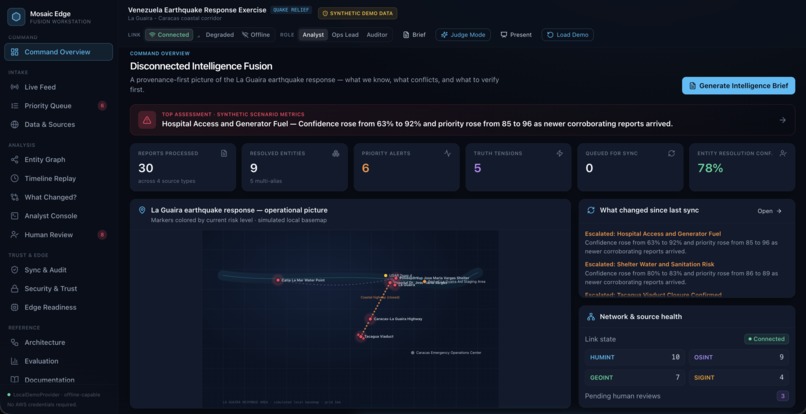
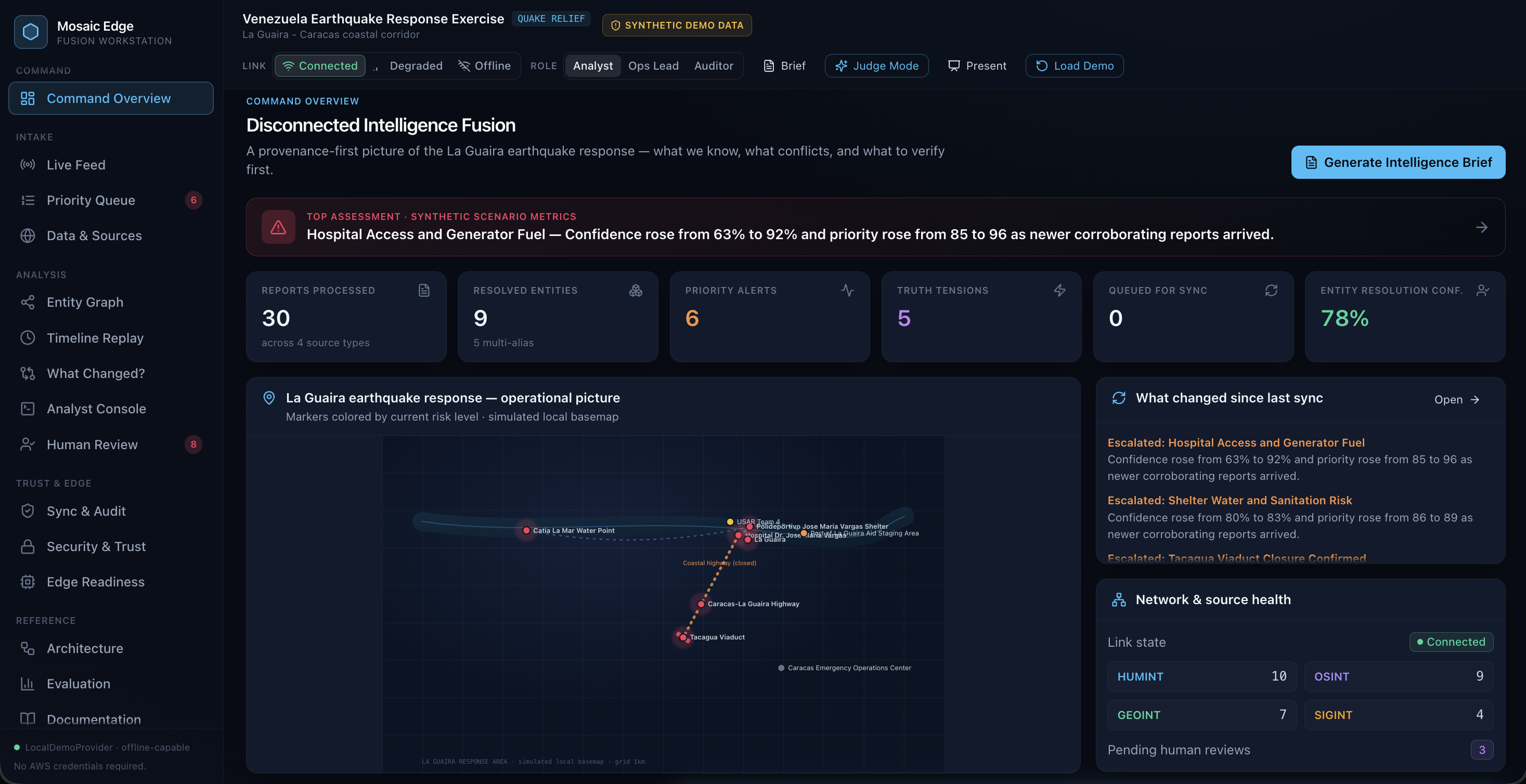
Turns fragmented disaster reports into a clear picture of what is known, conflicting, and urgent.
-
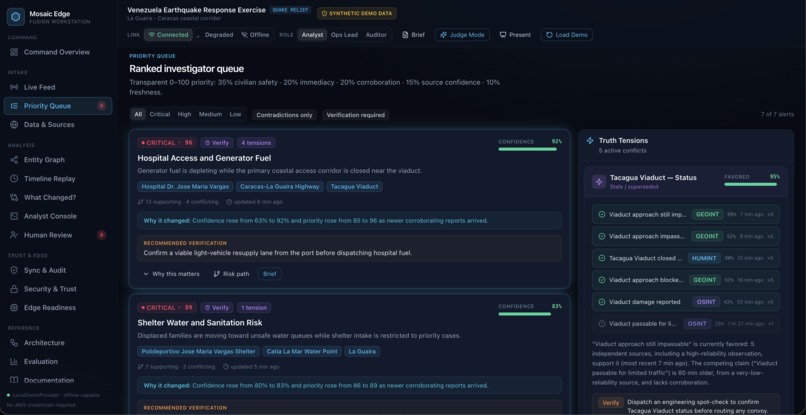
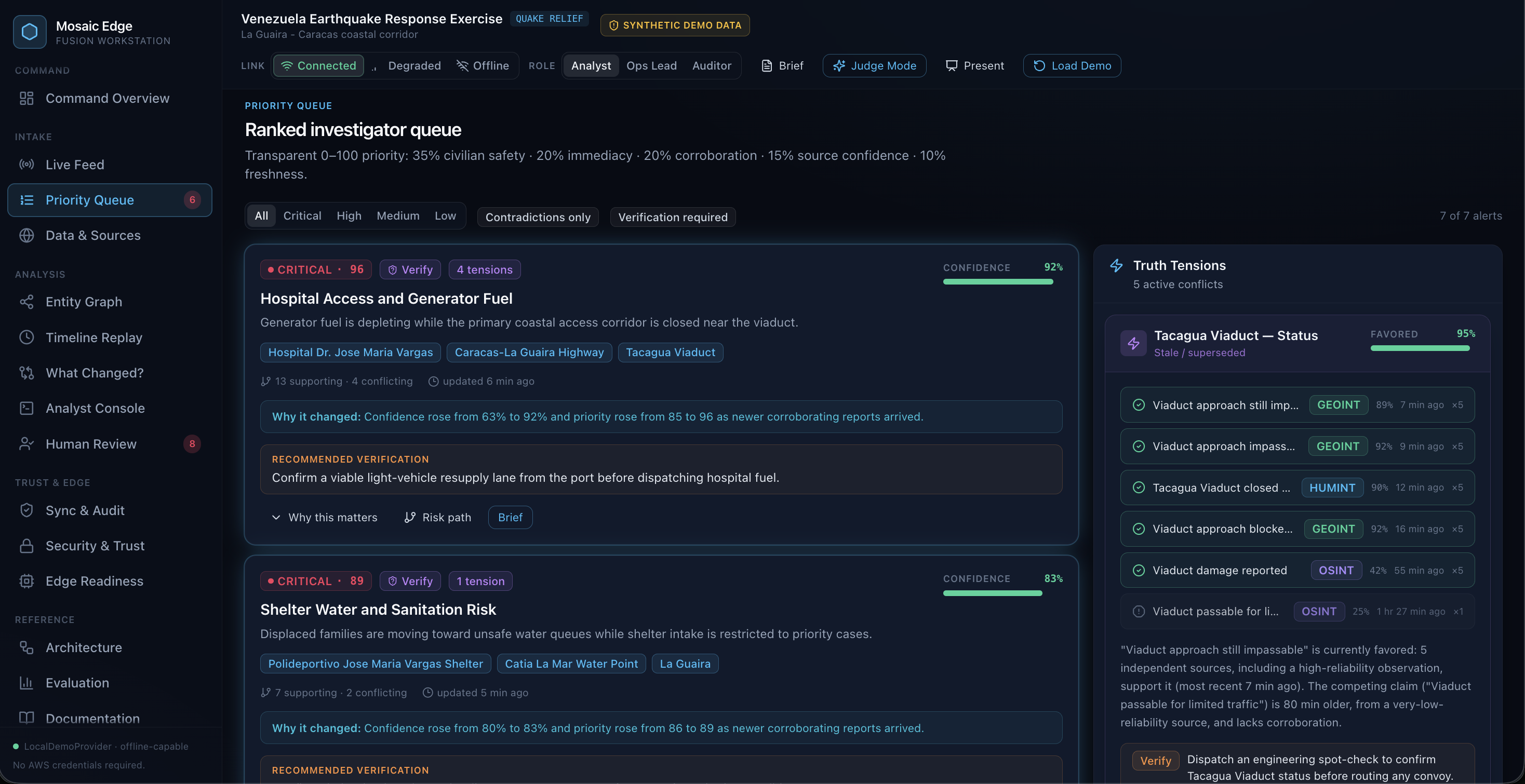
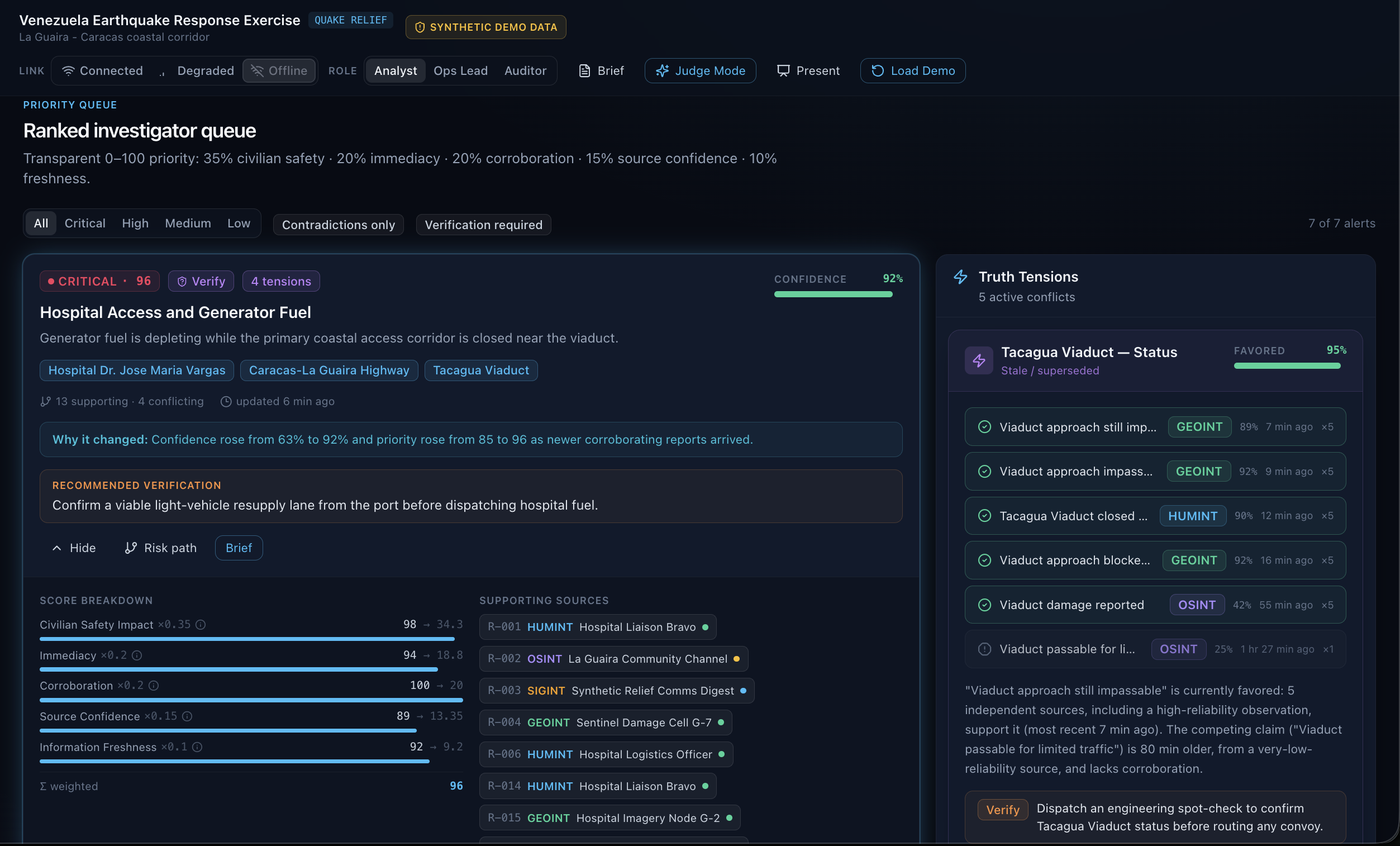
Ranks critical risks with transparent scoring while keeping conflicting claims visible.
-
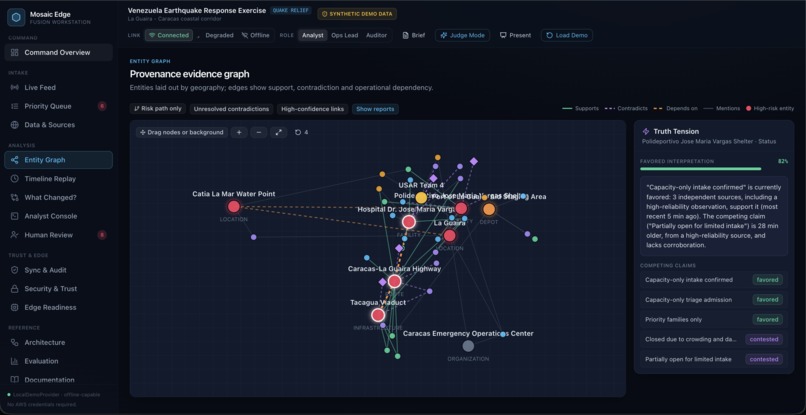
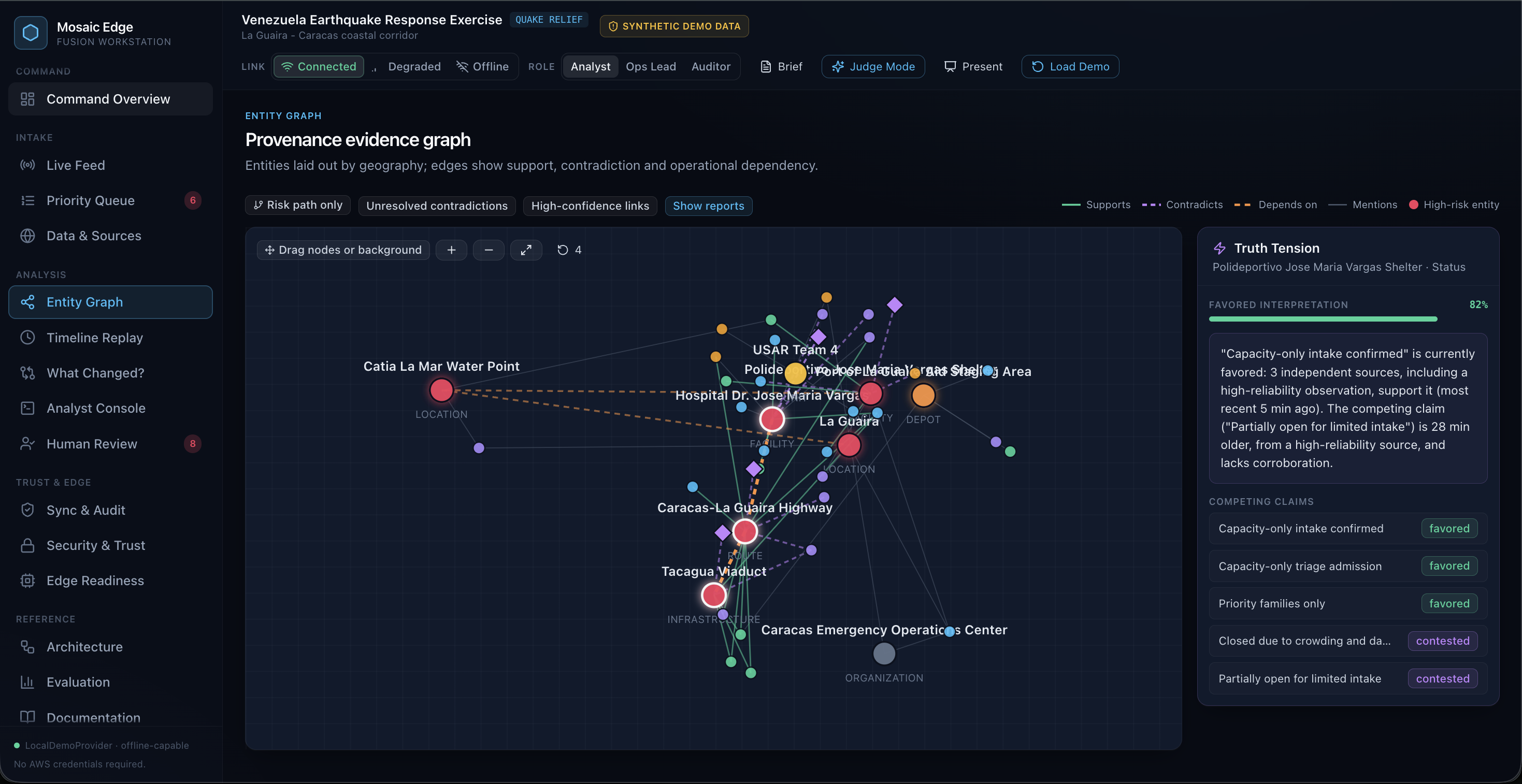
Connects reports, routes, facilities, and teams while showing support, contradictions, and dependencies.
-
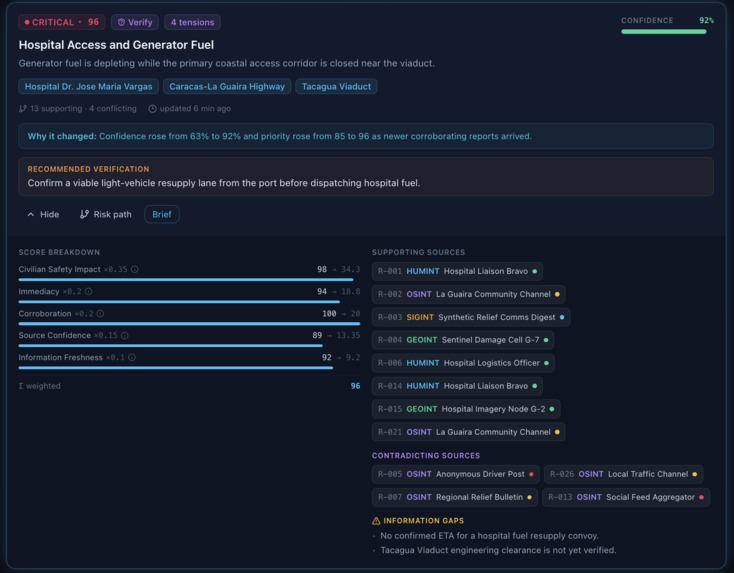
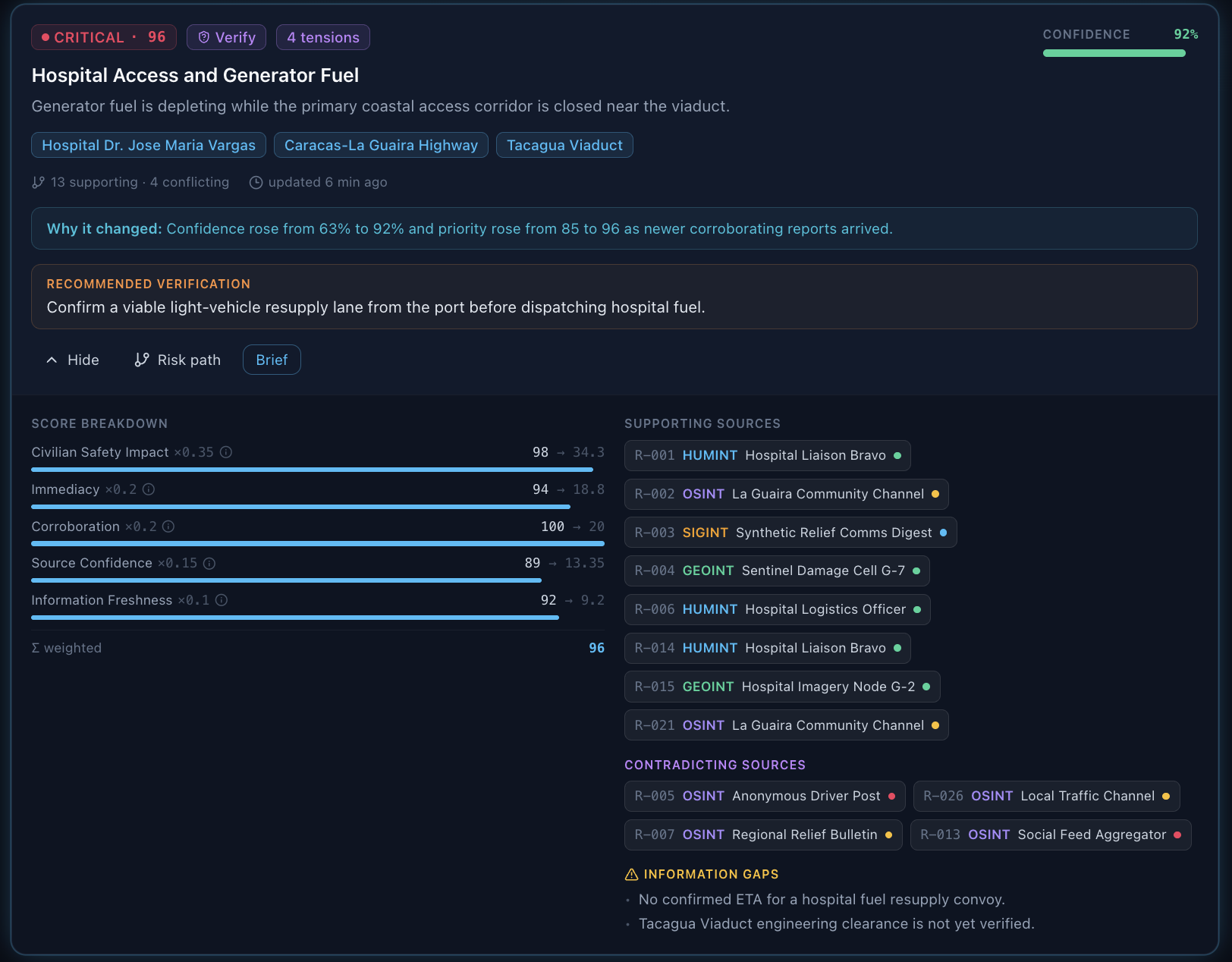
Explains each alert using weighted scores, supporting sources, conflicts, gaps, and verification steps.
-
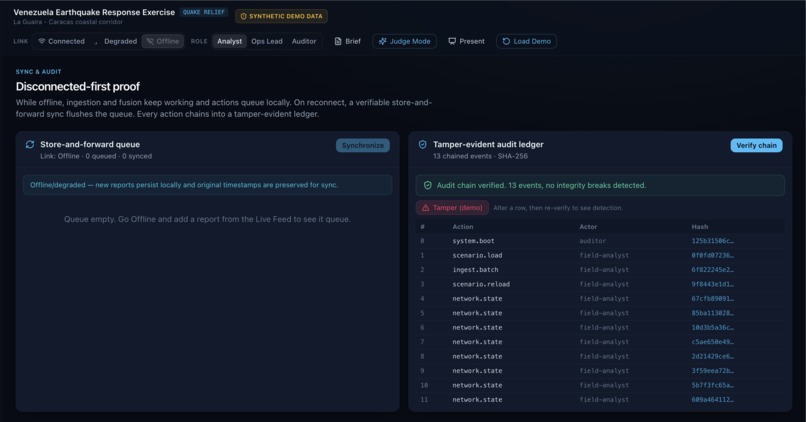
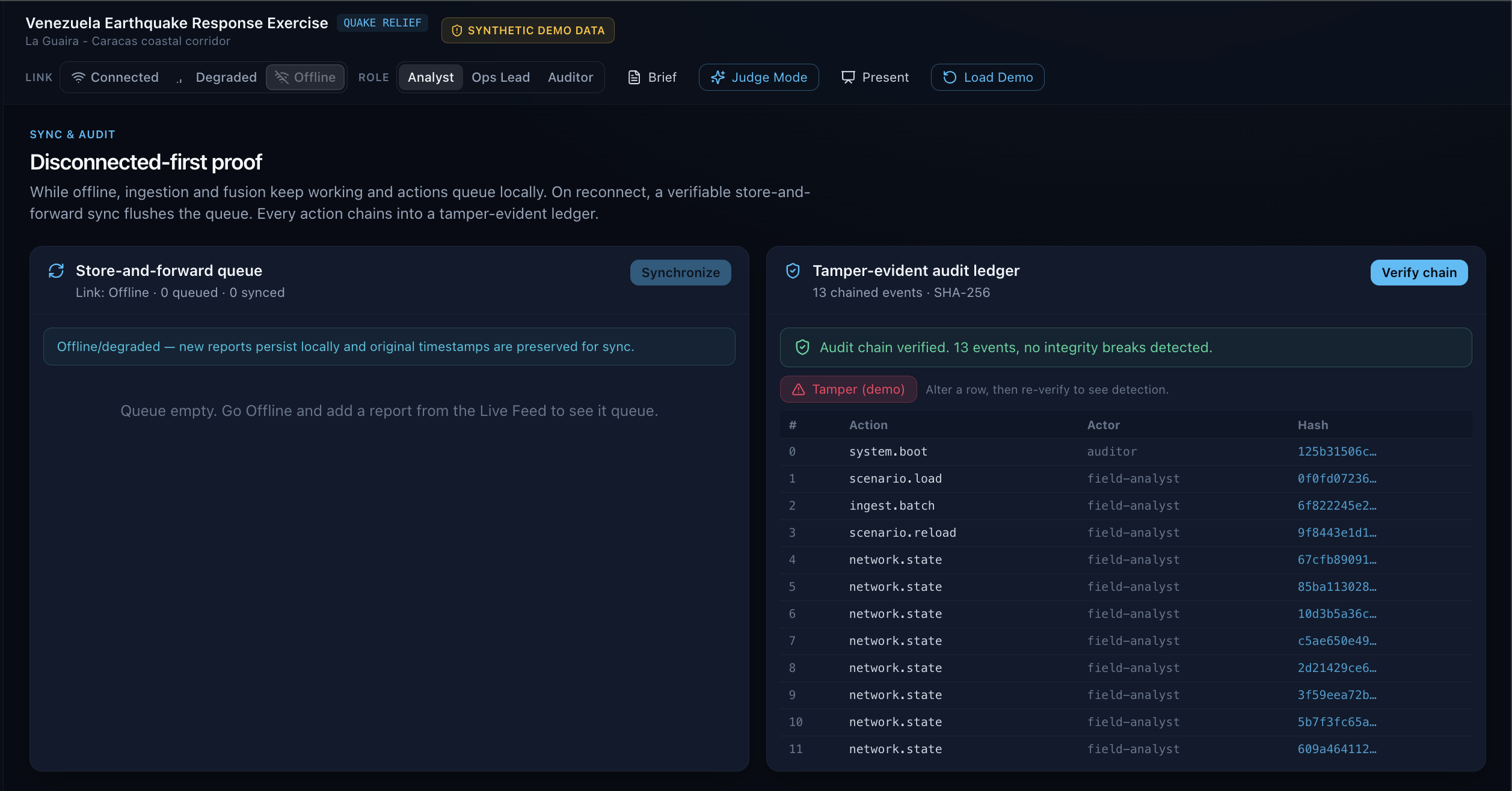
Preserves offline actions locally and protects the audit trail with SHA-256 integrity checks.
-
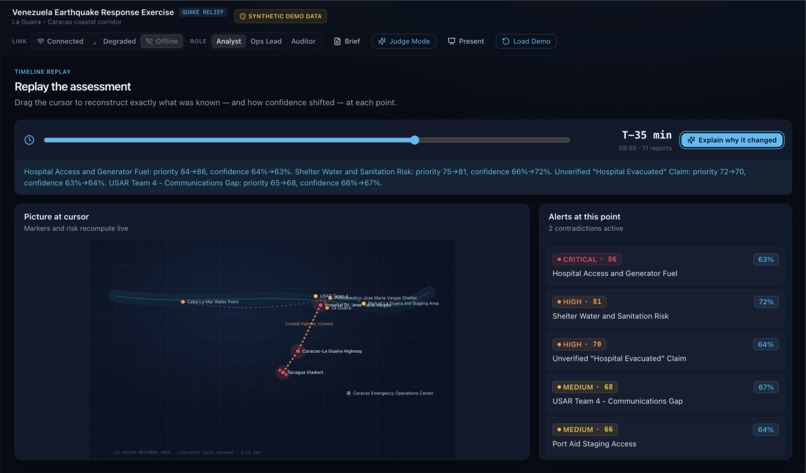
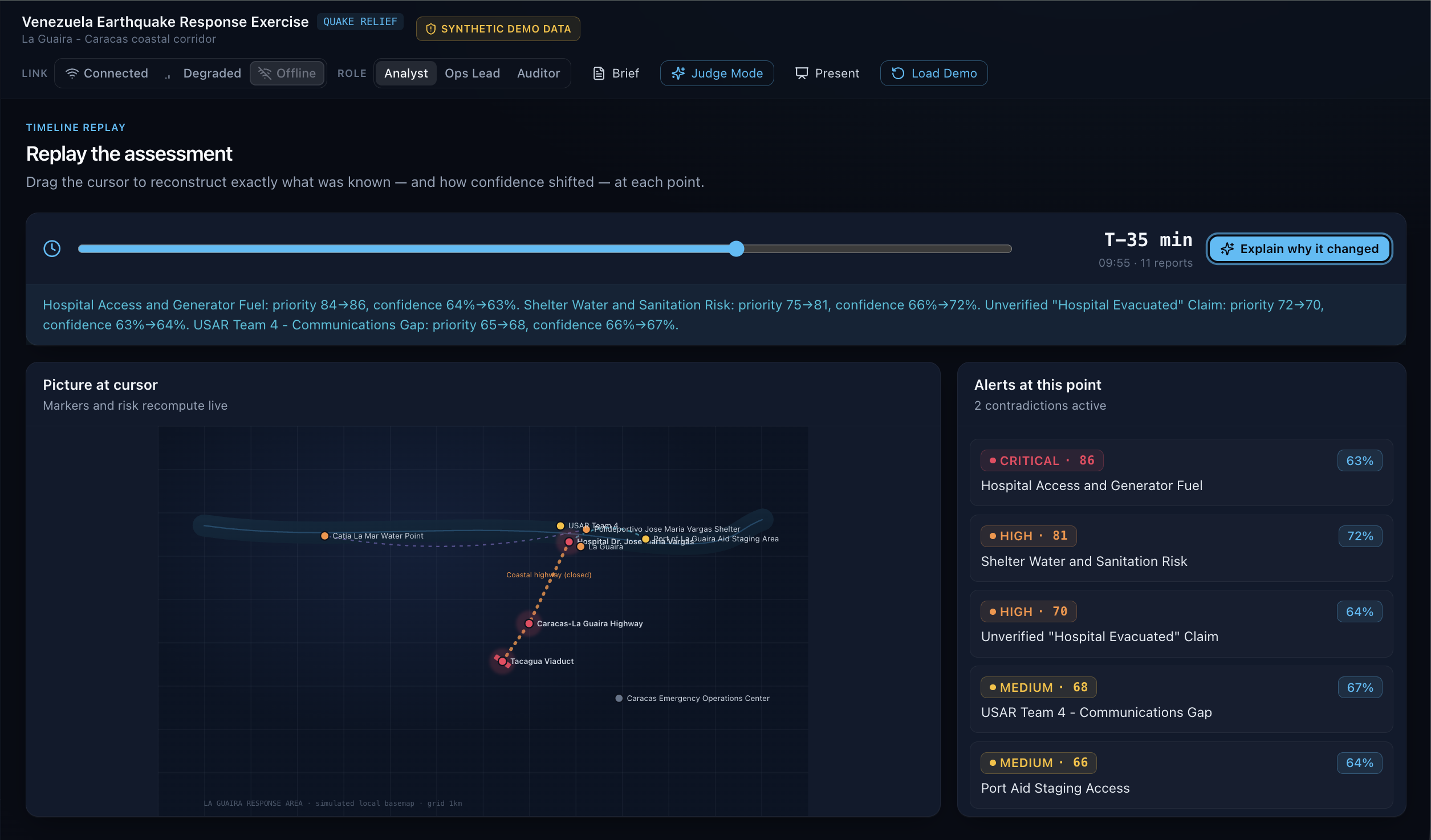
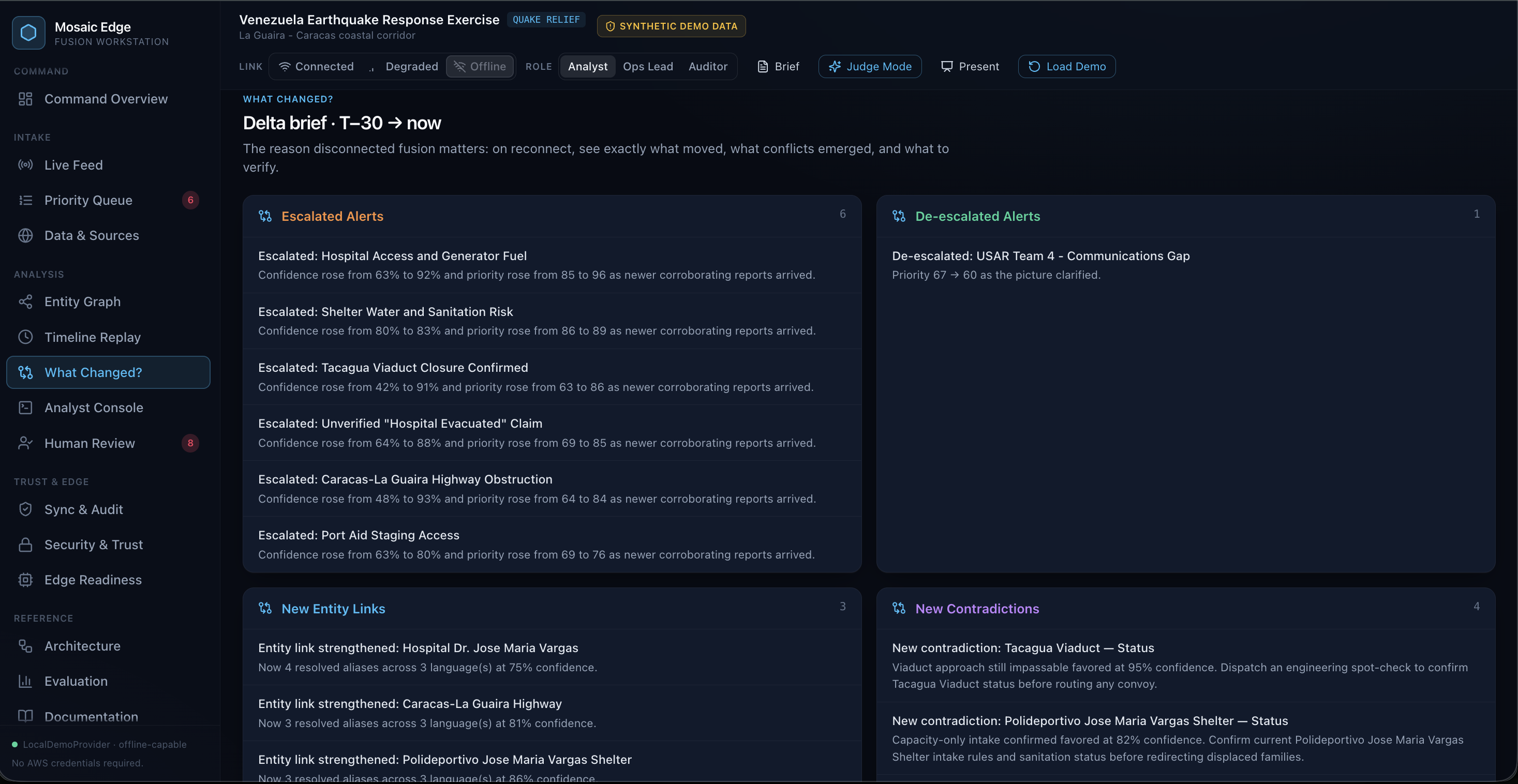
Reconstructs what was known at any moment and shows how new evidence changed confidence and priority.
-
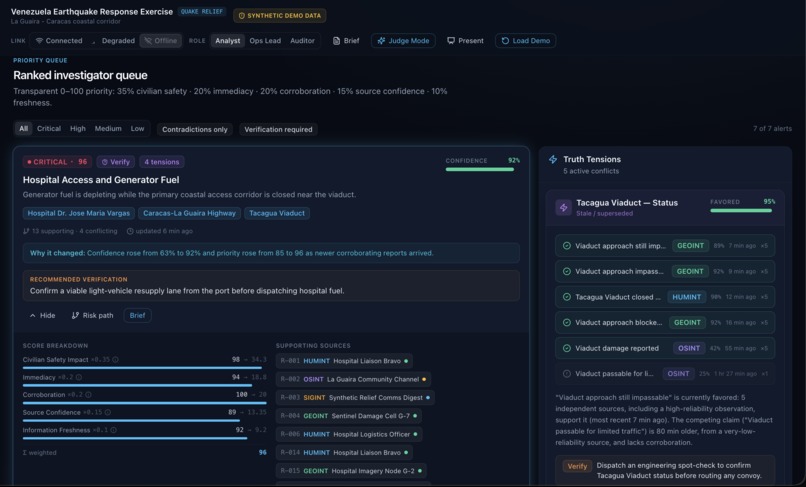
Shows why one interpretation is favored over stale, conflicting, or lower-confidence reports.
-
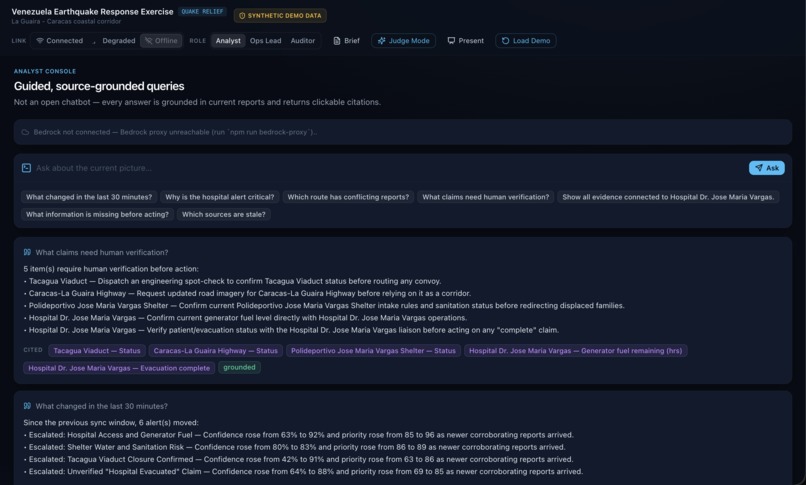
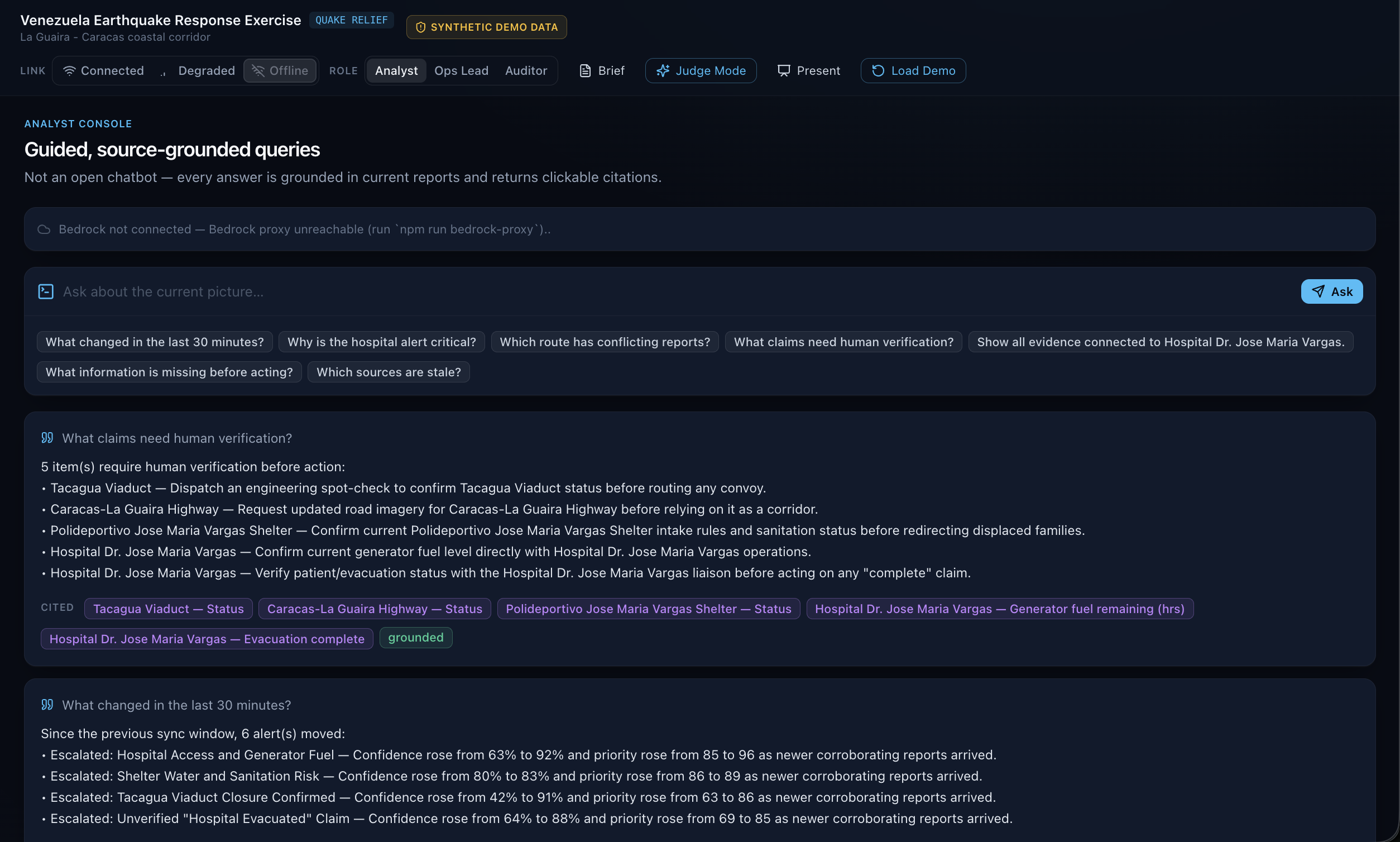
Answers operational questions using current evidence and returns grounded, clickable citations.
-
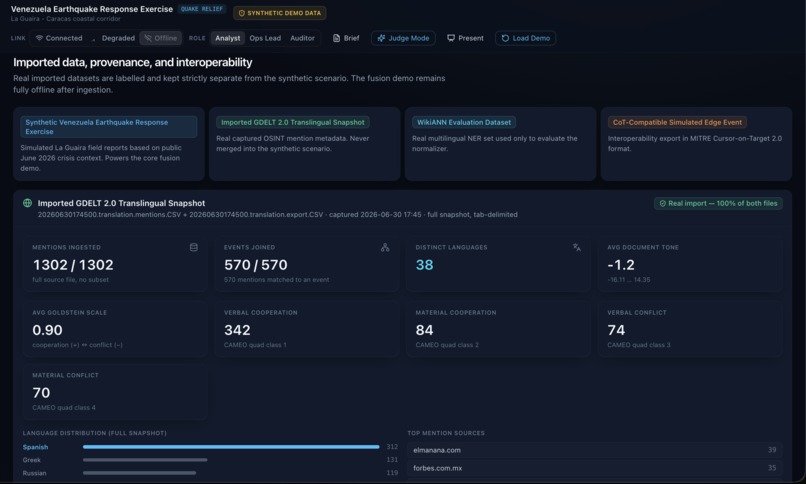
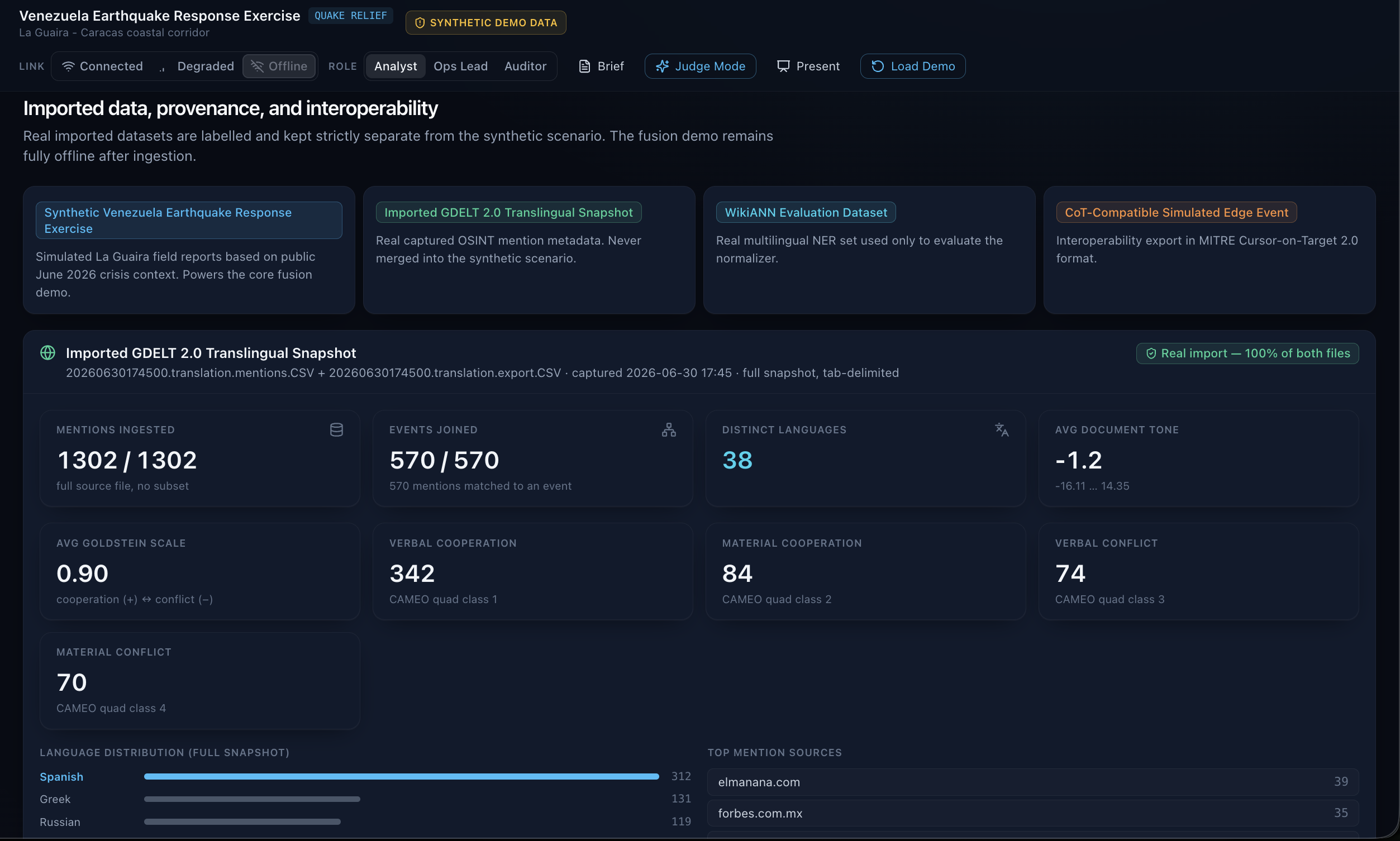
Separates real imported datasets from synthetic scenario data to preserve provenance and evaluation integrity.
-
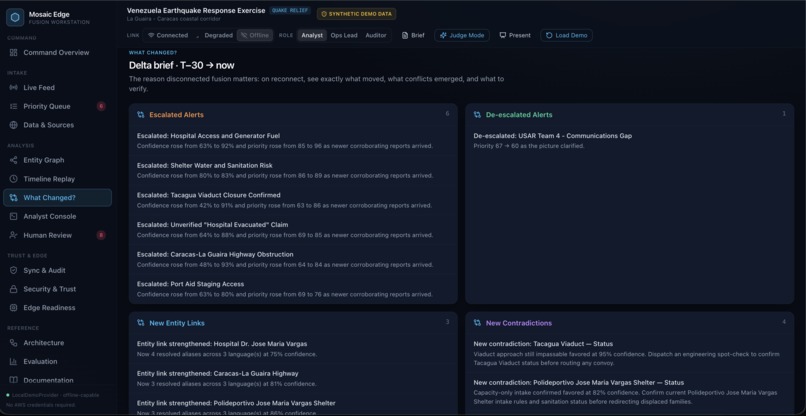
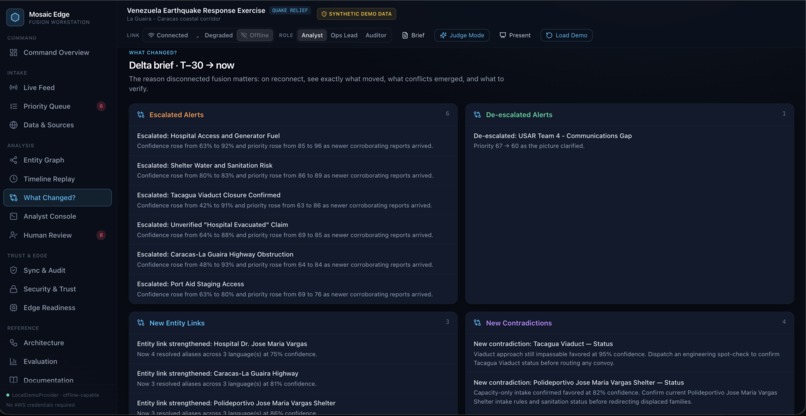
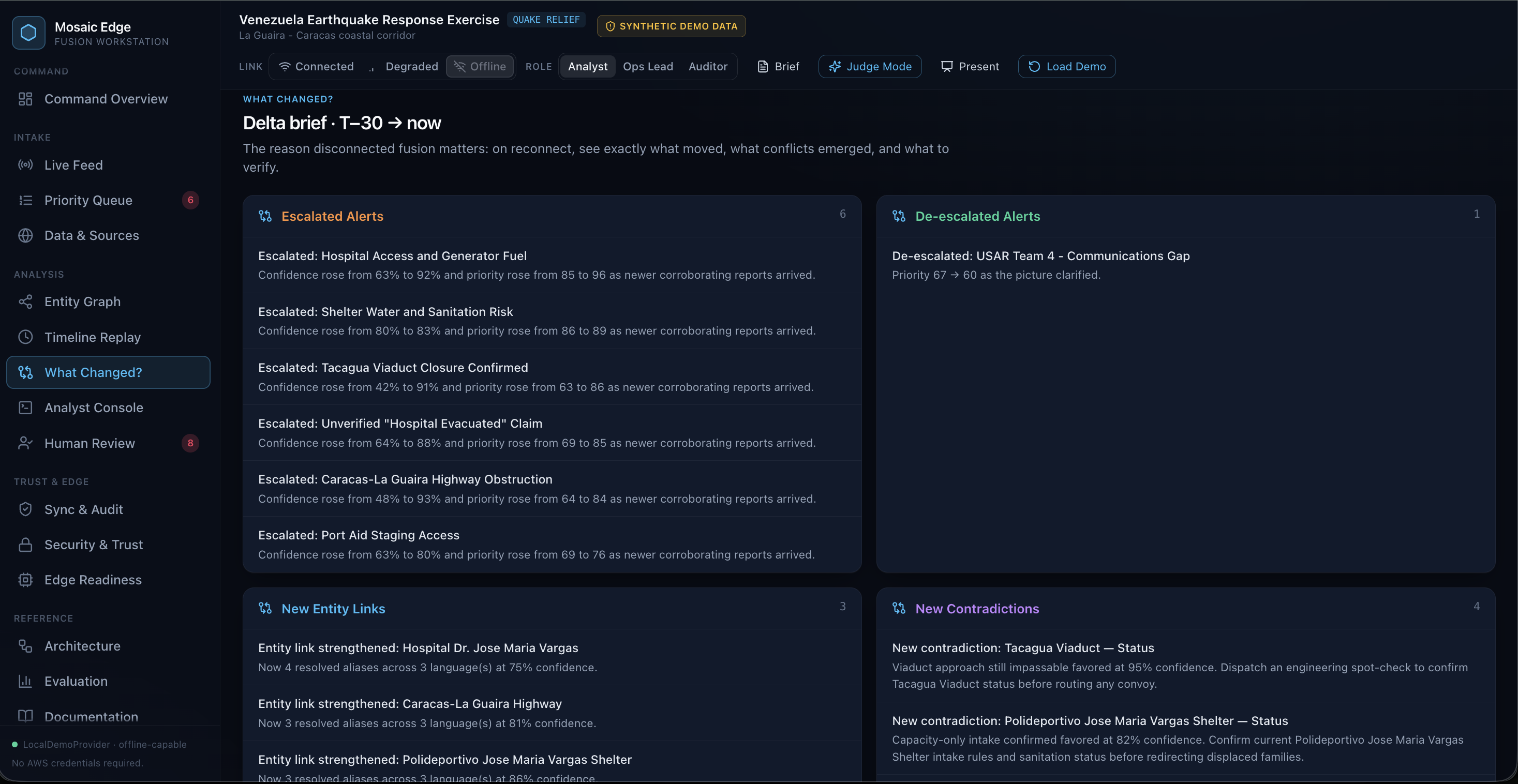
Summarizes what escalated, de-escalated, conflicted, or became newly connected since the last picture.
-
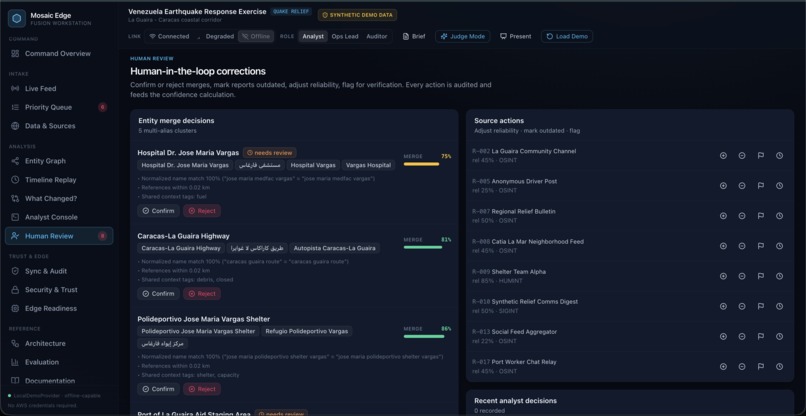
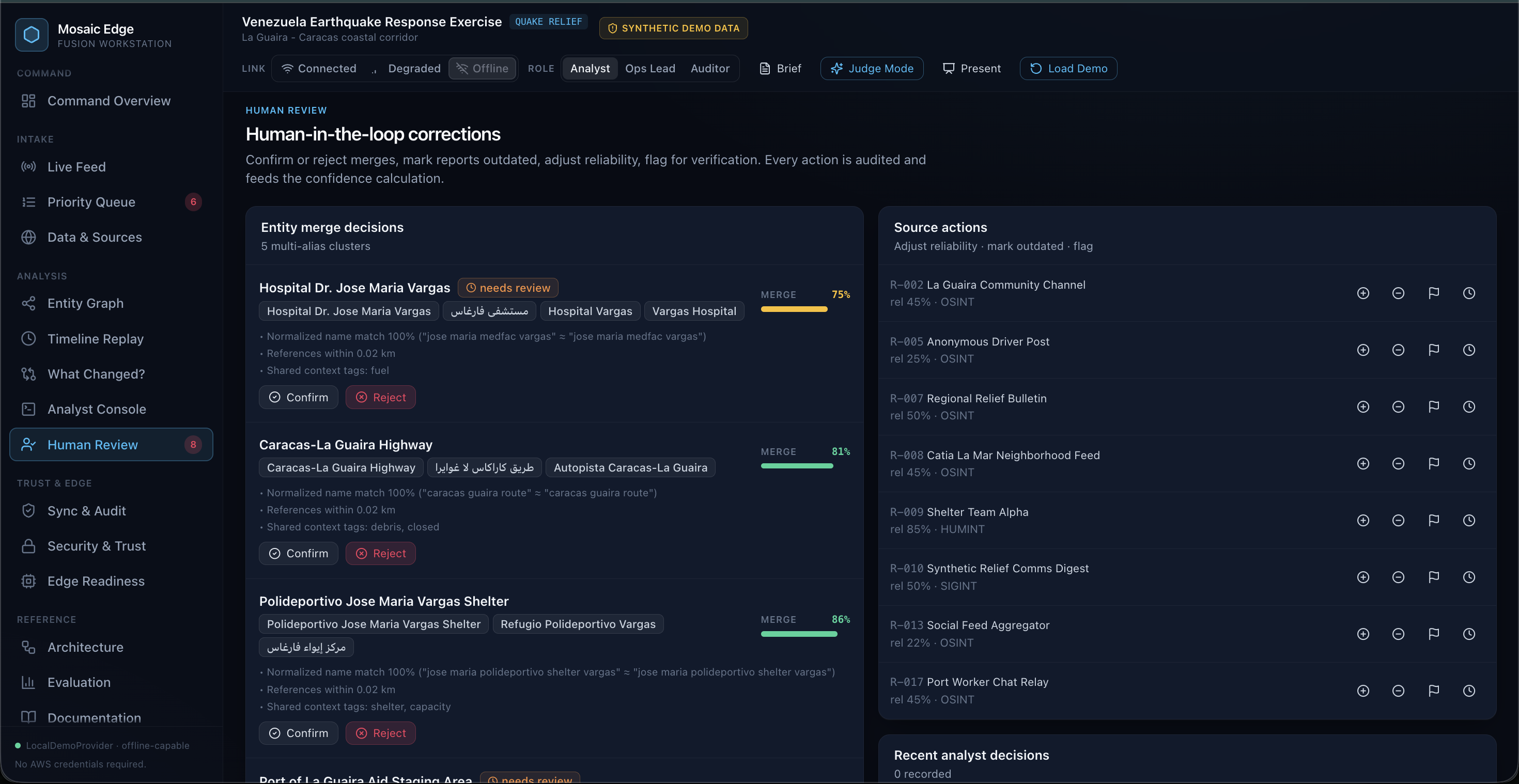
Lets analysts confirm merges, adjust source trust, flag reports, and feed corrections back into scoring.
-
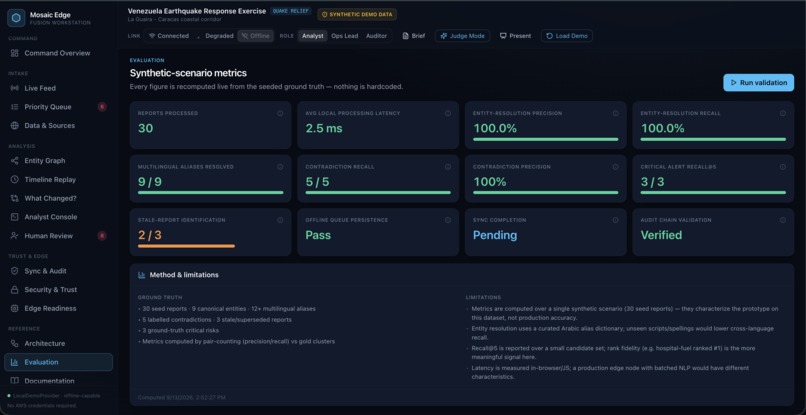
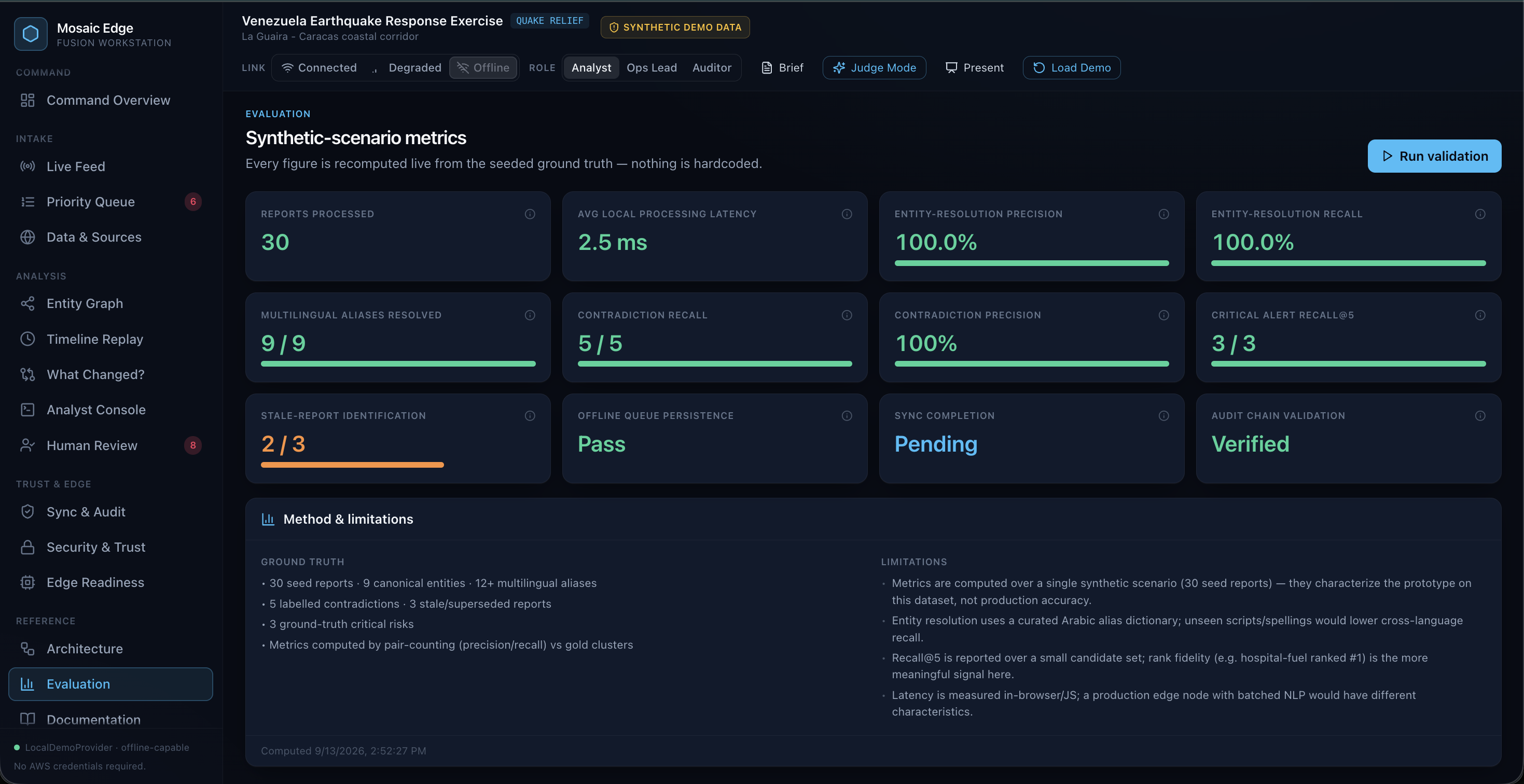
Measures entity resolution, contradiction detection, alert recall, latency, offline persistence, and audit integrity.
-
Inspiration
Disaster response becomes much harder when teams are receiving fragmented, multilingual, and sometimes contradictory information while connectivity is unreliable. Most modern intelligence tools depend heavily on cloud access or present a single confident answer without showing where uncertainty comes from.
I built Mosaic Edge around a different idea: responders should be able to see what is known, what conflicts, what has changed, and what still needs verification, even when the network disappears.
What it does
Mosaic Edge is an offline-first intelligence fusion platform for disaster response.
It ingests reports from multiple simulated sources and languages, resolves when different reports refer to the same people, locations, facilities, or events, detects contradictions, and prioritizes the most urgent risks.
Instead of hiding uncertainty, Mosaic Edge shows:
- supporting and contradicting evidence
- source provenance
- confidence breakdowns
- stale or low-reliability information
- changes in assessments over time
- recommended verification steps
The system can continue processing reports while disconnected. New information is queued locally and synchronized when connectivity returns, while preserving timestamps and generating an integrity receipt.
It also maintains a SHA-256 tamper-evident audit chain so analysts can verify whether the decision history has been altered.
How I built it
Mosaic Edge is built with React, TypeScript, Vite, Tailwind CSS, Zustand, Recharts, and Vitest.
The core system runs locally in the browser so the main workflow does not depend on internet access.
I implemented:
- multilingual entity resolution across English, Arabic, and Spanish
- conflict-aware evidence fusion
- transparent multi-factor priority scoring
- an interactive evidence graph
- timeline replay and "what changed" analysis
- offline report ingestion and store-and-forward synchronization
- a tamper-evident audit ledger
- human-in-the-loop review and corrections
- live evaluation metrics
- an optional Amazon Bedrock integration for source-grounded analyst queries
The prototype uses a controlled synthetic disaster scenario so the system can be evaluated repeatedly while keeping simulated reports clearly separated from real imported datasets.
Challenges
One of the biggest challenges was handling contradictory information without simply choosing one report and hiding the others.
Instead, I designed the system to preserve the disagreement and explain why one interpretation may currently be favored based on reliability, freshness, and corroboration.
Another challenge was designing the system around unreliable connectivity. Core functionality needed to continue operating locally rather than treating offline operation as an error state.
Multilingual entity resolution was also difficult because the same location or organization can appear under different spellings, aliases, transliterations, and languages.
What I learned
The biggest lesson was that useful AI systems should not only produce answers. They should make it possible to understand why those answers were produced.
For high-stakes environments, provenance, uncertainty, human review, and graceful offline operation can be just as important as model capability.
What's next for Mosaic Edge
Future versions of Mosaic Edge could expand from a single edge node into multiple cooperating field nodes, improve multilingual entity resolution, add encrypted local persistence, and integrate more production cloud infrastructure for synchronization and long-term storage.
The long-term goal is to give responders a trustworthy decision-support system that continues functioning when traditional infrastructure does not.
Built With
- ai
- amazon
- amazon-web-services
- bedrock
- computing
- css
- edge
- gdelt
- nova
- offline-first
- react
- recharts
- sha-256
- tailwind
- typescript
- vite
- vitest
- wikiann
- zustand

Log in or sign up for Devpost to join the conversation.