-
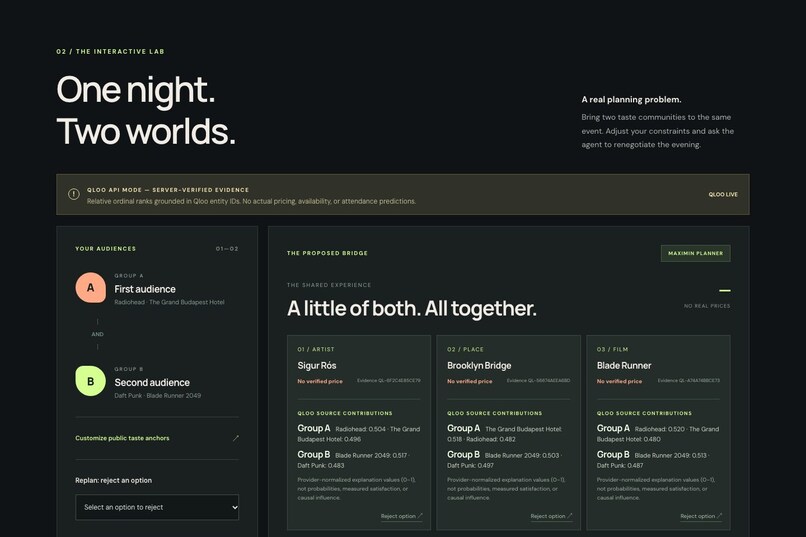
MOSAIC live Qloo planner: two audiences, three evidence-backed cultural options
-
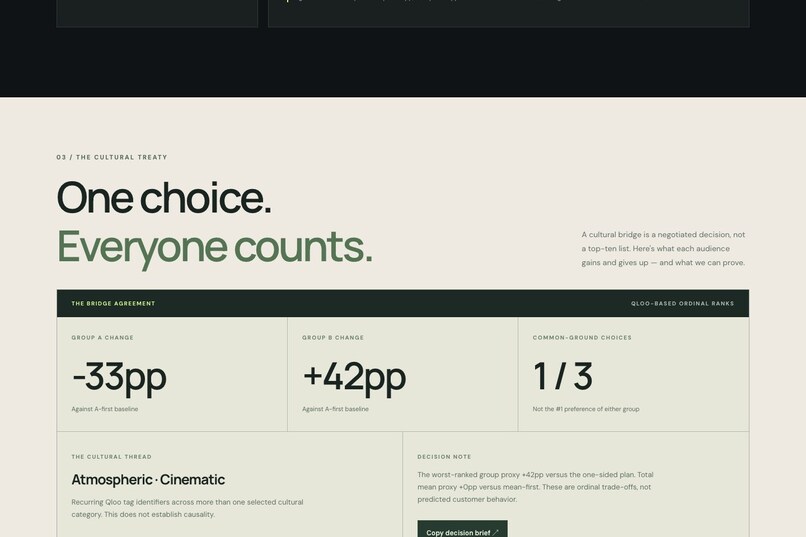
Cultural Bridge Agreement: Qloo-grounded audience trade-offs and source-backed cultural links
MOSAIC — Common Ground, by Design
Tagline: One event. Two audiences. A cultural agreement you can explain.
Live, Qloo-powered application: https://mosaic-agent-2026.onrender.com/
Open-source repository (MIT): https://github.com/Abdullah-m7/qloo-mosaic
Builder: Abdullah Almohammedi — solo entry
Built with: Qloo Taste AI (Search and Insights REST APIs), Node.js, JavaScript, HTML/CSS, Render, GitHub Actions
The 20-second case for MOSAIC
Most recommendation tools return a choice. MOSAIC helps two groups negotiate one. It uses real Qloo artist, place and film evidence, exposes what each audience gives up, shows source-backed cultural links, and revises the plan when an organizer vetoes an item. The result is a decision brief a team can question and improve — not an invented prediction or a booking.
Inspiration
Imagine a festival programmer planning one cultural night for two communities. One group gravitates toward indie film and alternative music; the other toward electronic music and cinematic spectacle. Selecting the favorite of one group makes the other feel overlooked. Averaging opaque recommendation scores hides the compromise.
The organizer needs more than a list of things people might like. They need to answer: What can these audiences reasonably agree on? Who gives up what? Which parts of the recommendation are supported by actual evidence? And what happens if a stakeholder rejects a choice?
MOSAIC makes the compromise inspectable and revisable.
What it does
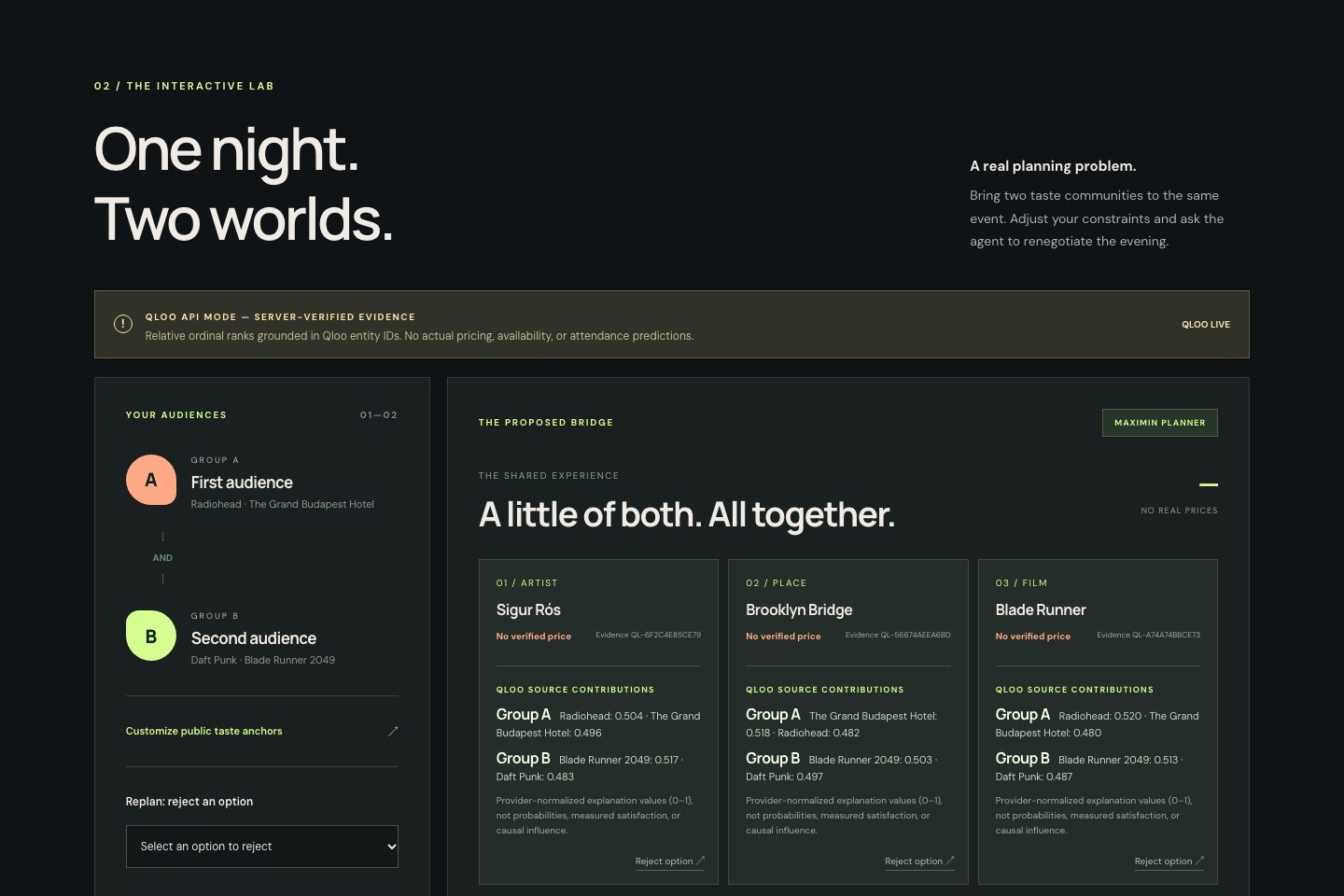
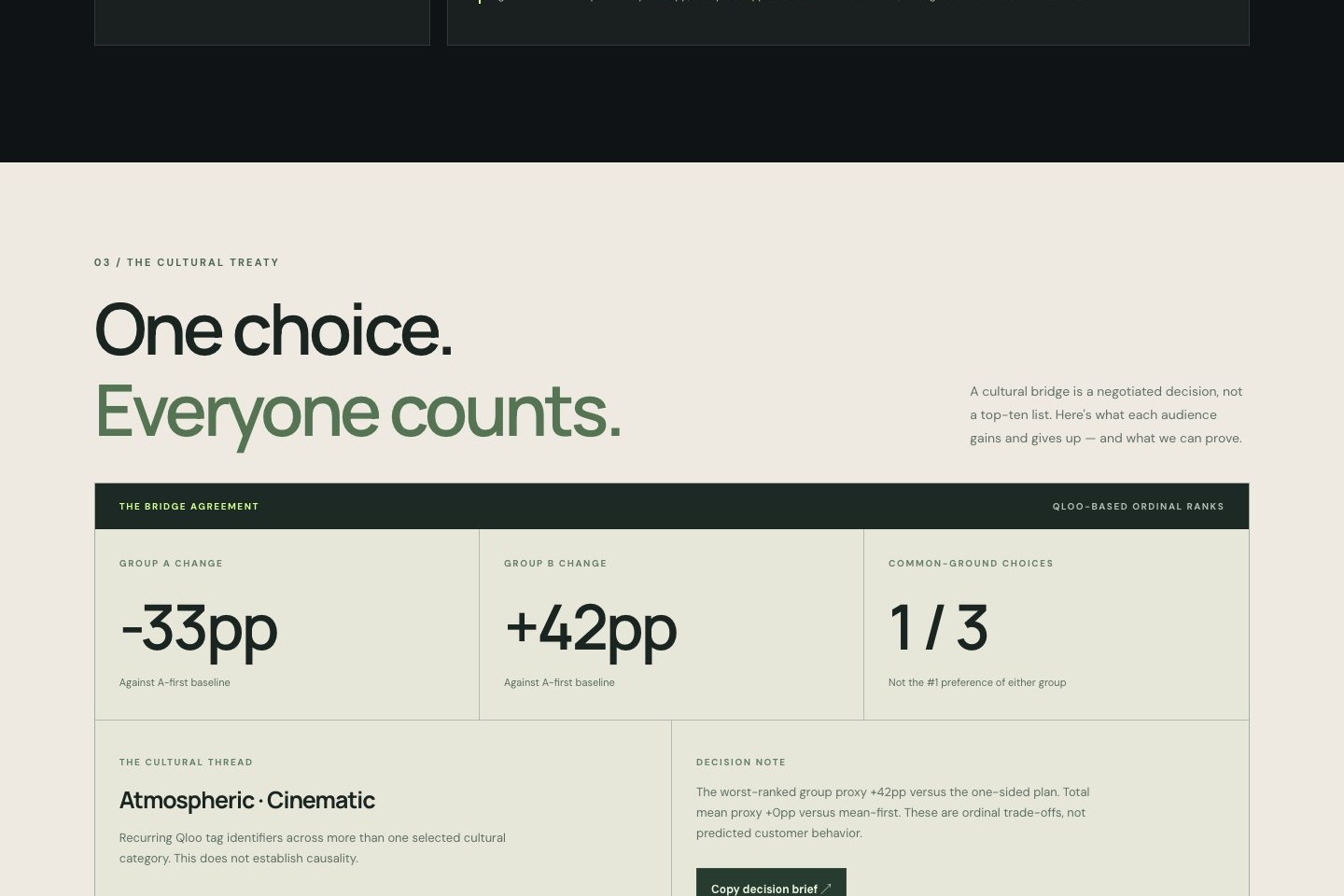
MOSAIC is a bounded cultural negotiation agent for event programmers. Enter two sets of public artist or film taste references and a city. It queries Qloo to discover real candidates across artist, place, and film categories, ranks the same shortlisted options independently for each audience, and builds a three-part Cultural Bridge Agreement.
Instead of announcing an unexplained winner, the application shows each group's relative rank trade-off against an audience-first or average-first alternative. The interactive Pareto frontier lets an organizer explore other grounded agreements without additional Qloo calls. A stakeholder can veto a choice, and MOSAIC re-plans from cached evidence when available. It also stress-tests what would happen if each selected item were unavailable, without claiming to know booking inventory.
A proposed cultural connection appears only when the same Qloo-provided tag ID is attached to options from different categories. An optional alternate agreement can preserve a source-supported cross-category thread within a fixed five-percentage-point loss limit on the lower audience rank proxy. If the data does not support such a link, MOSAIC says so. If Qloo cannot uniquely resolve a name or provide sufficient matching rankings, the agent abstains rather than inventing results.
The output includes an evidence trail and a copyable decision brief identifying the options, trade-offs, public taste references and real-world checks the organizer still needs to perform.
Why Qloo is essential
Qloo is not a decorative lookup. Its Search and Insights responses provide the entities, independent audience-relative rankings, available explanation signals and tag IDs on which the agreement depends. Without adequate Qloo evidence, the live agent will not fabricate a recommendation.
MOSAIC adds a specialized decision-and-revision workflow on top of Qloo: one transparent plan for two audiences, visible alternatives, vetoes, and source-backed reasoning. It does not attempt to replace Qloo's taste intelligence.
How we built it
The application uses Node.js with a responsive web interface and a bounded server-side REST client pinned to Qloo's hackathon API. The agent follows an auditable sequence: resolve public taste anchors, discover candidate entities, rank matched shortlists for both groups, compare three-category combinations, check provider-tag intersections, and support cached re-planning and explicit refusal. Qloo credentials never belong in the browser.
The core selection method maximizes the lower of two ordinal rank proxies computed on mutually ranked options. We do not compare raw numeric scores across independent Qloo calls or describe these proxies as satisfaction probabilities, attendance forecasts, or measures of demographic fairness. Source identity checks reject ambiguous entities that share a display name but have different provider IDs.
Challenges and accomplishments
Two difficult issues were handling incomplete or ambiguous Qloo evidence without quietly switching to invented data, and tracing a cross-category cultural link without having a model write a plausible but unverified story. We also made the trade-offs visible: an organizer can inspect a frontier, reject an item, or compare the same evidenced candidate set under different selection policies.
The current public release passed 131 automated tests, an anonymous Qloo-backed release check, and real Chrome walkthroughs at mobile (390px) and desktop (1440px) sizes. The release check verified three source-grounded categories, stress-test alternatives, cached veto re-planning and invalid-input refusal. These tests establish the working prototype, not improvement in real audience satisfaction or commercial traction.
Potential impact and what's next
The first buyer hypothesis is festival programmers and cultural-event agencies preparing programs for stakeholders with differing tastes. Their proposed job to be done is not automated booking: it is producing, defending, and revising a cultural-programming decision brief. The first paid offer to validate would be a per-event decision package for teams facing conflicting stakeholder preferences, not a claim that such purchases already exist.
The next milestones would be a properly licensed commercial Qloo arrangement, evaluation with actual event programmers using non-sensitive briefs, and a test of willingness to pay for an event decision package. Only after that evidence could we justify a recurring team workspace with approval history and authorized procurement integrations. We have not validated paying customers, pricing, revenue, booking availability, venue costs, film rights, or real-world audience outcomes.
How judges can try it
Open the live app at https://mosaic-agent-2026.onrender.com/ — no login is needed. The two example public taste profiles and the city are preloaded. Allow the first Qloo plan to finish; measured first requests were around 20–26 seconds and can vary with hosting cold starts. Review the artist/place/film cards and evidence ledger, compare the baselines, explore a verified cultural thread (if one exists), reject a card, and use Copy decision brief. The separately linked GitHub Pages preview uses synthetic data and is not the competition's live Qloo demo.
Verified production images: Desktop screenshot · Mobile screenshot


Log in or sign up for Devpost to join the conversation.