-
-
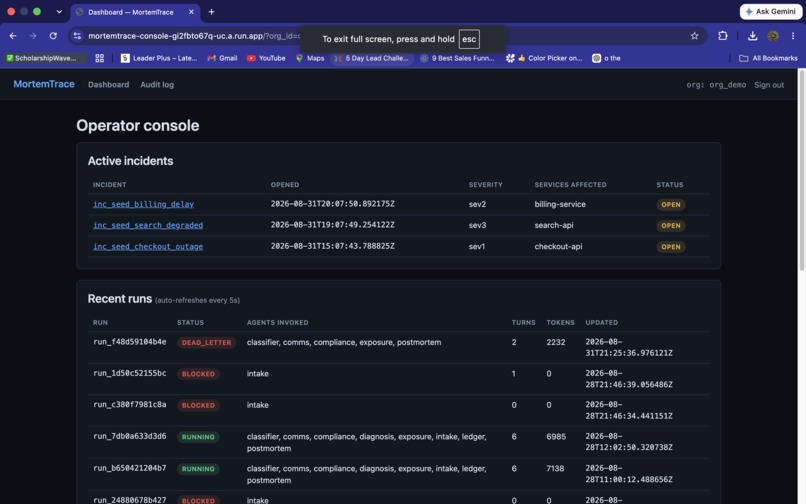
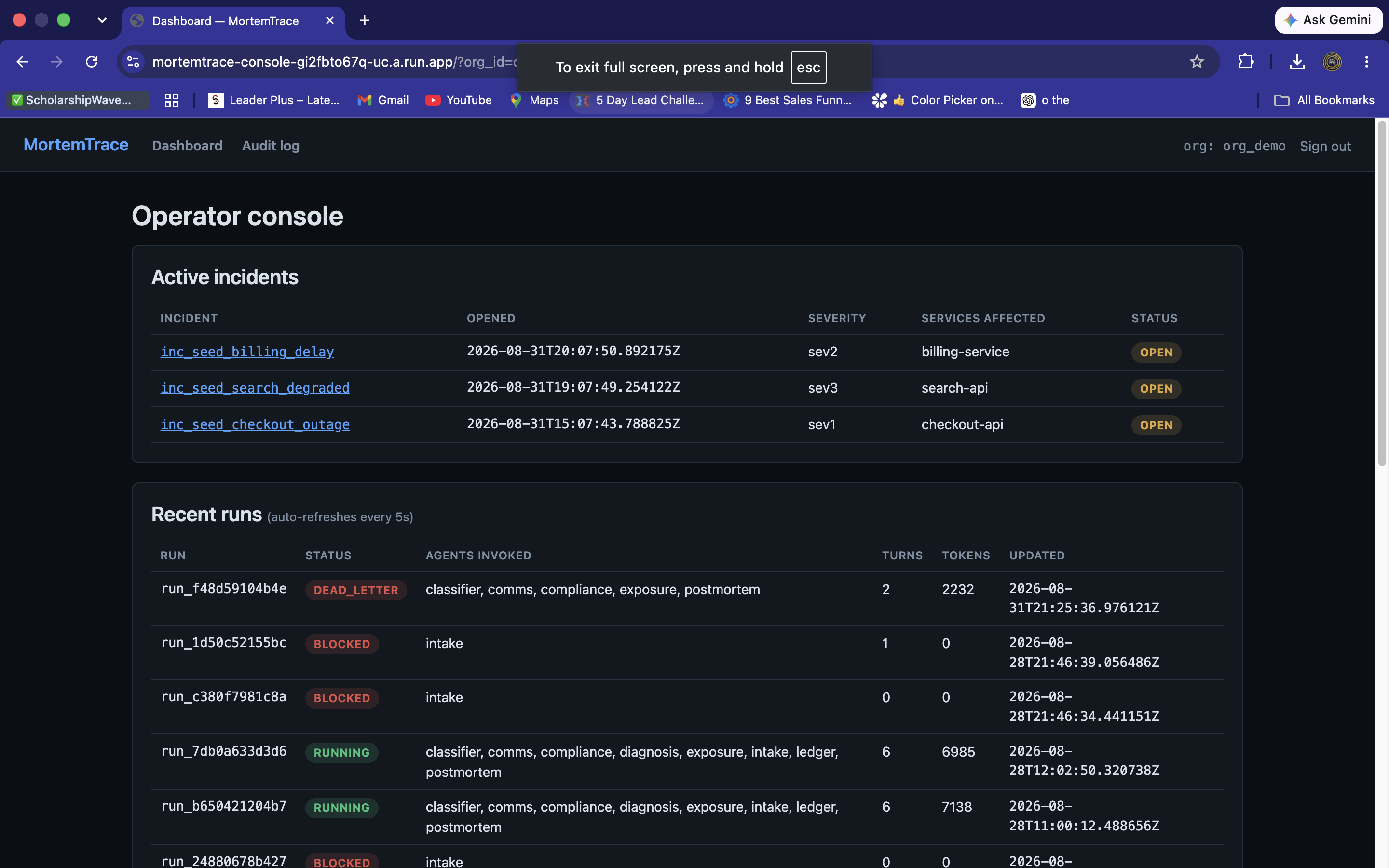
MortemTrace Dashboard
-
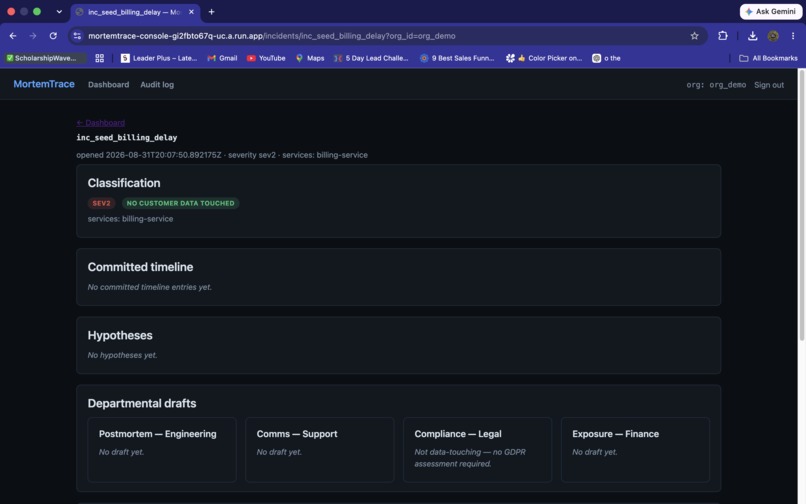
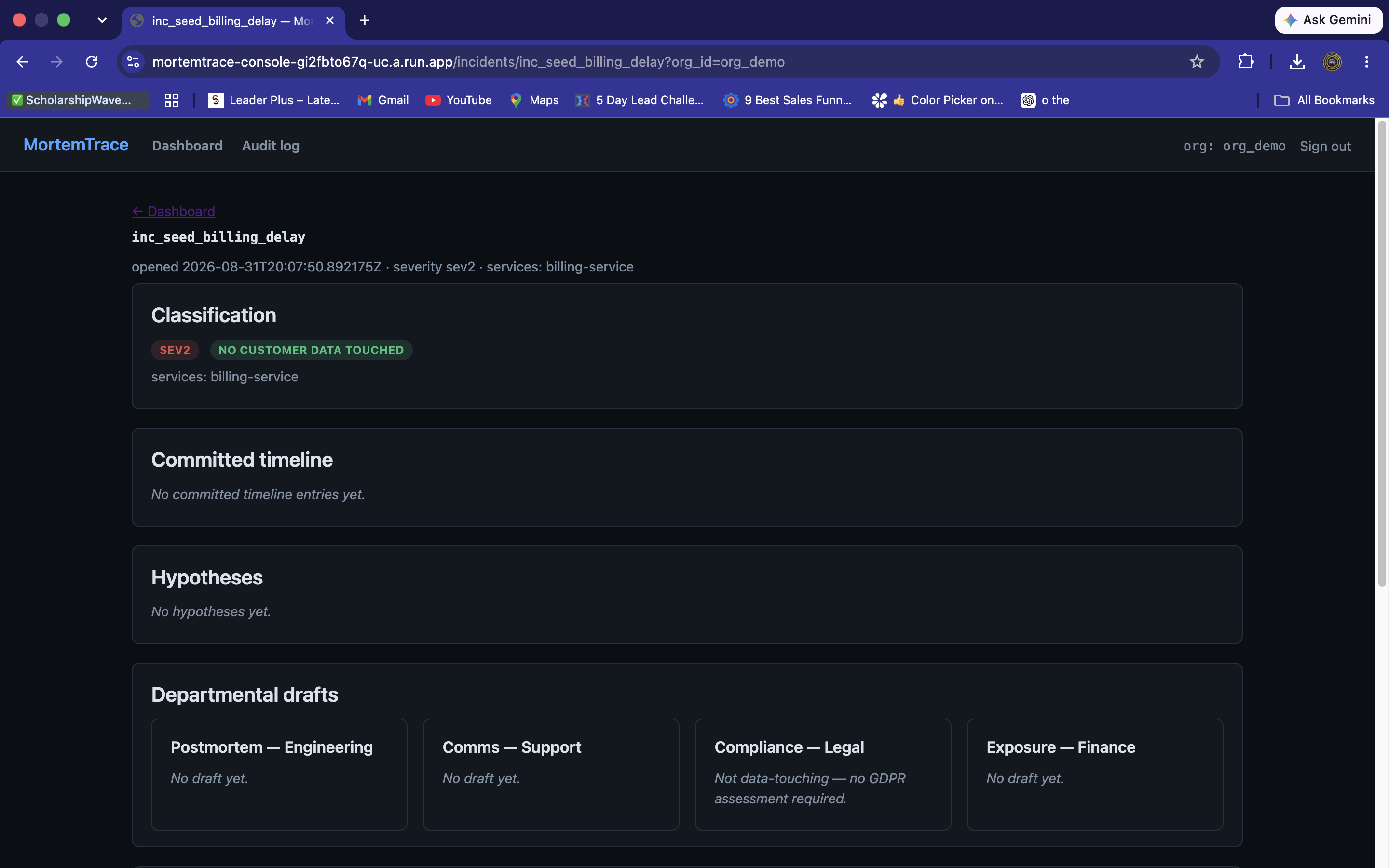
Incident Details
Inspiration
Every real incident produces the same second disaster: the postmortem gets written three days later from memory, Support improvises a status update that contradicts what actually happened, nobody checks whether customer data was touched until Legal asks two weeks in, and Finance learns about SLA credit exposure from an invoice instead of from the incident itself. The information existed the whole time, it just never got structured, traced to its source, or routed to the people with obligations because of the incident, not just the people debugging it.
The harder problem underneath: those four teams shouldn't see the same things. Support drafting a customer update has no business reading raw application logs. Legal assessing a GDPR clock doesn't need Engineering's stack traces. Every "role-based access control" we looked at solves this in the UI layer, a dashboard hides a button, which means the data is one API call away from anyone with slightly broader access than intended. We wanted to know if scope enforcement could live in the data layer itself, so that "Support cannot read raw evidence" isn't a prompt instruction an attacker or a bug can talk an agent out of, it's a query the database itself refuses to serve.
What it does
MortemTrace ingests an alert, a pasted log, a Slack thread, or a dashboard screenshot, and
turns it into one committed, source-traced incident timeline, every entry carries the
source_event_ids[] it was extracted from, and a commit without one is rejected at the
store layer, not just discouraged in a prompt. That single timeline then fans out to four
independently-scoped agents:
- Engineering drafts a postmortem with a proposed runbook fix.
- Support drafts a customer-facing status update - timeline access only, no raw logs.
- Legal assesses whether customer data was touched and starts a GDPR 72-hour clock the moment it's true, not when someone remembers to check.
- Finance calculates SLA credit exposure per affected customer.
A Watcher agent independently polls provider-status and CVE-shaped feeds on a schedule and correlates them against active incidents by service dependency graph, so "was this us or our cloud provider" is answered automatically, for exactly the incidents it actually affects, before anyone has to ask.
Every model call is screened both directions by Model Armor - prompt injection on the way in, secrets/PII on the way out, and every read, write, and denial is an OpenTelemetry span and a Firestore audit entry, queryable by run, incident, and org. A new department joins the fleet by publishing a registry entry with its scopes; nothing routes to it until that happens, and nothing about the Coordinator's code has to change.
Real organizations connect their existing tools - PagerDuty, GitHub Actions, Jenkins, Terraform, or anything else that can fire a webhook, through one universal receiver with per-connector signature verification (HMAC, bearer, or IP allowlist), not a bespoke integration per vendor.
How we built it
Google ADK for every agent, Gemini 3.5 Flash via Vertex AI, Model Armor for injection and
secrets screening, Firestore as the sole data store (one module - data/scope_store.py -
is the only code in the repository allowed to import the Firestore client at all; a test
greps the tree and fails the build if a second entry point appears), Pub/Sub for genuinely
asynchronous multi-hop dispatch, Cloud Run for both the ingest API and the operator
console, Cloud Scheduler for the periodic Watcher sweep, and OpenTelemetry/Cloud Trace for
tracing. FastAPI and Pydantic underneath; every Firestore document and Pub/Sub payload is
validated against a Pydantic schema before it's written or acted on.
The Coordinator is the only thing that decides who receives an event, a static routing table plus a Firestore-backed agent registry - and it never reasons about incident content itself; every actual decision is made by whichever worker it dispatches to. Guardian sits in front of every dispatch as a deterministic policy checkpoint, screening the real evidence body before a worker is even invoked, not just the envelope metadata around it.
Authentication went through a real design pass partway through the build, once it became clear a hackathon demo and a plausible production system have different needs here: Google/org SSO via OIDC (PKCE, state, and nonce all independently verified) mints a signed session cookie; which organizations a session may act as, and with what role, is resolved fresh from live membership rows on every request - never cached in the cookie itself, so a revoked membership takes effect on the very next request. Machine callers (the ingest API, scheduled sweeps, webhooks) authenticate through an entirely separate credential path, API tokens or per-connector signatures, so a webhook can never authenticate as a human, and a stolen session cookie can never touch the machine-to-machine surface.
Challenges we ran into
The architecture was right on paper well before it was right in production, and almost every real bug lived in the seam between our code and someone else's SDK or API, the kind of thing 149 unit tests that correctly mock Gemini and Model Armor will never catch, because the mock is exactly where the bug wasn't.
- ADK invokes
before_model_callback/after_model_callbackby keyword, not position, despite the type hints being declared positionally, confirmed by reading ADK's own source, whose comment admits it. Every live model call threwTypeErroruntil this was found; every test using a positional call passed the whole time. - The actual P0 requirement - Model Armor blocking a live prompt injection - was
silently a no-op. The code compared a protobuf enum via
"MATCH_FOUND" in str(enum_value).str()on a bare proto enum returns its ordinal ("2"), not its name. Model Armor was correctly returningMATCH_FOUNDfor a real injection string on a fully enabled filter, and the interpretation code still returned "allow" - every time. - A real, reproducible Model Armor false positive turned up during our own final
verification pass: an entirely benign incident report ("nginx pods restarted, 503s on
checkout") was flagged by the live
pi_and_jailbreakfilter. Confirmed twice, not flaky. A useful reminder that a content-safety classifier sitting in a live pipeline is itself something to monitor, not a black box to trust blindly - Guardian's audit trail is exactly what let us catch it in seconds instead of guessing. - Vertex AI 429 RESOURCE_EXHAUSTED, live, mid-hackathon, on a free-trial project. Backoff-and-retry alone doesn't help if the exhausted window is long; we added a genuine second layer, falling back to a different model on sustained exhaustion and proved both layers firing together on a real quota event, not just in a test.
- A stale browser session cookie could wedge a login into a permanent, silent loop: found through live testing, not a unit test, because the failure only appears once real browser cookie state is involved. Fixed by expiring an unusable cookie on the way out instead of leaving the browser stuck holding it.
- Firestore's own concurrency model bit us: two evidence items landing for the same incident could each read the same timeline document, each append their own entry, and the second write would silently discard the first, no error, just a missing entry in the one artifact the whole product is built around. Fixed with a real Firestore transaction, and proved the fix with a concurrency test using actual threads, not mocked timing.
- A cross-tenant authorization gap, caught in our own review pass before it ever
reached a judge: an early version resolved which tenant a request could act as from a
client-supplied
org_idrather than from the authenticated credential. Rebuilt so tenant identity comes only from a verified principal, andorg_idcan only select among organizations that principal already belongs to, never introduce one.
Accomplishments that we're proud of
Every claim in the architecture doc is backed by something we actually watched happen against live Google Cloud infrastructure not "should work," but a real incident that ran through all eleven agents, wrote a real timeline with a real cited source, and landed a real severity on a real dashboard. We found the P0 governance bug — the one requirement a judge would most want to see actually work by hitting our own deployed service with the exact injection string from our own spec, watching it correctly return "allow," and not accepting that as good enough. And when we found a genuine security gap in our own implementation during a self-review pass, we fixed it, wrote a regression test that proves it, and are disclosing it here rather than hoping nobody notices, because a "fortified enterprise fleet" that hides its own past mistakes has already missed the point of the category.
What we learned
The gap between "the architecture is correct" and "the deployed system behaves correctly"
is not a small one, and almost nothing closes it except actually running the thing against
the real infrastructure it's meant to run on, with a payload designed to break it. A
positional-vs-keyword callback, a str() on the wrong enum, a client-supplied tenant id
trusted one layer too early - every one of these reads as obviously wrong in hindsight and
was invisible in code review, invisible in 149 passing tests, and only became visible by
deploying and attacking our own system the way a real caller eventually would.
What's next for MortemTrace
Message-level Pub/Sub dedup (currently a documented, accepted gap at demo scale — a duplicate delivery re-runs a worker rather than being caught before a redundant Gemini call), a real dead-letter replay UI in the console instead of a CLI script, SAML support alongside OIDC for the enterprise identity providers that still require it, and a genuine global rate limit (today's is a real, tested per-instance token bucket, a meaningful floor, not the final answer at Cloud Run scale with many concurrent instances).

Log in or sign up for Devpost to join the conversation.