-
-
Morrowward - Small steps. A future you can see.
-
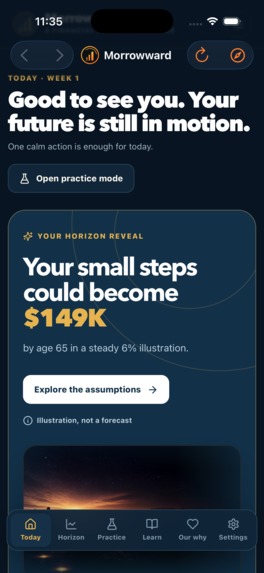
iPhone companion — The complete Morrowward experience in its iPhone shell, with native controls and six-tab mobile navigation.
-
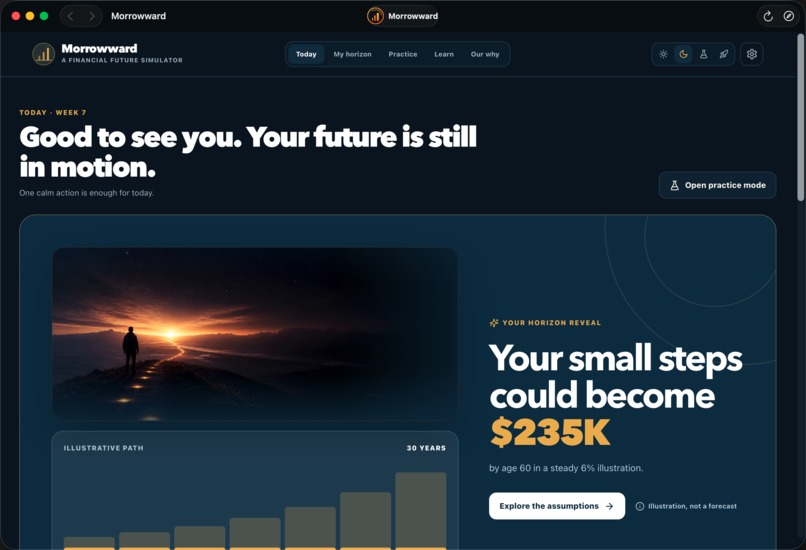
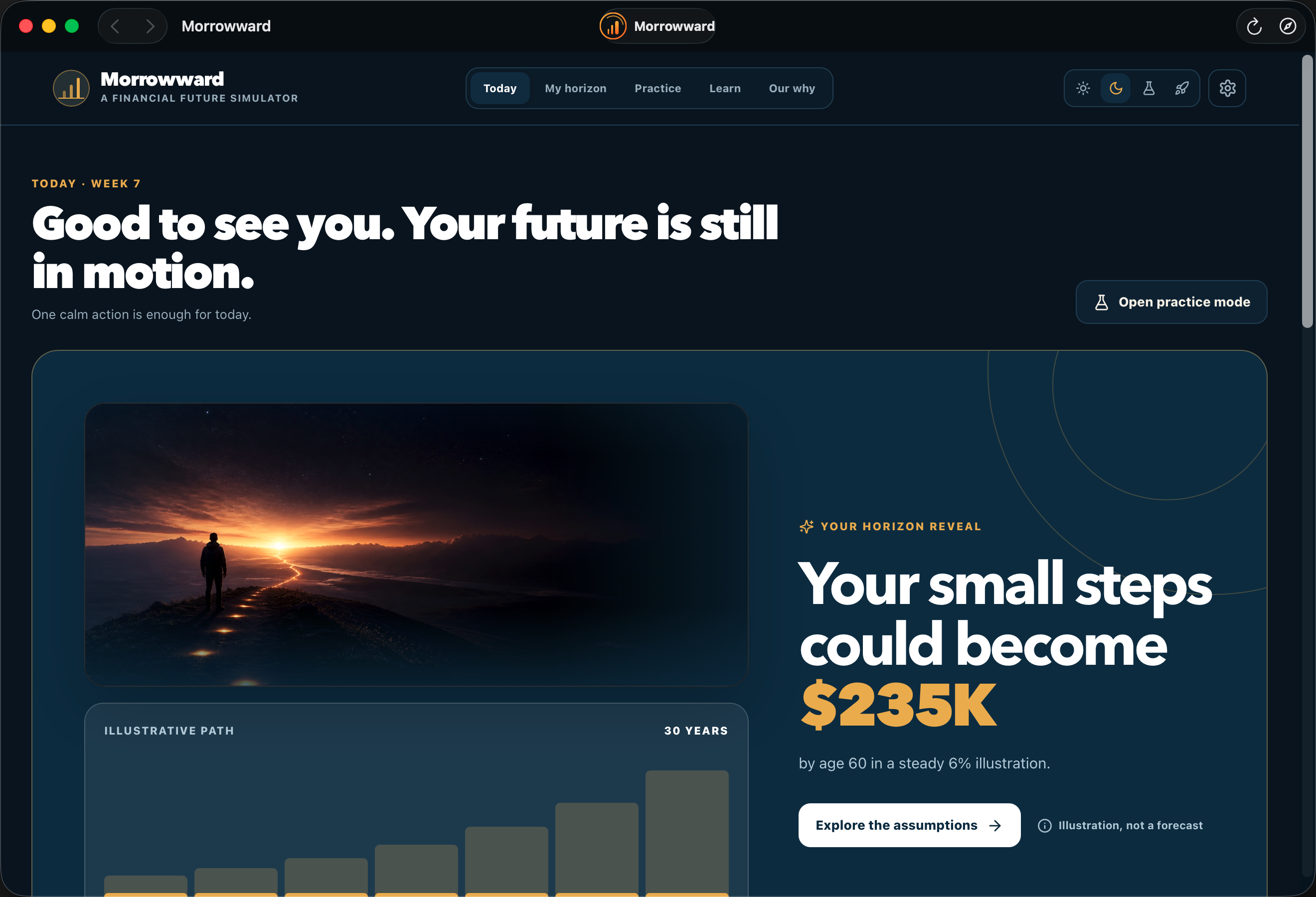
Mac companion — The complete local-first Morrowward experience running in a focused native macOS window.
-
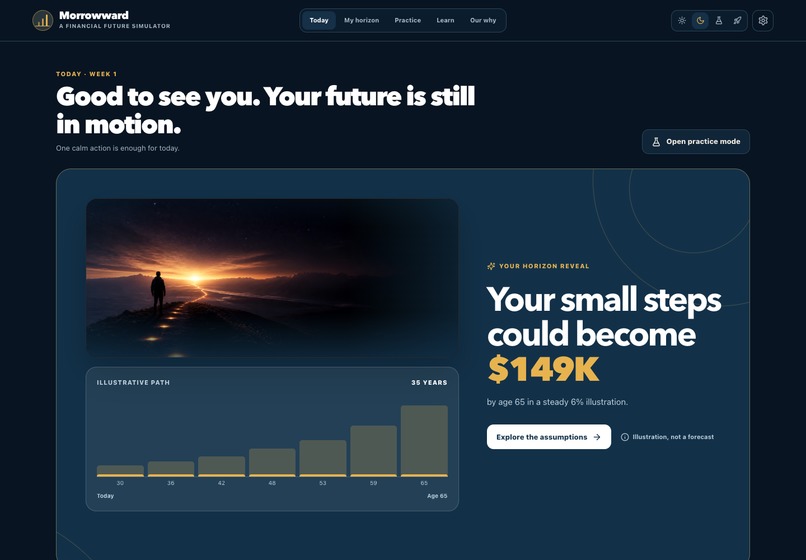
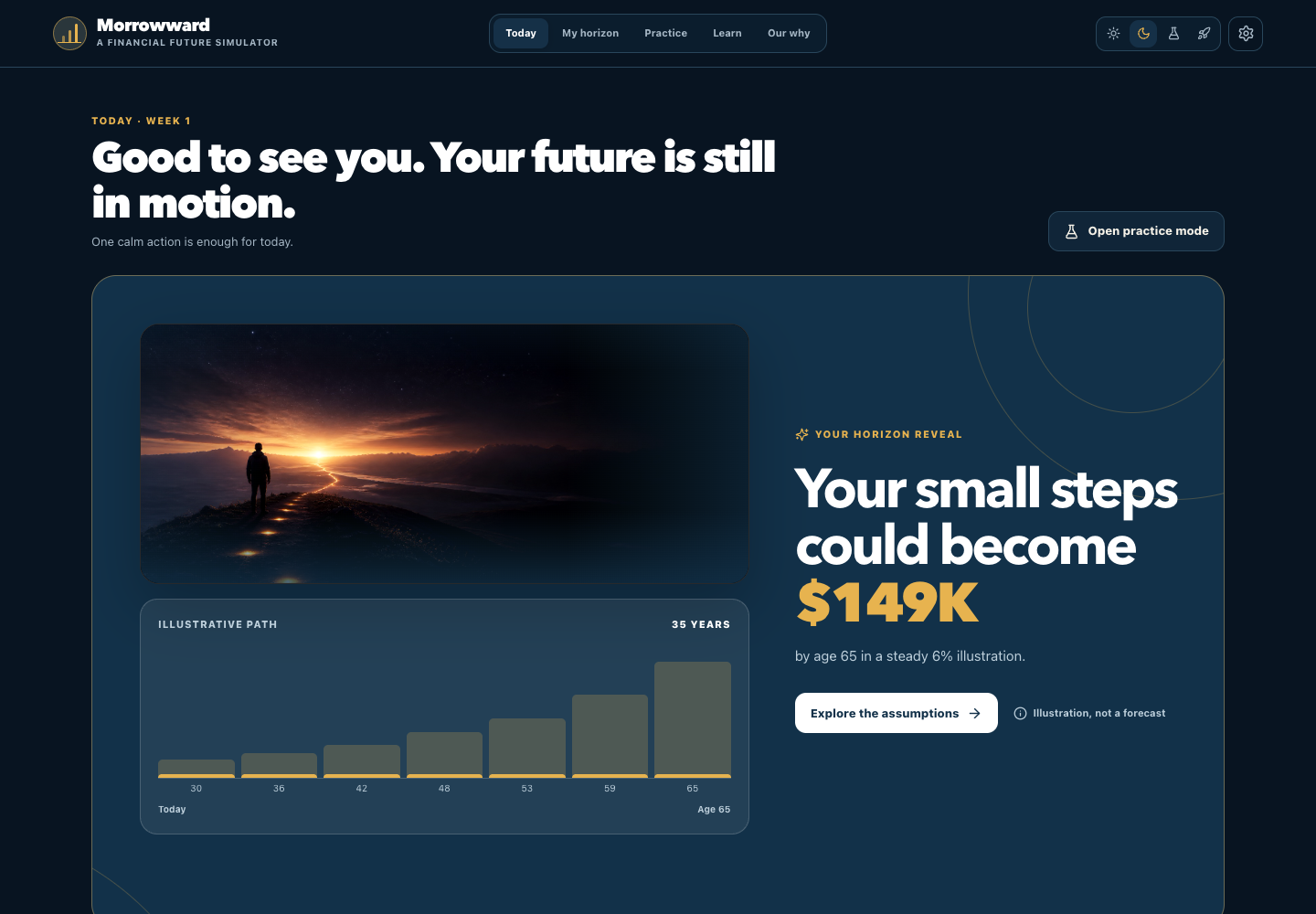
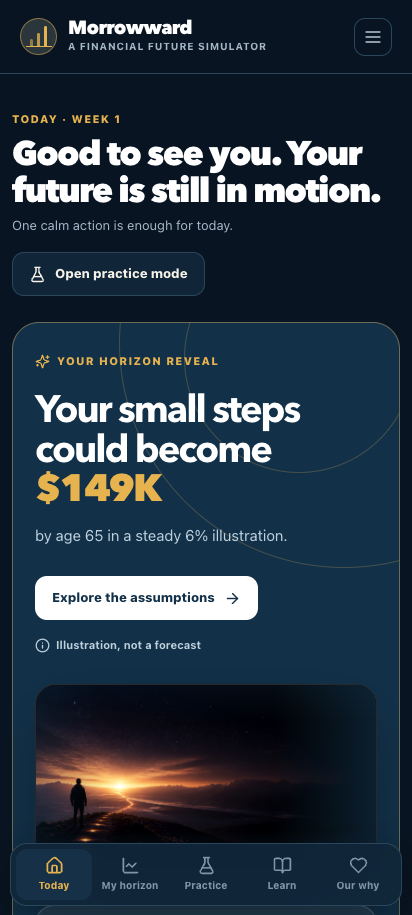
Today dashboard — A weekly habit becomes a visible horizon with an illustrative projection, next action, and clear assumptions.
-
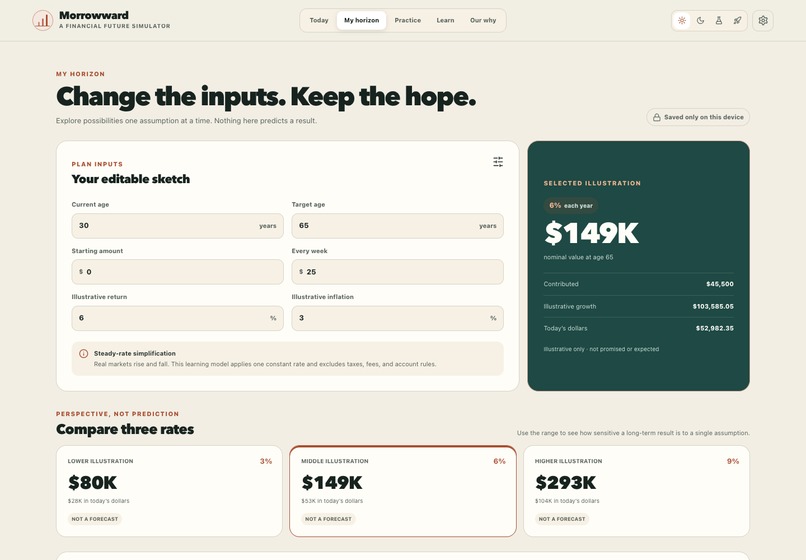
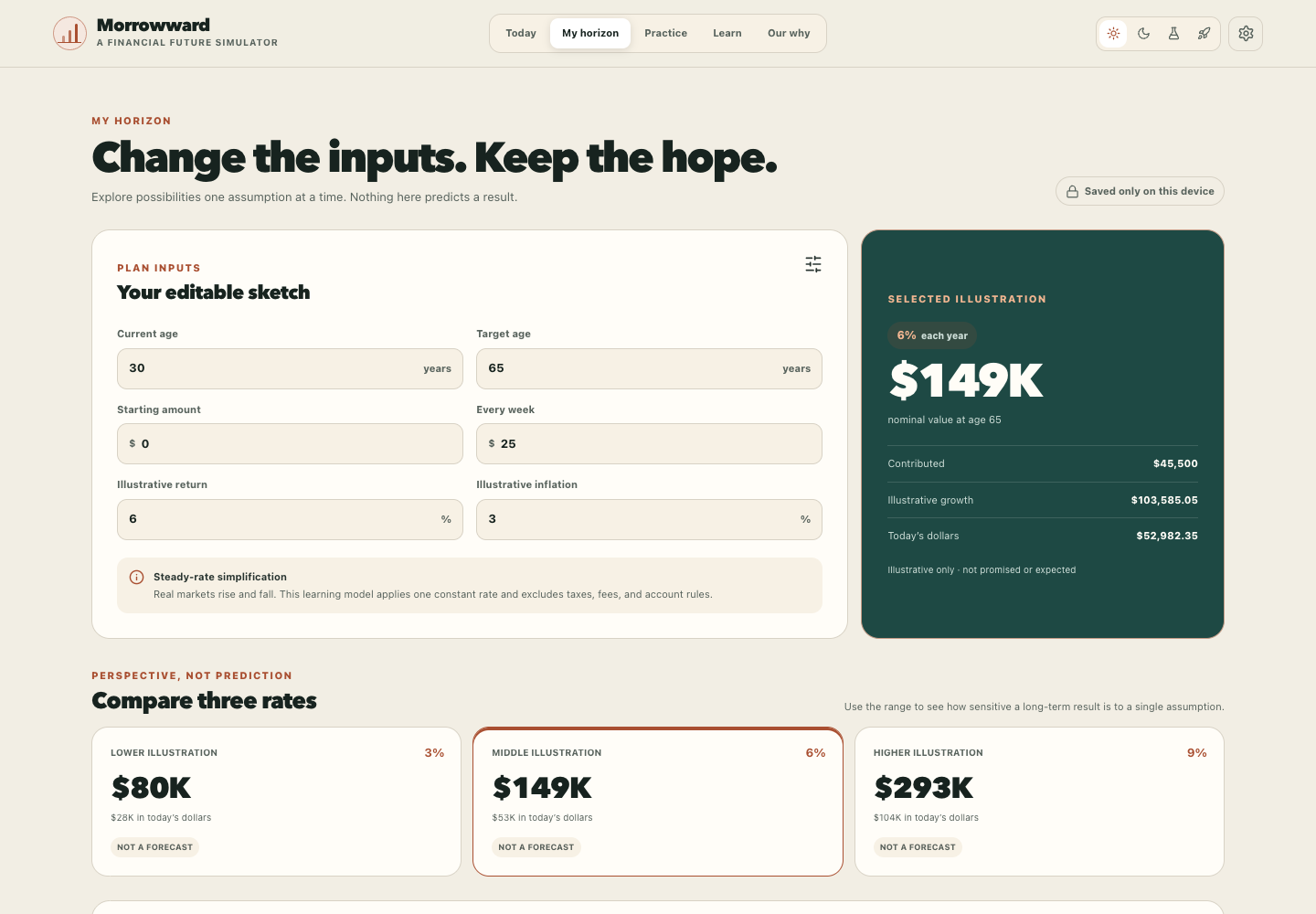
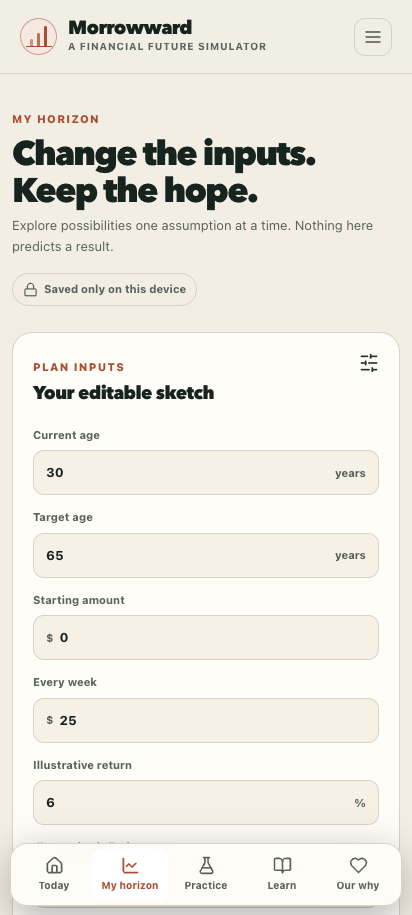
My Horizon — Edit age, balance, weekly contribution, return, and inflation, then compare three illustrative long-term scenarios.
-
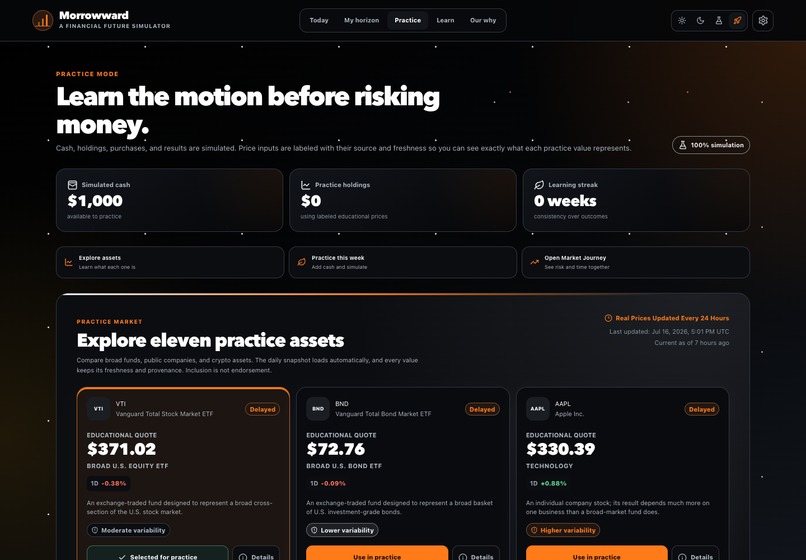
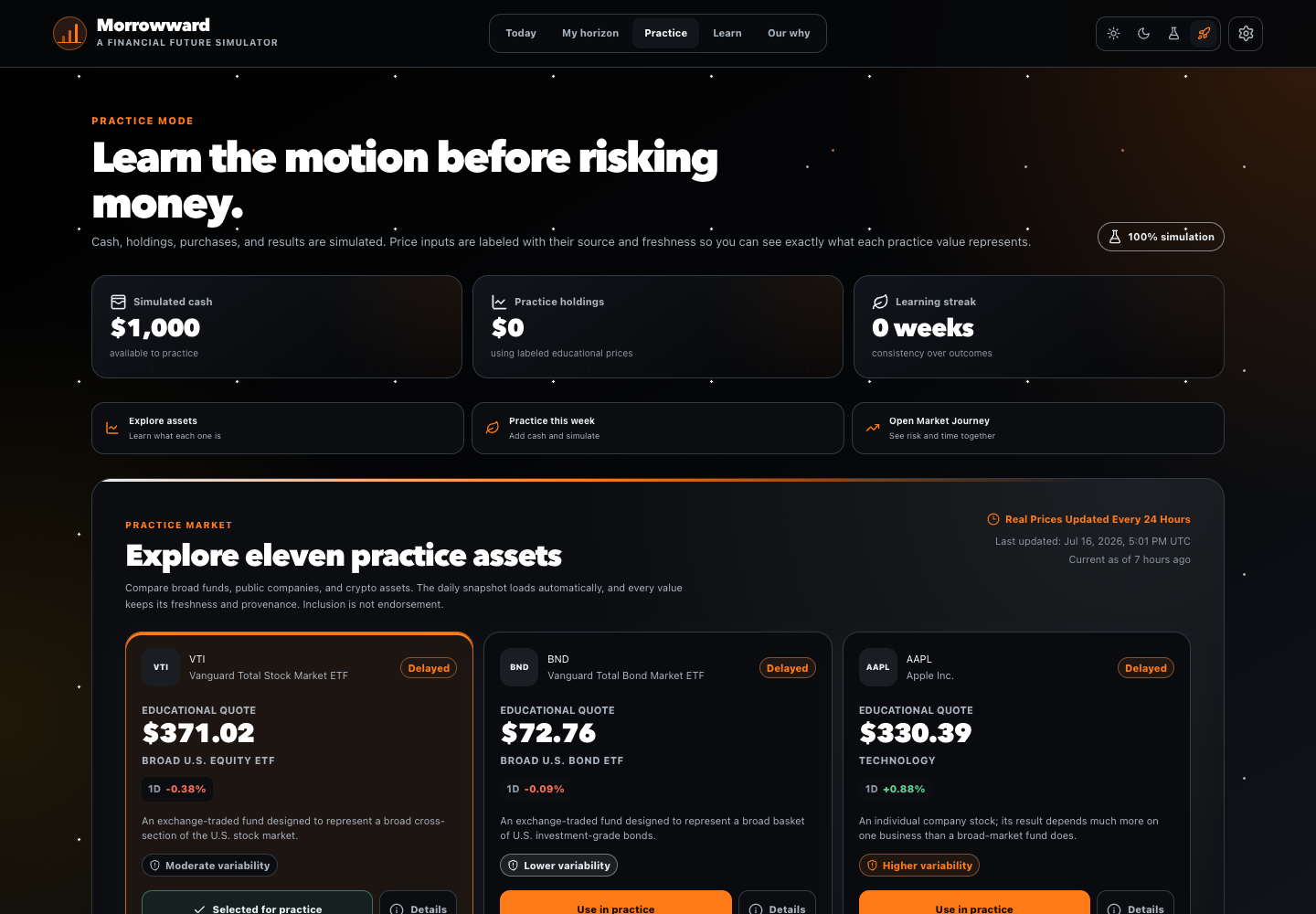
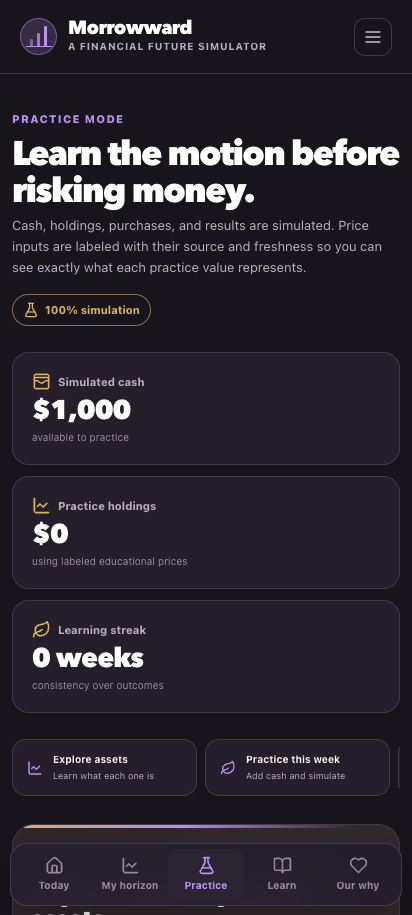
Practice mode — Use simulated cash and fractional purchases with daily educational prices, source details, and no real trades.
-
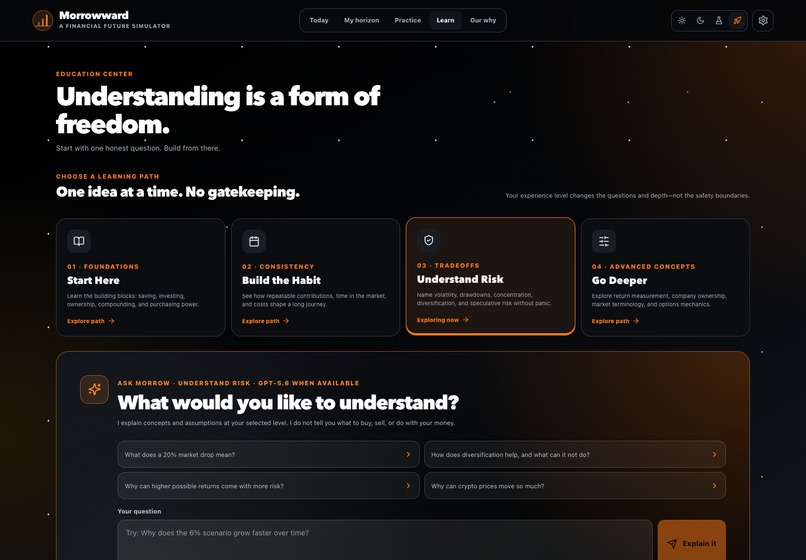
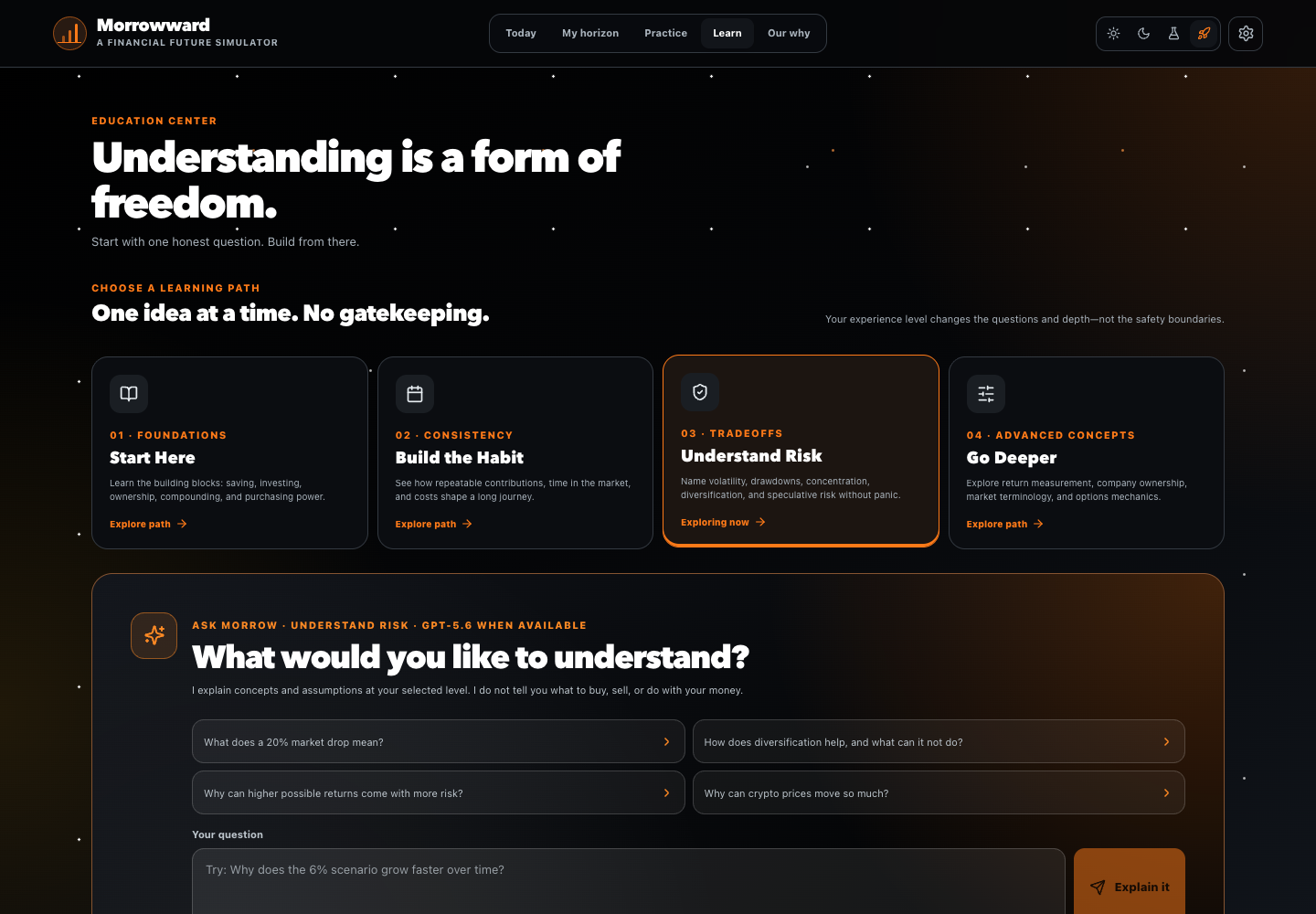
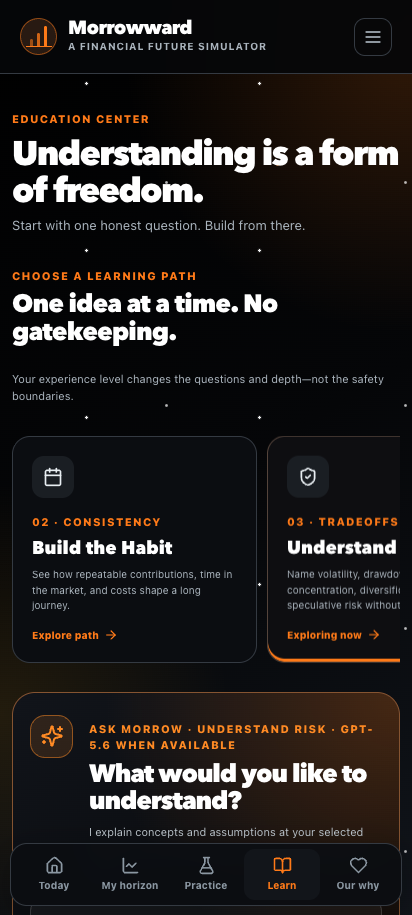
Education Center — Guided learning and trusted resources meet Ask Morrow, a bounded GPT-5.6 educator that explains, never recommends.
-
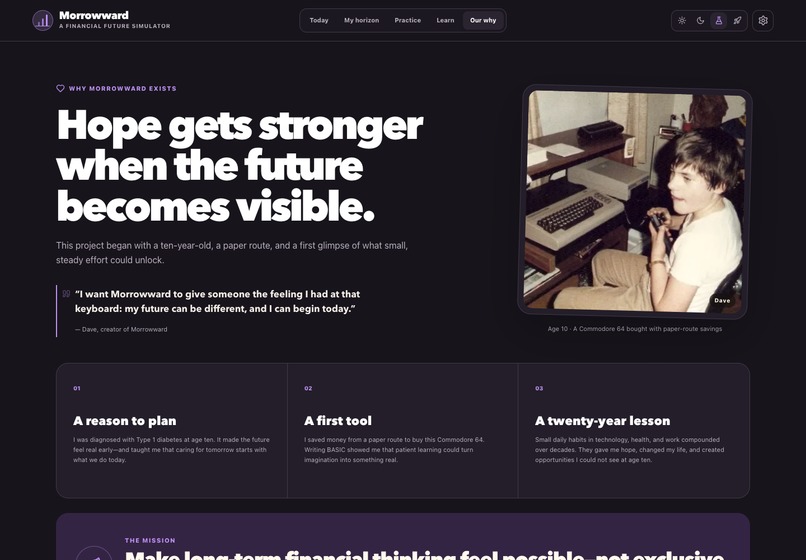
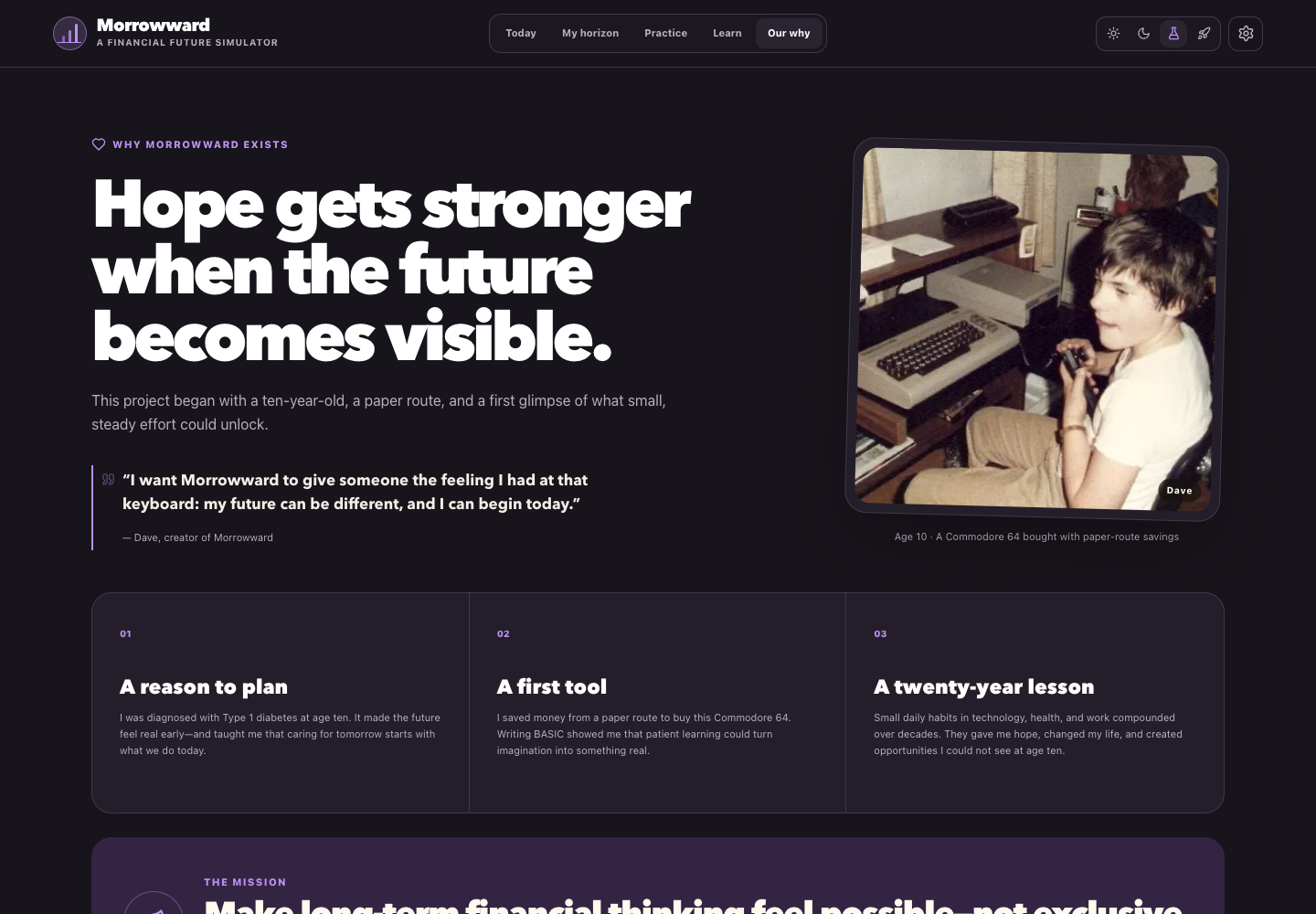
Our Why — Dave’s age-ten story connects Type 1 diabetes, paper-route savings, a Commodore 64, and hope built through daily habits.
-
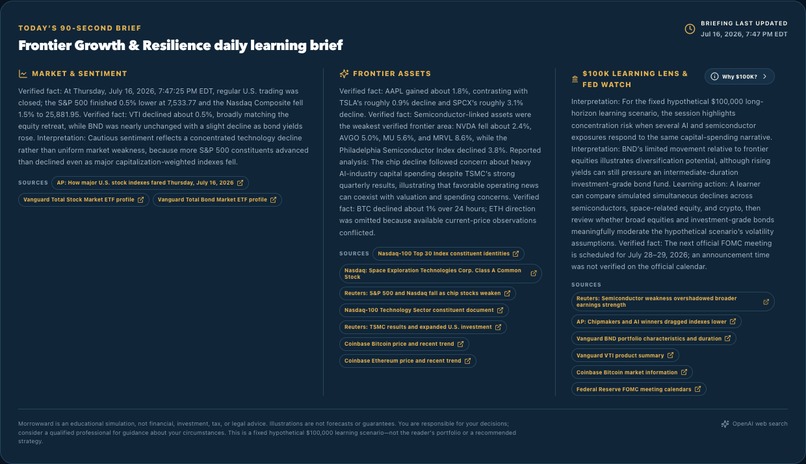
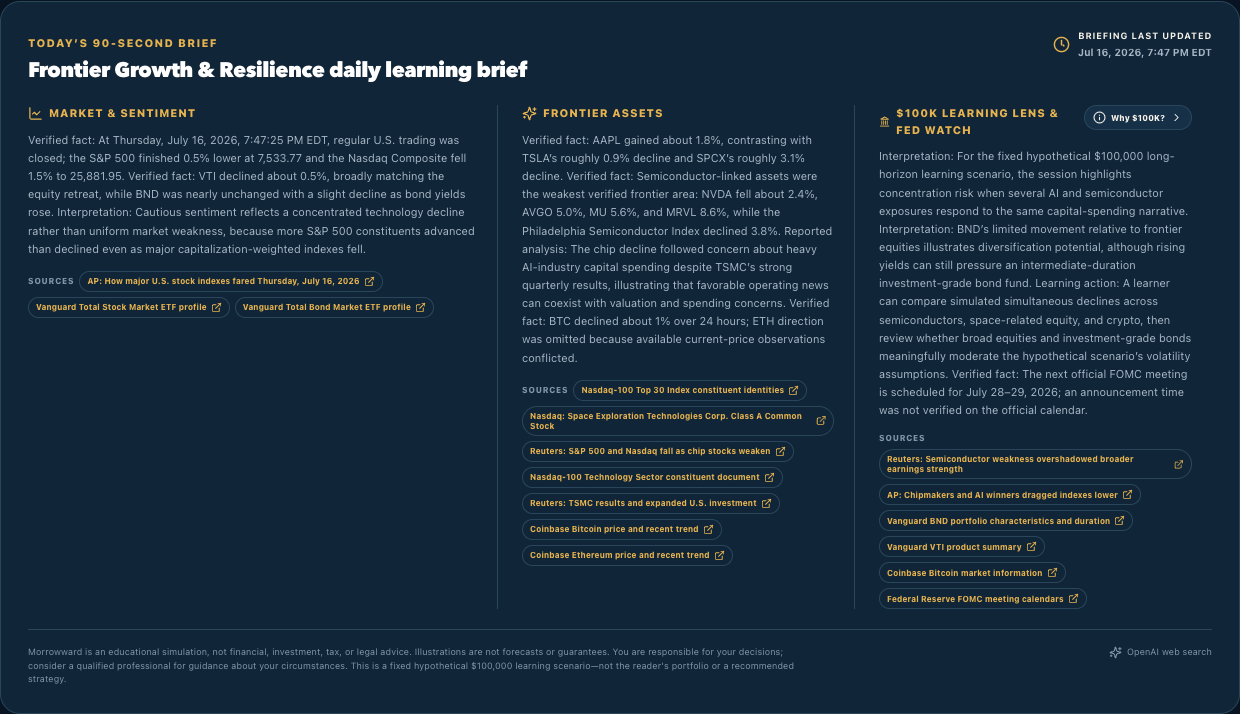
Daily briefing — A sourced 90-second brief separates market facts, frontier assets, a $100K learning lens, uncertainty, and citations.
-
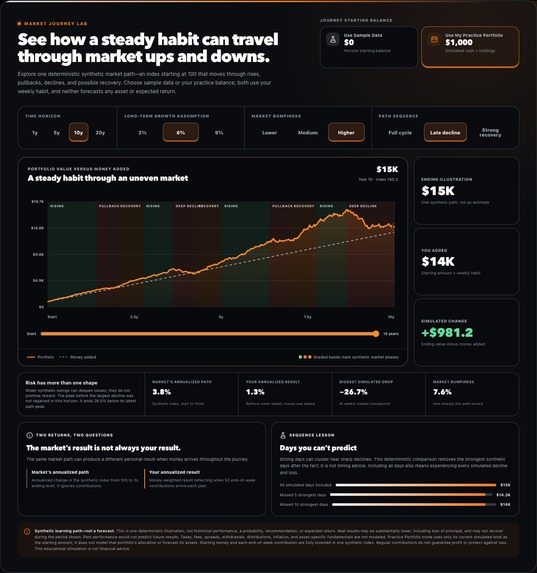
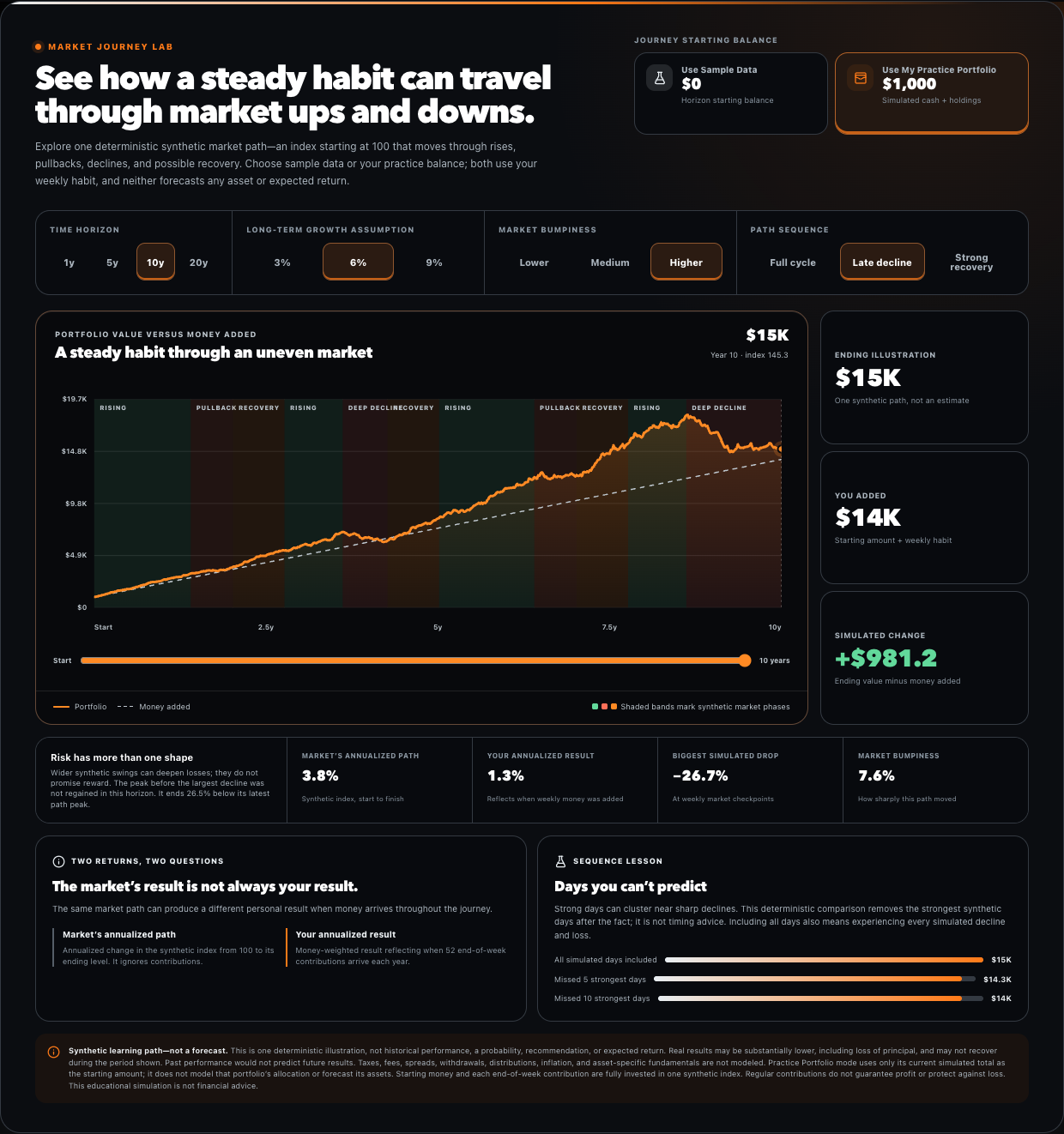
Market Journey Lab — Explore rallies, pullbacks, deep declines, and recovery through a deterministic illustration—not a forecast.
-
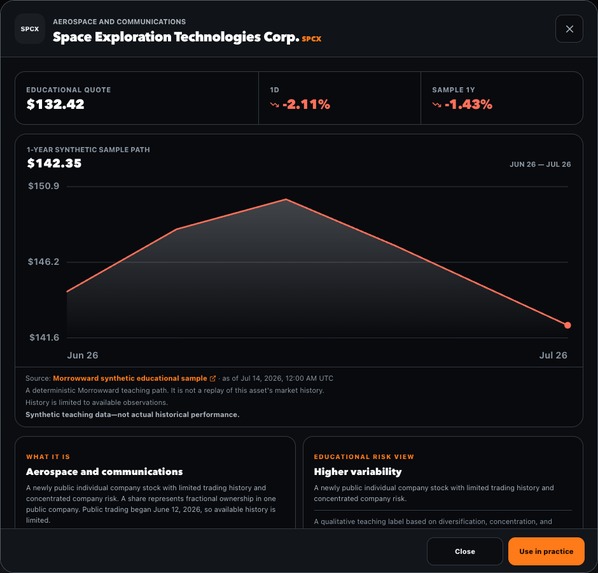
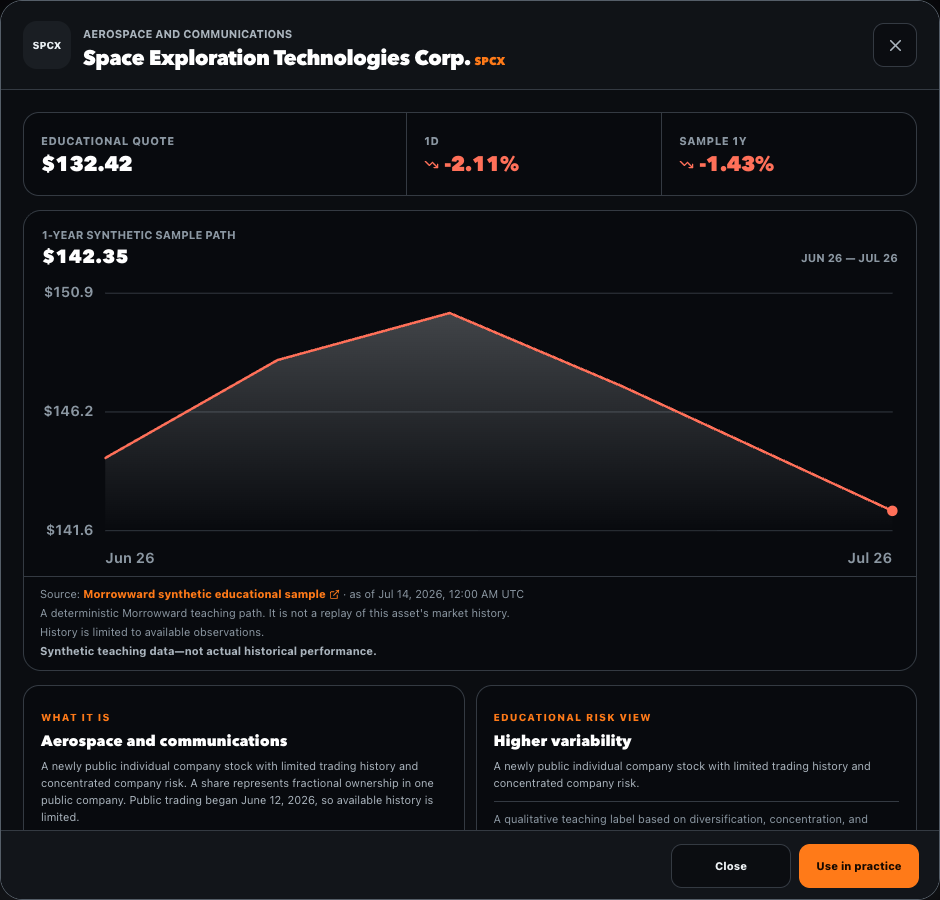
Asset detail — Learn what SPCX is, its category, risk, source freshness, and a bounded teaching path without buy or sell guidance.
-
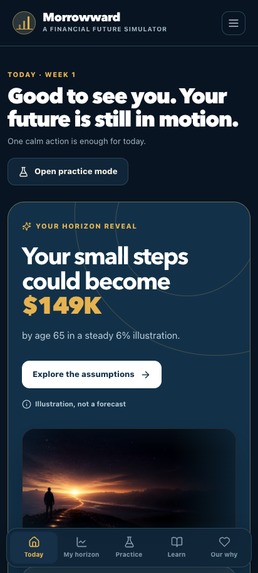
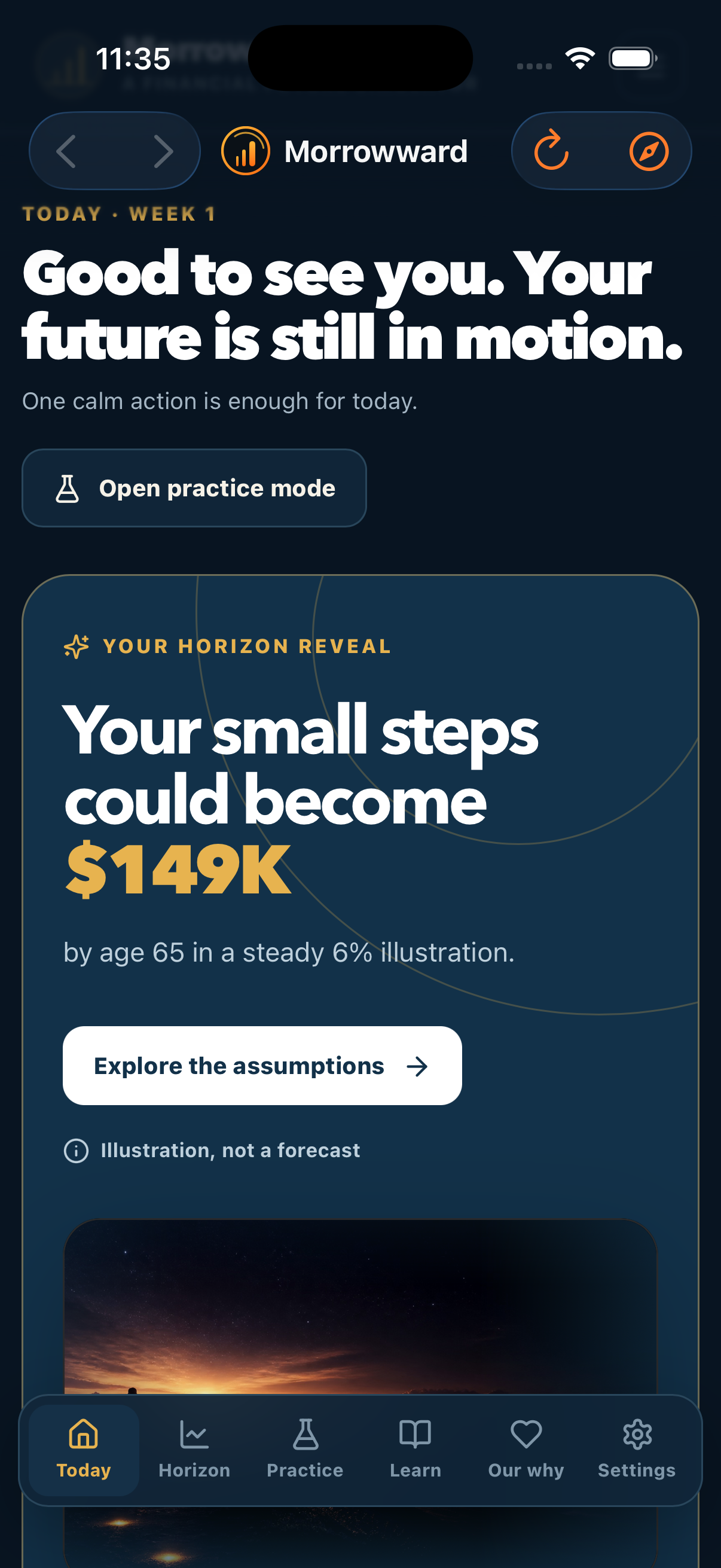
Today on mobile — Horizon theme keeps the long-term projection and next weekly action clear and readable on a phone.
-
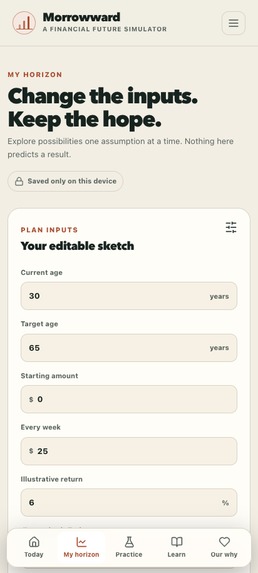
My Horizon on mobile — Dawn theme brings editable assumptions and three illustrative scenarios into a compact phone layout.
-
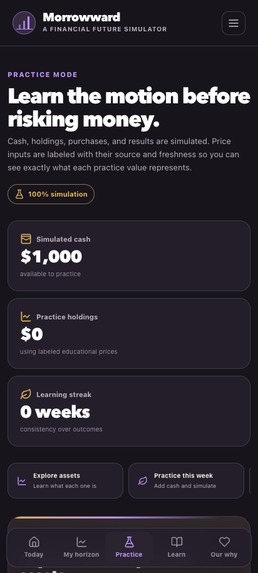
Practice on mobile — Simulated balances, fractional purchases, and asset education in a clearly labeled no-real-money experience.
-
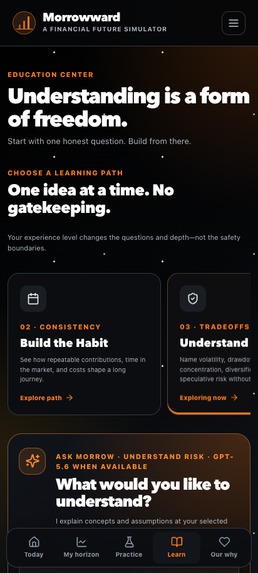
Learn on mobile — Guided topics, trusted resources, and the bounded Ask Morrow educator in the Space theme.
Morrowward
Small steps. A future you can see.
Morrowward is a local-first financial future simulator built to replace intimidation with hope. It helps adults—especially first-time investors—see how a modest weekly habit might compound over decades, practice investing without risking real money, and learn the concepts behind what they see.
The Complete Morrowward Builder’s Journal
Rather than compressing Morrowward’s four-day creation into six polished retrospective summaries, we documented the project as it happened in a detailed Builder’s Journal. It covers what Morrowward does, how we built it, the challenges and rejected approaches, accomplishments we are proud of, lessons learned, and what comes next—with dated decisions, testing evidence, deployment tradeoffs, human feedback, privacy reviews, and the journey from the first commit on July 14 to the completed video and Devpost submission on July 17.
The journal is one of Morrowward’s most valuable and unusual artifacts because it makes the human–agent collaboration inspectable. Dave contributed the personal mission, decades of investing experience, product taste, and final discernment; GPT-5.6 Sol in Codex translated that judgment into architecture, code, tests, documentation, and release evidence. It is not a post-hoc success story: it preserves uncertainty, failures, course corrections, and the reasoning behind key decisions, giving judges and future builders an honest record of how a deeply personal idea became a finished product in four days.
Welcome to Morrowward
The experience begins with a simple horizon: your current age, the age you are planning toward, a starting balance, and a weekly contribution. Morrowward immediately reveals three editable illustrative scenarios, separates contributions from growth, and shows an inflation-adjusted view. Users can then explore eleven practice assets with current market quotes via GPT-5.6 web search, refreshed daily, open accessible detail sheets for category/risk/provenance and a bounded teaching path, complete a weekly habit, and make a fractional simulated purchase. Market Journey then explores one, five, ten, or twenty synthetic years using either Sample Data from the Horizon balance or the current simulated Practice Portfolio total. A funded portfolio is selected automatically, while the user can toggle back to Sample Data at any time. Return assumptions and market bumpiness are independent, bull/bear/recovery paths remain uncertain, and one late-downturn path may finish without recovering. Morrowward distinguishes market CAGR from contribution-aware money-weighted return, makes drawdowns visible, and compares the same simulated path with all days versus its strongest days removed. The lesson is not “markets always recover”; it is that both risk and timing are unknowable in advance.
The Education Center organizes financial literacy into four paths—Start Here, Build the Habit, Understand Risk, and Go Deeper—with 48 guided questions tailored across New, Familiar, and Advanced modes. Canonical government and regulator resources lead each subject; industry research and verified Grokipedia articles are visibly labeled by source tier. A bounded GPT-5.6 educator returns a structured title, key ideas, assumptions, and a safe simulator activity, while deterministic related questions keep the learner moving without spending another call until they choose to submit. Today also presents one validated daily GPT-5.6 briefing as exactly three source-linked cards: Market & sentiment, Frontier assets, and $100K learning lens & Fed watch, with its last-successful-update time and no visitor refresh control. The fixed hypothetical $100,000 Frontier Growth & Resilience scenario is a public teaching lens—not a user's balance, recommended strategy, or model portfolio. Its expandable Why $100K? detail uses simple illustrative scale math, Investor.gov sources, and an explicit reminder that the milestone is useful rather than magical or guaranteed to make the next stage faster. A fourth Space theme—deep black, star-glow white, and rocket-fire orange—joins Dawn, Horizon, and Alchemy while preserving the same accessible information hierarchy. After onboarding, an optional motivational welcome is selected from two approved AI-generated historical interpretations—Marcus Aurelius or Benjamin Franklin—and remains stable for that browser. Playback is user controlled, exact captions and primary quote sources are available, and the assigned welcome can be replayed from Our Why.
The simulator does not rely on AI for math. Its projection, market-path, and practice engines are deterministic, testable, and available offline. Market Journey uses a reproducible synthetic learning path, not historical named-asset prices and not a forecast. Practice Portfolio mode supplies only the local cash-plus-holdings total as that path’s opening amount; it does not model the allocation or predict any held asset. Quote generation is a separate bounded GPT-5.6 Responses API job: once per UTC day after the market session it uses required web search, strict structured output, store: false, and at most one search call to gather the fixed eleven-symbol allowlist into a shared validated snapshot. Every accepted asset passes identity, observation-time, schema, and source-evidence checks; unsupported assets fall back explicitly. A 12-hour Redis/KV NX retry guard plus warm-runtime singleflight prevents duplicate and rapid repeated work. The same Redis service supplies atomic shared per-client limits and a 100-request UTC-day educator circuit breaker; potentially cost-bearing educator requests fail closed if that safety store is configured but unavailable. If cron misses a run, the first normal quote request can self-heal in the background while visitors receive saved or synthetic data, and two bounded observation-only UI rechecks can adopt the result without starting another generation. After success, the product says Real Prices Updated Every 24 Hours, shows the exact refresh time and completed-hours age, retains per-asset source/freshness, and never describes the snapshot as real-time. Plans and simulated holdings remain in the browser; the quote job receives only the public allowlist—never balances, holdings, transactions, or identity. The optional GPT-5.6 educator receives a bounded question, experience level, education topic, and at most four illustrative values: years remaining, weekly contribution, return, and inflation. It never receives a starting balance, practice holdings, transaction history, identity, or medical story. Its structured output must explain assumptions, avoid individualized buy/sell instructions, and include an educational disclaimer.
Daily briefing generation is a separate protected once-daily Vercel cron, not an interactive visitor request. Its 150-second function window allows GPT-5.6 to use required web search and strict structured output to return candidate public facts, citations, identity checks, market-session context, and Federal Reserve dates. Deterministic code then binds those candidates to returned evidence, removes unsupported sentences, treats unsupported internal asset checks as unavailable, and publishes only when all three sections retain source-backed copy; its narrow URL normalization never equates different article IDs or meaningful query parameters, and apart from harmless fragment/trailing-slash cleanup, only documented AP stable-ID variants may bridge differing paths. The job sends the fixed $100,000 learning scenario but no visitor plan, balance, holdings, or identity. Public reads only return the durable last validated edition; a failed run never overwrites it, and an evergreen edition makes no current-market claims when no validated edition is available.
The mission is personal. At age ten, Dave was diagnosed with Type 1 diabetes and knew he would need to plan for a future with lifelong medical needs. Savings from a paper route bought his first Commodore 64, where daily experiments in BASIC started a path into technology. Morrowward carries that lesson forward: a small repeated action can change what feels possible twenty years from now.
GPT-5.6 Sol in Codex accelerated product definition, architecture, parallel implementation, financial property tests, AI guardrails, accessibility, offline design, documentation, and end-to-end verification. It orchestrated bounded specialist agents for market contracts, UI, fresh xAI media tooling, and review, while the primary session retained integration responsibility and reran the complete suite. During hands-on use, Codex also turned decades of investor lessons into a deterministic Market Journey model while keeping CAGR, cash-flow return, volatility, drawdown, and timing claims technically distinct. GPT-5.6 powers the bounded educator, daily educational brief, and source-backed daily public-quote snapshot; it never calculates projections or executes financial activity. For the two approved welcomes, Codex created the fresh consent-gated campaign pipeline, reviewed original-resolution stills and full motion sequences, rejected weaker retries and a technically valid but creatively unsuccessful fallback, and preserved Dave's final approval gate. xAI supplied specialized image, video, and built-in narration generation, but never supplies quotes, risk scores, or financial facts. The provider video audio is discarded, narration is separately disclosed, and the shipped app makes no xAI runtime calls.
Morrowward is an educational simulation, not financial, investment, tax, or legal advice. Illustrative results are not guarantees.
AI Orchestration and Technical Architecture
The AI Orchestration guide explains how Morrowward separated responsibilities across models, agents, deterministic code, and human judgment. GPT-5.6 Sol in Codex served as the primary engineering orchestrator—turning product direction into architecture, implementation, tests, and release evidence while coordinating bounded specialist agents. Deterministic TypeScript remained the source of truth for every financial calculation, while GPT-5.6 powered carefully constrained education, sourced daily quotes, and market briefings. Specialized xAI models created optional historical media through a fresh, consent-gated pipeline, but never supplied financial facts or runtime decisions.
This document also describes the technical safeguards that made the orchestration trustworthy: structured outputs, source validation, data minimization, cost circuit breakers, durable caching, deterministic fallbacks, media provenance, accessibility testing, and explicit human approval gates. The goal was not to use AI everywhere; it was to assign each capability the role it could perform responsibly, keep one integration owner accountable for the complete system, and preserve enough evidence for judges and future builders to inspect how every important output was produced.


Log in or sign up for Devpost to join the conversation.