-
-
Split_feature
-
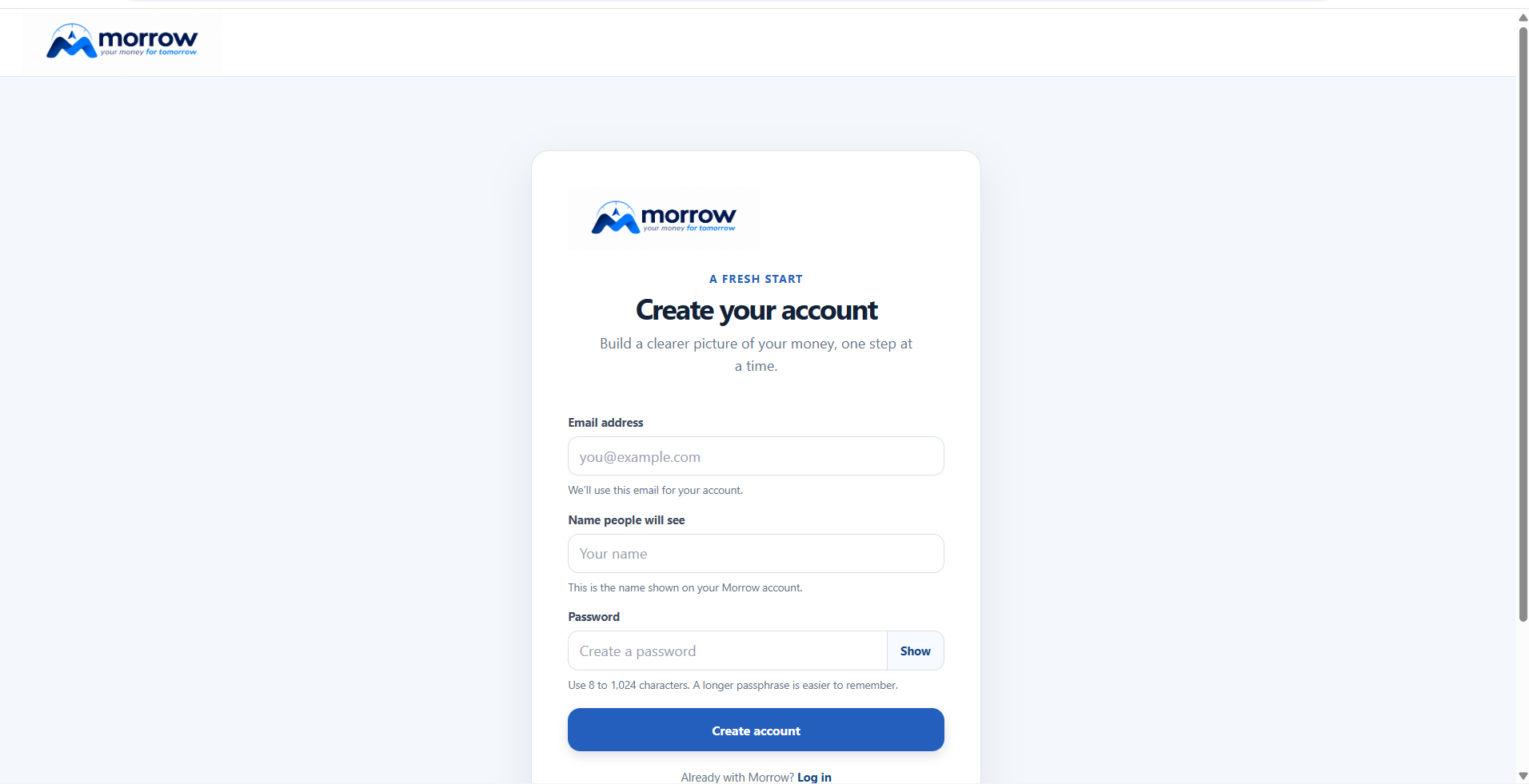
Login_Page
-
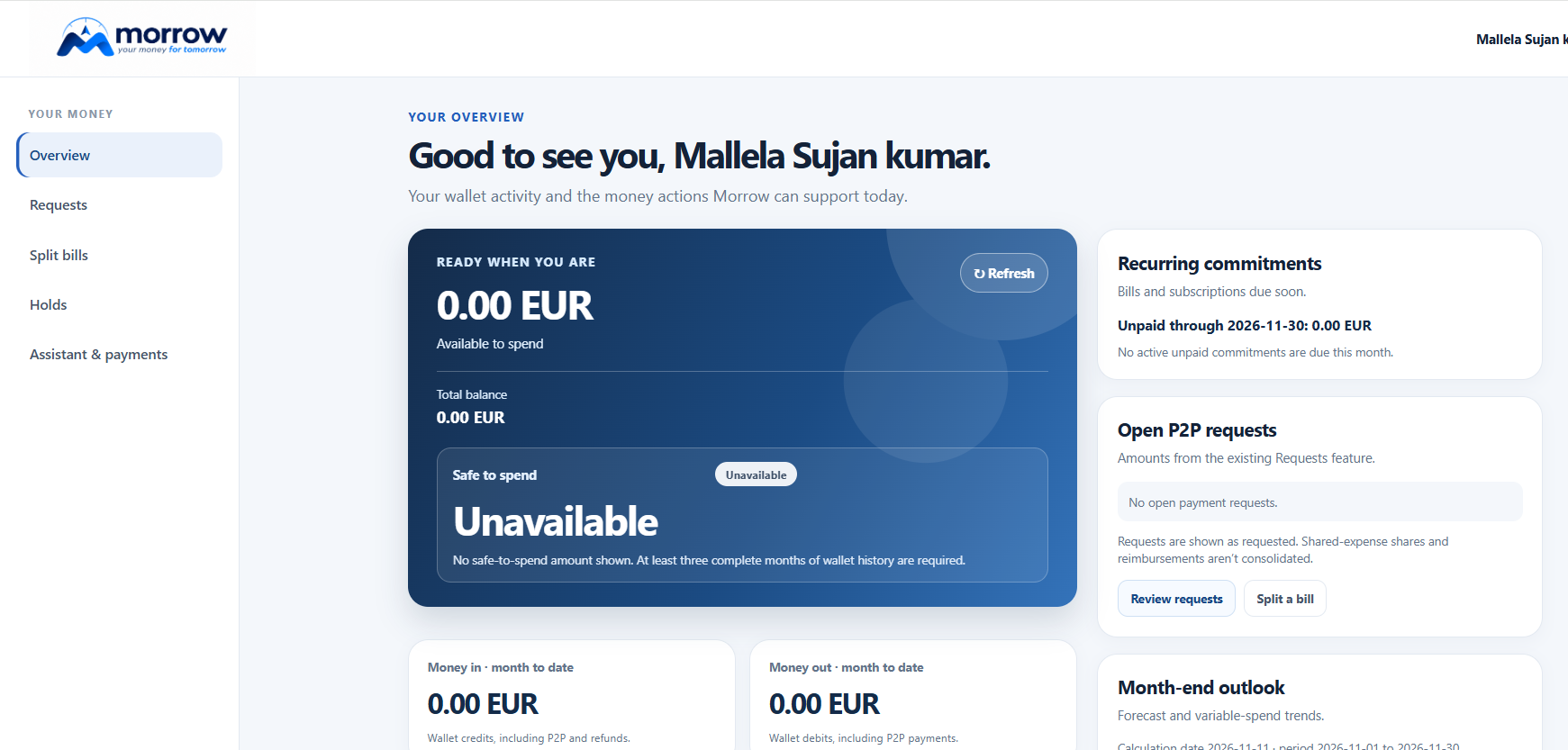
User_Dashboard
Morrow — Your Money for Tomorrow
Managing money is not just about checking your bank balance. Rent, subscriptions, upcoming bills, shared expenses and pending reimbursements all affect how much you can actually afford to spend.
Most payment applications do a good job of showing what has already happened. They show balances, transactions and spending charts. But they often leave users with a bigger question: How much of my money can I really spend after accounting for everything that's still ahead?
That question became the starting point for Morrow.
We built Morrow as a personal finance companion that focuses on what happens next, rather than simply summarising the past. It brings together available funds, upcoming commitments, shared expenses, reimbursements and projected spending to give users a clearer picture of their financial position.
Beyond the account balance
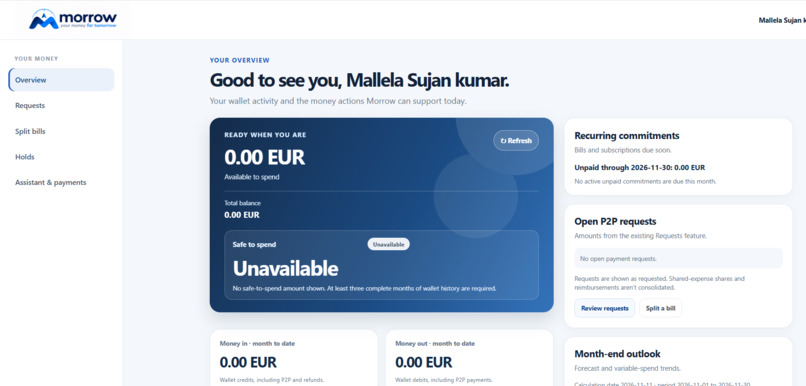
At the centre of Morrow is Safe-to-Spend, a calculation designed to estimate how much money a user can comfortably spend.
Instead of treating the entire account balance as available money, Morrow accounts for unpaid commitments, expected remaining expenses, savings goals and a safety buffer. Users can track recurring payments such as rent, utilities and subscriptions, and distinguish between expenses that are due and those that have already been paid.
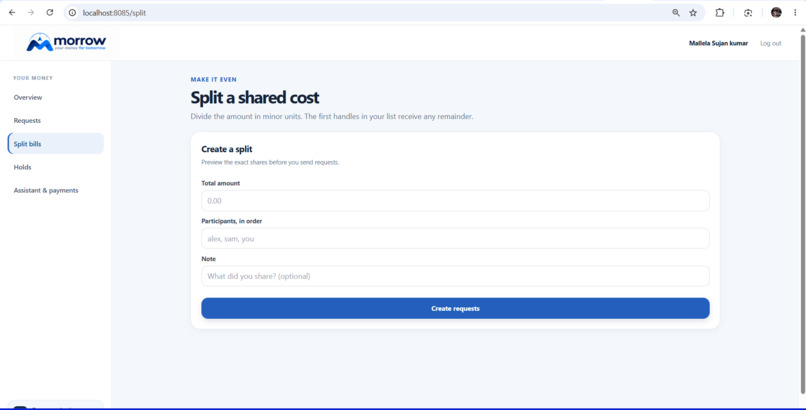
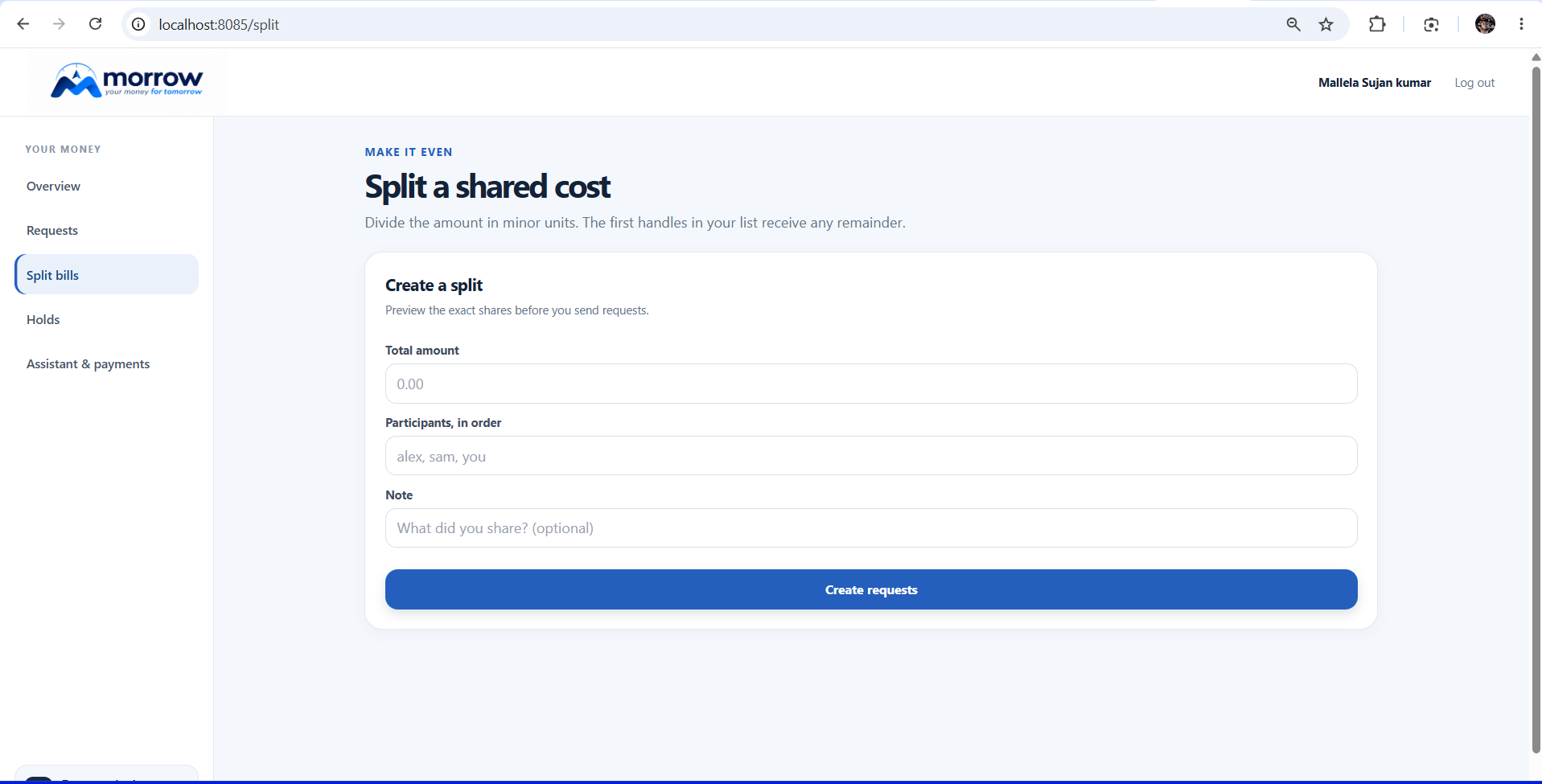
We also wanted shared expenses to be represented more accurately. Consider a group dinner costing ₹1,200, where one person pays the entire bill but their personal share is only ₹400. Morrow recognises the full ₹1,200 cash outflow while recording ₹400 as that person's expense and ₹800 as an outstanding reimbursement.
Partial repayments update the outstanding amount as money comes back. Importantly, money that someone owes the user is not treated as available cash until it is actually received.
Understand the impact before spending
We introduced Spend Impact to help users evaluate a purchase before making it.
A user can enter a planned purchase and see how it could affect their Safe-to-Spend amount and projected month-end financial position. The forecast considers known commitments and estimated remaining variable expenses, while keeping the distinction between actual figures and estimates clear.
This makes Morrow more than a transaction tracker. It helps users think through the consequences of everyday financial decisions before committing to them.
AI that explains, not decides
We integrated a conversational AI assistant using Google Gemini so users can ask questions about their financial position in natural language.
However, we made an important architectural decision: AI should not be responsible for authoritative financial calculations.
Morrow's application logic handles financial records, commitments, reimbursements and forecasts. Gemini helps interpret questions and explain the results, but it does not independently determine balances, invent transactions or silently modify financial records.
We also integrated the PayPal Developer Platform using PayPal Sandbox to demonstrate payment functionality within the application.
Engineering challenges and what we learned
One of our biggest challenges was maintaining consistency across different financial activities.
A payment, a personal expense, an outstanding reimbursement and a refund are related, but they are not interchangeable. Counting them incorrectly can make a user's financial position misleading.
We had to account for full payment amounts versus personal shares, partial reimbursements, paid commitments, pending authorizations and refunds. We also worked on keeping wallet operations, payment records and financial information consistent.
Another challenge was forecasting responsibly. A forecast is an estimate, not a guarantee. We wanted Morrow to communicate that uncertainty rather than present projected numbers as facts.
These decisions influenced both our backend logic and the way financial information is presented in the interface.
What makes Morrow different?
Morrow connects information that is usually spread across separate financial tools:
- Wallet: Understand available funds and account activity.
- Commitments: Keep track of upcoming and recurring payments.
- Shared expenses: Track personal shares, outstanding amounts and partial reimbursements.
- Spend Impact: Understand how a planned purchase changes your financial position.
- Forecasting: Look ahead at expected expenses and month-end position.
- AI Companion: Ask questions and understand financial information conversationally.
- PayPal Integration: Experience payment functionality through the PayPal Sandbox.
Instead of asking users to interpret several disconnected numbers, Morrow brings them together around one practical question:
Can I afford this, considering everything else I still need to pay for?
What's next?
Morrow is a starting point for a more proactive approach to personal finance. We would like to improve transaction categorisation, introduce better recurring-payment detection, personalise forecasts as more financial history becomes available and explore more seamless payment integrations.
Our goal is simple: help people understand not just how much money they have today, but how today's decisions affect tomorrow.


