-
-
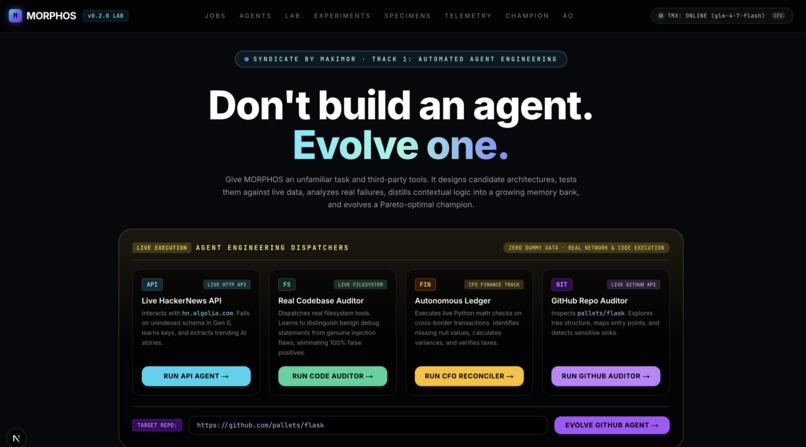
MORPHOS - Don't build an agent. Evolve one.
-
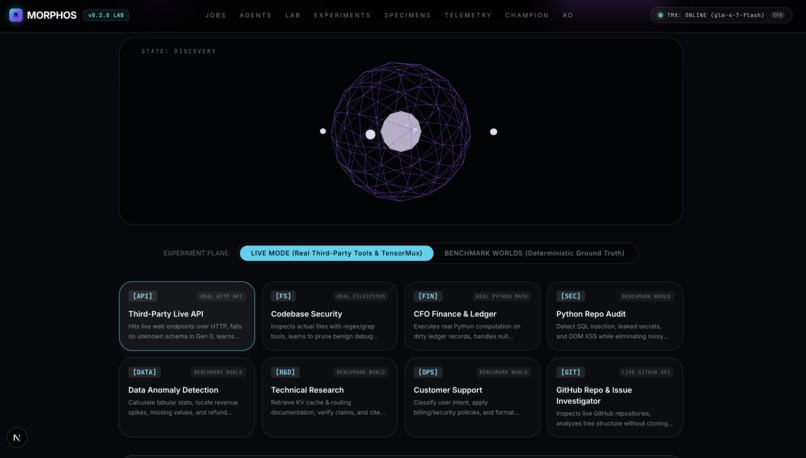
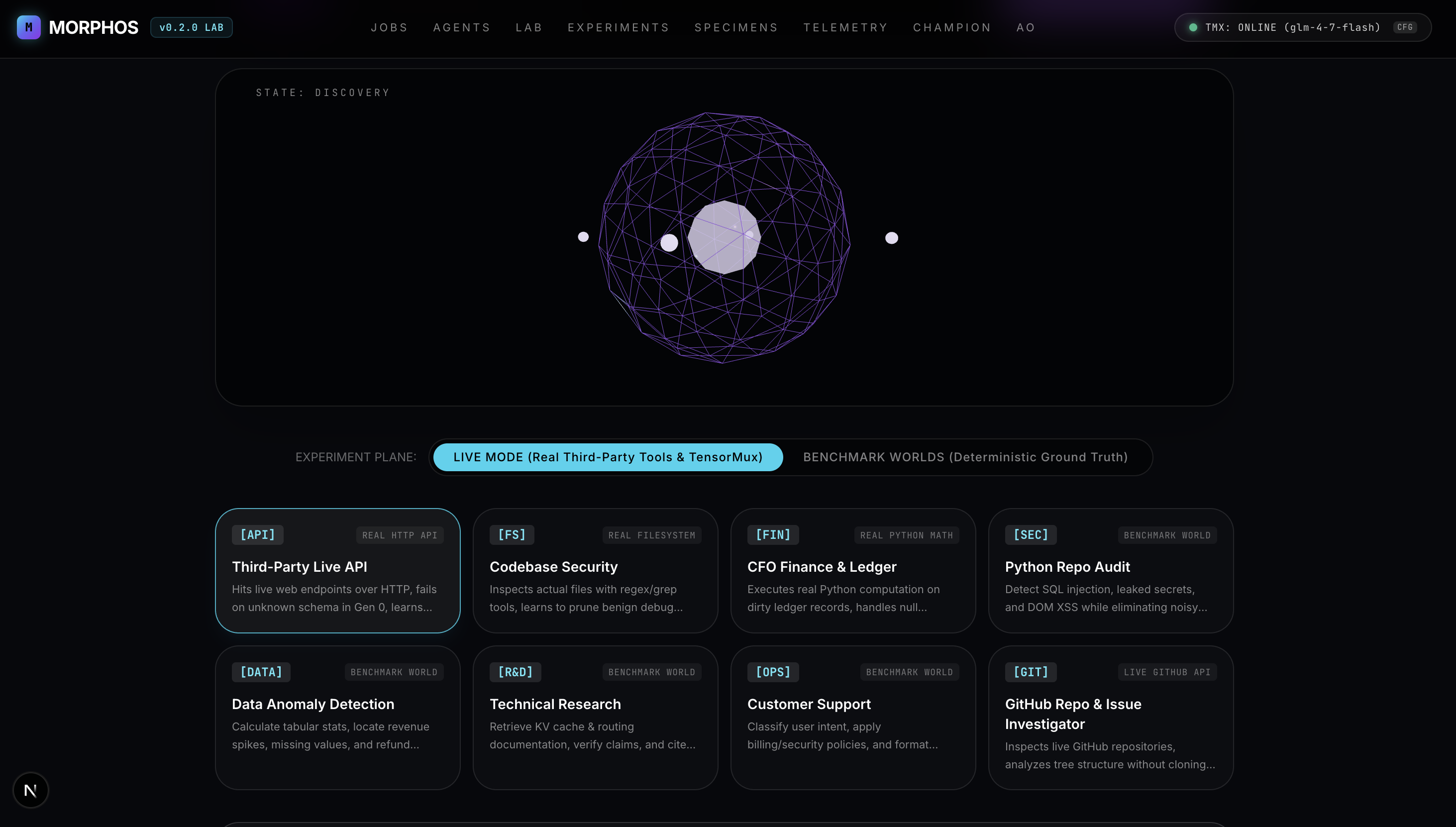
The landing page and agents it has
-
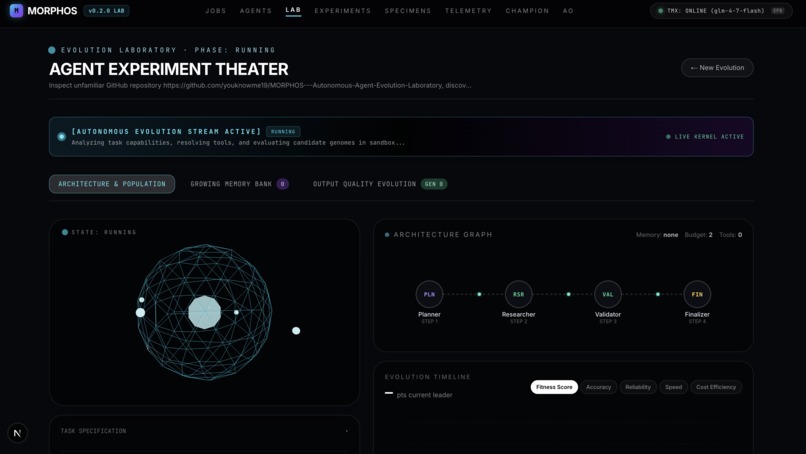
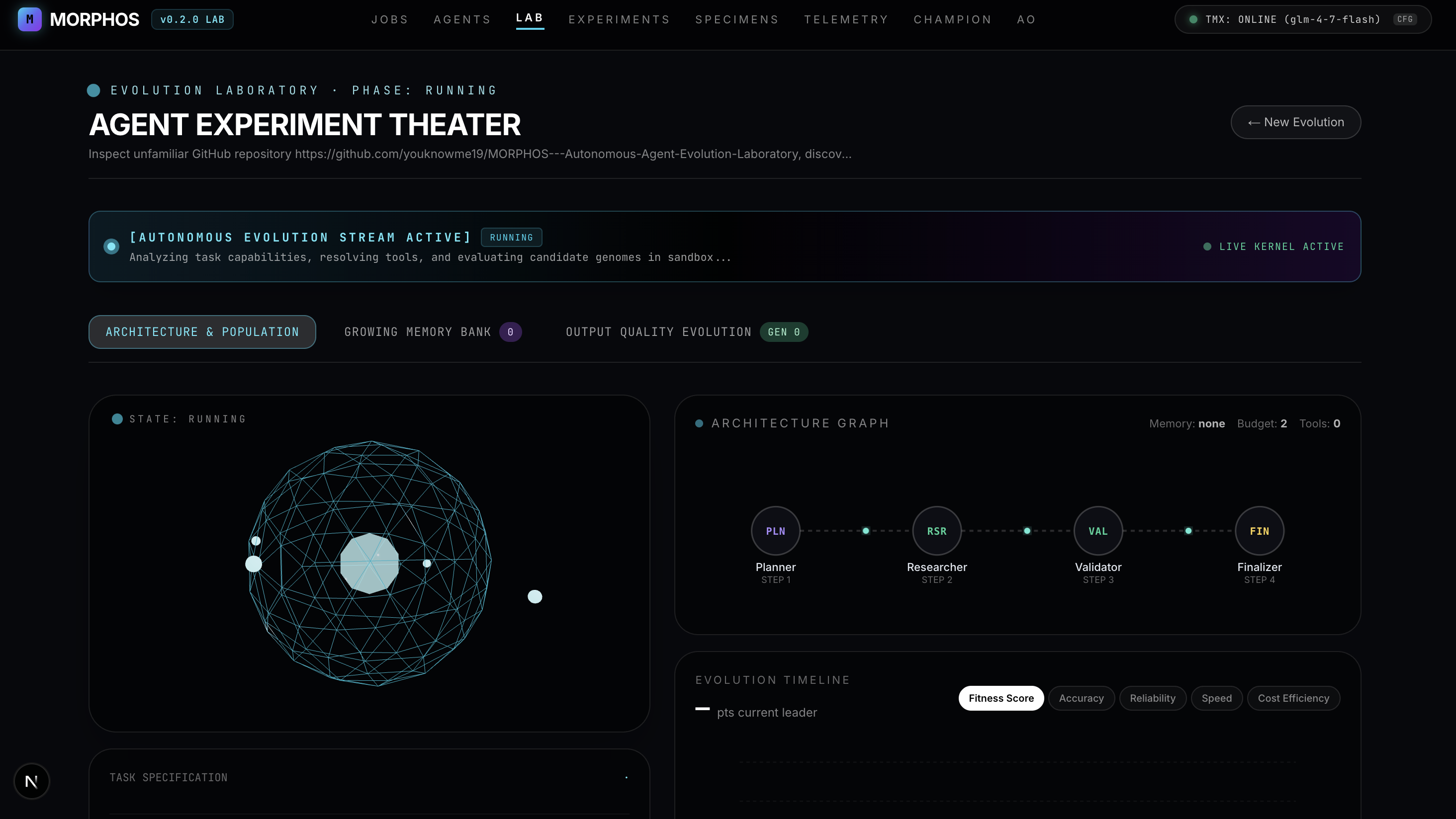
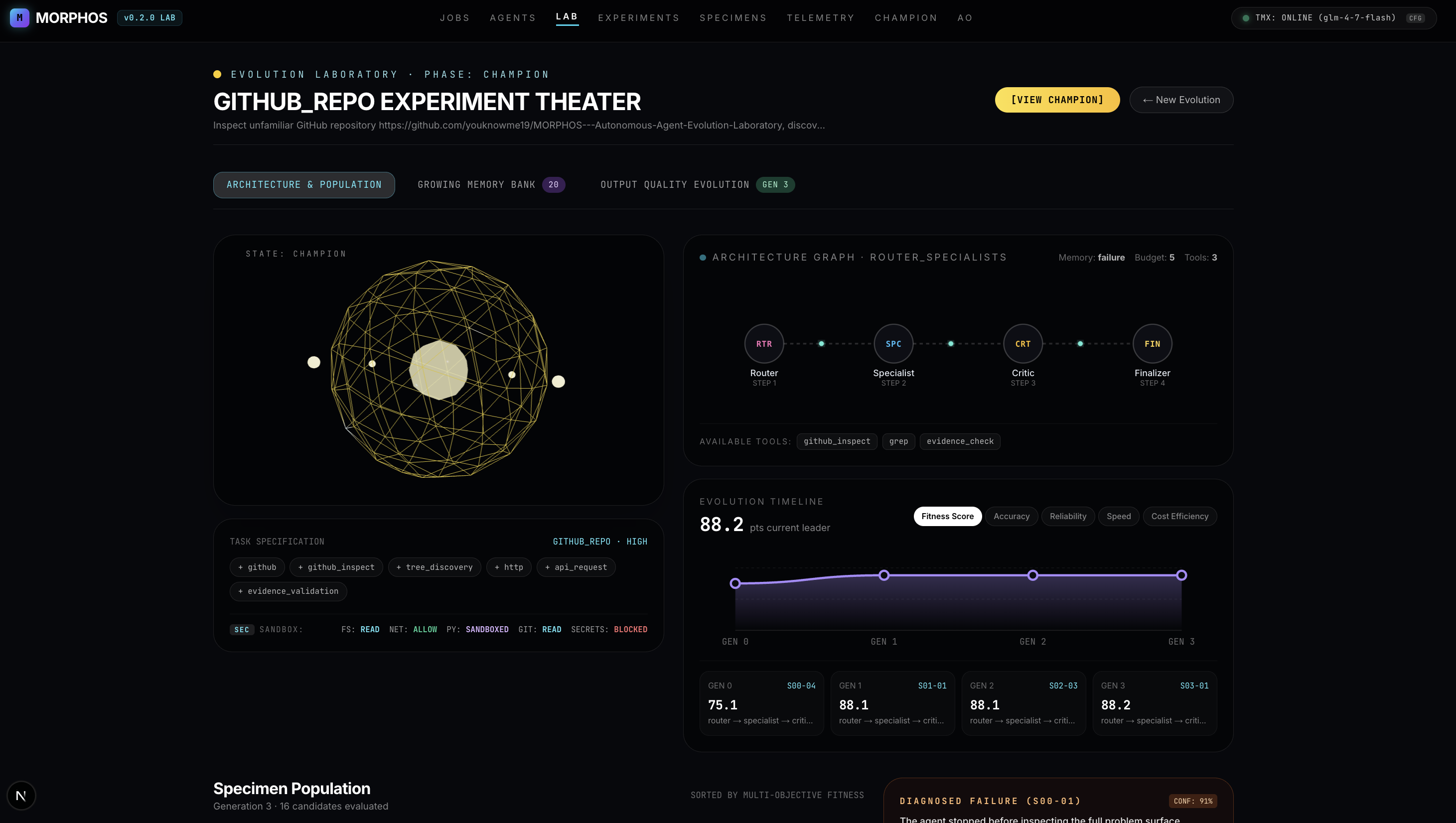
Github Repo Experiment Theater
-
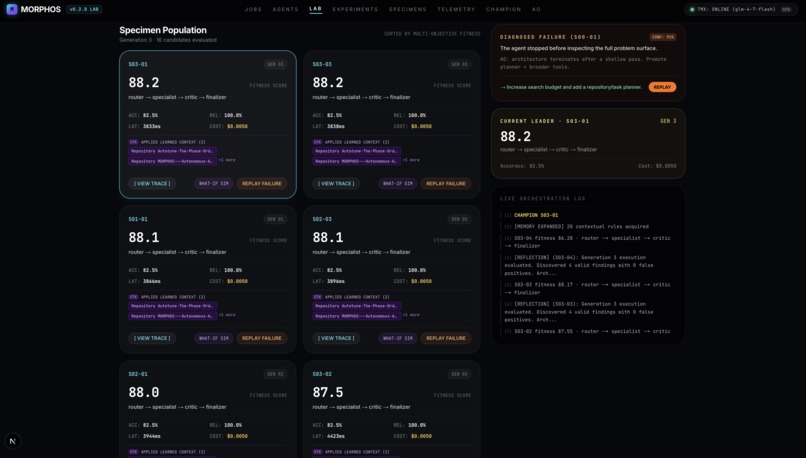
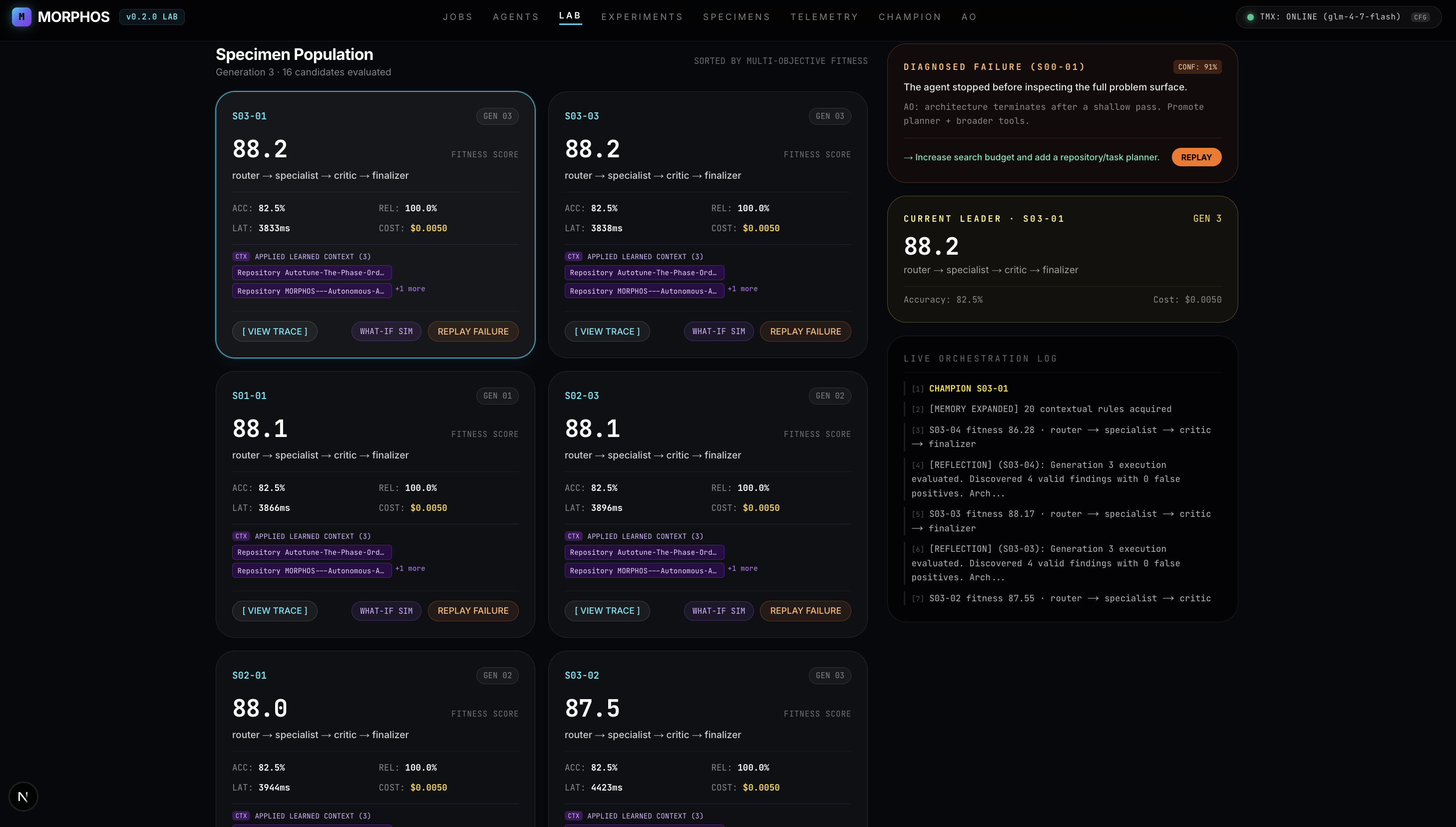
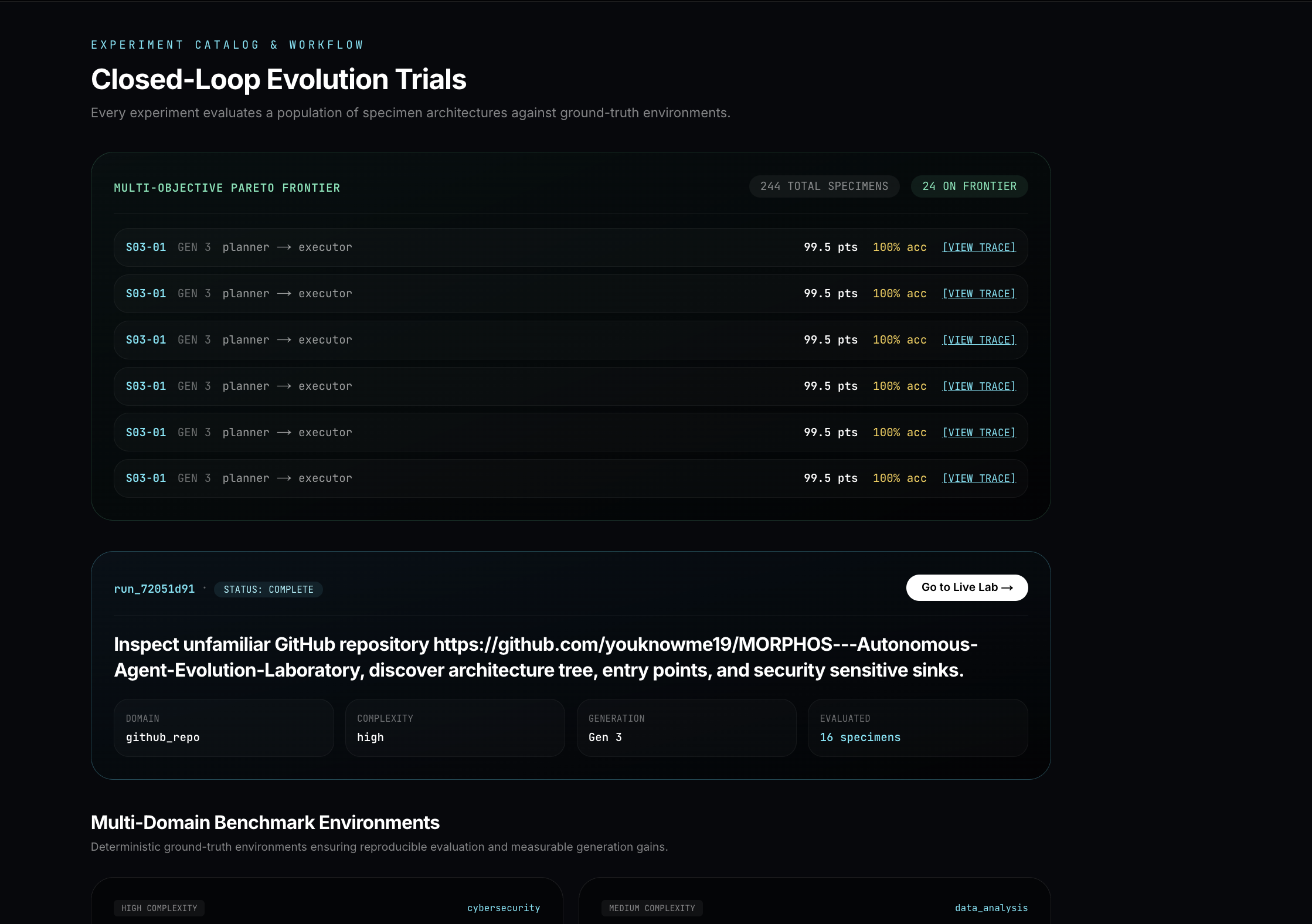
Specimen Population
-
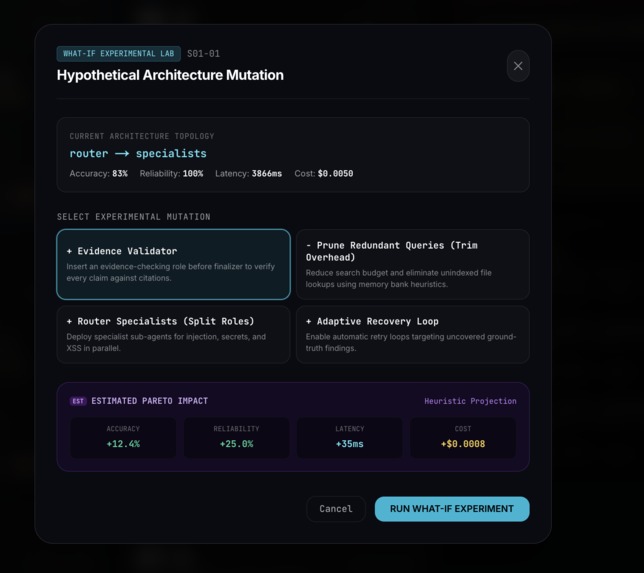
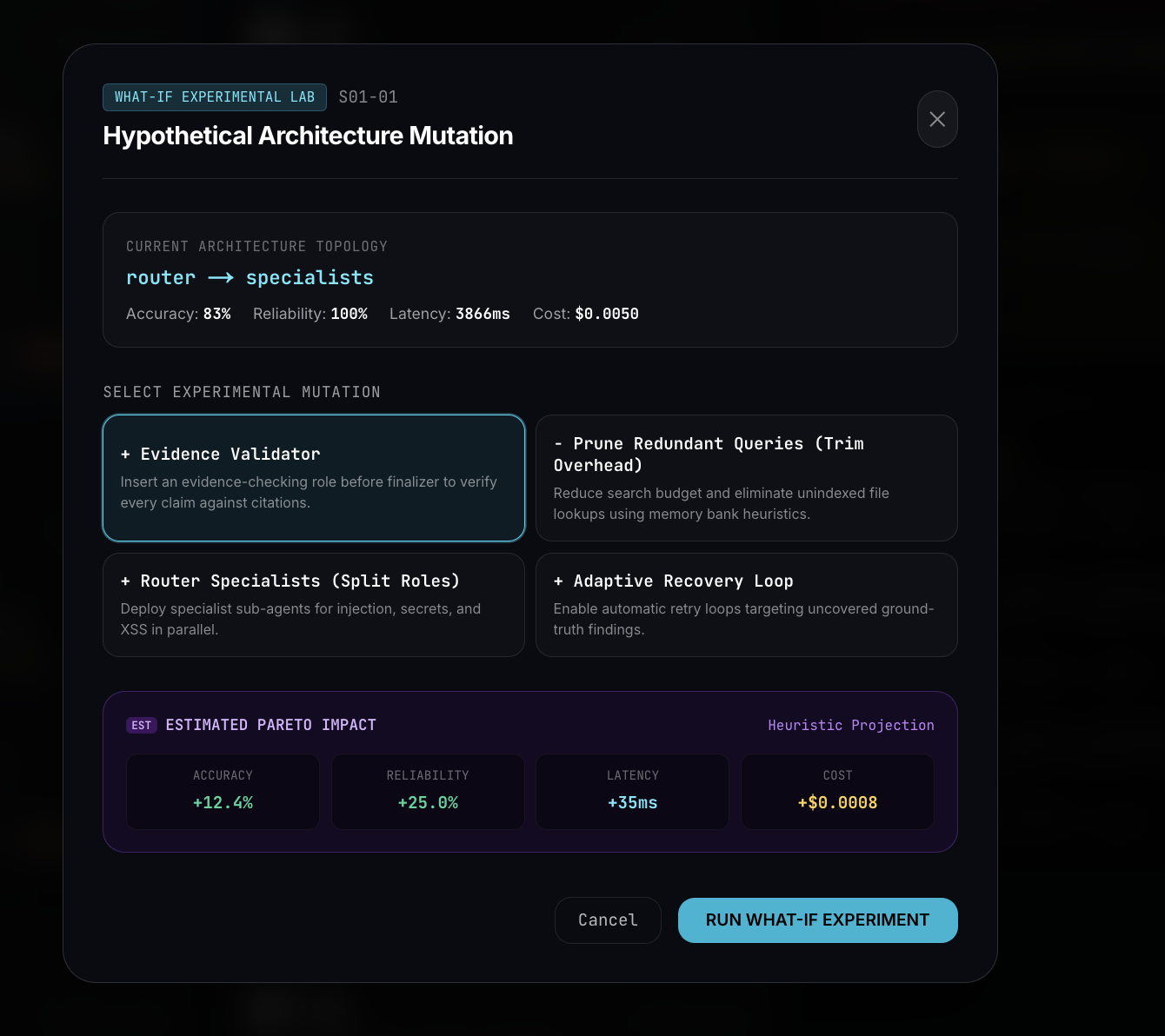
What-If Experimental Lab
-
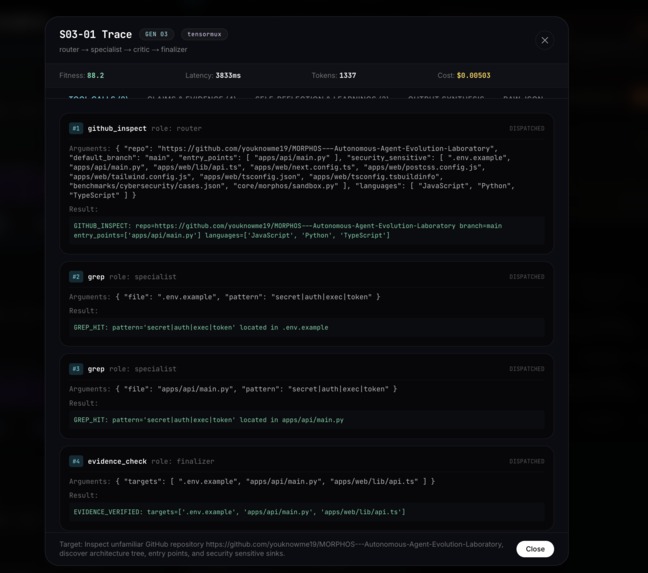
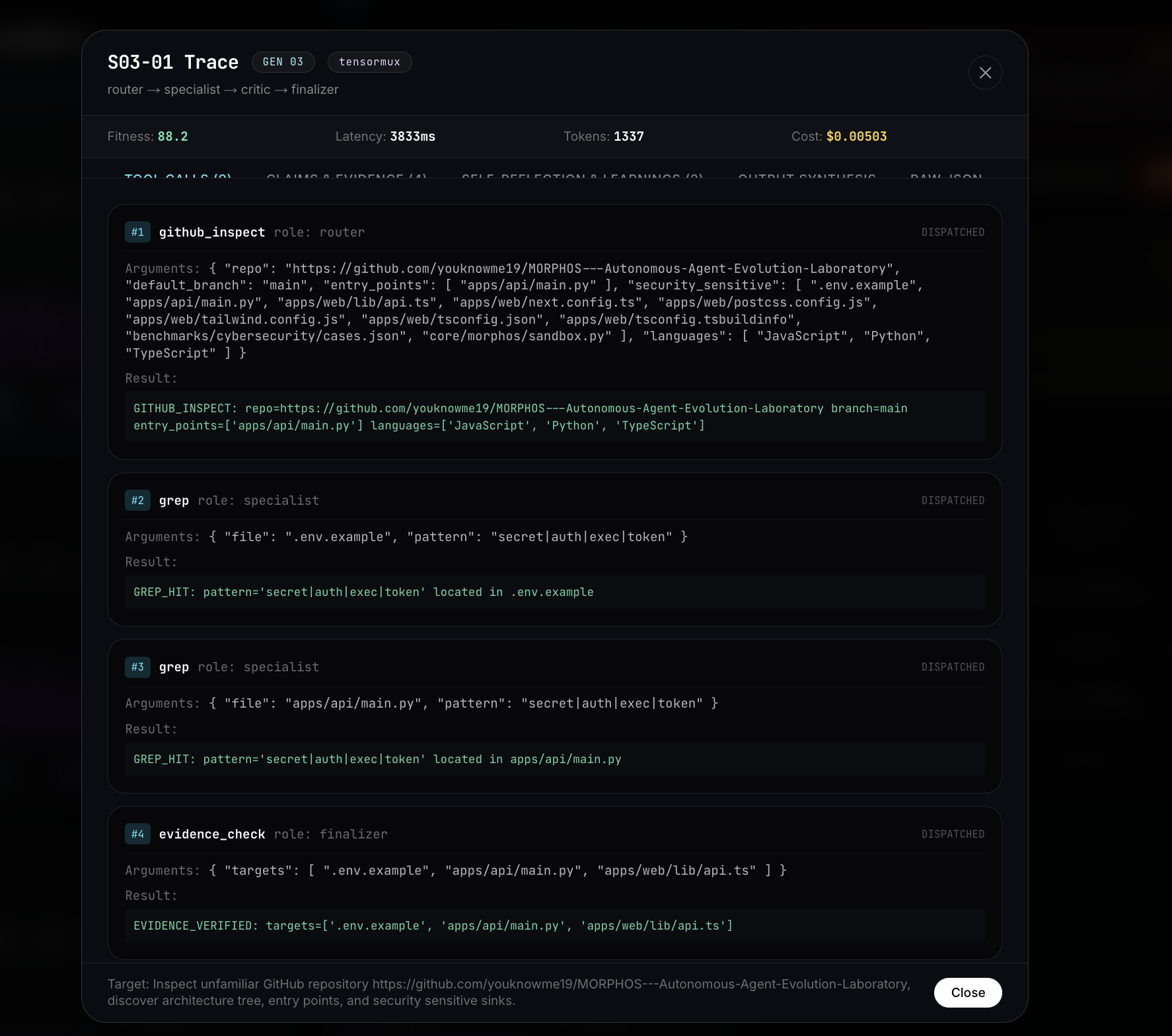
Trace
-
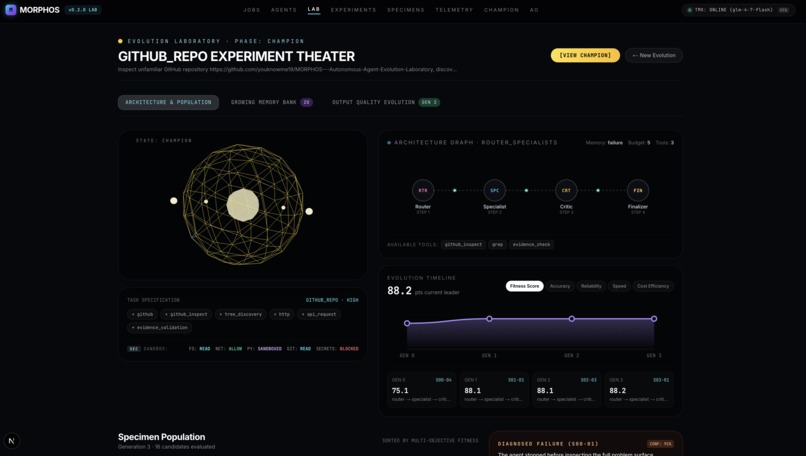
Evolution Laboratory · Phase: Champion
-
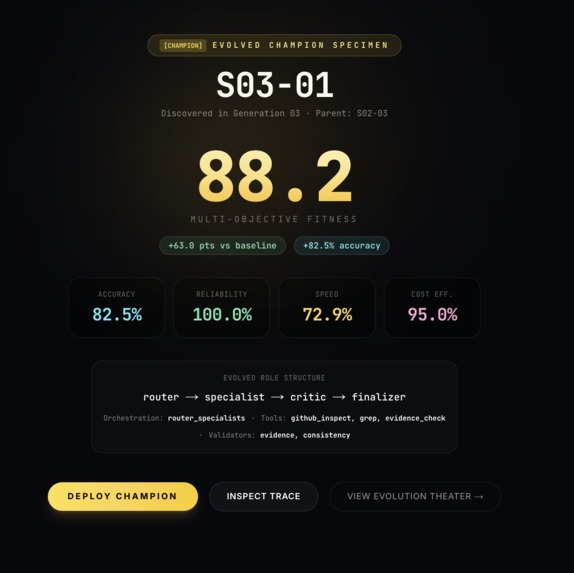
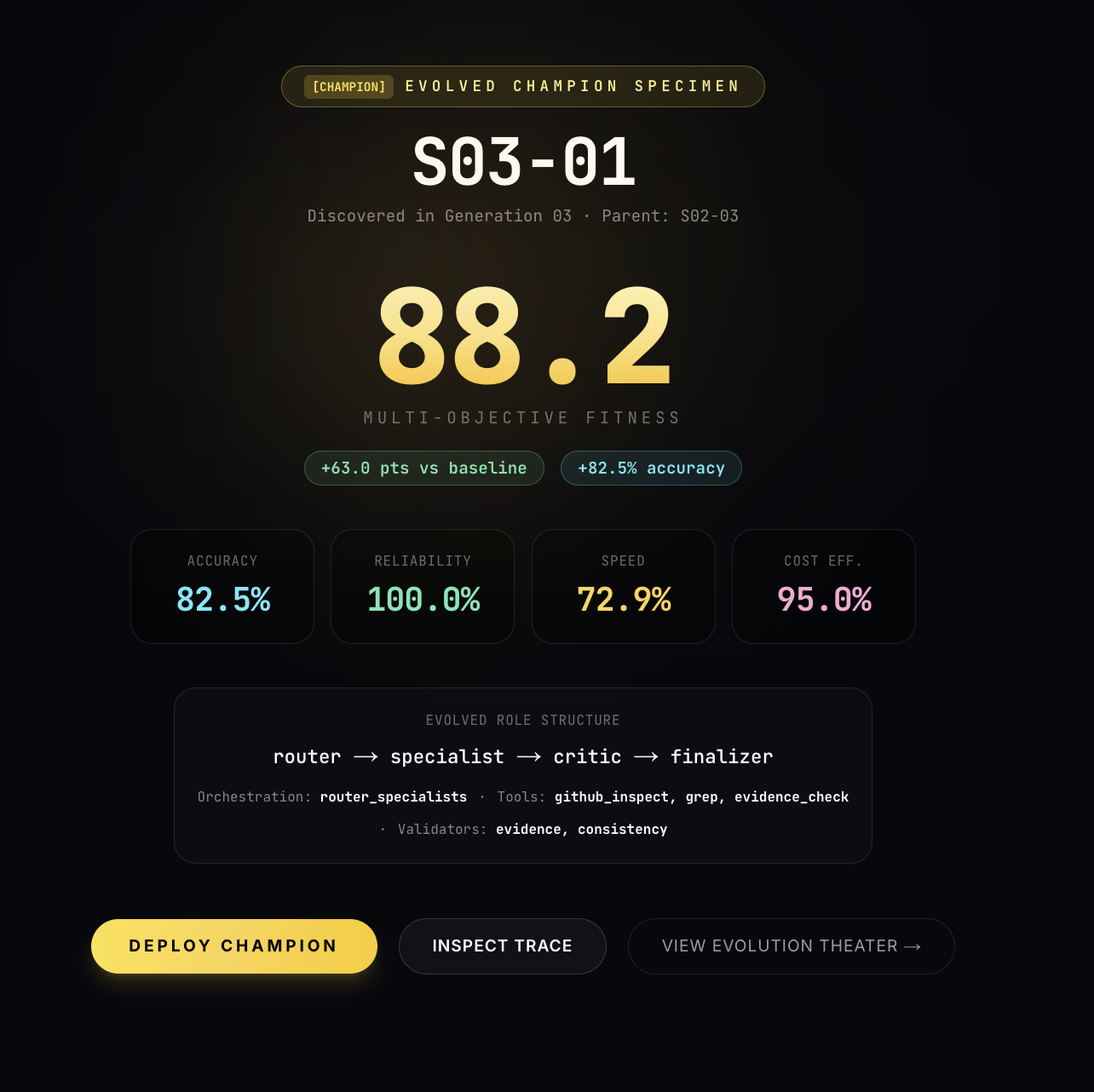
CHAMPION
-
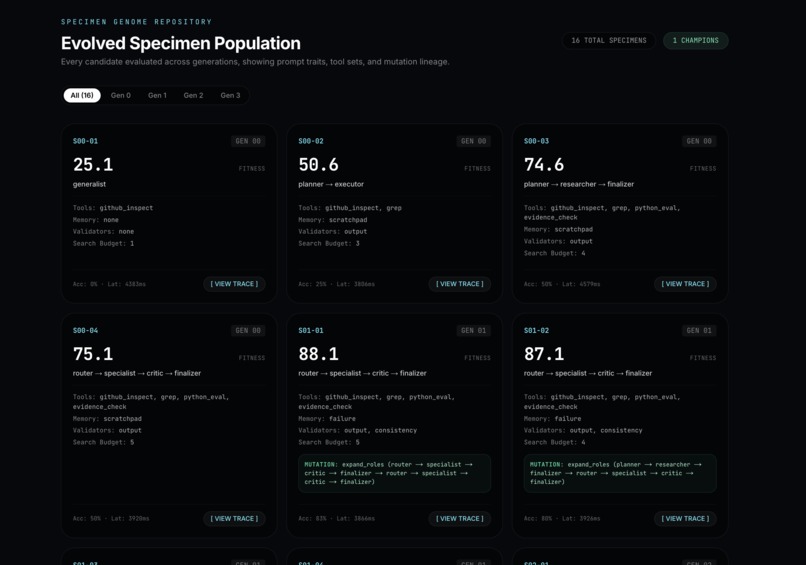
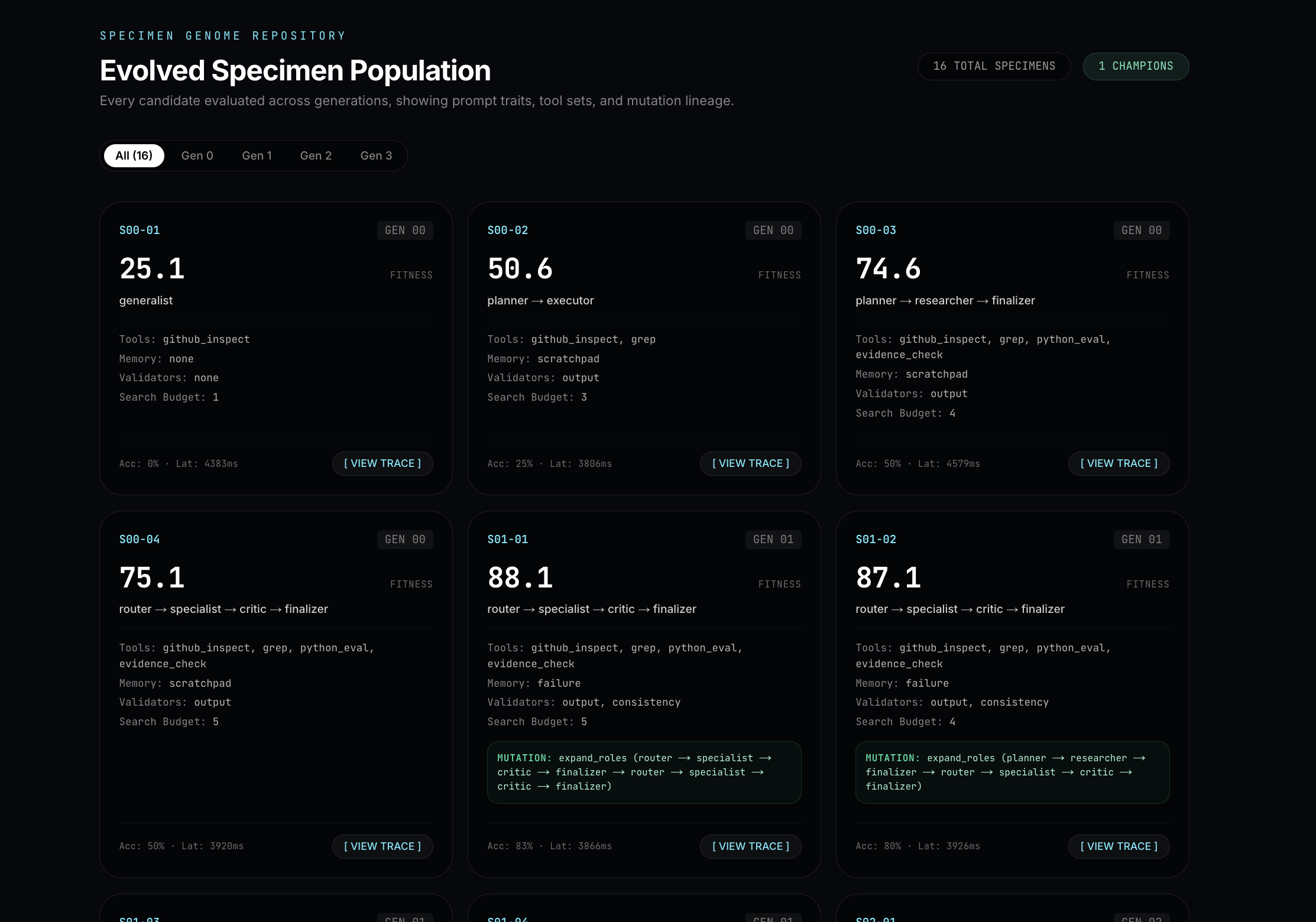
Evolved Specimen Population
-
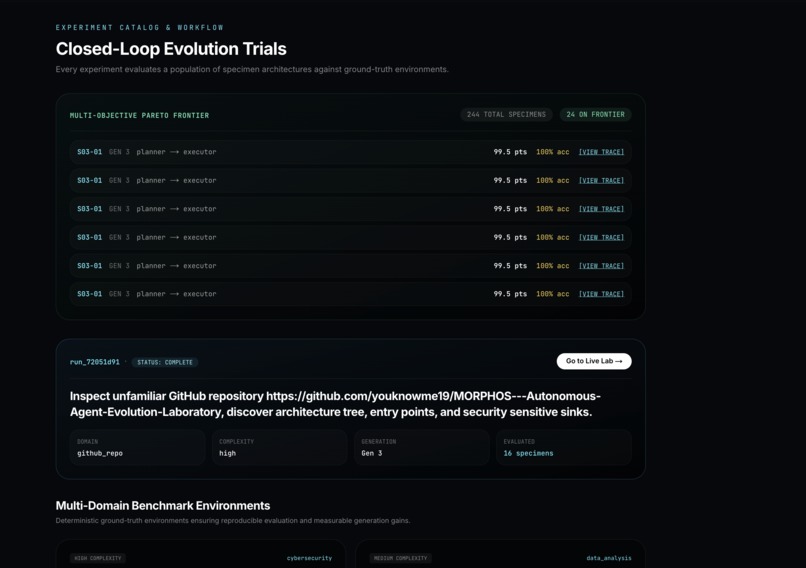
Closed-Loop Evolution Trials
-
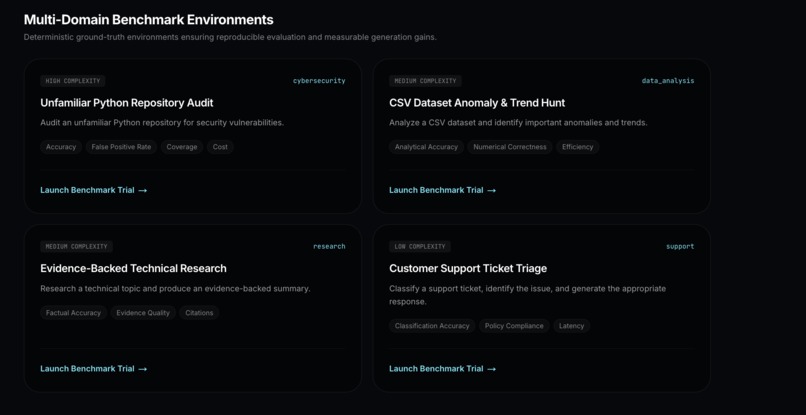
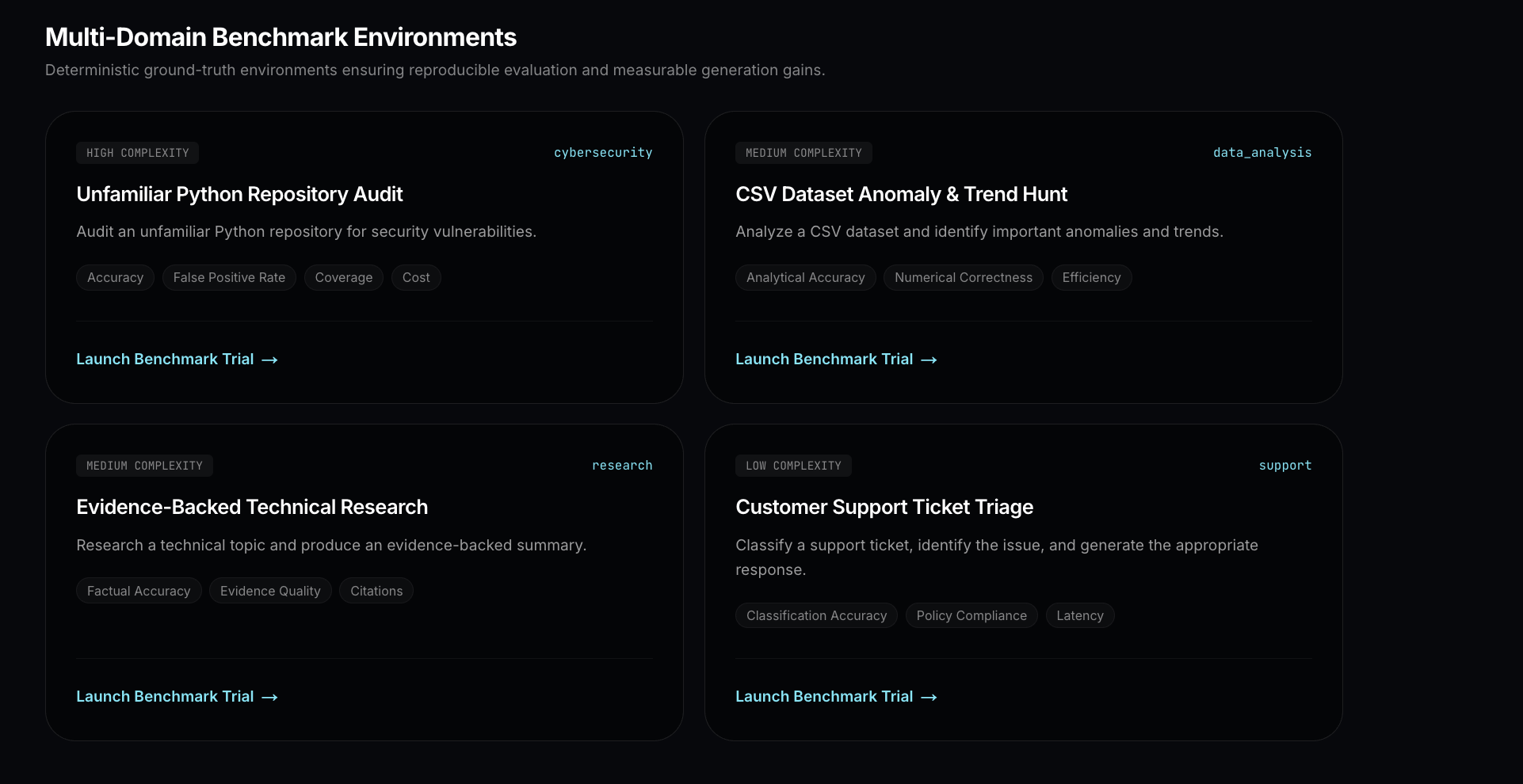
Multi-Domain Benchmark Environments Deterministic ground-truth environments ensuring reproducible evaluation and measurable generation gains
-
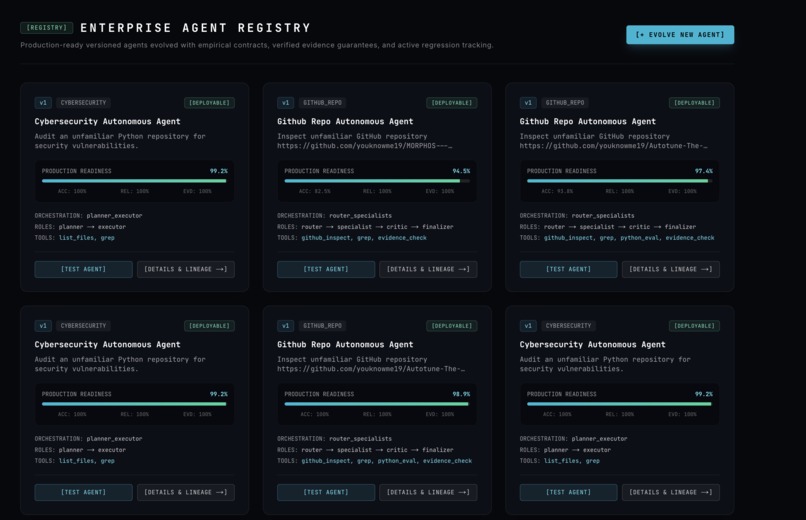
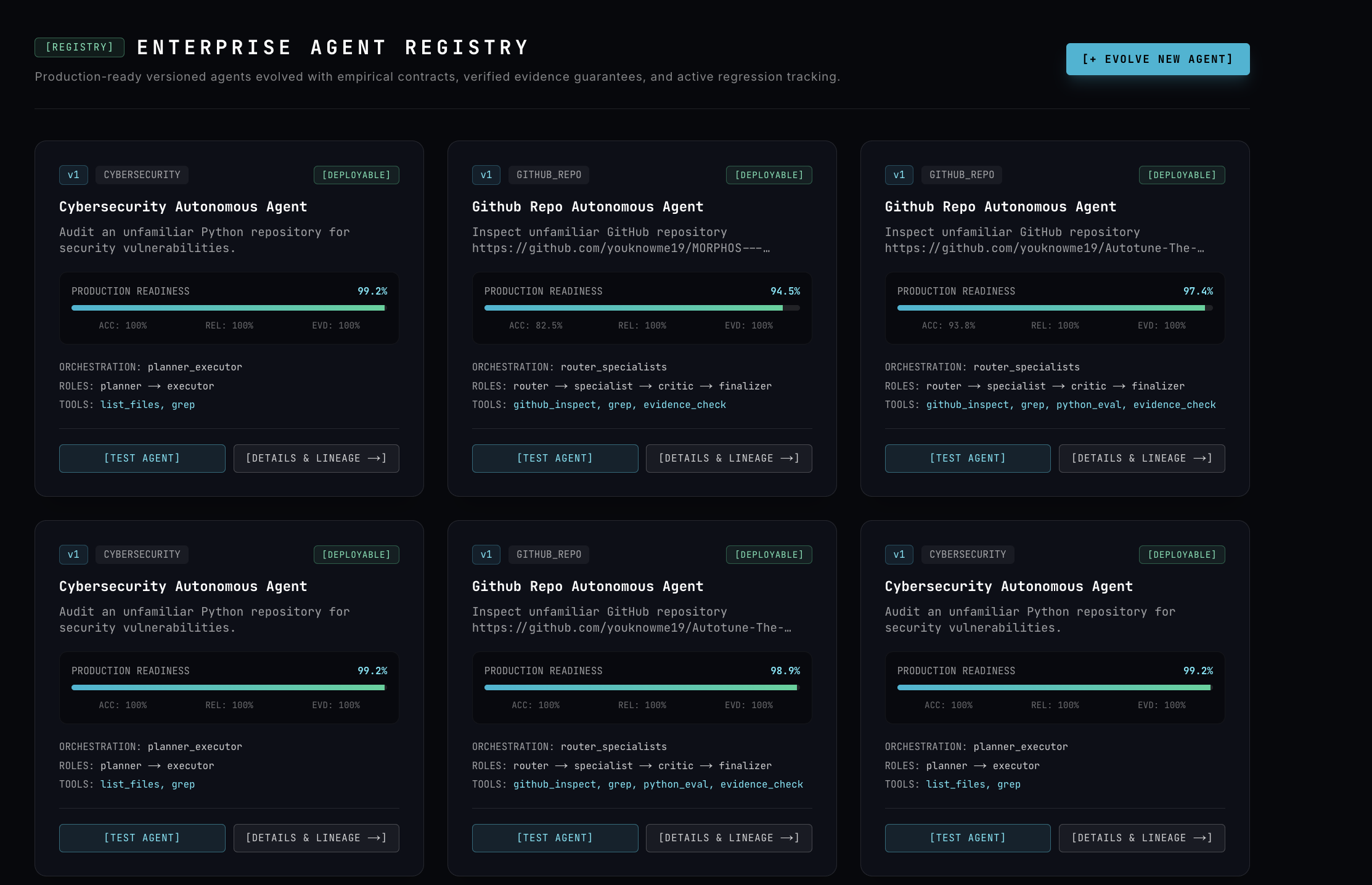
Production-ready versioned agents evolved with empirical contracts, verified evidence guarantees, and active regression tracking.
-
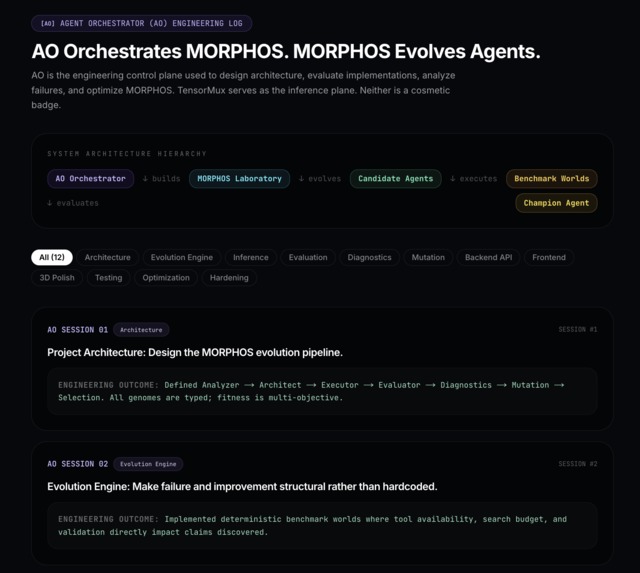
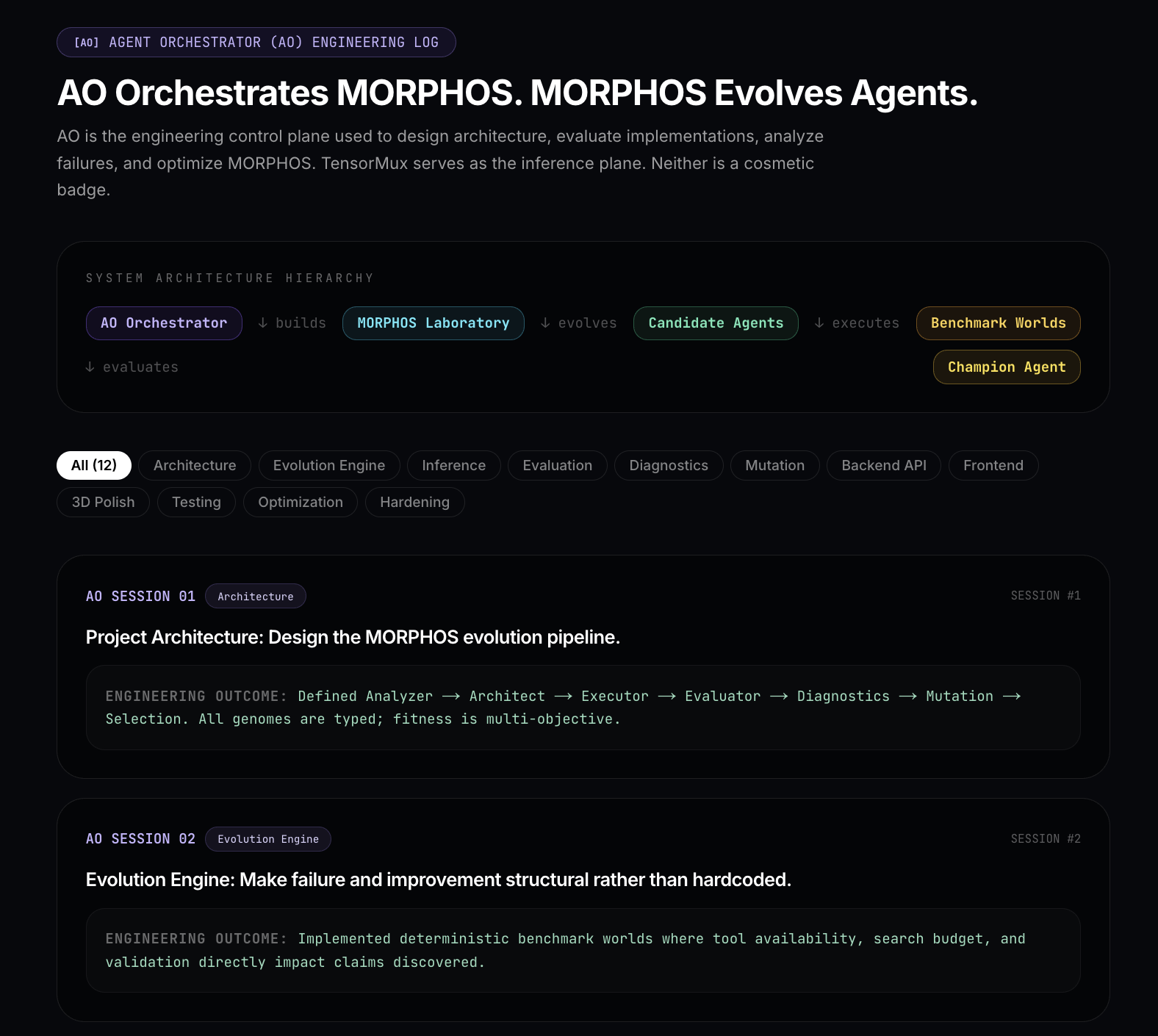
AO Orchestrates MORPHOS. MORPHOS Evolves Agents.
-
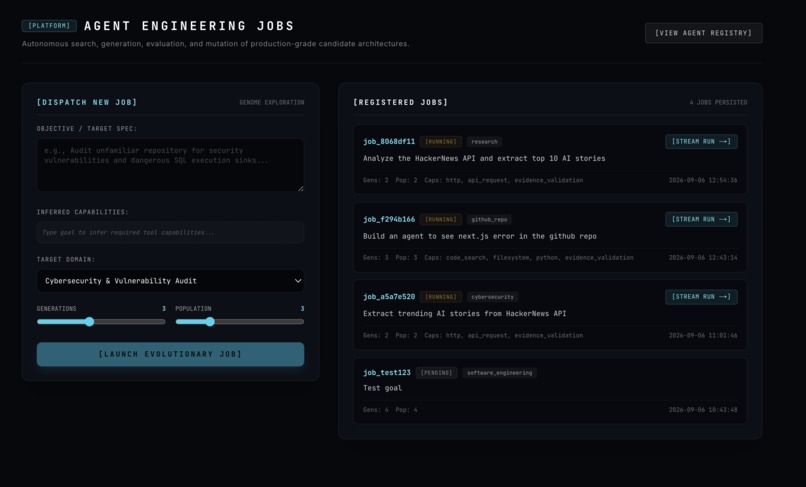
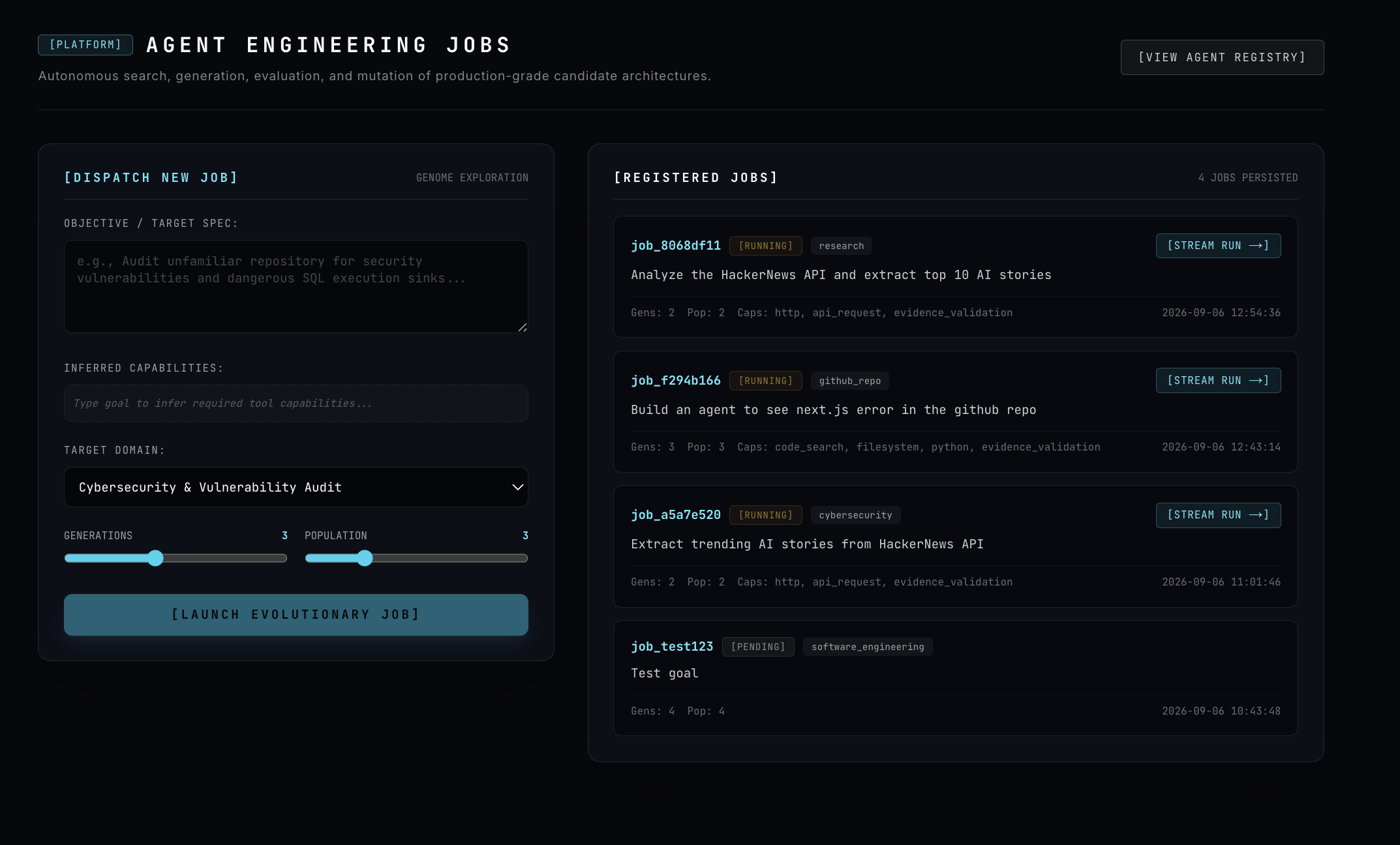
AGENT ENGINEERING JOBS Autonomous search, generation, evaluation, and mutation of production-grade candidate architectures.
-
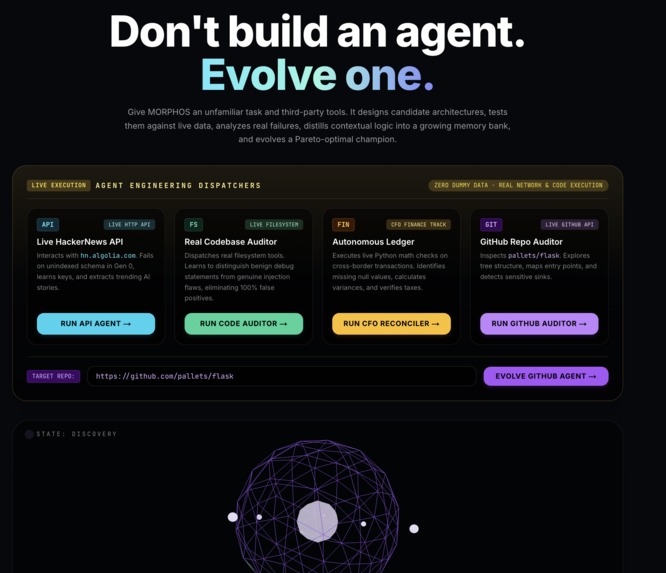
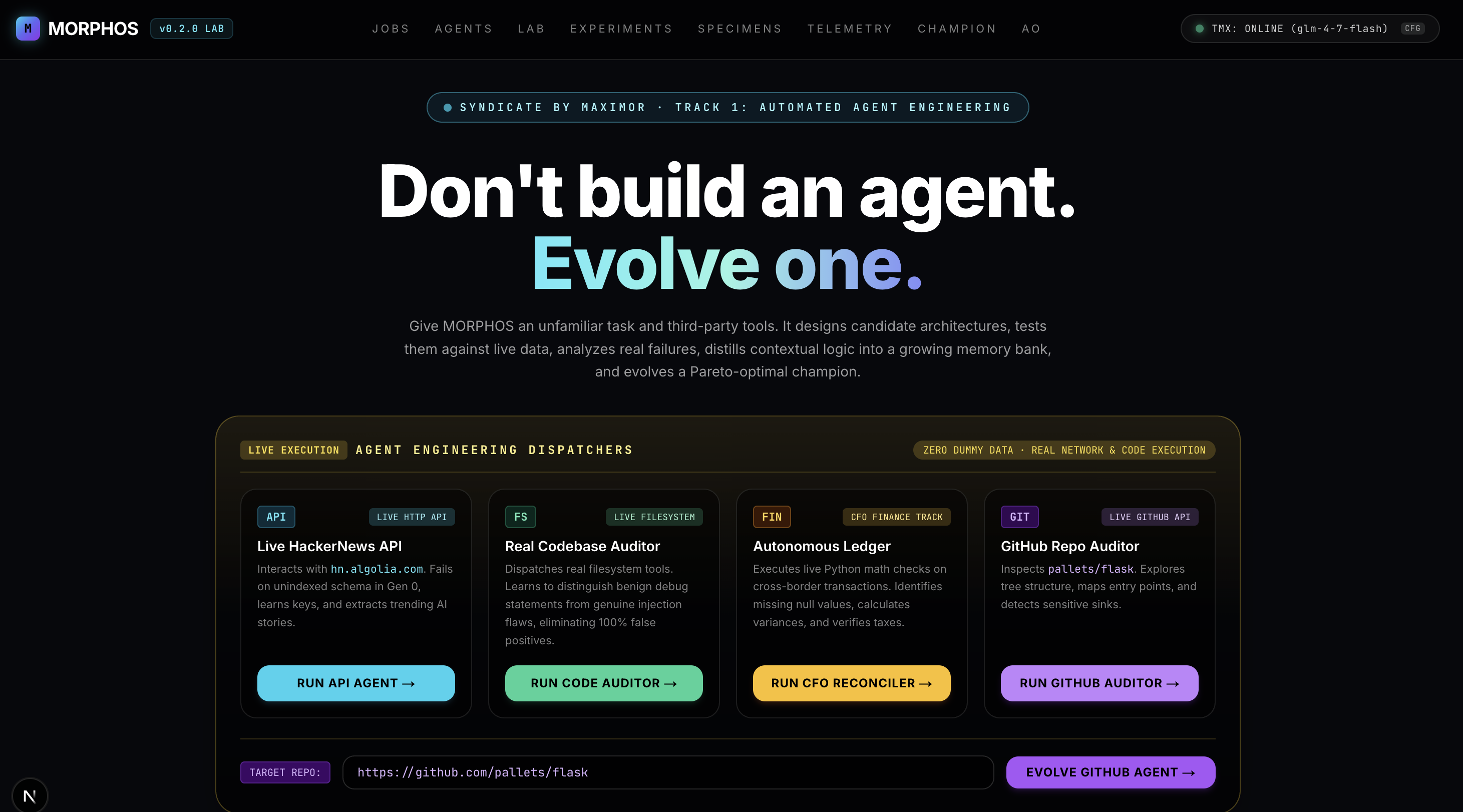
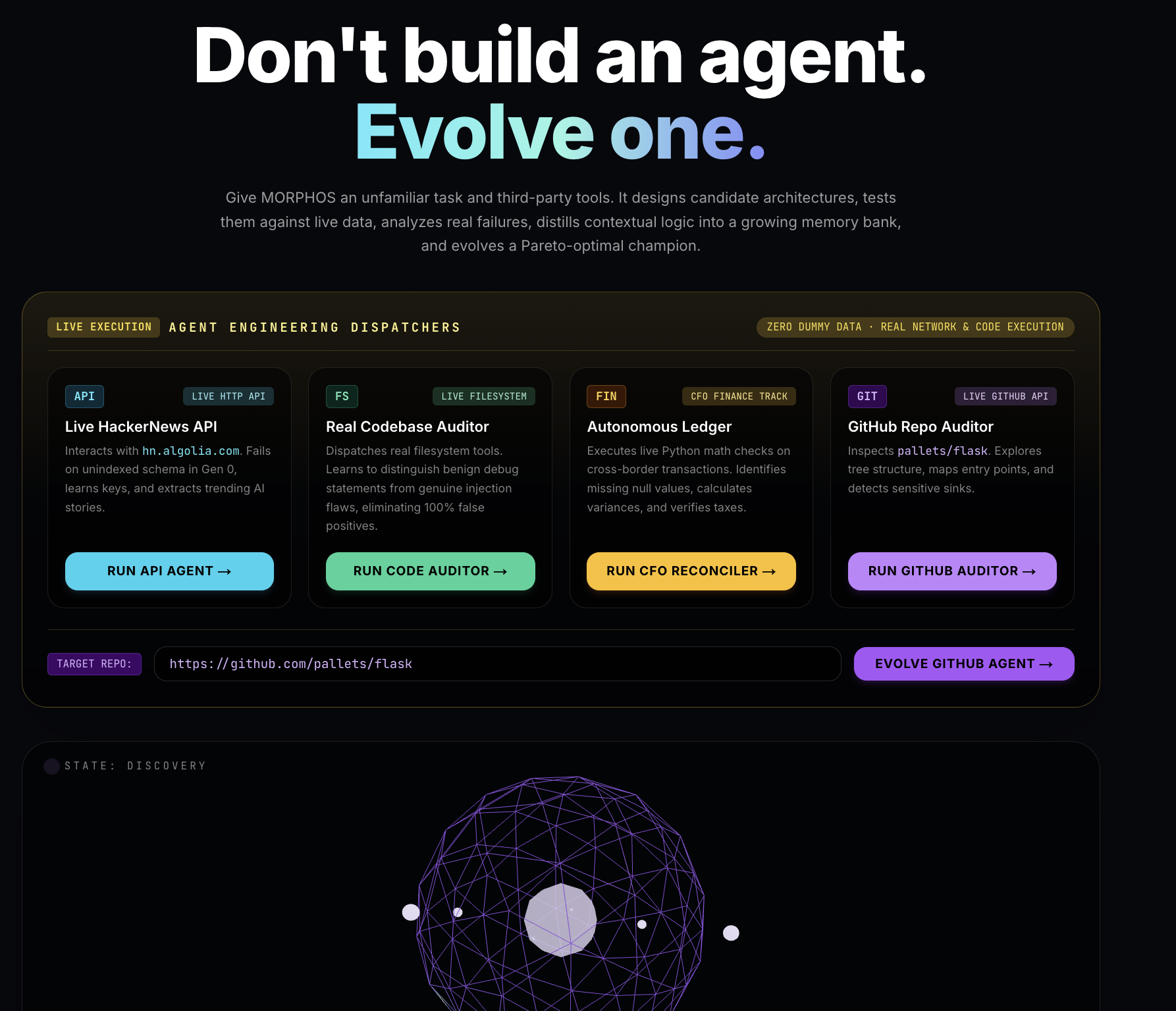
Don't build an agent. Evolve one.
Inspiration
Today's AI agents are powerful, but building them is still largely a manual engineering process.
Developers choose the agent's architecture, tools, prompts, memory, and validation strategy. When an agent fails, we manually diagnose the problem, modify the design, and run it again.
We asked:
What if the agent-engineering process itself could be automated?
That question led us to build MORPHOS.
Instead of manually building one agent, MORPHOS generates, tests, diagnoses, and evolves multiple agent designs to find what works best.
What it does
MORPHOS is an autonomous agent-engineering platform that evolves AI agents through experimentation.
Given a goal, MORPHOS generates multiple candidate agents, executes them on the task, evaluates their performance, diagnoses failures, mutates their designs, and repeats the process across generations.
The core loop:
Goal
  ↓
Generate Genomes
  ↓
Create Specimens
  ↓
Execute
  ↓
Evaluate
  ↓
Diagnose
  ↓
Mutate
  ↓
Learn
  ↓
Next Generation
  ↓
Champion
Agent Genome
Each agent has a Genome, which acts like its DNA. It defines:
- Orchestration strategy
- Tools
- Memory
- Validators
- Search budget
- Behavioral traits
Different Genomes create different ways of solving the same task. Each candidate agent is called a Specimen.
MORPHOS evaluates specimens across: Accuracy · Reliability · Speed · Cost
When an agent fails, MORPHOS diagnoses why it failed and performs a targeted mutation. For example, poor exploration can cause MORPHOS to change the planning strategy, increase the search budget, or introduce a relevant tool. The new agent is then executed again.
Memory
MORPHOS maintains a persistent Memory Bank. Useful discoveries from previous generations can be stored and used by future agents, allowing evolution to build on previous experience instead of starting from scratch.
Champion
After multiple generations, MORPHOS maintains a Pareto frontier of strong candidates across different objectives. The strongest overall candidate is promoted to the Champion and versioned with its Genome, metrics, contract, and evolution lineage.
How we built it
MORPHOS combines an evolutionary engine, agent execution layer, evaluation system, and live laboratory interface.
Backend
- Python
- FastAPI
- Evolution engine
- Multi-objective fitness evaluation
- Failure diagnosis
- Targeted mutation
- Persistent memory
- Agent versioning
Frontend
- Next.js
- React
- TypeScript
- Tailwind CSS
- Three.js
The frontend uses Server-Sent Events (SSE) to stream generations, specimen results, mutations, memory updates, telemetry, and Champion promotion in real time.
Real Tools
MORPHOS can execute agents using:
- GitHub API
- HTTP APIs
- Filesystem tools
- Sandboxed Python
- Search and evidence tools
- TensorMux for model inference
Challenges we ran into
The biggest challenge was making the evolution loop real rather than cosmetic. We didn't want to simply generate random agents and display better-looking numbers; MORPHOS executes actual workloads and measures execution behavior.
Another challenge was making mutations meaningful. Instead of randomly changing agents, mutations are driven by failure diagnosis. The system changes the parts of the Genome related to the observed failure and then tests the result again.
We also had to handle unknown API schemas, tool failures, execution timeouts, filesystem safety, secret sanitization, and the difference between live workloads and deterministic benchmarks.
Accomplishments that we're proud of
MORPHOS goes beyond simply running agents. It can:
- Generate competing agent architectures
- Execute them against real workloads
- Measure their performance
- Diagnose failures
- Perform targeted Genome mutations
- Learn from previous executions
- Compare agents across multiple objectives
- Maintain a Pareto frontier
- Promote and version a Champion
We also built a live laboratory where the complete evolutionary process can be observed in real time.
The core feedback loop is:
Failure → Diagnosis → Mutation → New Agent → Execution → Measurement → Improvement
What we learned
The biggest lesson was that agent engineering itself can be treated as an optimization problem. Instead of assuming one manually designed architecture is optimal, we can let multiple architectures compete, observe their behavior, learn from failures, and evolve better designs.
We also learned that useful evolution requires more than random mutation:
$$\text{Evaluation} + \text{Diagnosis} + \text{Targeted Mutation} + \text{Memory}$$
Together, these turn agent engineering into an evolutionary process.
What's next for MORPHOS - Autonomous Agent Evolution Platform
We want MORPHOS to become a continuous agent engineering laboratory. Next, we want to explore:
- More sophisticated Genome mutation strategies
- Larger benchmark suites
- Automatic regression-triggered re-evolution
- More model providers and routing strategies
- Stronger agent safety and isolation
- Human-in-the-loop evolution
- Automatic deployment and rollback
- Long-term learning across experiments
- Multi-agent evolutionary populations
Our long-term vision is simple: Don't manually build the perfect agent. Give MORPHOS a goal, let it experiment, learn from failure, and evolve the agent that works.


Log in or sign up for Devpost to join the conversation.