-
-

Landing_page
-
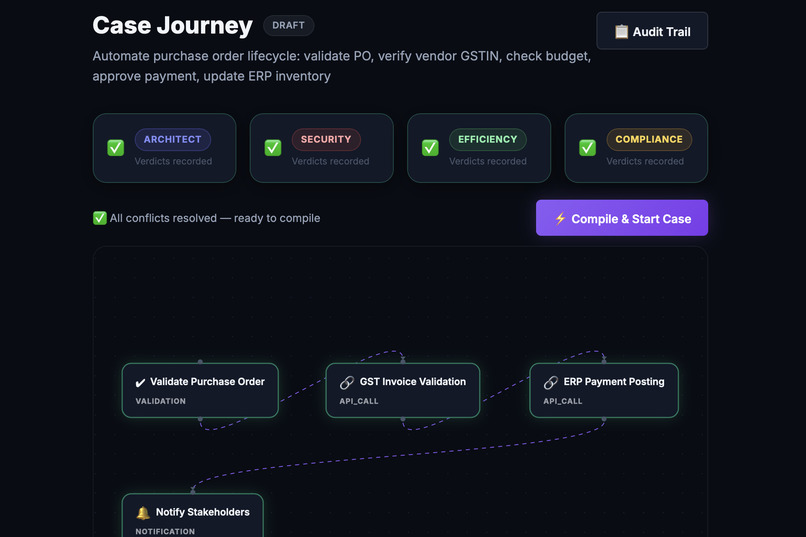
Architecture_Court
-
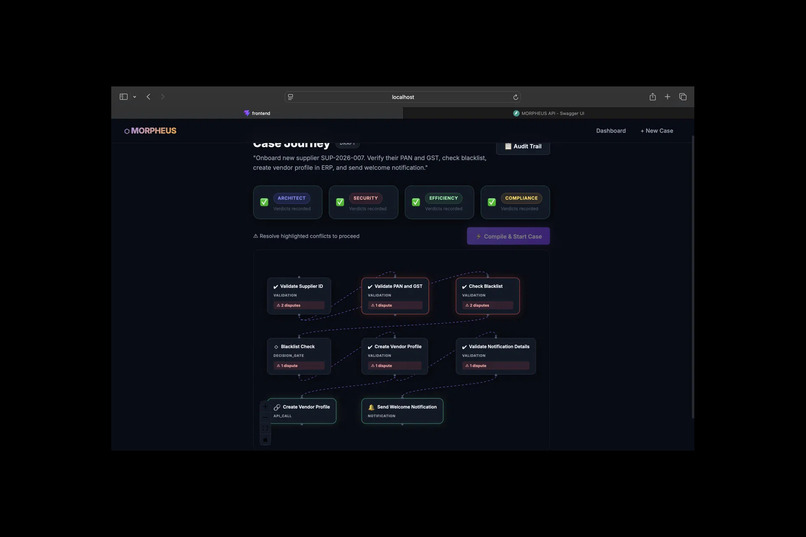
Triggered_nodes
-
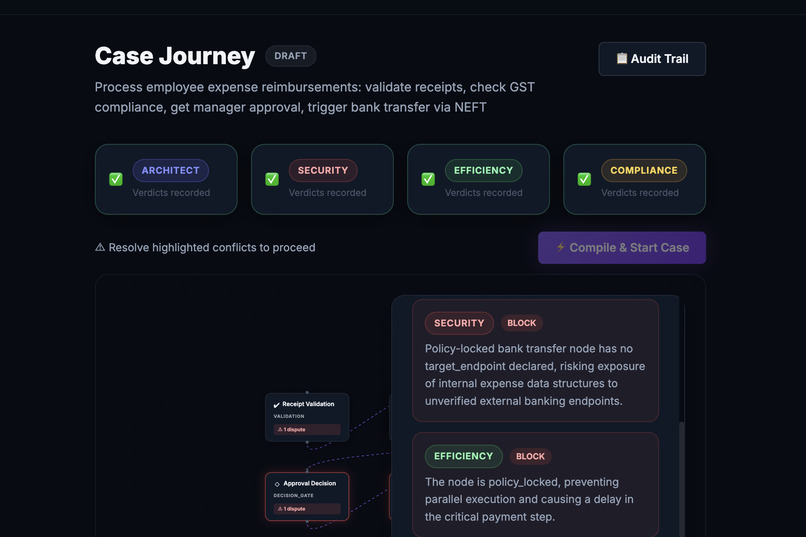
Human-as-a-judge
-
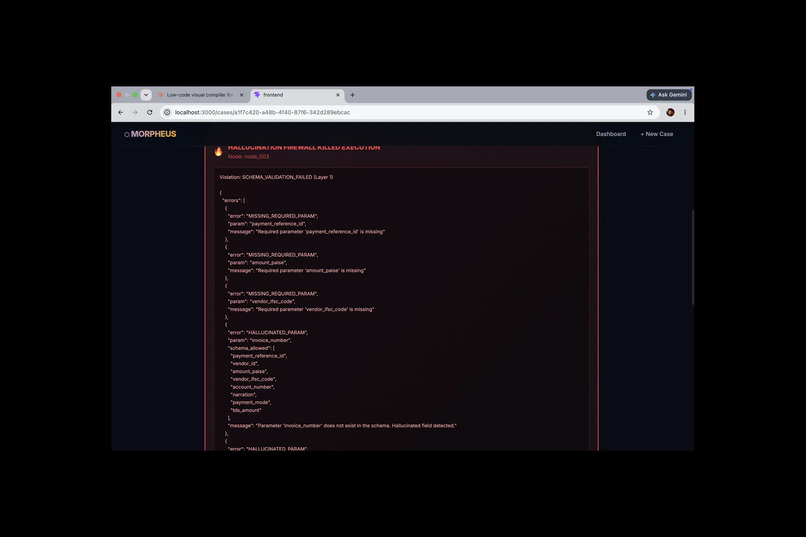
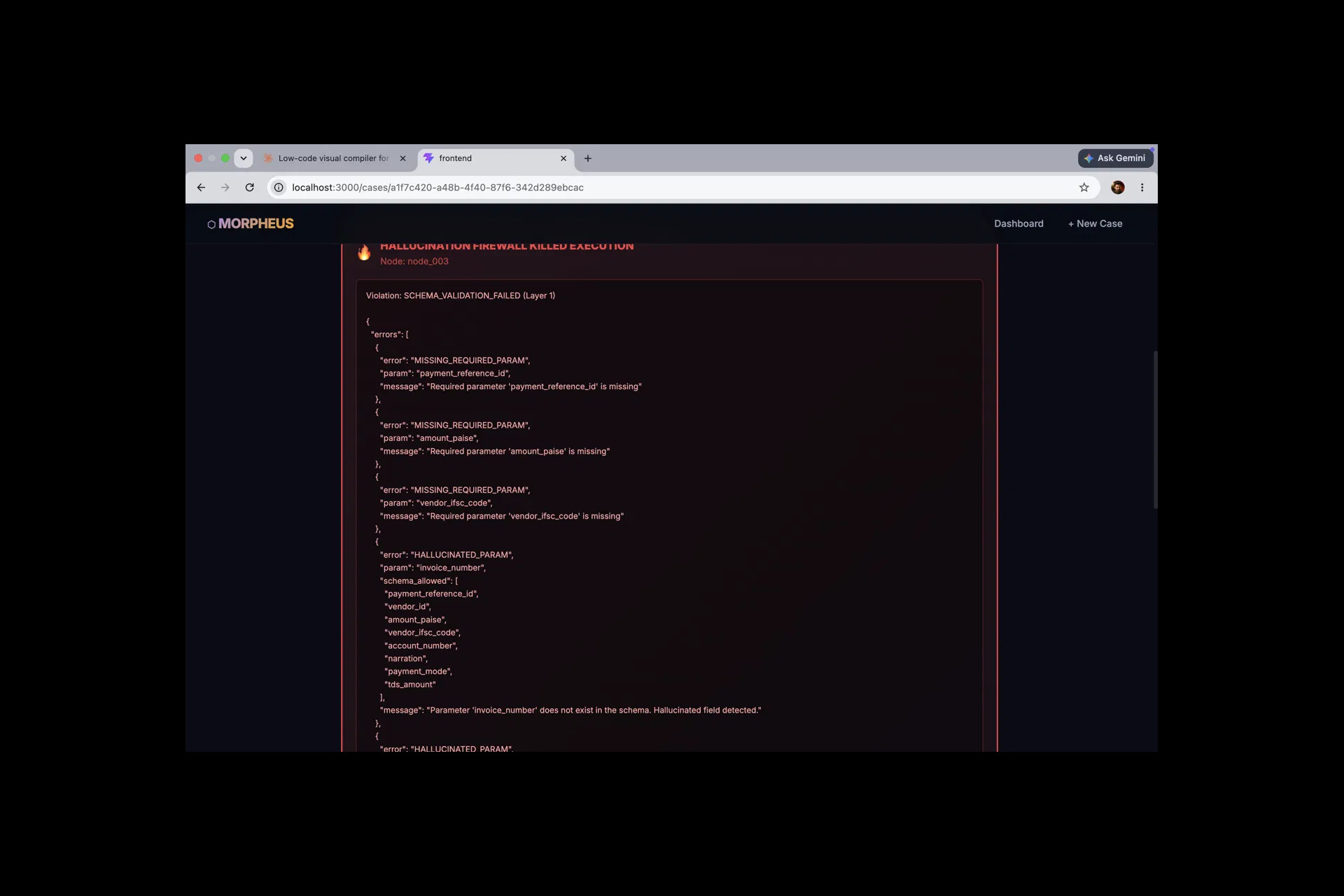
Hallucination_Firewall
-
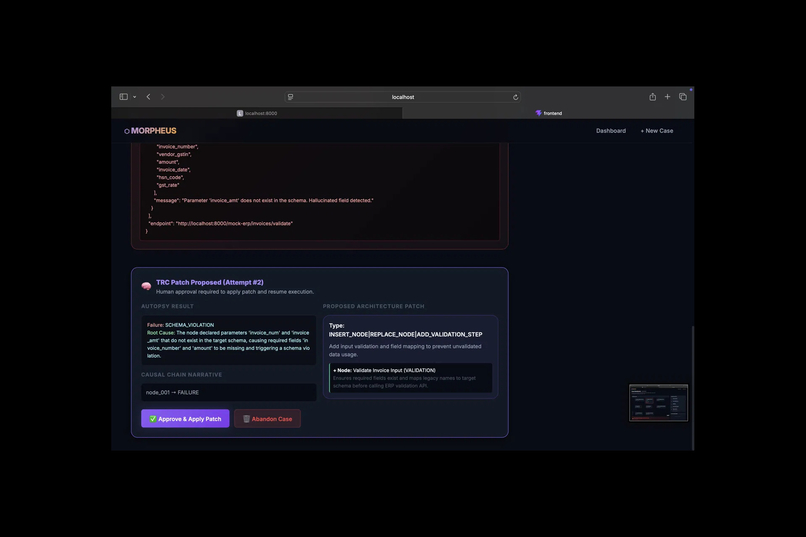
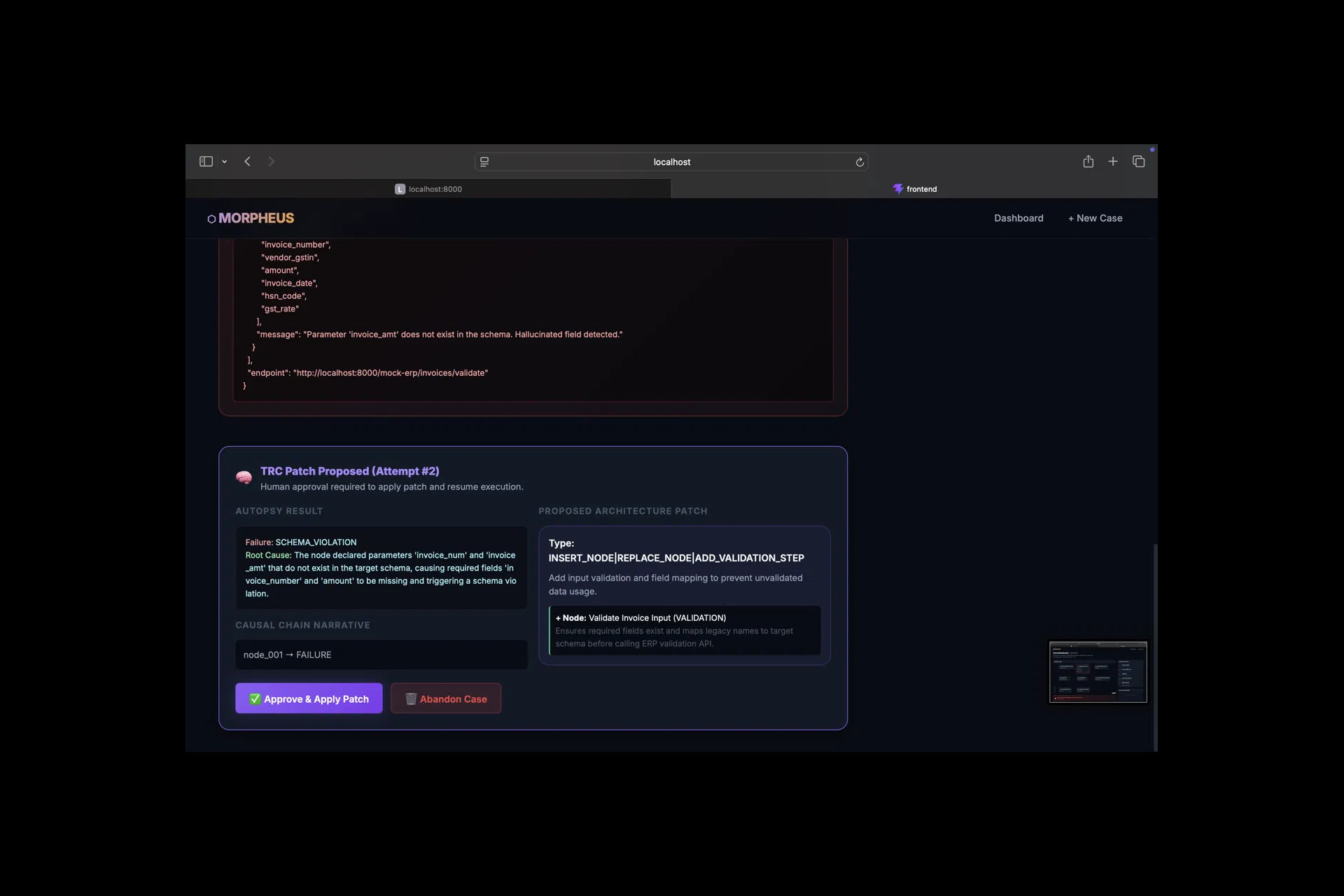
TRC
-
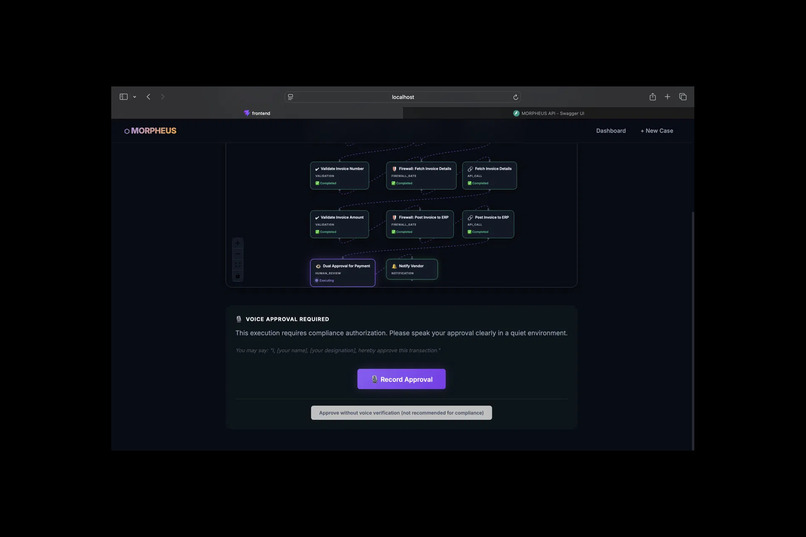
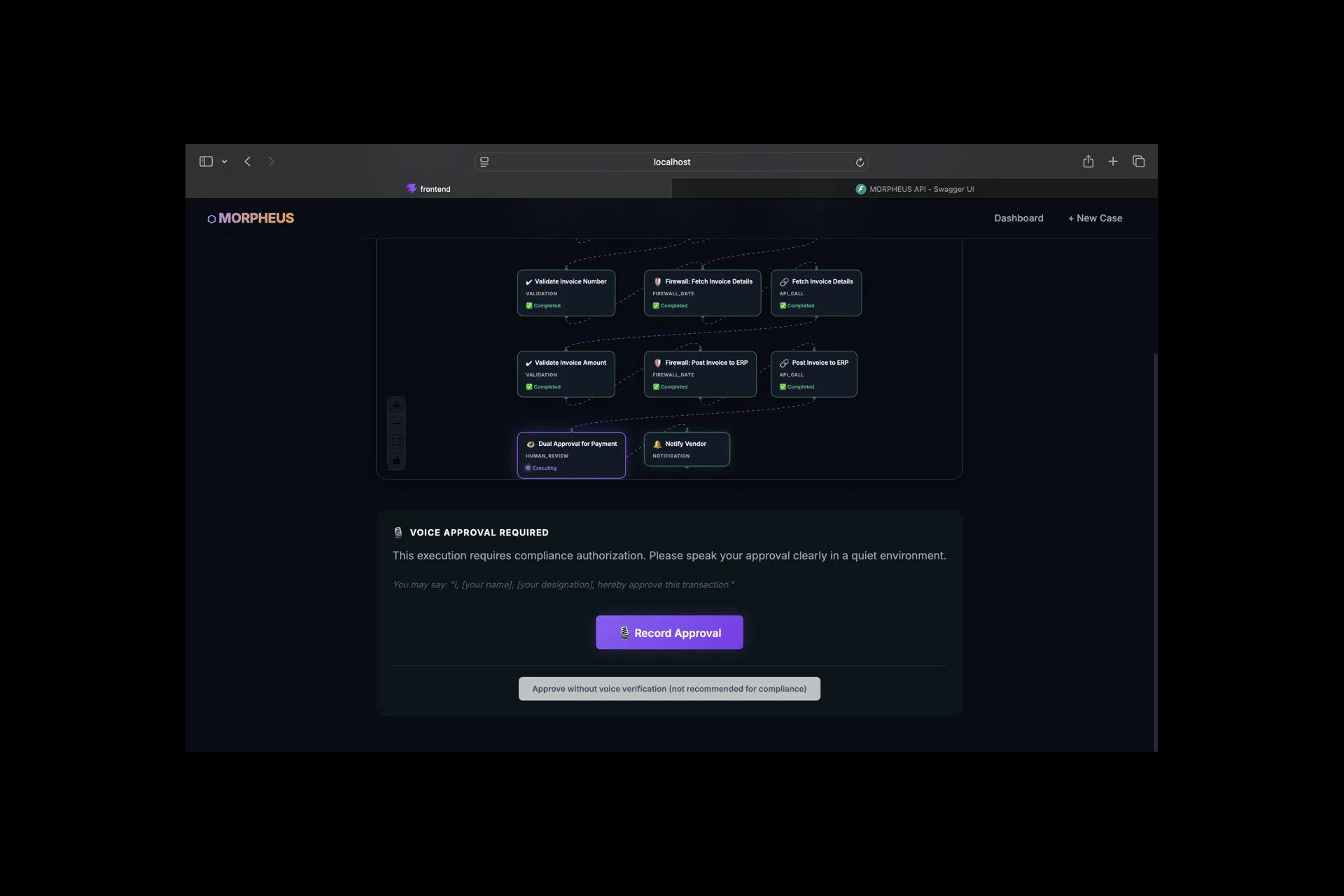
Voice_Verification
-
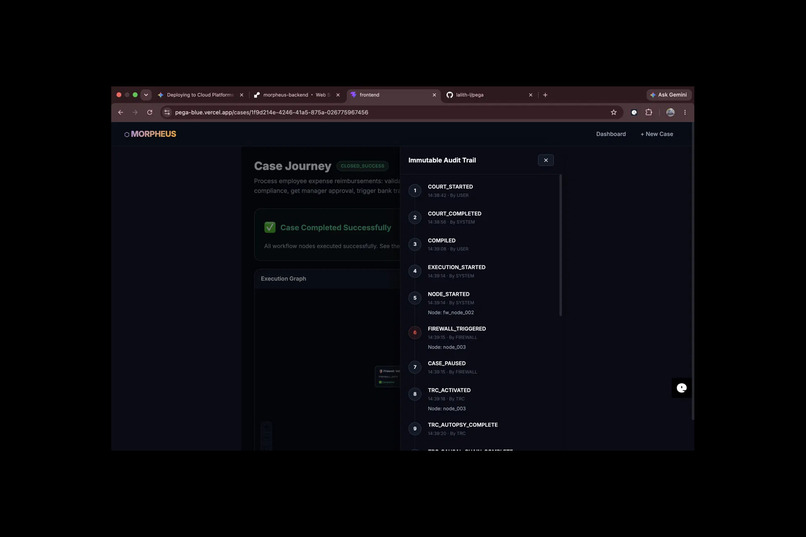
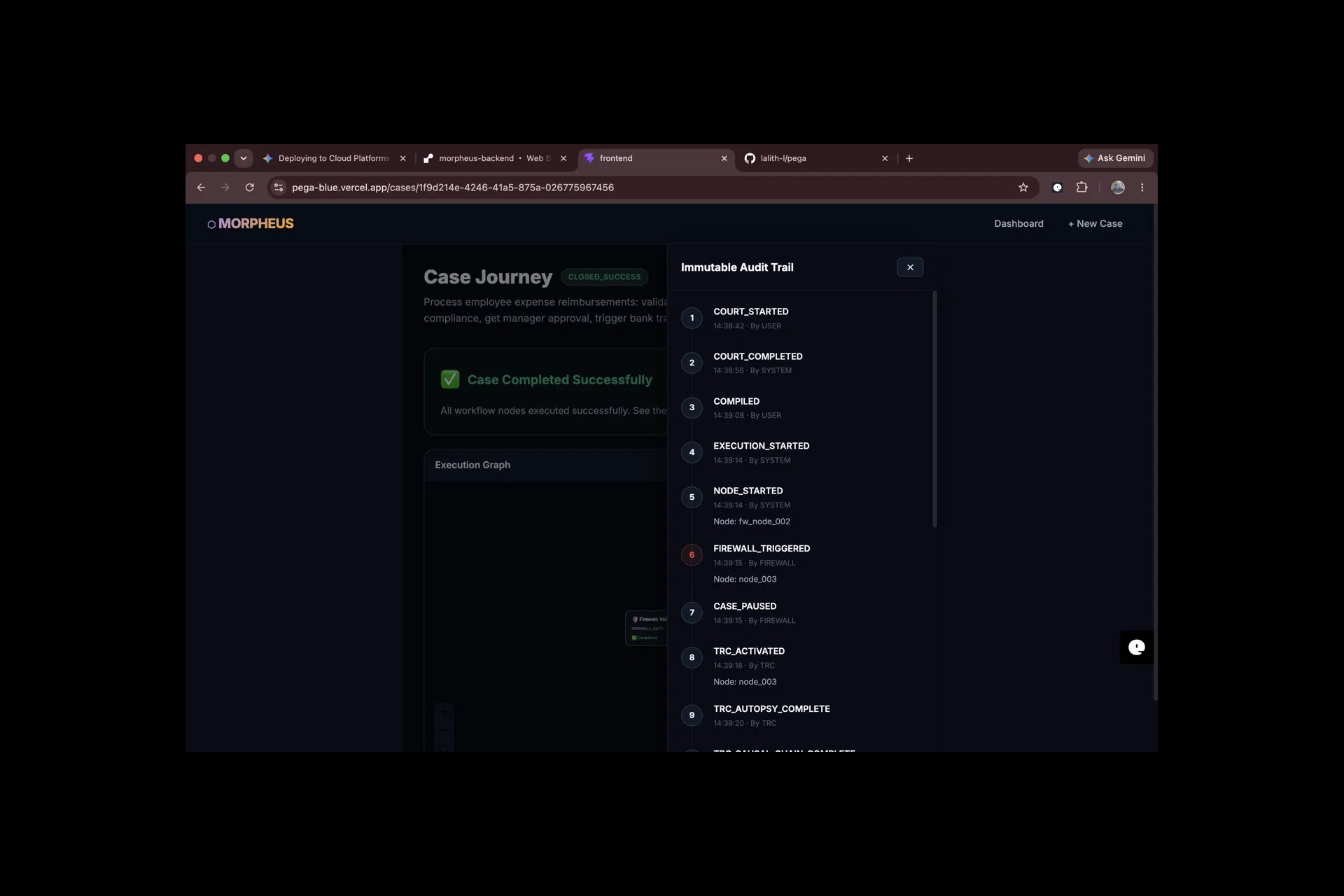
Audit_Trial
-
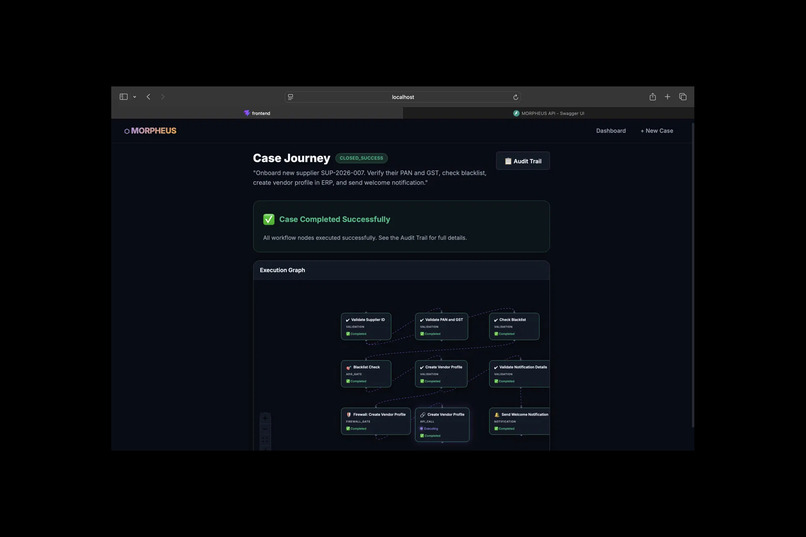
Closed_case

MORPHEUS: AI-Native Case Management for Autonomous Enterprises
Inspiration
The rise of autonomous AI agents has fundamentally changed enterprise automation. Traditional case management platforms were designed for humans—employees who make decisions, follow policies, and can be held accountable for mistakes. AI agents operate differently. They execute at machine speed, can hallucinate, misuse APIs, fabricate data, or violate compliance requirements without realizing it.
We asked ourselves a simple question:
If AI is becoming the new enterprise workforce, why are we still using workflow systems built for humans?
That question inspired MORPHEUS—an AI-native enterprise Case Management platform designed from the ground up for autonomous AI agents. Instead of assuming AI is always correct, MORPHEUS assumes AI can be wrong and builds governance, verification, and self-healing into every stage of execution.
What it does
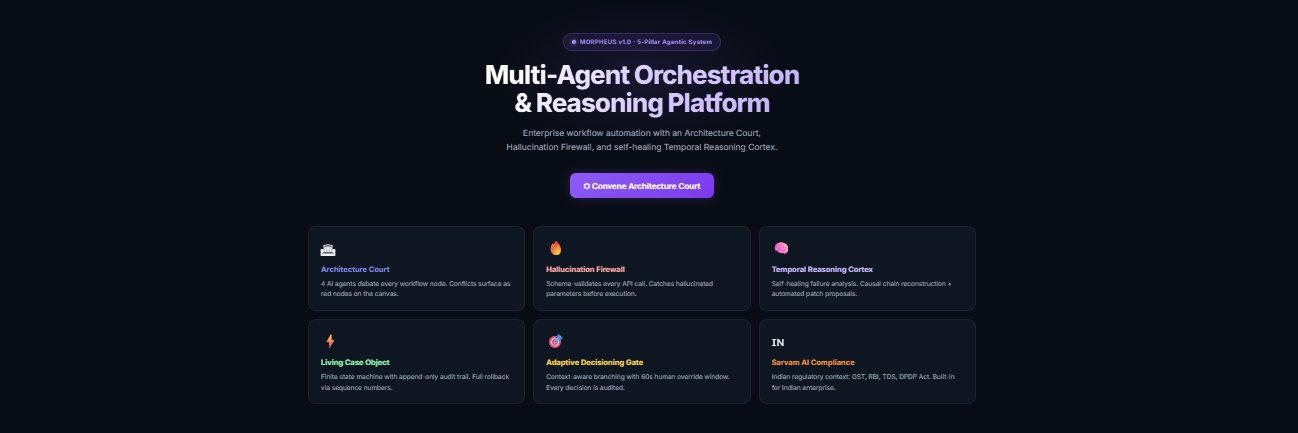
MORPHEUS transforms a business objective into a complete enterprise workflow using structured adversarial intelligence.
Instead of manually drawing workflow diagrams, users simply describe their business objective in natural language—or speak it in Hindi, Tamil, or any Indian language.
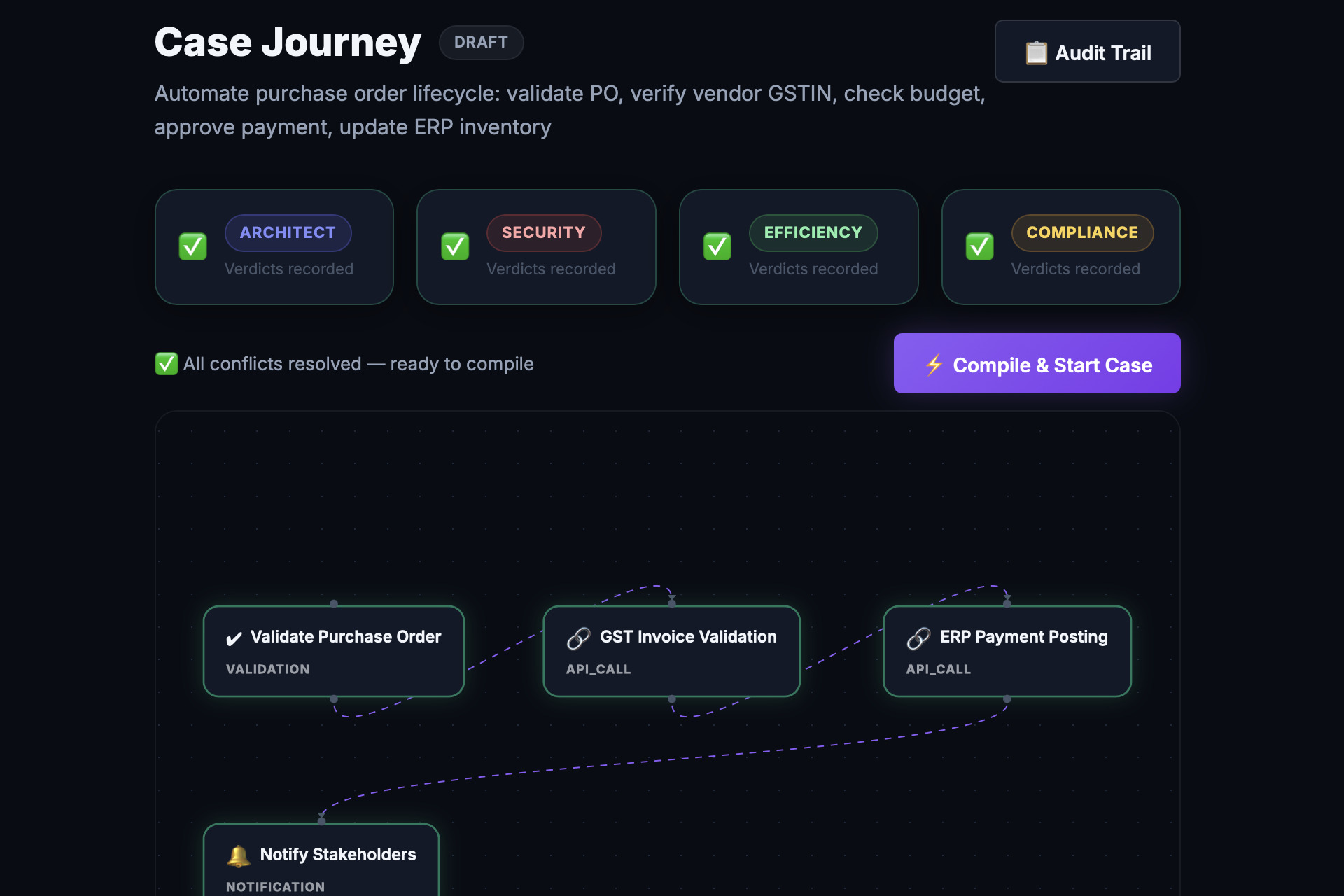
Four specialized AI agents immediately collaborate through an Architecture Court:
- Architect Agent proposes the workflow.
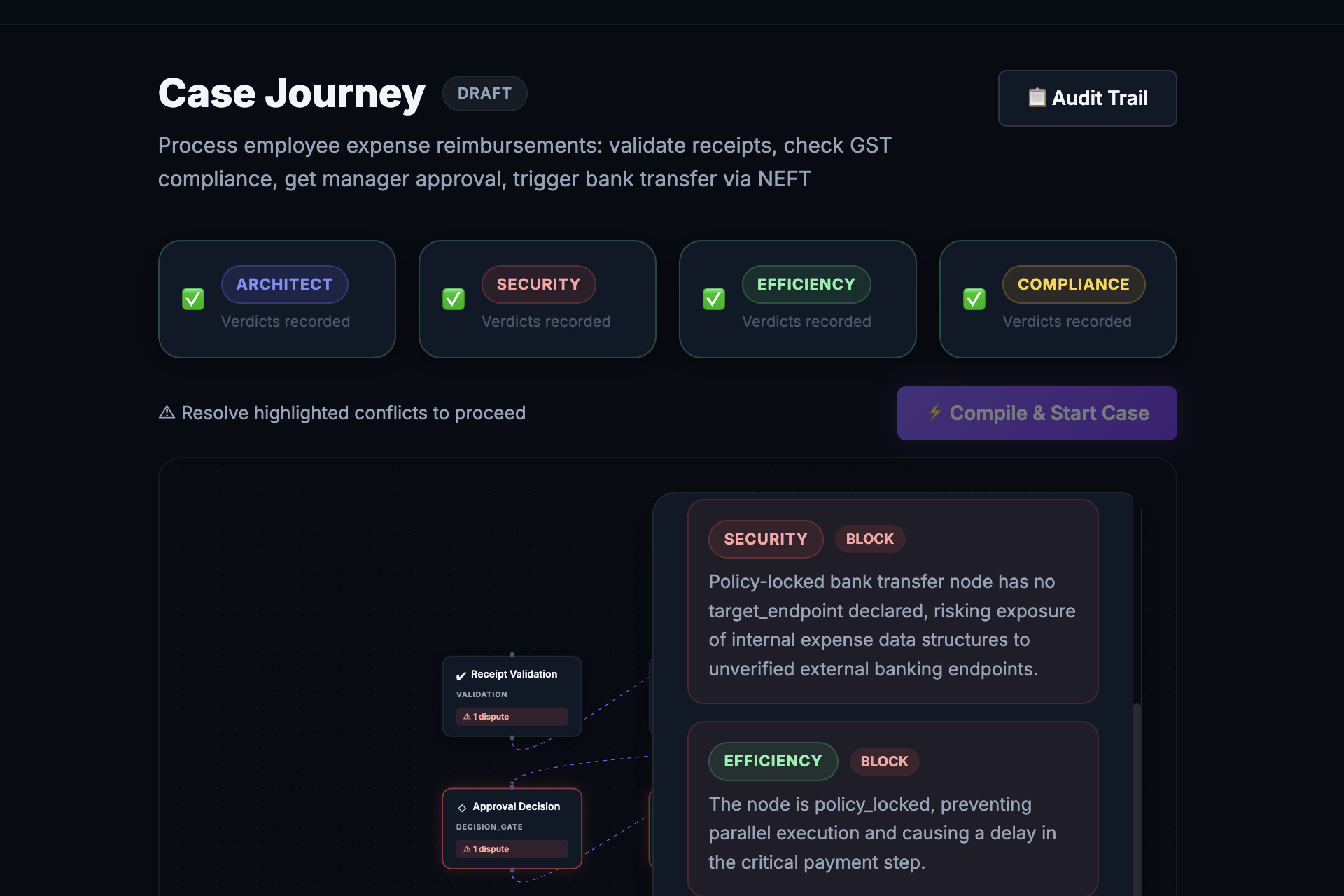
- Security Agent challenges it for vulnerabilities.
- Efficiency Agent optimizes execution cost and performance.
- Compliance Agent (powered by Sarvam AI) validates the design against Indian regulations including GST Act, TDS provisions, DPDP Act, and SOX Section 404.
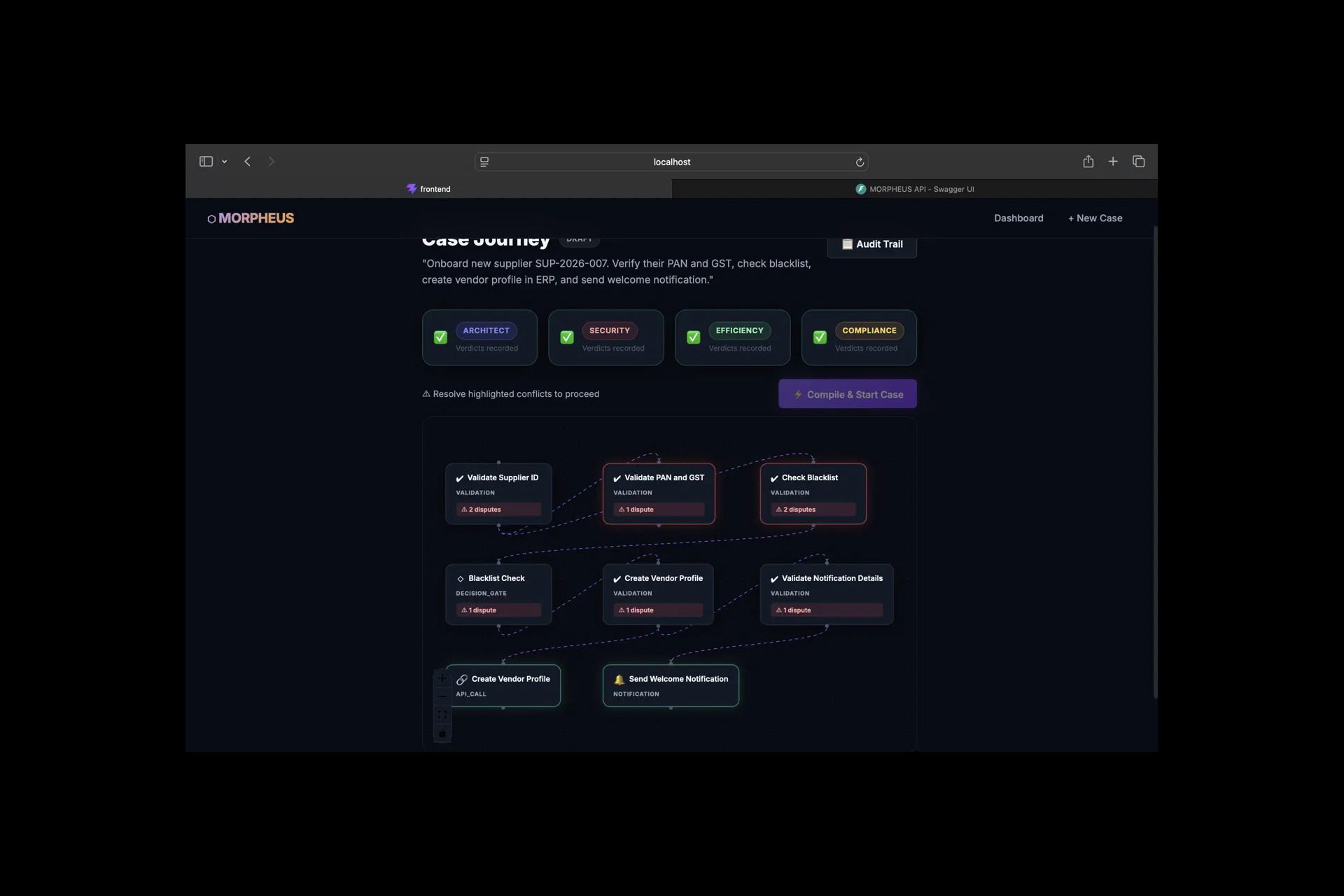
Rather than hiding disagreements, MORPHEUS visualizes them as red conflict nodes on an interactive workflow canvas. The human becomes the judge, resolving only disputed decisions instead of designing the workflow manually.
Once approved, the workflow is compiled into a persistent Case Object stored inside Neo4j AuraDB. Unlike traditional workflows that terminate after execution, a Case Object maintains identity, execution history, relationships, and architectural evolution throughout its lifecycle.
Before every external API invocation, a Hallucination Firewall validates generated requests against the live production schema. If an AI agent attempts to call an outdated endpoint or uses incorrect parameters, the request is blocked before any enterprise system is affected.
When failures occur, MORPHEUS activates its Temporal Reasoning Cortex. Using Neo4j graph traversal, it reconstructs the execution history, identifies the root cause, proposes an architectural correction, validates it through a mini Architecture Court, and resumes execution from the corrected state. Every correction becomes a permanent Amendment stored within the graph, creating an immutable and continuously evolving audit trail.
Human approvals are secured using Sarvam AI's Speech APIs, where spoken approvals are transcribed and stored as legally auditable compliance artifacts.
How we built it
Our architecture combines multiple AI and graph technologies into a unified enterprise platform.
AI Orchestration
- Multi-agent Architecture Court
- LLM-driven workflow generation
- Adversarial reasoning between specialized agents
- Human-in-the-loop conflict resolution
Knowledge & Memory
Neo4j AuraDB stores:
- Case Objects
- Workflow graphs
- Execution history
- Architectural amendments
- Compliance artifacts
Representing workflows as graphs enables causal reasoning, historical analysis, and continuous architectural evolution.
Safety Layer
We built a Hallucination Firewall that intercepts every AI-generated API request before execution.
Instead of trusting LLM outputs, the firewall validates every endpoint and parameter against the production schema. Invalid calls are rejected before reaching enterprise systems, dramatically reducing operational risk.
Compliance Layer
Sarvam AI powers:
- Multilingual voice input
- Speech-to-text approvals
- Indian language interaction
- Compliance validation
Voice approvals become permanent, legally auditable records linked directly to the corresponding Case Object.
Self-Healing Engine
Failures are not treated as dead ends.
Execution history is modeled as a graph, allowing Neo4j traversal algorithms to reconstruct the causal chain, diagnose failures, generate architectural patches, and resume execution without restarting the entire workflow.
Challenges we ran into
One of our biggest challenges was designing a system that balances AI autonomy with enterprise trust.
Allowing AI agents to independently execute workflows is powerful, but it also introduces risks such as hallucinated API calls, compliance violations, and cascading failures. We addressed this by introducing structured adversarial debate instead of relying on a single AI model.
Another challenge was modeling workflows as living Case Objects rather than traditional pipelines. We had to rethink how execution history, amendments, approvals, and relationships should persist over time. Neo4j's graph model proved ideal because it naturally represents evolving enterprise processes.
Designing the self-healing mechanism was also challenging. Instead of simply retrying failed steps, we wanted the platform to understand why the failure occurred, propose architectural improvements, and permanently learn from those corrections.
What we learned
This project reinforced an important lesson:
Enterprise AI isn't just about making better decisions—it's about making trustworthy decisions.
We learned that governance, transparency, explainability, compliance, and auditability are just as important as intelligence itself.
Graph databases are particularly well suited for enterprise reasoning because they preserve relationships, causality, and history in ways that traditional relational databases cannot.
We also realized that multiple specialized AI agents debating one another consistently produce more reliable architectures than relying on a single model.
What's next for MORPHEUS
Our vision extends beyond workflow automation.
Future improvements include:
- Continuous learning from historical enterprise cases
- Industry-specific compliance packs
- Digital twin simulation before workflow deployment
- Multi-enterprise knowledge graphs
- Risk prediction using graph neural networks
- Native integrations with enterprise ERP and CRM platforms
- Autonomous optimization based on historical amendments
Ultimately, we envision MORPHEUS as the operating system for autonomous enterprise execution—where AI agents can safely design, execute, repair, and continuously improve business processes under human governance.
Final Thought
Pega built Case Management for human executors. MORPHEUS rebuilds Case Management for autonomous AI agents that can hallucinate, fabricate data, and create enterprise risk at machine speed.
By combining structured adversarial intelligence, graph-native memory, hallucination prevention, self-healing execution, multilingual interaction, and enterprise compliance, MORPHEUS redefines what trustworthy AI automation should look like.

Log in or sign up for Devpost to join the conversation.