-
-
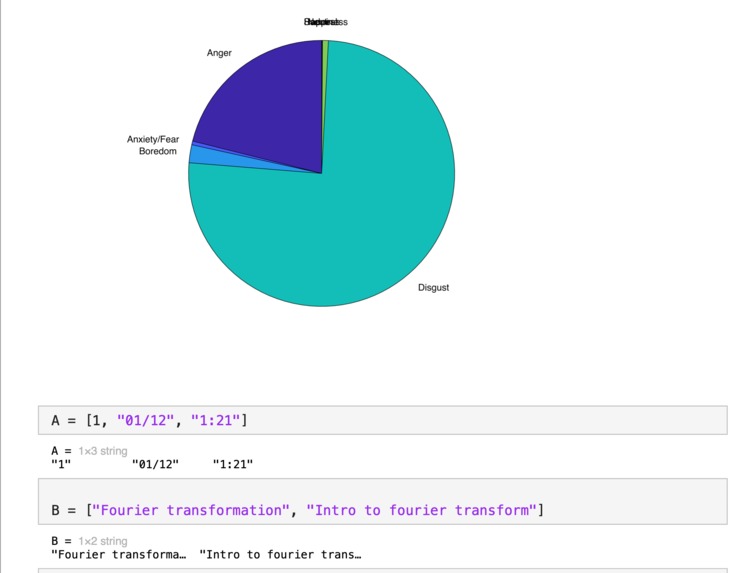
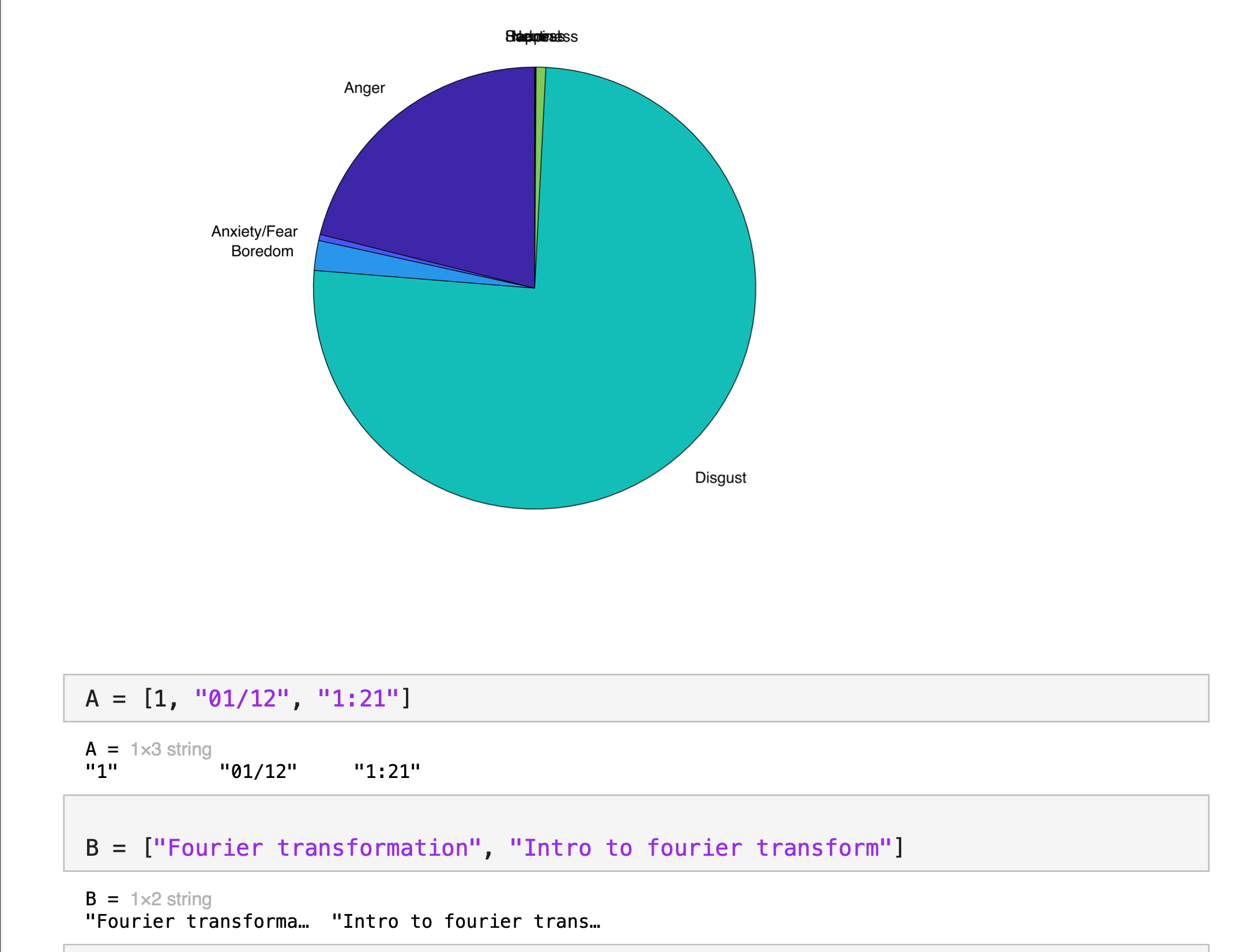
Our speech emotion recognition model output
-
Our logo
-
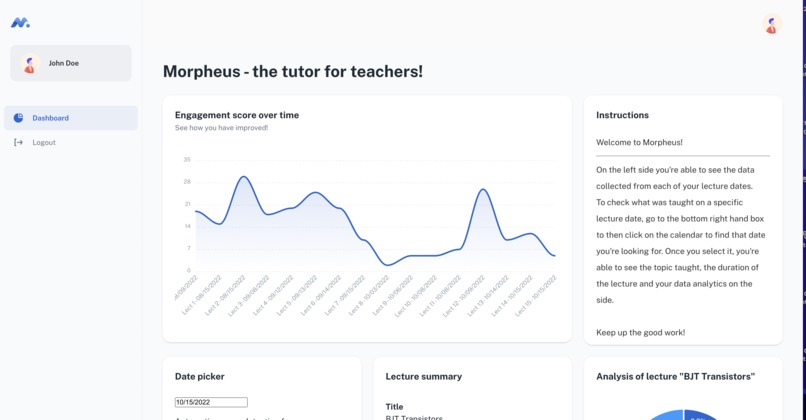
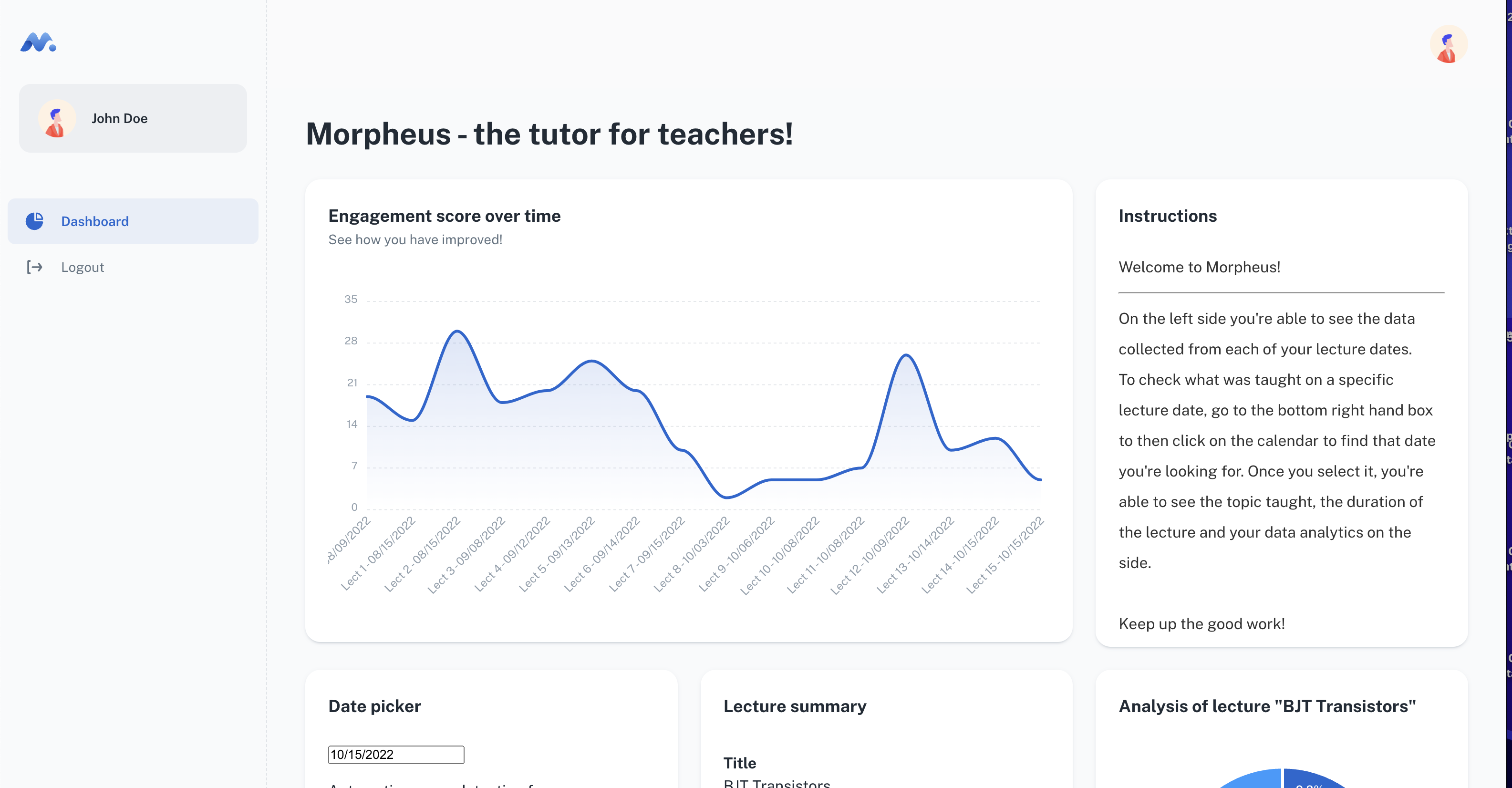
Our Dashboard for professors
-
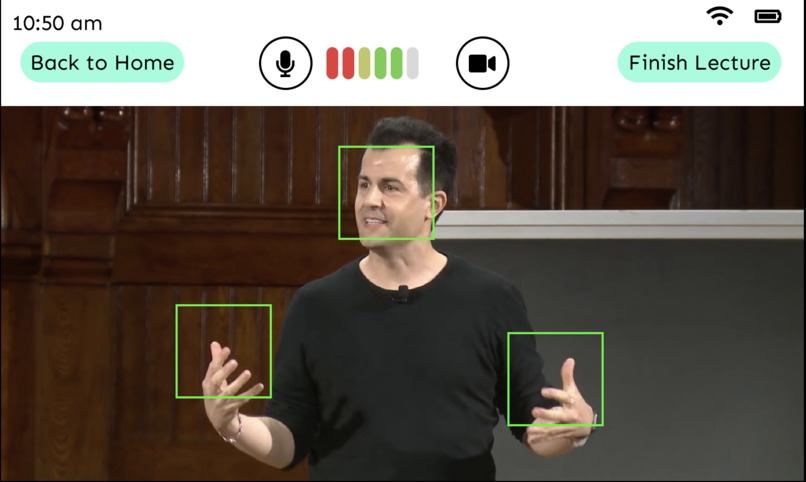
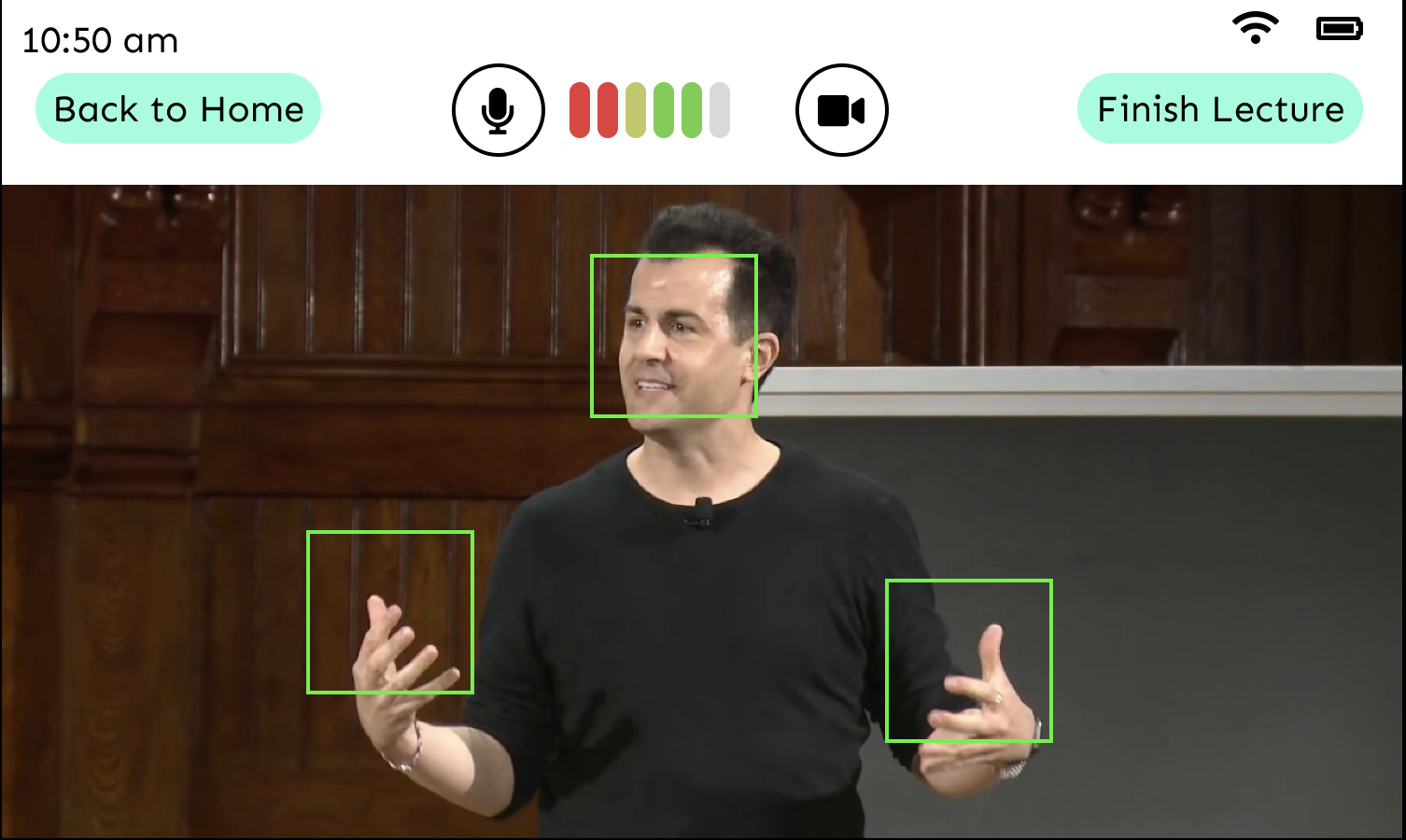
Live Lecture tracking feature
-
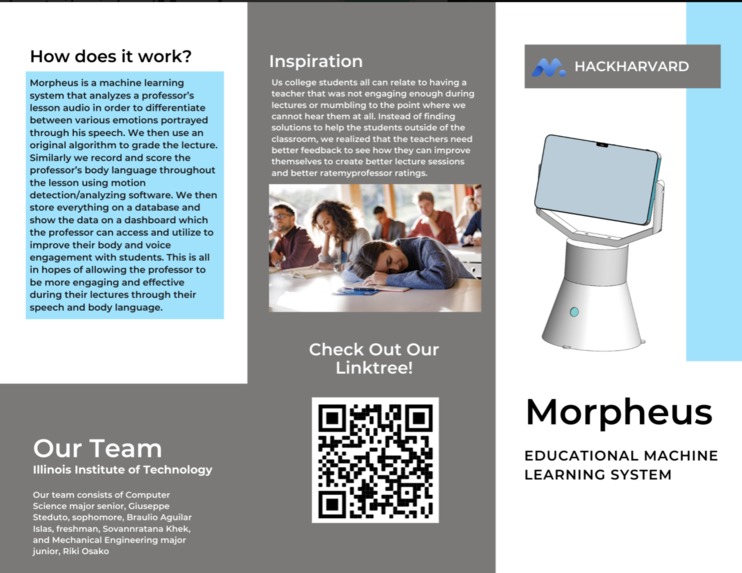
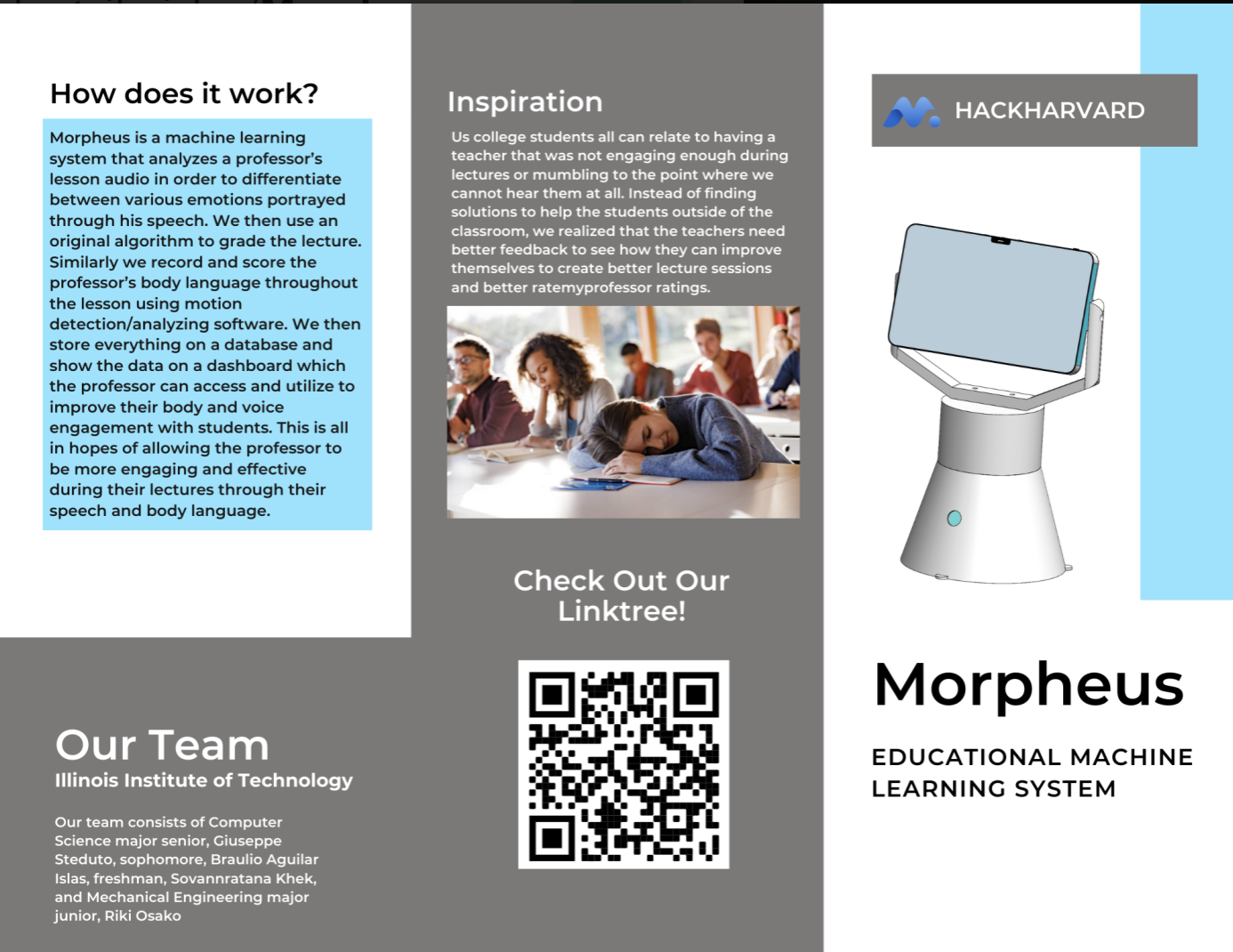
Flyer for our entire platform and product
Inspiration
Us college students all can relate to having a teacher that was not engaging enough during lectures or mumbling to the point where we cannot hear them at all. Instead of finding solutions to help the students outside of the classroom, we realized that the teachers need better feedback to see how they can improve themselves to create better lecture sessions and better ratemyprofessor ratings.
What it does
Morpheus is a machine learning system that analyzes a professor’s lesson audio in order to differentiate between various emotions portrayed through his speech. We then use an original algorithm to grade the lecture. Similarly we record and score the professor’s body language throughout the lesson using motion detection/analyzing software. We then store everything on a database and show the data on a dashboard which the professor can access and utilize to improve their body and voice engagement with students. This is all in hopes of allowing the professor to be more engaging and effective during their lectures through their speech and body language.
How we built it
Visual Studio Code/Front End Development: Sovannratana Khek
Used a premade React foundation with Material UI to create a basic dashboard. I deleted and added certain pages which we needed for our specific purpose. Since the foundation came with components pre build, I looked into how they worked and edited them to work for our purpose instead of working from scratch to save time on styling to a theme. I needed to add a couple new original functionalities and connect to our database endpoints which required learning a fetching library in React. In the end we have a dashboard with a development history displayed through a line graph representing a score per lecture (refer to section 2) and a selection for a single lecture summary display. This is based on our backend database setup. There is also space available for scalability and added functionality.
PHP-MySQL-Docker/Backend Development & DevOps: Giuseppe Steduto
I developed the backend for the application and connected the different pieces of the software together. I designed a relational database using MySQL and created API endpoints for the frontend using PHP. These endpoints filter and process the data generated by our machine learning algorithm before presenting it to the frontend side of the dashboard. I chose PHP because it gives the developer the option to quickly get an application running, avoiding the hassle of converters and compilers, and gives easy access to the SQL database. Since we’re dealing with personal data about the professor, every endpoint is only accessible prior authentication (handled with session tokens) and stored following security best-practices (e.g. salting and hashing passwords). I deployed a PhpMyAdmin instance to easily manage the database in a user-friendly way. In order to make the software easily portable across different platforms, I containerized the whole tech stack using docker and docker-compose to handle the interaction among several containers at once.
MATLAB/Machine Learning Model for Speech and Emotion Recognition: Braulio Aguilar Islas
I developed a machine learning model to recognize speech emotion patterns using MATLAB’s audio toolbox, simulink and deep learning toolbox. I used the Berlin Database of Emotional Speech To train my model. I augmented the dataset in order to increase accuracy of my results, normalized the data in order to seamlessly visualize it using a pie chart, providing an easy and seamless integration with our database that connects to our website.
Solidworks/Product Design Engineering: Riki Osako
Utilizing Solidworks, I created the 3D model design of Morpheus including fixtures, sensors, and materials. Our team had to consider how this device would be tracking the teacher’s movements and hearing the volume while not disturbing the flow of class. Currently the main sensors being utilized in this product are a microphone (to detect volume for recording and data), nfc sensor (for card tapping), front camera, and tilt sensor (for vertical tilting and tracking professor). The device also has a magnetic connector on the bottom to allow itself to change from stationary position to mobility position. It’s able to modularly connect to a holonomic drivetrain to move freely around the classroom if the professor moves around a lot. Overall, this allowed us to create a visual model of how our product would look and how the professor could possibly interact with it. To keep the device and drivetrain up and running, it does require USB-C charging.
Figma/UI Design of the Product: Riki Osako
Utilizing Figma, I created the UI design of Morpheus to show how the professor would interact with it. In the demo shown, we made it a simple interface for the professor so that all they would need to do is to scan in using their school ID, then either check his lecture data or start the lecture. Overall, the professor is able to see if the device is tracking his movements and volume throughout the lecture and see the results of their lecture at the end.
Challenges we ran into
Riki Osako: Two issues I faced was learning how to model the product in a way that would feel simple for the user to understand through Solidworks and Figma (using it for the first time). I had to do a lot of research through Amazon videos and see how they created their amazon echo model and looking back in my UI/UX notes in the Google Coursera Certification course that I’m taking.
Sovannratana Khek: The main issues I ran into stemmed from my inexperience with the React framework. Oftentimes, I’m confused as to how to implement a certain feature I want to add. I overcame these by researching existing documentation on errors and utilizing existing libraries. There were some problems that couldn’t be solved with this method as it was logic specific to our software. Fortunately, these problems just needed time and a lot of debugging with some help from peers, existing resources, and since React is javascript based, I was able to use past experiences with JS and django to help despite using an unfamiliar framework.
Giuseppe Steduto: The main issue I faced was making everything run in a smooth way and interact in the correct manner. Often I ended up in a dependency hell, and had to rethink the architecture of the whole project to not over engineer it without losing speed or consistency.
Braulio Aguilar Islas: The main issue I faced was working with audio data in order to train my model and finding a way to quantify the fluctuations that resulted in different emotions when speaking. Also, the dataset was in german
Accomplishments that we're proud of
Achieved about 60% accuracy in detecting speech emotion patterns, wrote data to our database, and created an attractive dashboard to present the results of the data analysis while learning new technologies (such as React and Docker), even though our time was short.
What we learned
As a team coming from different backgrounds, we learned how we could utilize our strengths in different aspects of the project to smoothly operate. For example, Riki is a mechanical engineering major with little coding experience, but we were able to allow his strengths in that area to create us a visual model of our product and create a UI design interface using Figma. Sovannratana is a freshman that had his first hackathon experience and was able to utilize his experience to create a website for the first time. Braulio and Gisueppe were the most experienced in the team but we were all able to help each other not just in the coding aspect, with different ideas as well.
What's next for Untitled
We have a couple of ideas on how we would like to proceed with this project after HackHarvard and after hibernating for a couple of days.
From a coding standpoint, we would like to improve the UI experience for the user on the website by adding more features and better style designs for the professor to interact with. In addition, add motion tracking data feedback to the professor to get a general idea of how they should be changing their gestures.
We would also like to integrate a student portal and gather data on their performance and help the teacher better understand where the students need most help with. From a business standpoint, we would like to possibly see if we could team up with our university, Illinois Institute of Technology, and test the functionality of it in actual classrooms.


Log in or sign up for Devpost to join the conversation.