-
-
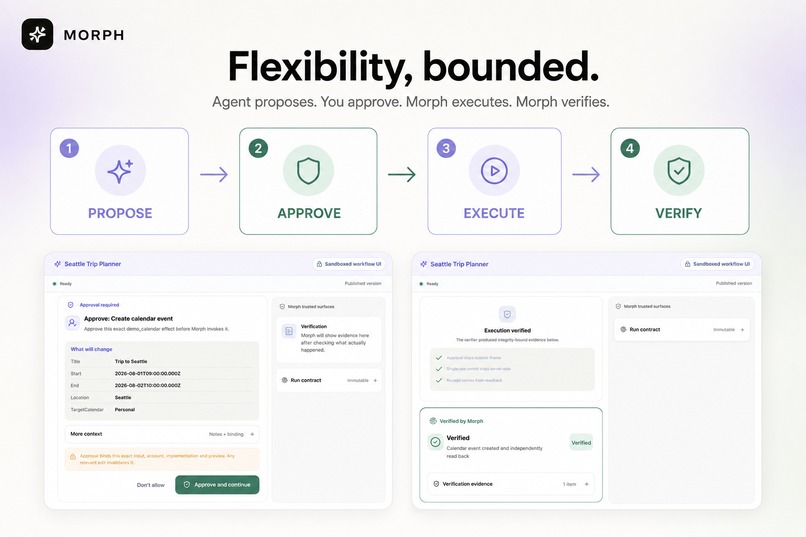
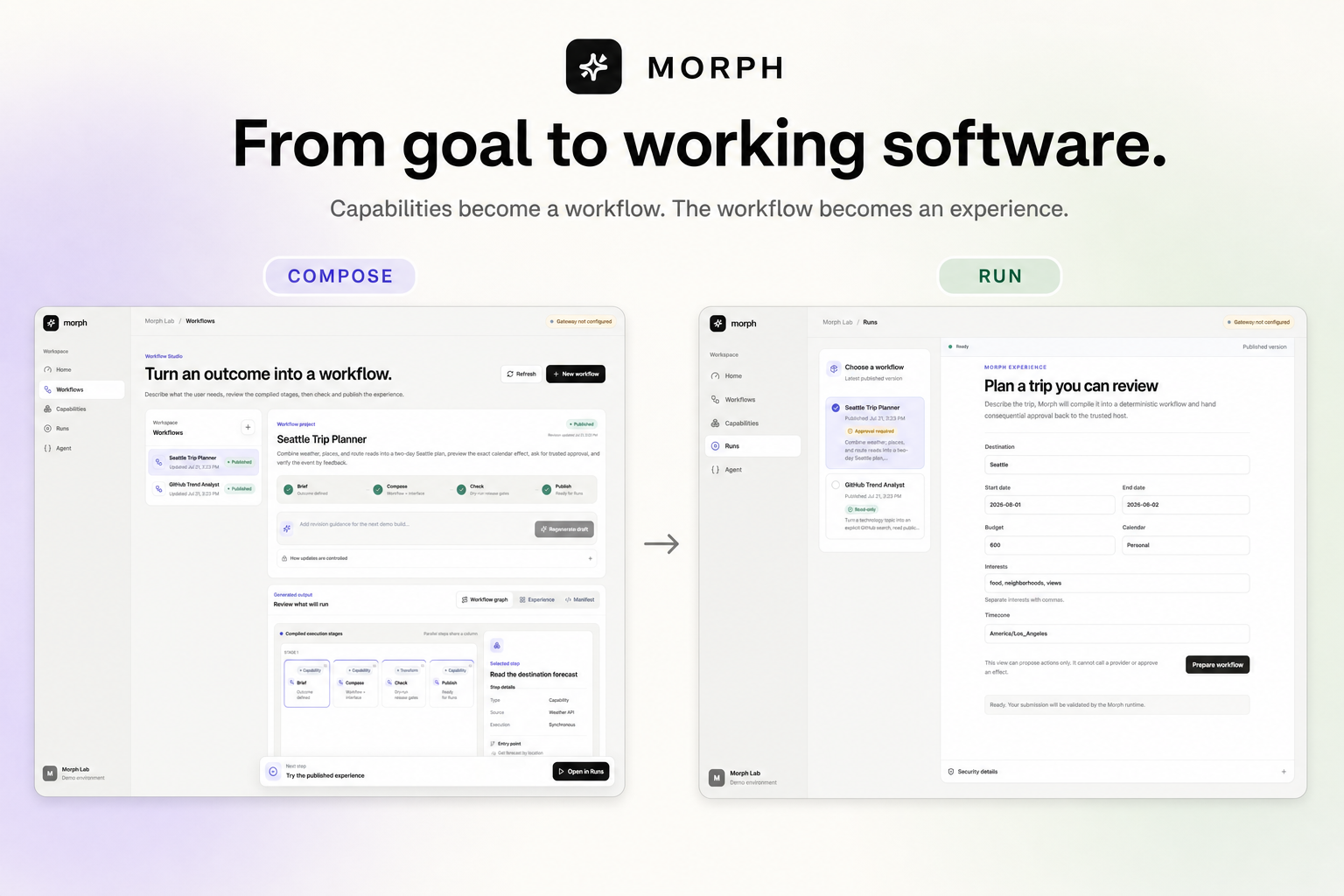
From goal to working software — Compose to Run.
-
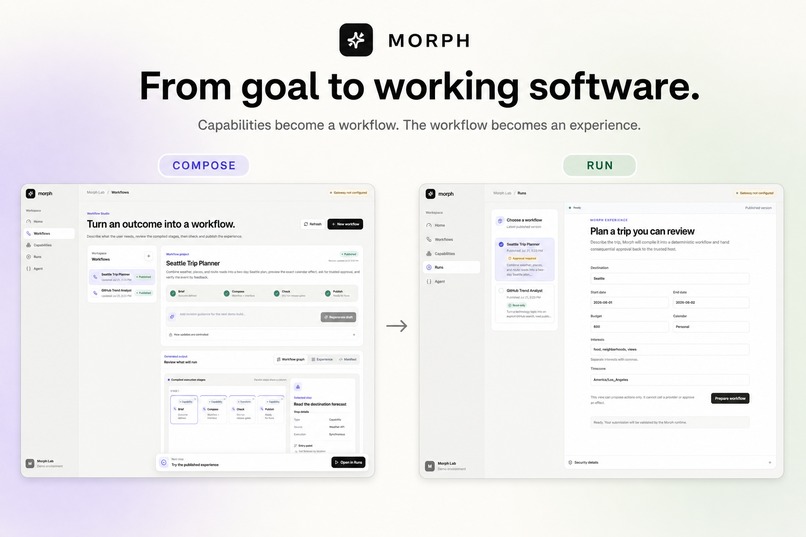
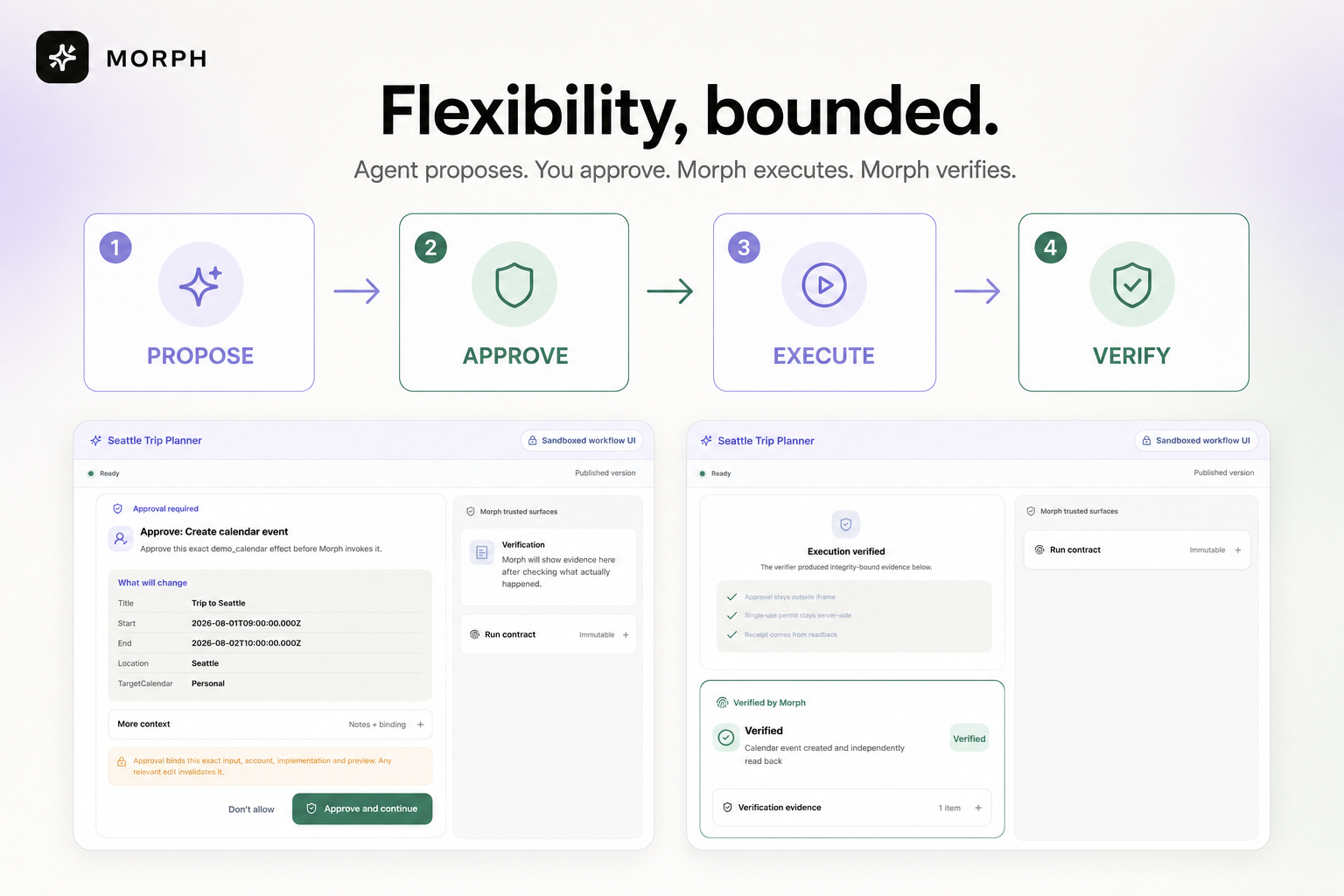
Flexibility, bounded — Propose, Approve, Execute, Verify.
Inspiration
AI agents are powerful, but their actions are often opaque and unpredictable. We wanted users to get the flexibility of an agent without giving up understanding, approval, or control.
What it does
Morph turns a user goal into a visible, editable workflow and a purpose-built interface across connected services. During generation, a coding agent first creates explicit Capabilities, then composes them into a deterministic Workflow. At runtime, Morph executes that workflow, while a bounded agent can still invoke approved capabilities dynamically when needed.
Before any consequential action, Morph shows the exact effect, asks for approval, issues a single-use execution permit, verifies the provider result, and produces a receipt. The demo follows a Seattle trip from workflow generation and publication through calendar execution and deterministic readback.
How we built it
Morph is a TypeScript full-stack application with a React/Vite experience, an Express runtime, schema-validated capability contracts, workflow compilation, approval and permit services, verification, and receipts. The Runtime SDK gives generated consumer experiences a narrow interface for invoking capabilities and running workflows.
Our existing Sentra agent integrates GPT-5.6 Terra for bounded semantic proposals. GPT-5.6 can suggest the next capability call or workflow structure, but Morph retains authority over contracts, approvals, provider execution, and verification.
Codex accelerated the full lifecycle: product architecture, capability and workflow contracts, the developer console, generated consumer experience, runtime SDK, trip and GitHub demos, E2E validation, documentation, and demo production. Key product and trust decisions remained explicit and reviewable throughout.
Challenges
The hardest part was preserving agent flexibility while making execution deterministic. We separated semantic proposal from execution authority, modeled exact effects before approval, and made verification a first-class step instead of assuming a successful API response meant the user goal was achieved.
Accomplishments
We completed the end-to-end loop: create capabilities, compose and publish a workflow, generate a user-facing experience, preview exact effects, approve, execute once, independently verify, and issue a receipt.
What we learned
The most useful agent platform is not the one that hides the most complexity. It is the one that turns uncertainty into an inspectable plan and makes every consequential transition legible.
What's next
Next we will add more capability adapters, captured-interface onboarding for platforms without OpenAPI, stronger replay and audit tooling, collaborative workflow editing, and deployable generated experiences.
Built With
- codex
- express.js
- fastapi
- node.js
- openai
- openapi
- python
- react
- sqlite
- typescript
- vite


Log in or sign up for Devpost to join the conversation.