Inspiration
Haiti faces one of the lowest water and sanitation coverage rates in the Western Hemisphere. Only 26 percent of the population has access to improved sanitation, and most rural households rely on unsafe water sources like wells and springs. When we learned about how affordable technologies could reduce waterborne diseases, we saw an opportunity to combine local agriculture and simple science into a practical, scalable solution. The idea grew from the realization that Moringa oleifera, a plant already thriving in Haiti, can naturally purify water and that discarded tyres can become low-cost filter components.
What it does
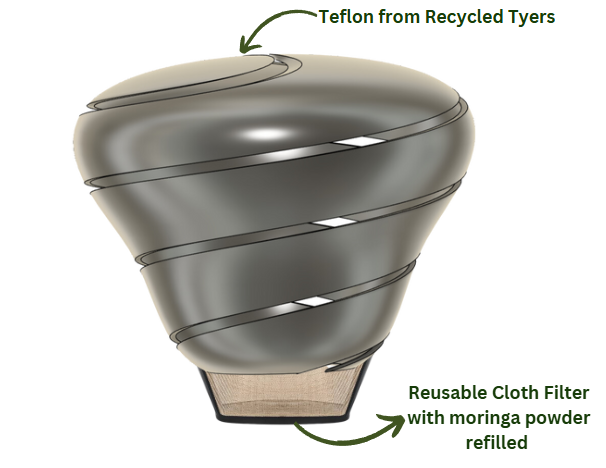
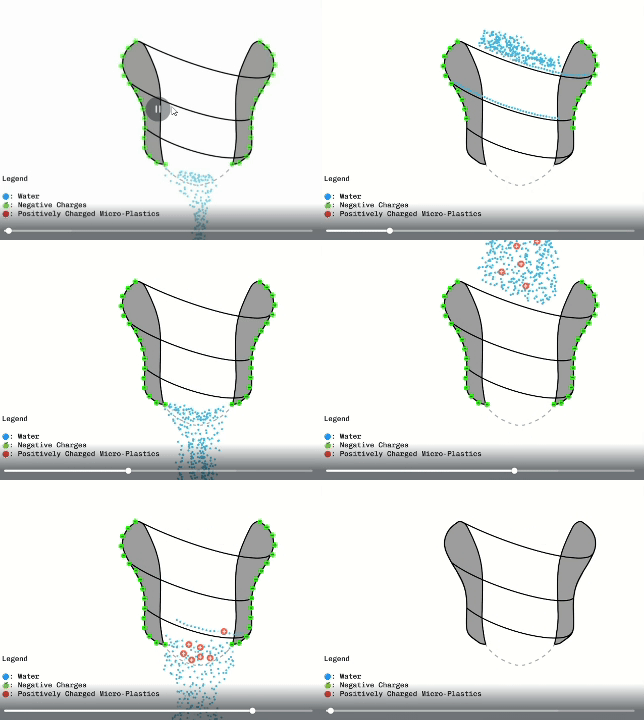
Our solution is a moringa-infused triboelectric water filter that removes bacteria and particulates in a single step. No electricity, no complex maintenance. Each unit costs USD 3–5 and USD 0.05 per refill. Moringa seed proteins act as a natural coagulant, removing over 90 percent of bacteria. Triboelectric surfaces use static electricity generated through friction to boost filtration efficiency. All components are designed to be locally sourced, recyclable, and affordable.
How we built it
We combined two proven scientific principles: Moringa coagulation - powdered moringa seeds bind and remove contaminants. Triboelectric filtration - static charge attracts particulates, improving filter performance. We mapped out a circular supply chain where local tyre recyclers fabricate filter components, farmer cooperatives provide moringa seeds, and village distributors handle sales and refills. The design prioritizes low-tech assembly and community ownership, making it feasible to scale even in rural settings.
Challenges we ran into
Sourcing and processing moringa seeds to meet consistent quality standards. Designing filter components that are durable yet inexpensive. Accounting for Haiti’s infrastructure gaps, security challenges, and limited transport. Planning how to sustain operations without over-reliance on external NGOs.
Accomplishments that we're proud of
Researching a cost-effective filter design that integrates local agro and waste resources. Creating a scalable circular business model linking farmers, recyclers, and distributors. Produced a clear 10-year impact plan, aiming to reach 2.5 million Haitians. Received strong validation from public health and sustainability research.
What we learned
Effective solutions for global challenges don’t always require high tech, sometimes the simplest ideas scale the fastest. Designing for local ownership is key to long-term sustainability. Interdisciplinary approaches, combining environmental engineering, agriculture, and social enterprise, unlock new possibilities.
What’s next for the moringa-infused triboelectric water filter
Launch a pilot program in 4–5 communes, producing and distributing 1,000 units using the initial grant. Train local sellers and recyclers to handle production, refills, and education. Expand to 10,000 units by Year 3, with a stable refill network and NGO support for outreach. By Year 10, scale to 500,000 units, creating 1,000+ local jobs and preventing tens of thousands of waterborne disease cases annually. Explore expansion to other Caribbean and Sub-Saharan African countries facing similar water access challenges.
Built With
- 3d-modeeling
- 3d-printing
- fluid-dynamics
- tribo-electric-effect

Log in or sign up for Devpost to join the conversation.