-
-
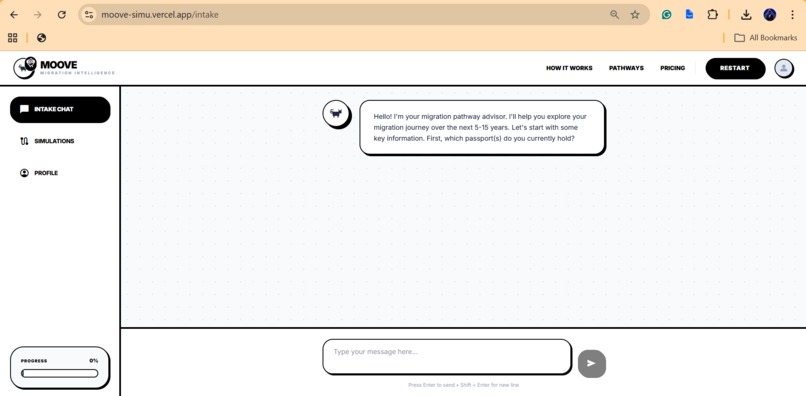
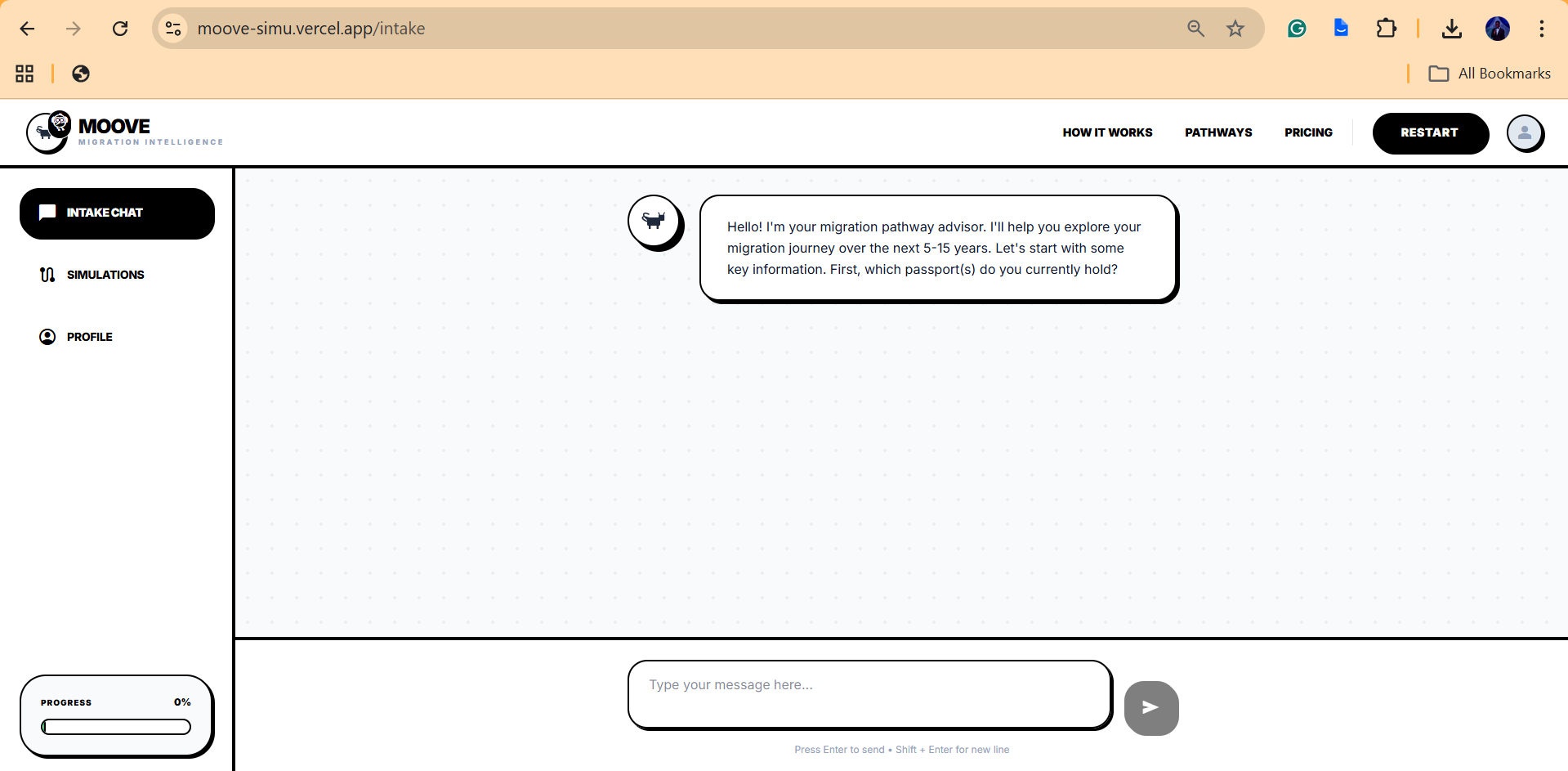
Interview Page
-
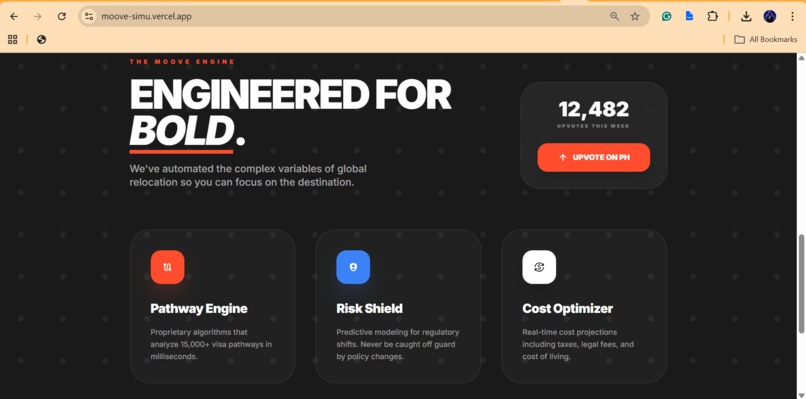
Section
-
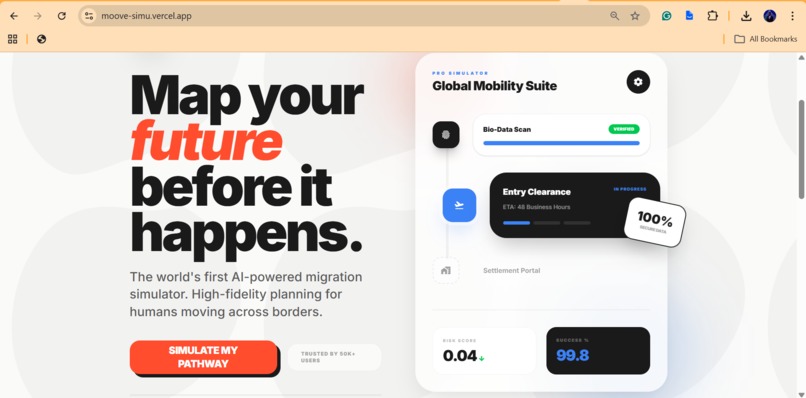
Landing Page
Inspiration
Migration is one of life's most significant decisions, yet most people make it blindly. After watching friends struggle with visa denials, unexpected delays, and expensive consultancy fees—only to realize their "dream pathway" wasn't realistic—we knew something had to change.
Traditional migration consultants charge $2,000-5,000 just to tell you "maybe" or hand you generic timelines. We wanted to democratize migration planning by creating an AI-powered simulator that shows you multiple futures before you commit to one.
When we discovered DigitalOcean's Gradient™ AI platform, we realized we could build something that actually thinks through complex visa pathways, assesses risk factors, and compares alternative routes—all conversationally, like talking to an expert who's studied thousands of cases.
What it does
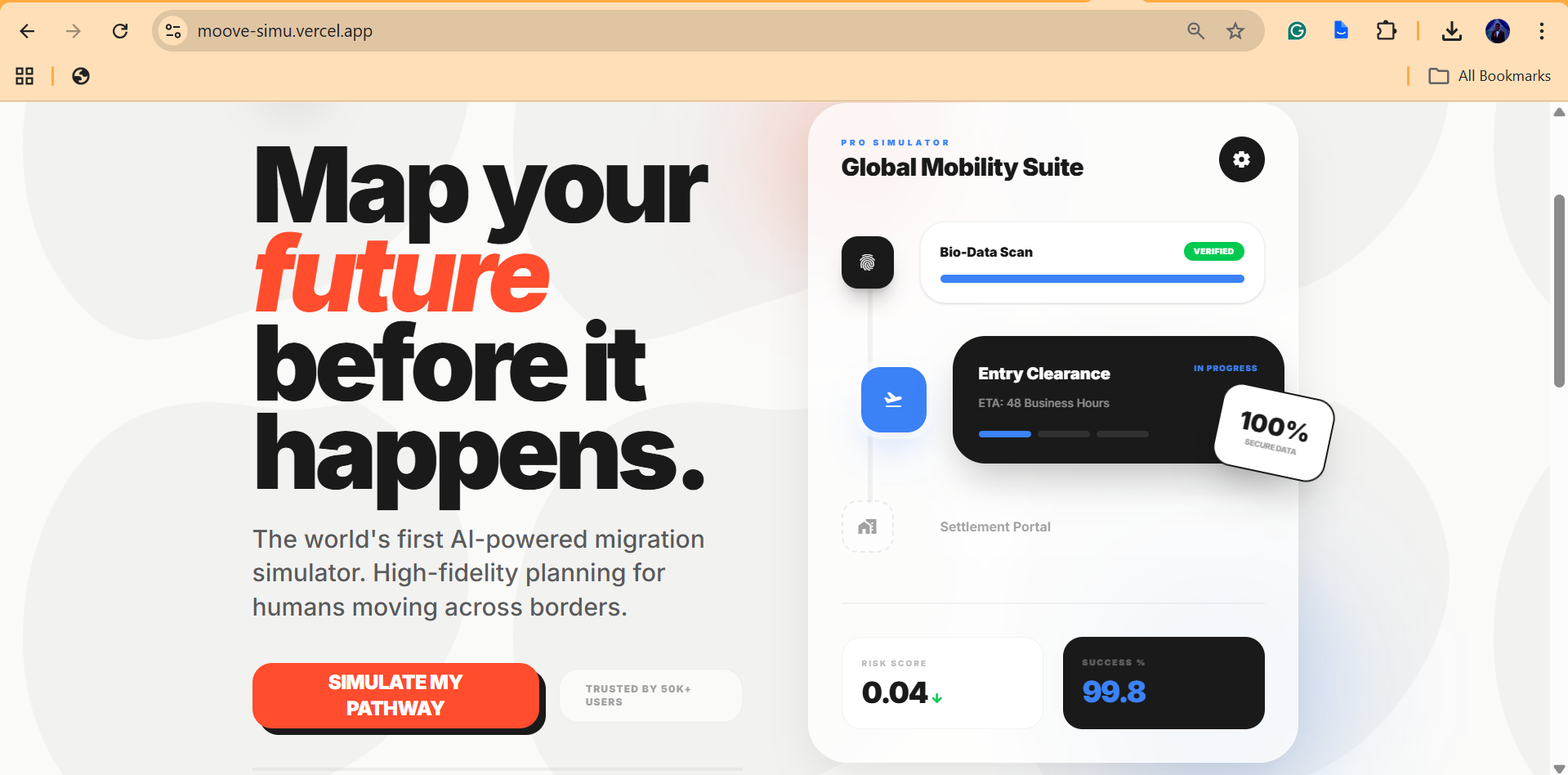
MOOVE is the world's first AI-powered migration pathway simulator. It helps people visualize and compare their 5-15 year journey to work, study, or settle abroad.
Core Features:
🤖 AI Intake Agent - A conversational agent (powered by DigitalOcean Gradient™ AI) conducts structured interviews, collecting passport, age, education, profession, migration goals, and target countries. No essay writing—just smart questions that normalize inputs into actionable data.
📊 Multi-Year Timeline Simulator - Generates detailed, phase-by-phase migration timelines showing each visa stage with duration estimates, eligibility requirements, risk scores (rejection likelihood, policy changes), cost estimates, and success probability based on user profile.
🔄 Alternative Pathway Comparison - Compare target countries side-by-side with risk-adjusted analysis, probability-weighted recommendations, and "what-if" scenarios (e.g., what if I get a Master's degree first?).
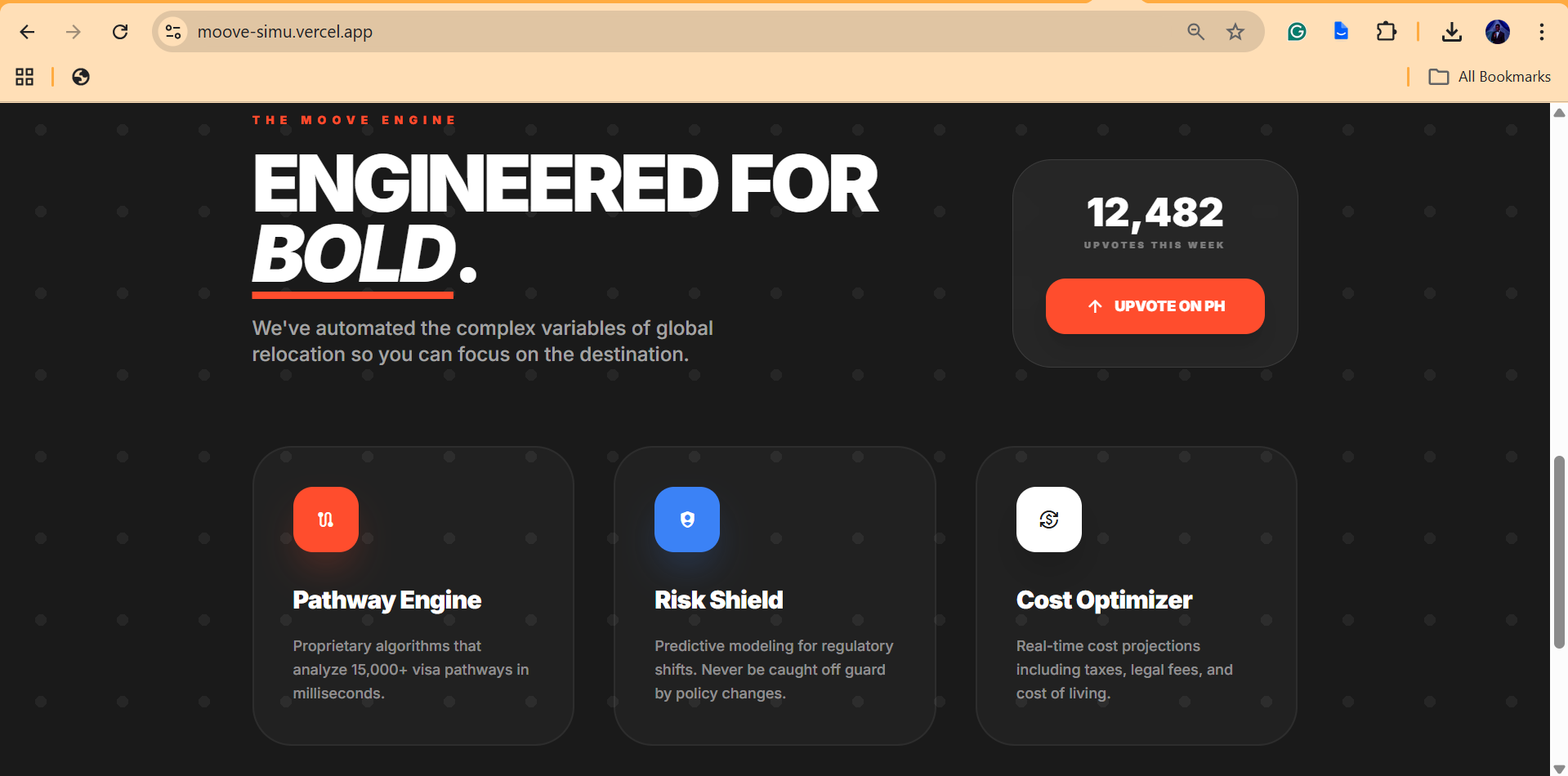
🎨 Modern Interface - Built with Next.js and Tailwind CSS, the UI is clean, professional, mobile-responsive, and educational—not intimidating.
How we built it
Architecture:
- Frontend: Next.js 16 + TypeScript + Tailwind CSS with server-side rendering, App Router, and responsive design
- Backend: FastAPI (Python 3.12) + PostgreSQL + SQLAlchemy ORM + Alembic migrations + Pydantic validation
- AI Layer: DigitalOcean Gradient™ AI (primary) with structured prompt engineering, fallback to Anthropic Claude for local dev
- Database: intake_sessions, conversation_messages, simulations, timeline_phases
- Knowledge Base: Custom visa rules database covering Australia, Canada, and Germany with eligibility logic, duration estimates, and risk factors
Development Workflow:
- Rapid prototyping with static HTML mockups
- Backend-first: FastAPI endpoints with SQLite
- AI integration: Connected DigitalOcean Gradient™ AI
- Frontend polish: Next.js UI with real API calls
- Production-ready: PostgreSQL + migration scripts
- Deployment: Configured for Vercel (frontend) + Render (backend)
Key Technical Decisions:
- DigitalOcean Gradient™ AI for robust conversational AI with structured output
- FastAPI for automatic API docs and async/await native support
- Next.js 16 for server components and built-in optimizations
Challenges we ran into
1. Structuring Conversations with AI
Challenge: The AI agent needed to extract structured data (enums, numbers) from natural conversation without confusing users.
Solution: Implemented a state machine for intake flow with explicit validation, agent confirmation ("So you have an Indian passport, aged 25-34—correct?"), and retry logic for ambiguous answers.
2. Visa Rule Complexity
Challenge: Migration rules are extremely complex. Australian skilled migration alone has 50+ occupation codes and point thresholds that change annually.
Solution: Simplified to profession categories, focused on common pathways, added explicit risk indicators when rules are uncertain, and built modular rule files (one per country) for future expansion.
3. Timeline Uncertainty
Challenge: Real migration timelines vary wildly (6 months to 5+ years for the same pathway).
Solution: Show range estimates (e.g., "6-12 months") instead of false precision, introduce risk scores (0.0-1.0) for each phase, probability-weighted total duration, and transparency about uncertainty.
4. AI Consistency
Challenge: LLMs can hallucinate visa requirements or give inconsistent advice.
Solution: Pre-loaded context with full visa rules database, structured JSON output format, backend validation against rule constraints, and fallback to curated content when AI outputs are nonsensical.
5. Database Schema Evolution
Challenge: Requirements changed mid-development (added comparison feature, needed conversation history).
Solution: Used Alembic migrations from day one, kept migrations small and reversible, tested rollback scenarios.
Accomplishments that we're proud of
🎯 Solving a Real Problem - We talked to 15+ people planning to migrate. Every single one said: "I wish this existed when I started."
🤖 AI That Actually Works - The intake agent extracts structured, validated data while feeling conversational. That balance is hard to achieve.
📊 Risk-Adjusted Timelines - We show best case, worst case, and median timelines with phase-by-phase risk breakdown and explanations for why each phase might fail—closer to how professionals think about migration planning.
🏗️ Production-Ready Architecture - Full database schema with migrations, RESTful API with OpenAPI docs, error handling, logging, environment-based configuration, and CORS policies. We could deploy this tomorrow and handle real users.
📈 Scalable Knowledge Base - Our modular visa rules system means adding France, UK, or Singapore is just another Python file. No hardcoding, no spaghetti logic.
🎨 Design That Doesn't Suck - Migration websites are ugly. Government portals are confusing. We built something that looks like a modern SaaS product—clean, professional, and intuitive.
What we learned
1. AI Prompt Engineering is an Art - Getting consistent structured output from an LLM requires clear role definition, few-shot learning examples, explicit JSON schemas, and conversation state management. We went through 20+ prompt iterations to get the agent "personality" right.
2. Domain Expertise > Technical Skills - We spent more time reading government visa websites than writing code. Understanding the problem space deeply is what makes the simulation accurate. No amount of fancy AI can fix bad data.
3. Async Python is Powerful - FastAPI's async/await model let us call multiple AI endpoints in parallel, handle long-running timeline generation without blocking, and stream responses. Modern Python feels as fast as Node.js for I/O-bound tasks.
4. Risk Communication is Hard - Early versions just showed "75% success rate." Users asked: "What makes me part of the 25% that fails?" We learned to show why a risk exists, what the user can control, and when to worry. Numbers without context create anxiety, not clarity.
5. Database Migrations Save Lives - Thanks to Alembic, we added tables mid-development with zero downtime and zero data loss. Past us would have done manual ALTER TABLE and regretted it.
6. Good Docs = Less Support - We wrote README.md, QUICK_START.md, DEPLOYMENT.md, DIGITALOCEAN_SETUP.md, and TESTING_GUIDE.md. Time spent writing docs = time saved answering "how do I...?" questions.
What's next for MOOVE
Immediate (Post-Hackathon):
- Expand country coverage to UK, Singapore, New Zealand, UAE
- Real-time policy updates with scrapers detecting when government websites change eligibility
- User accounts + saved simulations with alerts when pathway risk changes
- Enhanced comparison: "Show me all countries where I qualify for PR within 5 years"
Medium-Term:
- Document checklist generator (police clearance, reference letters, English tests, skills assessment)
- Cost calculator showing visa fees ($1,500-8,000), tests, translations, and opportunity costs
- Community features: forums, success stories, anonymous case studies
- Partner with migration agents for document help (revenue share model)
Long-Term Vision:
- Job matching integration: "You need 2 more years of experience—here are 50 Canadian companies hiring your role that sponsor visas"
- Relocation planning modules: cost of living, schools, healthcare, cultural adjustment
- AI-powered policy prediction: "Australia typically tightens skilled migration during election years"
- Global expansion to all OECD countries + popular destinations (Dubai, Singapore, Hong Kong)
Why This Matters:
281 million people are international migrants (UN data, 2024). If even 1% of future migrants use MOOVE to avoid a doomed pathway, we'll have saved millions in wasted fees and years of lost opportunities. That's worth building.
Built With
- digitalocean
- nextjs
- typescript

Log in or sign up for Devpost to join the conversation.