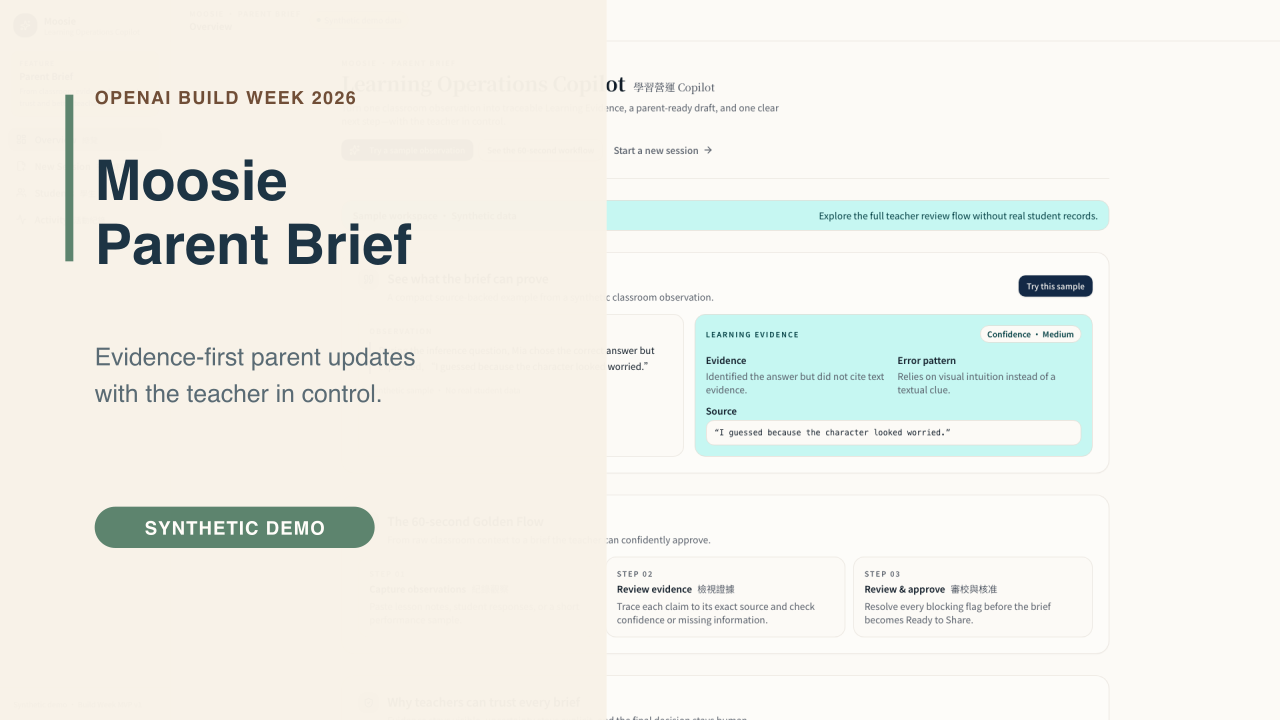
Moosie Parent Brief
Moosie Parent Brief is the first public workflow in Moosie Learning Operations Copilot—an AI assistant for small learning centers that turns scattered classroom observations into evidence-backed parent communication and actionable next-lesson plans.
Our goal is simple:
Help teachers spend less time rewriting notes after class, while making every important parent-facing claim traceable, reviewable, and teacher-approved.
Inspiration
Teachers in small tutoring centers often finish class with valuable but fragmented observations: a learner spoke more confidently, struggled with a grammar pattern, needed prompting for a certain question type, or showed progress in a specific activity.
Turning those notes into a thoughtful parent update takes time. It also requires care: a message should be encouraging, specific, accurate, and useful for the next lesson—without overstating progress or inventing facts.
We did not want to build another generic AI text generator. We wanted to build a workflow that preserves the teacher’s professional judgment:
Classroom observation
→ Learning evidence
→ Parent-ready brief
→ Teacher review
→ Teacher approval
→ Ready to Share
The project was inspired by a practical question:
What if teachers could begin with an AI draft, while still retaining full control over what becomes parent communication?
What it does
Moosie Parent Brief helps teachers transform lesson notes into:
- Structured learning evidence
- Identified strengths and error patterns
- A concise bilingual parent update in English and Traditional Chinese
- A more detailed parent-facing explanation
- A recommended next-lesson objective and short practice activity
- Review flags for missing evidence, low confidence, sensitive content, or missing information
Every generated brief begins as a Draft. It cannot become Ready to Share until a teacher reviews it and resolves any blocking flags.
The public demo uses synthetic data only. Moosie does not automatically send messages to parents.
How we built it
We designed Moosie as a focused vertical slice rather than a full school-management platform.
The core workflow starts with lesson context and raw teacher observations. GPT-5.6 extracts structured learning evidence, identifies observable patterns, and generates parent-facing language and a next-lesson recommendation.
A key part of the product is evidence traceability. Important factual claims are linked back to the original teacher input through a source_span contract:
source_span = {
  field: "observation_text",
  start_char: number,
  end_char: number,
  quote: string
}
The application validates that:
quote === input[field].slice(start_char, end_char)
If a factual claim does not have valid supporting evidence, Moosie adds a Needs Evidence review flag instead of presenting the claim as trustworthy.
We also built the workflow around a two-layer review model:
- Artifact status:
DraftorReady to Share - Review flags:
Needs Evidence,Low Confidence,Sensitive Content, andMissing Information
This separation prevents a common AI-product failure mode: treating “generated” as equivalent to “approved.”
Human-in-the-loop by design
Teachers remain responsible for high-impact communication.
Moosie is designed so that:
- AI-generated content starts as a draft.
- Blocking review flags must be resolved before approval.
- Teachers can edit the brief before approving it.
- Editing an approved brief returns it to Draft for re-review.
- The product does not automatically send anything to parents.
This makes the AI useful without asking teachers to surrender their judgment.
What we learned
1. Trust is a product feature
A polished message is not enough. Teachers need to know why the system made a claim and whether that claim is grounded in what happened in class.
Showing source evidence, confidence, and review flags is more valuable than hiding uncertainty behind fluent language.
2. The best AI workflow is not always fully automated
The most meaningful automation was not “send a parent message automatically.” It was reducing the time needed to turn raw notes into a strong first draft—while making exceptions visible for teacher review.
3. Scope discipline creates a stronger demo
We intentionally avoided building a full CRM, LMS, scheduling system, parent app, or automated messaging platform.
Instead, we concentrated on one workflow:
observation → evidence → parent brief → review → approval
That focus made the product easier to understand, test, and improve.
4. Safety requirements should shape the interface
We learned that safety is not only a prompt or policy issue. It must be visible in the interface:
- explicit Draft status
- clear confidence signals
- blocking review flags
- approval gates
- synthetic demo data
- no automatic sending
Challenges we faced
Turning unstructured notes into reliable evidence
Teacher notes can be short, mixed-language, incomplete, or ambiguous. A note such as “今天表現不錯” should not become a detailed claim about measurable progress.
We addressed this by distinguishing between supported evidence, low-confidence inferences, and missing information. Ambiguous input should trigger review—not fabricated certainty.
Preventing plausible but unsupported claims
AI can produce language that sounds helpful while adding details that were never observed. This is especially risky in education, where parent communication affects trust.
Our evidence validation approach was built to catch unsupported factual claims before they reach an approval-ready state.
Balancing a friendly experience with operational rigor
Moosie needed to feel approachable for teachers while still providing the operational details needed for review: evidence sources, confidence levels, flags, statuses, and approval states.
We used a bilingual interface and progressive disclosure so the core workflow remains understandable without hiding important safeguards.
Building a credible public demo without real student data
Because this project concerns children and classroom records, the public demo uses fully synthetic student profiles and lesson notes. This required us to design realistic cases without exposing personal information.
What’s next
We plan to continue improving Moosie through teacher testing and evaluation of:
- Completion time compared with manual parent-update workflows
- Teacher retention of AI draft language
- Evidence support rate for factual claims
- Approval confidence
- Common correction types
- Reliability across normal, ambiguous, bilingual, and sensitive cases
Our long-term vision is not to replace teachers. It is to give small learning centers better operational tools so that meaningful classroom learning can become clearer parent trust and better teaching decisions.
From classroom evidence to parent trust and better teaching.


Log in or sign up for Devpost to join the conversation.