Inspiration
A lunar construction crew (excavators, haulers, a compactor, a regolith printer, a surveyor) will work with limited communication windows and no operator in the loop. A plan that overdraws a battery or puts two robots in the same blast zone is not a small bug on the Moon. Large language models are very good at turning a construction brief into a work breakdown and very bad at guaranteeing that the breakdown is executable. We wanted the two halves to talk: the model plans, a constraint solver proves the plan against the physical budgets, and when the solver says no it tells the model exactly which constraints collided, so the model can repair the plan instead of guessing again.
What it does
- Brief to requirements. A plain-English brief ("build a 20 m landing pad and a 60 m blast berm with two excavators, two haulers, a compactor, a printer and a surveyor within 14 days") becomes structured requirements (site grid and work zones, structures with dimensions, fleet with battery budgets, deadline) that the planner can correct before anything is scheduled.
- Task graph with quantities. Nemotron proposes the tasks: what to do, on which structure, in which zone, how much (cubic metres excavated, square metres compacted or sintered), in what order, with which robot type. Durations and energies are not the model's guess: a documented rate model turns the quantities into hours and watt-hours, so the model cannot make a plan feasible by shrinking numbers.
- Proof. A deterministic validator catches structural defects (cycles, unknown references, missing phases for a structure, work no robot can do), then an OR-Tools CP-SAT model schedules the graph: precedence, one task per robot at a time, one robot per safety zone, per-robot battery budgets including every leg the robot drives (travel is exact: CP-SAT picks each robot's order and pays the legs of that order), the deadline, makespan minimised and proven.
- Repair with reasons. When the model's graph is infeasible, CP-SAT returns a minimal set of conflicting constraints (for example
energy:EX1,precedence:T4->T2) with the numbers behind them ("EX1 and EX2 each have 5,000 Wh; the excavator tasks need at least 9,915 Wh in total, 15 Wh of it travel, and cannot be split across 2 excavators (10,000 Wh combined) without exceeding one budget"). That goes back to Nemotron, up to three rounds; every change the model makes is shown as a diff, and scope reductions are flagged for the planner's approval. Only solver-verified schedules reach the Gantt chart, together with a Nemotron-written explanation. - Execution and replanning. The plan runs in a 2D site simulator with travel, battery drain and injected failures. When a robot fails, the agent locks the in-progress work, reschedules the remaining tasks with the solver in milliseconds, and escalates to Nemotron only when the remaining fleet provably cannot finish, so the work has to be re-scoped. Before and after are shown side by side.
- Robustness. A Monte Carlo panel replays the plan hundreds of times with random robot failures and duration jitter and reports the probability of finishing within the deadline, which robots are single points of failure, and what a spare would buy.
- On rovers, in NVIDIA Isaac Sim. Seven four-wheeled PhysX rovers carry out the verified plan on the rim of Shackleton crater (NASA LOLA's 5 m/px terrain) at lunar gravity. When a rover breaks down, the rovers' telemetry goes to Moonwright, CP-SAT replans, and the rovers carry out the new verified schedule: the agent senses, decides and acts in a physics simulation. When a rover stalls for a reason the map does not show, NVIDIA Cosmos Reason 2 reads its camera: a rock at its nose means it is sound and goes around, under the same health check; anything else means it is lost, and Moonwright replans.
How we built it
- Models on Nebius Token Factory (OpenAI-compatible API):
nvidia/Nemotron-3_5-Lightningfor the short structuring call (thinking off, ~4 s),nvidia/Nemotron-3-Ultra-550b-a55bwith reasoning for task-graph generation and repair (the step that needs multi-step decomposition),nvidia/nemotron-3-super-120b-a12bfor the explanation prose. Each size does the job its size fits; the UI shows which model answered each step with tokens and latency. Structured output usesresponse_format(JSON schema first, JSON mode as fallback) and every answer is validated with pydantic and re-asked with the validation errors when needed. - Verification: Python validator plus a CP-SAT model with optional intervals per (task, robot), an
AddCircuitper robot whose arcs time and charge the leg between two consecutive tasks (exact, sequence-dependent travel),AddNoOverlapper robot and per zone, linear energy budgets and a makespan objective. Infeasibility explanations use assumption literals per named constraint group,SufficientAssumptionsForInfeasibility, a deletion filter to make the core minimal, and a multi-worker fallback for instances the single-worker proof cannot finish. Every schedule is re-verified by an independent checker before it is shown. - Simulation and replanning: a grid simulator with travel time and energy, battery depletion as a failure, event detection, and a replanning path that derives the remaining work from the original task definitions, locks the running task to its robot, and refuses replans that drop work.
- Isaac Sim closed loop: NVIDIA Isaac Sim 5.1 on a Windows RTX 4070 SUPER. Each robot is an articulation (chassis and four driven wheels) on terrain cut from NASA LOLA's map of Shackleton's rim; the executor follows the 2D simulator's rules, and a bridge script hands the measured frame to the backend's
replan_after_event(the same code path as the 2D replans) and the verified schedule back to the rovers. RTX rendering with Replicator; NASA's RASSOR model. - Perception on the rover:
nvidia/Cosmos-Reason2-8B(open weights, 4-bit NF4 with bitsandbytes, 7.1 GB) on the same GPU as Isaac Sim, in its own venv. A stalled rover's navigation camera (Replicator) goes to it with a sight-only question; up to five sampled answers vote.cosmos_eval.pyscores the question on rendered camera pictures whose answer is known. - Stack: Python 3.13, FastAPI with server-sent events for the live trace, OR-Tools, pydantic; Next.js 16, TypeScript and Tailwind for the app (Gantt, replay canvas, before/after, Monte Carlo); a static site that replays the three runs recorded live on Token Factory scene by scene, with no backend and no key; a video pipeline (Playwright, OpenAI TTS, ffmpeg) whose every quoted figure is checked against the saved runs before recording.
How this differs from "an LLM that writes a schedule"
The short version: the solver's proof is what makes the model's repairs work. Given CP-SAT's minimal infeasibility core with its numbers, Nemotron 3 Ultra repaired 70 % of the plans it got wrong; told only that they were refused, 32 % (Fisher's exact test p = 0.008).
The model never emits a schedule. It emits scope: tasks, quantities, precedence, robot types. Hours and watt-hours come from a rate model, the assignment and timing come from the solver, and only a proven schedule reaches the robots. The novelty is not the verifier (verify-and-repair for robot task allocation exists in the literature); it is the loop: minimal infeasibility cores with numeric hints as repair instructions, execution-time replanning with locked in-progress work and a scope guard, and Monte Carlo robustness with replanning inside the loop.
Results
Every number below is a live run on Nebius Token Factory: 22 test briefs of five designed kinds x 3 repeats x two model arms planning from the same requirements, 66 runs per arm, every saved plan in the repository (docs/eval/).
- Final pipeline (run 4). Nemotron 3 Ultra ended with a CP-SAT-verified plan in 86 % of runs (Wilson 95 % CI 76-93 %) and with the full work in scope in 80 % (69-88 %). 55 % verified on the first graph, so the repair loop, fed the solver's minimal core, added 31 points at 0.85 repair rounds per run. Nemotron 3 Super: 82 % verified, 76 % in scope, 45 % first try, at about a fifth of the cost ($0.02 against $0.10 per plan, mean; Ultra's median $0.05). Median wall time per plan with Ultra: 58 s. 326 requests, 0 errors.
- Honest failure. On the three designed-impossible briefs, 7 of 9 Ultra runs ended without a plan, 5 of them with CP-SAT-proven advice ("finishing needs 85 h, 25 h past the 60 h deadline"); the two that verified had cut 10-40 % of the work and are counted out of scope.
- Measure, find, fix. Each run exposed something the checks could not see yet: run 1 plans that passed by shrinking the work (now a volume conflict), run 2 hauls scheduled before their material was dug (17 of 56 verified Ultra plans; now a supply-order conflict, 0 of 57 in run 4), run 3 slips of the structuring model (a smaller pad the brief allows read as the full one: that brief went from 0 of 3 to 3 of 3 in scope). Scored with the final checks, Ultra's in-scope rate went 68 % -> 77 % -> 80 % over runs 2-4.
- Nemotron-written schedules. Given the 21 verified task graphs of run 3, Nemotron 3 Ultra wrote schedules that all passed the same independent checker (0 violations in 21). CP-SAT with exact travel matched or beat every one and proved it optimal: shorter on 5, by up to 36 h.
- Replanning. 102 robot failures injected into run 4's verified plans: CP-SAT alone recovered 82 (80 %, CI 72-87 %) in a median 9 ms; the other 20 provably exceed the surviving batteries, the case that goes back to Nemotron. Asked live for the first 10 of them ($1.13), Nemotron 3 Ultra re-scoped the remaining work into a CP-SAT-verified replan 8 times; twice no repair verified and the previous plan stayed in force.
- What the proof is worth (ablation). Same code, briefs and model, but repair prompts that only say the graph was refused, with no core and no numbers: Ultra turned 9 of 28 refused first graphs into verified plans (32 %, CI 18-51 %), against 21 of 30 (70 %, CI 52-83 %) when fed the solver's minimal core and numeric hint (Fisher's exact test p = 0.008); 71 % of runs verified instead of 86 %. The first graphs verify at the same rate (58 % and 55 %): the difference is entirely in the repairs.
- Robustness (Monte Carlo). The recorded landing-pad plan replayed 200 times with random robot failures (0.002 per robot-hour) and duration jitter, every failure replanned by CP-SAT: 37 % finish within the 336 h horizon (95 % CI 31-44 %). 118 of the 126 misses trace to the compactor, the printer and the surveyor, which have no backup; with one spare of each, 86 % (81-90 %).
- On PhysX rovers (Isaac Sim). With EX1 lost at hour 10 on Shackleton's rim, CP-SAT rescheduled the remaining 10 tasks from the rovers' telemetry in 0.01 s (72 h to 79 h) and the rovers finished every task at 79 h, the same as the 2D simulator; none of the 6 completed drives reached its zone after the planned start. Physics also showed what the travel model misses: a skid-steer rover that has to turn around first takes 9.7 % longer on that leg.
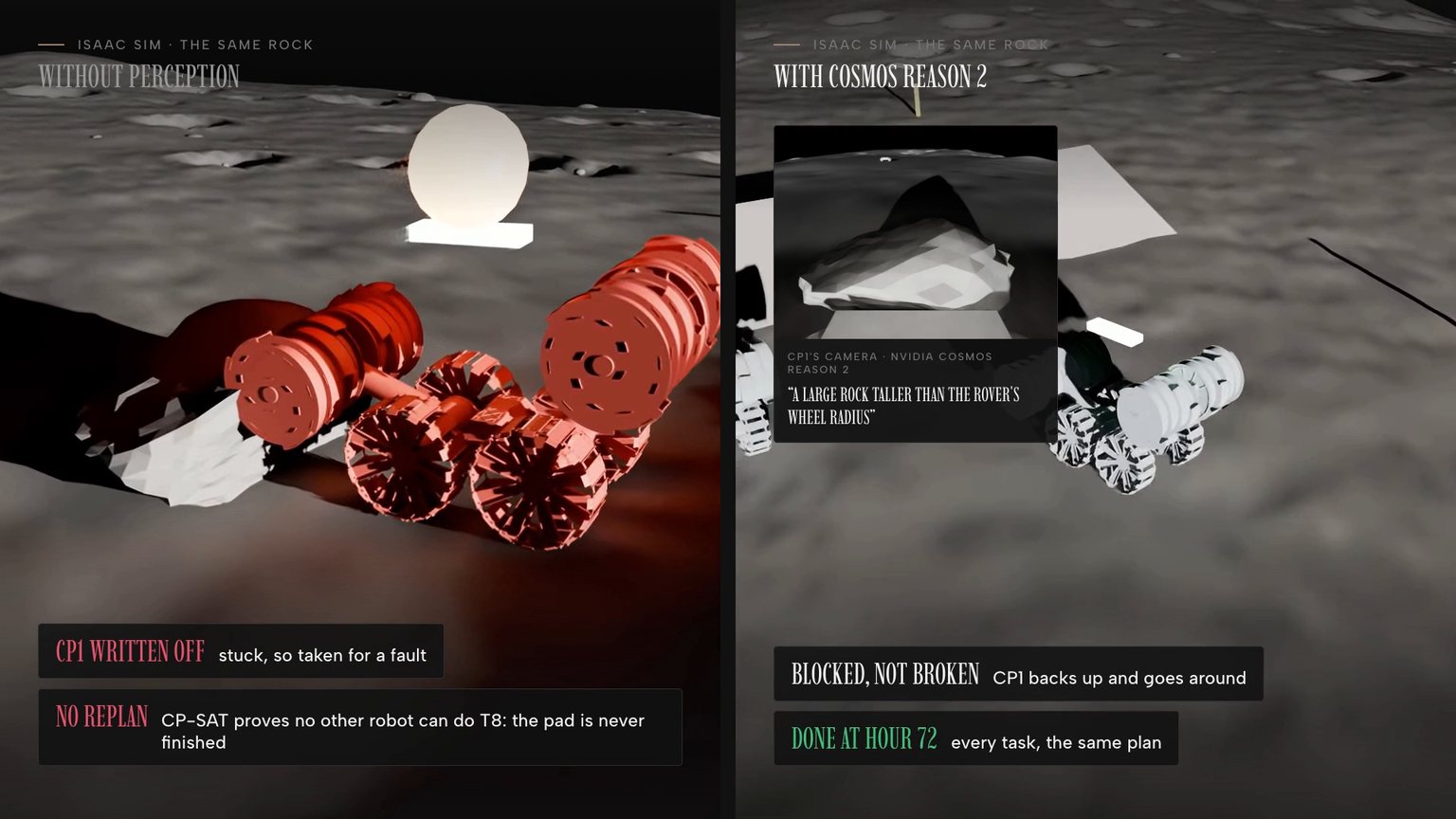
- What the rover sees decides whether the plan survives (Isaac Sim, Cosmos Reason 2). The same mission with a 1.4 m boulder in the lane of the site's only compactor: without perception the stall is a fault, CP-SAT proves no surviving robot can compact (
capability:T8) and the mission stops at 61 h with three tasks undone; with Cosmos Reason 2-8B on its camera ("A large rock taller than the rover's wheel radius", 3 of 3 votes) the compactor goes around and every task is done at 72.0 h. The other answer: a hauler's drive fails on a clear road, Cosmos sees nothing at its nose (3 of 3, its own long shadow ignored), CP-SAT hands its hauls to the other hauler in 0.01 s, and every task is done at 72.7 h. On ten held-out camera pictures it found 4 of 5 rocks (the fifth out of its camera's sight) and cleared 5 of 5 drive faults; Cosmos Reason 2-2B found 1 rock.
Challenges
- Making solver feedback useful to a language model: a raw infeasibility proof is not a repair instruction. We named every constraint group, extracted a minimal core, and wrote one-sentence hints with the actual numbers.
- Keeping the model honest: the live models sized energies to fit whatever battery they were told about, so every first-try plan "fit". Grounding durations and energies in quantities and a rate model made infeasibility real again and turned repairs into visible scope decisions.
- Single-worker core extraction times out on dense graphs that the multi-worker solve refutes instantly; a multi-worker deletion-filter fallback with a shared deadline fixed it.
- Replanning accounting: remaining work must come from the original task definitions, the running task must stay locked, and a replan that silently drops a task has to be rejected.
- Reasoning shares
max_tokenswith the answer: at 16,384 tokens, 78 of 190 Ultra reasoning calls were cut off before answering; at 32,768 with one re-ask at 65,536, 4 or 5 of about 125 per run. Strictjson_schemadecoding held on all three models, and 1,494 requests over four runs saw no error and no rate limit. Ultra produced 200-300 output tokens per second against Super's 150, so the larger model was also the faster one for us. - Getting a camera model to read a stall honestly. Told the rover had stalled, Cosmos Reason reasoned "it has not moved, so something must be in the way" and the 8B called every clear road blocked, its own long shadow included. What fixed it was the planner's lesson again: keep inference out of the proposer. The camera question asks only what is at the nose; the mission knows the rover stalled and the physics checks the reading.
What we learned
- The repair loop turned a refused first graph into a verified plan in 31 of every 100 runs of the final pipeline, and it works because of the proof: without the core and its numbers, the same model recovered 32 % of refused graphs instead of 70 %.
- Nemotron sequences a verified graph validly; its failures are in the decomposition (45 % of Ultra's first graphs in run 4 were refused: energy, supply order, horizon, scope), which is exactly what the validator and the core can name.
- Scoring a planner by "a schedule was found" overstates it: until volume, supply and the structuring itself were checked against the brief, plans passed by shrinking or reordering the work. Saving every plan made every new check re-scorable for free.
Limitations and known failures
- Travel is exact for the planning model (straight legs between zone centres in whole hours, in the order CP-SAT picks), not terrain and not turning in place, which Isaac Sim shows can add 10 % to a leg. The 2D simulator is kinematic; in Isaac Sim the driving is PhysX but the work (digging, hauling, sintering) is not simulated physically, and failures are injected.
- Durations and energies come from an illustrative rate model calibrated to the briefs' battery units, not from a specific robot's datasheet; quantities are the model's estimates from the structure dimensions and are shown with their basis.
- No recharging, no night cycle, one depot, no material-flow coupling between hauling and placement beyond precedence.
- The repair loop can re-scope work; scope changes are flagged in the UI, and the coverage check refuses graphs that drop a structure's phase, but a shallower bowl is still a planner decision.
- Failure cases in run 4:
large_fleet_pad_berm_road(eleven robots, sintering within 17 % of two printer batteries) failed 2 of 3 Ultra runs on the printer budget, one of them ending on a repair that referenced a task it had deleted; a repair can also answer with an unchanged graph (Superlanding_pad#2, the same 4,782 Wh verdict three times); and the structuring model can drop an operation the brief asks for, which only the coverage check against its own requirements catches.
Who would use this
NASA lists the need. Its FY26 Civil Space Shortfall Prioritization includes SF15, "Operate multi-agent robotic and crewed systems in cooperative planetary surface activities", with need 15.04, "Perform Earth-independent cooperative tasks on planetary bodies using autonomous software tools in multi-agent robotic systems", and need 4.01, "Perform site preparation and bulk regolith manipulation for infrastructure construction, including landing pads, berms, ...": the landing pad and berm this demo plans. Users: site-preparation planners in lunar surface construction programs (NASA's surface construction work, ICON's Project Olympus, KICT's lunar construction research, multi-rover missions in the line of JPL's CADRE) and, on Earth, remote and hazardous earthworks where a fleet of electric machines executes a plan with little supervision: mine sites, disaster recovery, offshore.
How it gets used, in order:
- Concept studies, now. Years before a crew lands, a site-preparation team has to decide how many machines, how much battery and how much time a pad and its berm need. Each variant is a brief: Moonwright returns a verified schedule or a CP-SAT proof of what is missing (a later deadline, a bigger battery, one more robot), and Monte Carlo gives the chance of finishing on time when robots fail and the robots the plan cannot afford to lose. With Nemotron 3 Ultra on Token Factory that is about a minute and a median $0.05 per plan (mean $0.10), so a dozen variants cost about a dollar.
- The crew's computer, next. The replan needs no network (a median 9 ms on a laptop CPU), so it can run on board when a robot fails, while Nemotron re-scopes the work from the ground.
- Earthworks on Earth. The same loop, with a rate table from the machines' datasheets, for electric earthmoving fleets at remote mine sites and disaster recovery, where a plan has to respect batteries, exclusion zones and a handover date with little supervision.
The code is MIT-licensed, so a team can run it with its own robots' rates.
Track fit
Moonwright is an embodied-agent runtime for a robot crew: it senses telemetry (positions, batteries, failures), decides (verified rescheduling, escalation to the reasoning model when the fleet cannot finish) and acts (new per-robot task lists). In NVIDIA Isaac Sim the loop is closed on PhysX rovers: the telemetry comes from the physics, and the rovers drive the schedule that comes back, and the rovers see: Cosmos Reason 2 reads a stalled rover's camera and proposes the cause, which the physics then checks, the same propose-and-check shape as Nemotron and CP-SAT. GR00T and SONIC are control policies for arms and humanoids; these rovers are driven by a plain heading controller. Perception and the replan need no network (the solver replan a median 9 ms on a laptop CPU), which is the part a robot's own computer would run, 1.3 light-seconds from Earth.
What's next
- A turn allowance and terrain slope in the travel model, measured from the Isaac Sim drives.
- Perception on real camera footage (dust, glare, rocks the renders do not have), and before work starts, not only on a stall: a camera check that a zone is clear.
- ROS 2 execution of the per-robot task lists; recharging and night cycles; multiple depots.
- Rate tables from real robot datasheets and a material-flow model (haul cycles tied to placement).
- Monte Carlo as a Nebius Serverless Job, and the replan measured on a Jetson-class board.
Built With
- cp-sat
- fastapi
- nasa-lola
- nebius-token-factory
- nemotron-3-super
- nemotron-3-ultra
- nemotron-3.5-lightning
- next.js
- nvidia-cosmos
- nvidia-isaac-sim
- nvidia-nemotron
- or-tools
- physx
- pydantic
- python
- tailwindcss
- typescript

