Inspiration
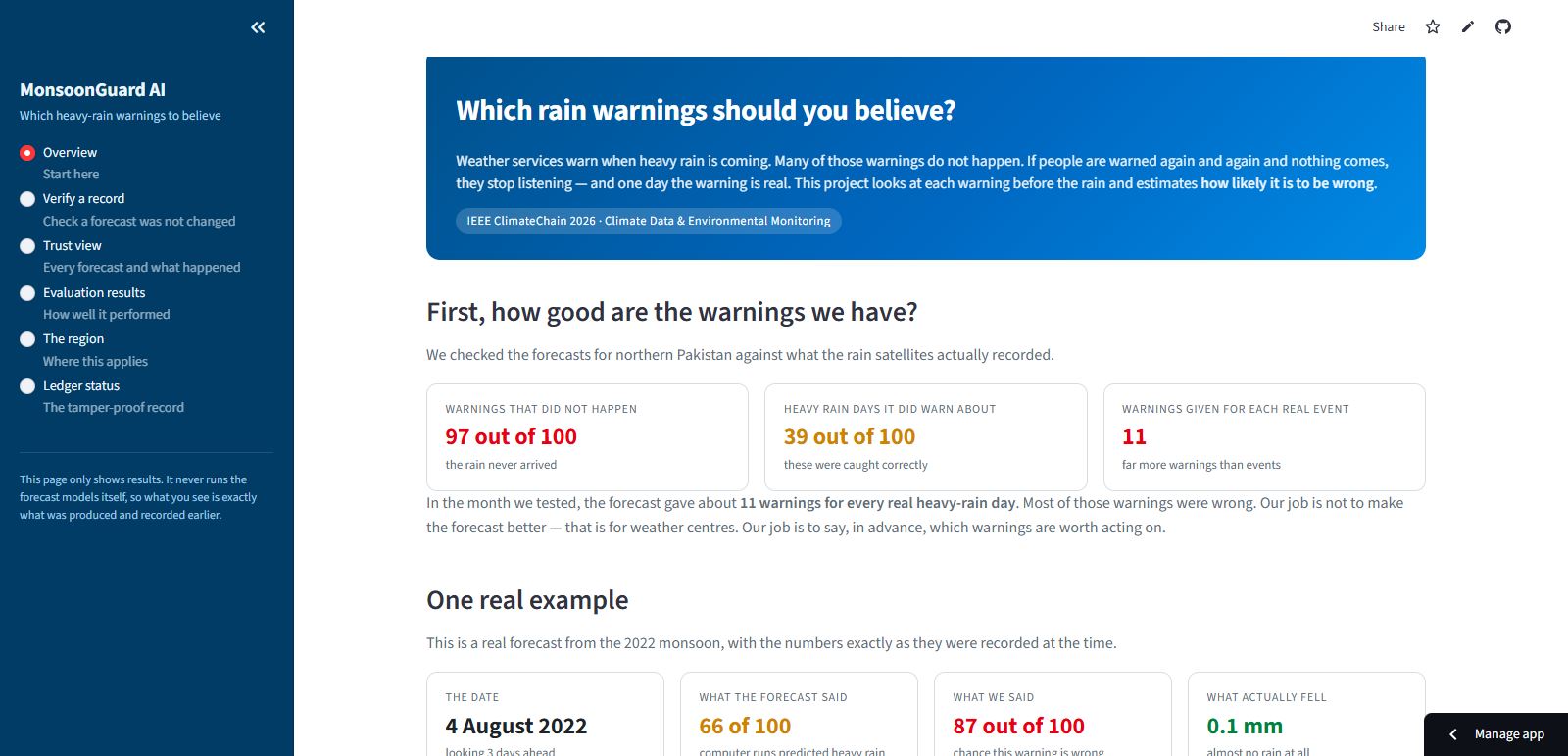
Pakistan is highly vulnerable to extreme monsoon rainfall and flooding, yet weather forecasts are not always equally reliable. I wanted to explore a question beyond simply predicting rain: how can we identify when an extreme-rainfall forecast may be unreliable before people depend on it?
This inspired me to build MonsoonGuard AI, an independent research project focused on forecast reliability in northern Pakistan. My goal was to combine ensemble weather forecasts, satellite rainfall observations, machine learning, and blockchain-based auditing to make forecast uncertainty more transparent and verifiable.
What it does
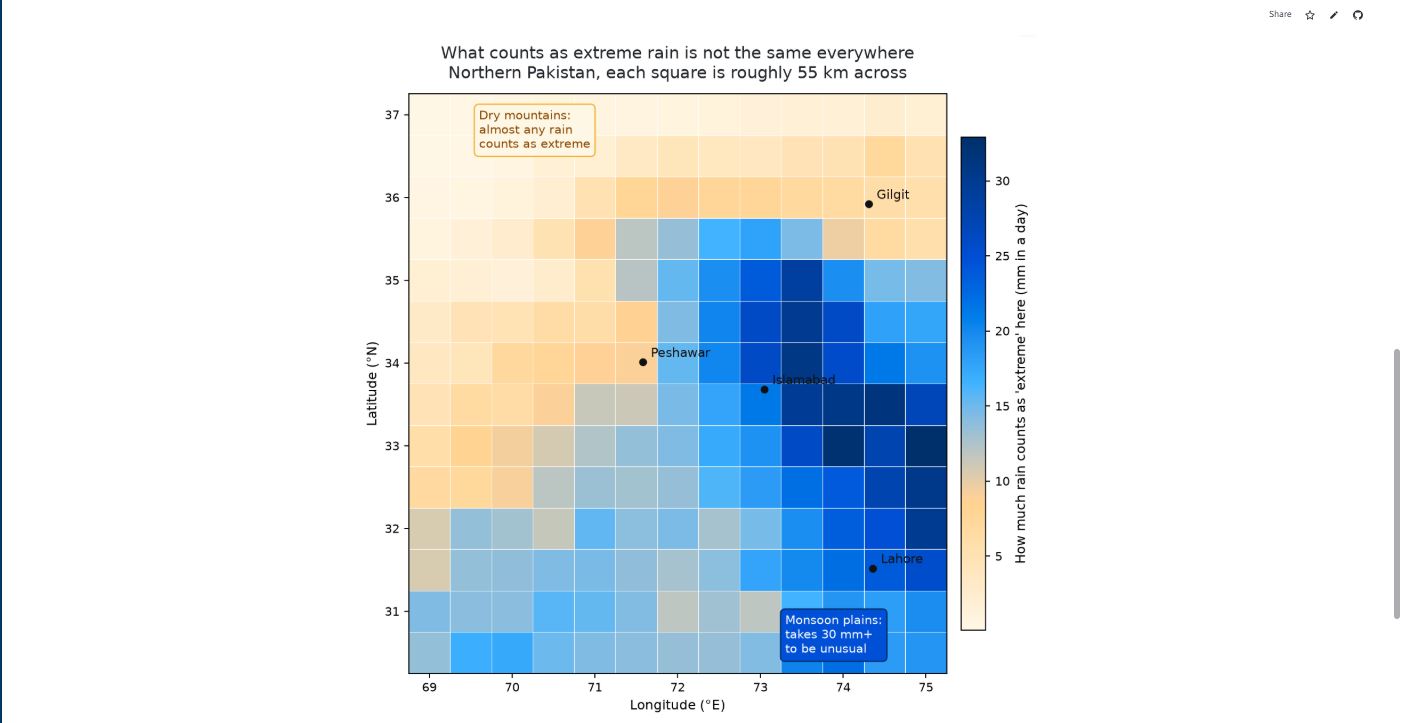
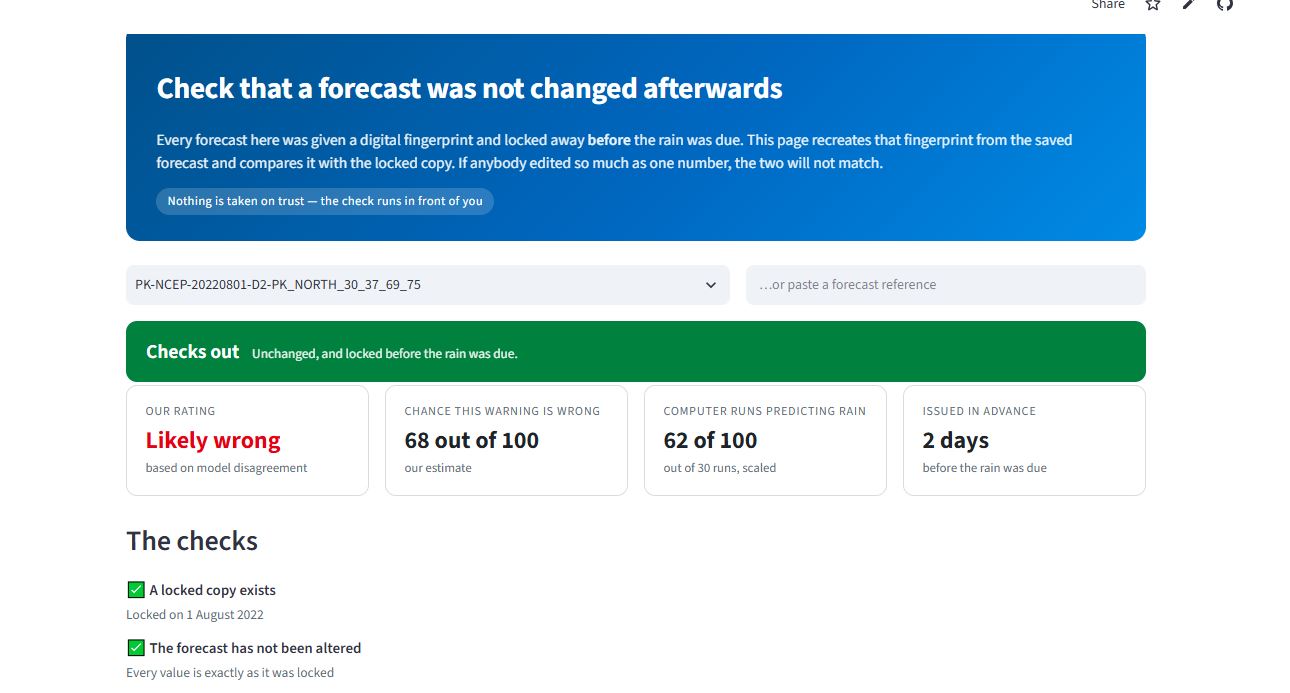
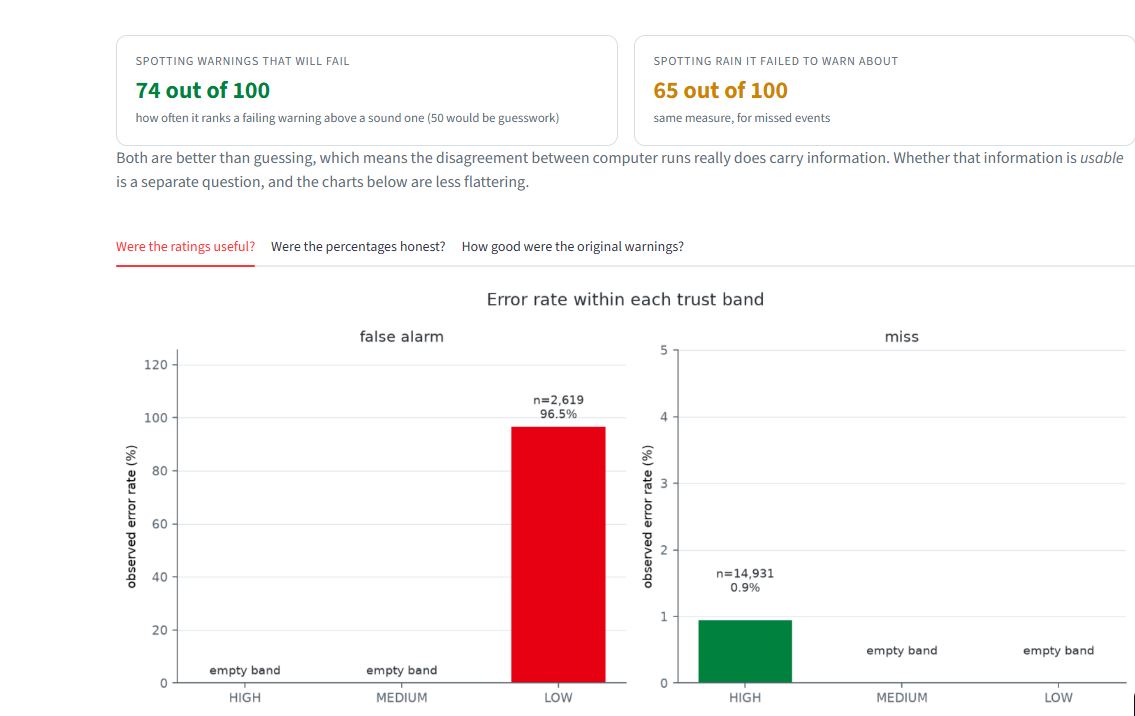
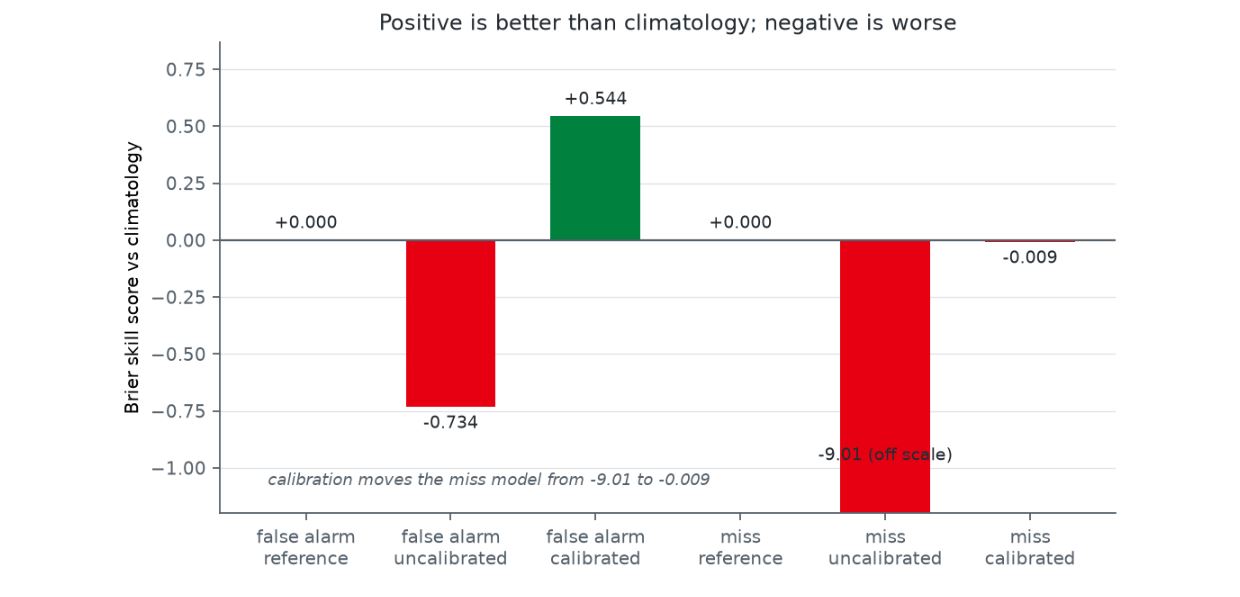
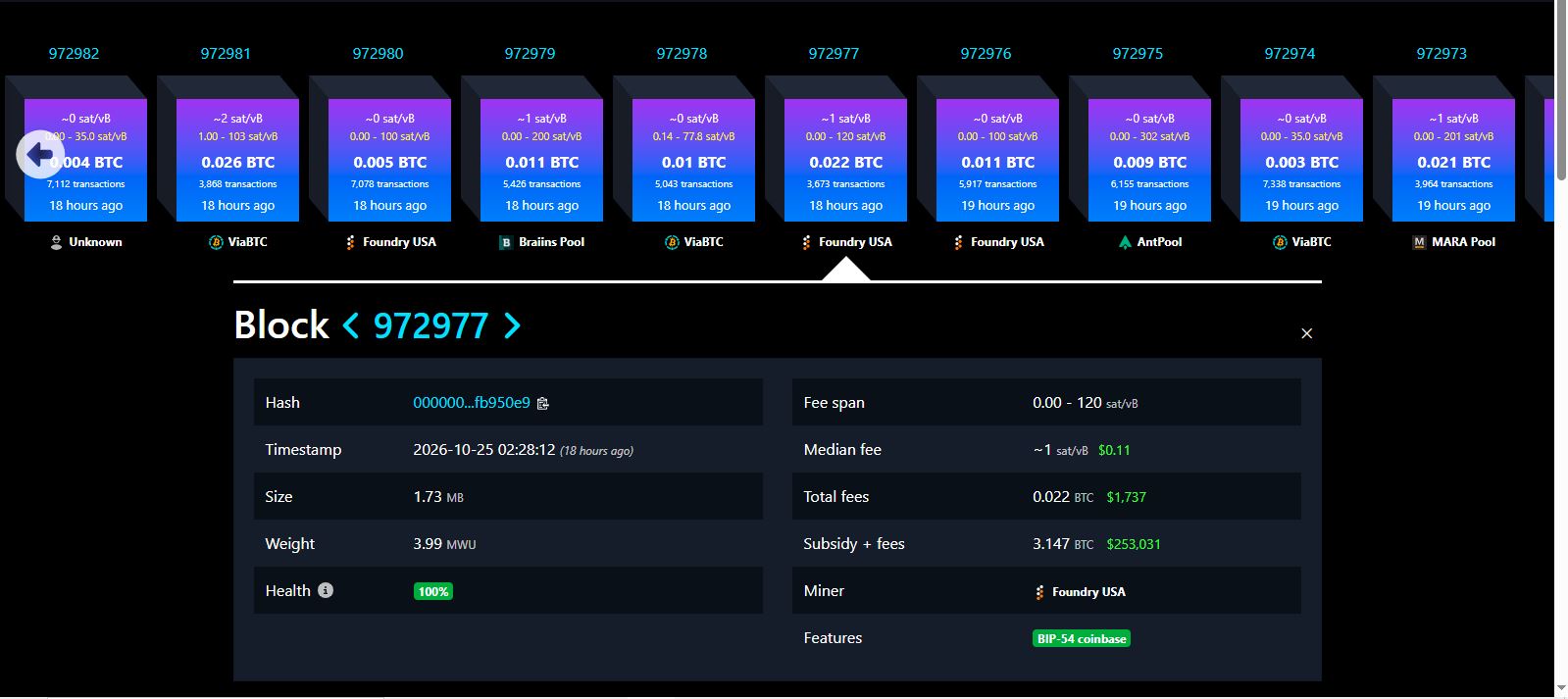
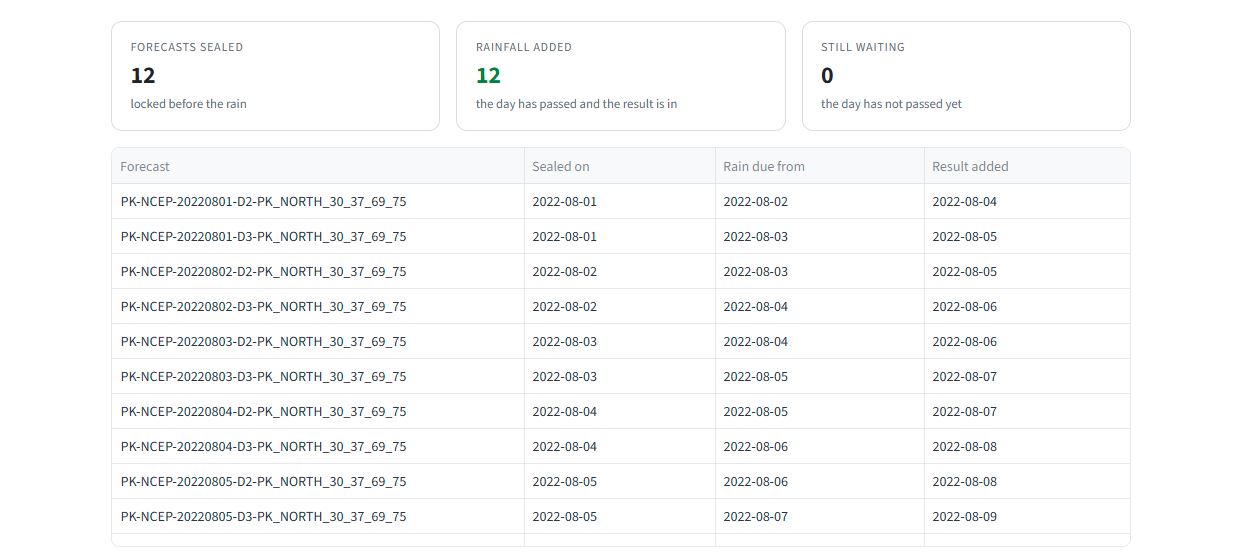
MonsoonGuard AI analyses ensemble rainfall forecasts and compares them with satellite-observed rainfall to study forecast reliability. It extracts features such as disagreement between forecast ensemble members, predicted rainfall statistics, and monsoon indicators. Machine-learning models estimate the risk of false alarms and missed extreme-rainfall events, while probability calibration helps make their outputs more meaningful. The project also incorporates a cryptographic audit layer designed to preserve forecast records, trust labels, and observed outcomes in a verifiable form. This helps verify record integrity without confusing it with the actual accuracy of a weather forecast.
How we built it
I independently developed a reproducible data and machine-learning pipeline using NCEP ensemble forecasts from TIGGE, NASA IMERG satellite precipitation data, and Madden–Julian Oscillation indicators. I implemented the data-alignment pipeline, extreme-rainfall event labelling, ensemble feature extraction, logistic regression baselines, separate models for false alarms and missed events, and isotonic probability calibration. I evaluated the models using chronological data splits and metrics such as Brier skill score and ROC AUC. I also developed a blockchain audit component using Solidity and a local Hardhat environment, alongside cryptographic hashing and timestamp proofs for historical records.
Challenges we ran into
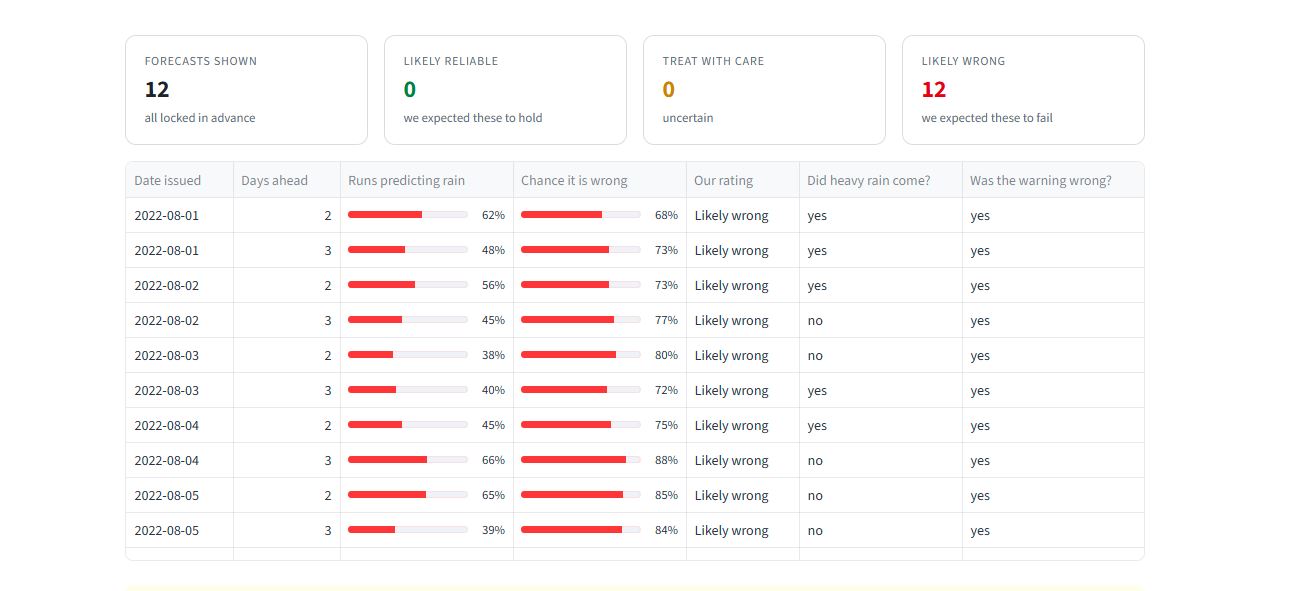
As a solo developer, one of my biggest challenges was obtaining and aligning historical weather data from different sources. Forecast accumulation periods, observation timestamps, spatial resolutions, and incomplete data archives required careful handling. Another challenge was evaluating whether the model could generalise beyond the period used for development. My experiments showed that performance varied across seasons, and trust thresholds that worked during the 2022 evaluation did not transfer reliably to a held-out June 2024 period. I also had to distinguish record integrity from forecast accuracy. Blockchain can help verify that a record has not been altered, but it cannot guarantee that the underlying prediction is correct.
Accomplishments that we're proud of
I independently developed an end-to-end research pipeline connecting weather-forecast data, satellite observations, machine learning, probability calibration, and verifiable audit records. My evaluation produced encouraging results for false-alarm estimation within the tested 2022 period while revealing important limitations in generalisation. I am particularly proud of documenting these limitations instead of presenting preliminary results as universally reliable. I also implemented and tested the Solidity audit contract locally and created cryptographic timestamp proofs for historical forecast and outcome records.
What we learned
I learned that forecast reliability is a different problem from weather prediction. A model can identify useful patterns in forecast uncertainty without necessarily generalising to another season or year. Working independently on the project also strengthened my understanding of data engineering, machine learning evaluation, probability calibration, temporal leakage prevention, and smart-contract development. Most importantly, I learned that blockchain is most useful in this context as an accountability and verification layer, complementing scientific validation rather than replacing it.
What's next for MonsoonGuard AI
My next steps are to expand the historical dataset across additional monsoon seasons, improve generalisation across seasonal conditions, and investigate better-calibrated trust thresholds. I also plan to incorporate additional atmospheric indicators, evaluate the models against independent observation periods, and account for uncertainty in satellite-derived rainfall estimates. On the audit side, I aim to deploy and test the registry on a public testnet, integrate forecast commitments with a live data pipeline, and simplify verification for researchers and other users. My long-term goal is to develop MonsoonGuard AI into a more robust and transparent framework for assessing extreme-rainfall forecast reliability and supporting evidence-based climate-risk decisions.
Built With
- artificial-intelligence
- blockchain
- climate-resilience
- climate-tech
- data-integrity
- data-science
- explainable-ai
- hardhat
- machine-learning
- nasa-imerg
- predictive-analytics
- python
- riskassesment
- scientific-computing
- smart-contracts
- solidity
- tigge
- weather-forecasting
- web3


Log in or sign up for Devpost to join the conversation.