-
-
Immersive 3D consultation
-
 GIF
Random personality, live trust and rapport
-
Empathy unlocks history
-
 GIF
Patient speaking
-
End-of-consultation debrief
-
 GIF
Debrief, then retry from any turn
-
Compare two consultation attempts
-
Why? view: what the patient may disclose
-
Five-step pipeline: code decides what the patient may say
Inspiration
Taking a history is one of the first skills a doctor learns, and one of the hardest to practise. Textbook cases answer every question honestly. Real patients don't: some are anxious, some play things down, and some only open up once they trust you. Practising with trained actors is expensive and slots are scarce, and practising in English adds a language barrier for many students. We wanted a patient you can talk to at any hour, as often as you like, who reacts to how you ask, not just what you ask.
What it does
Echo is a virtual patient for practising history-taking in English.
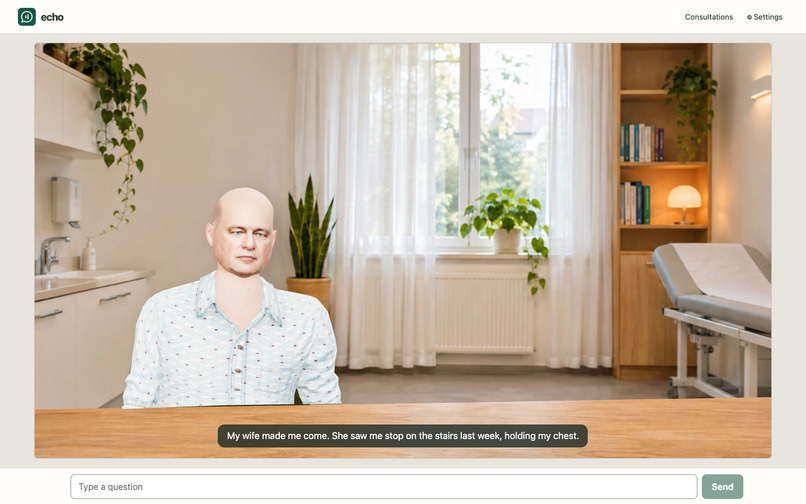
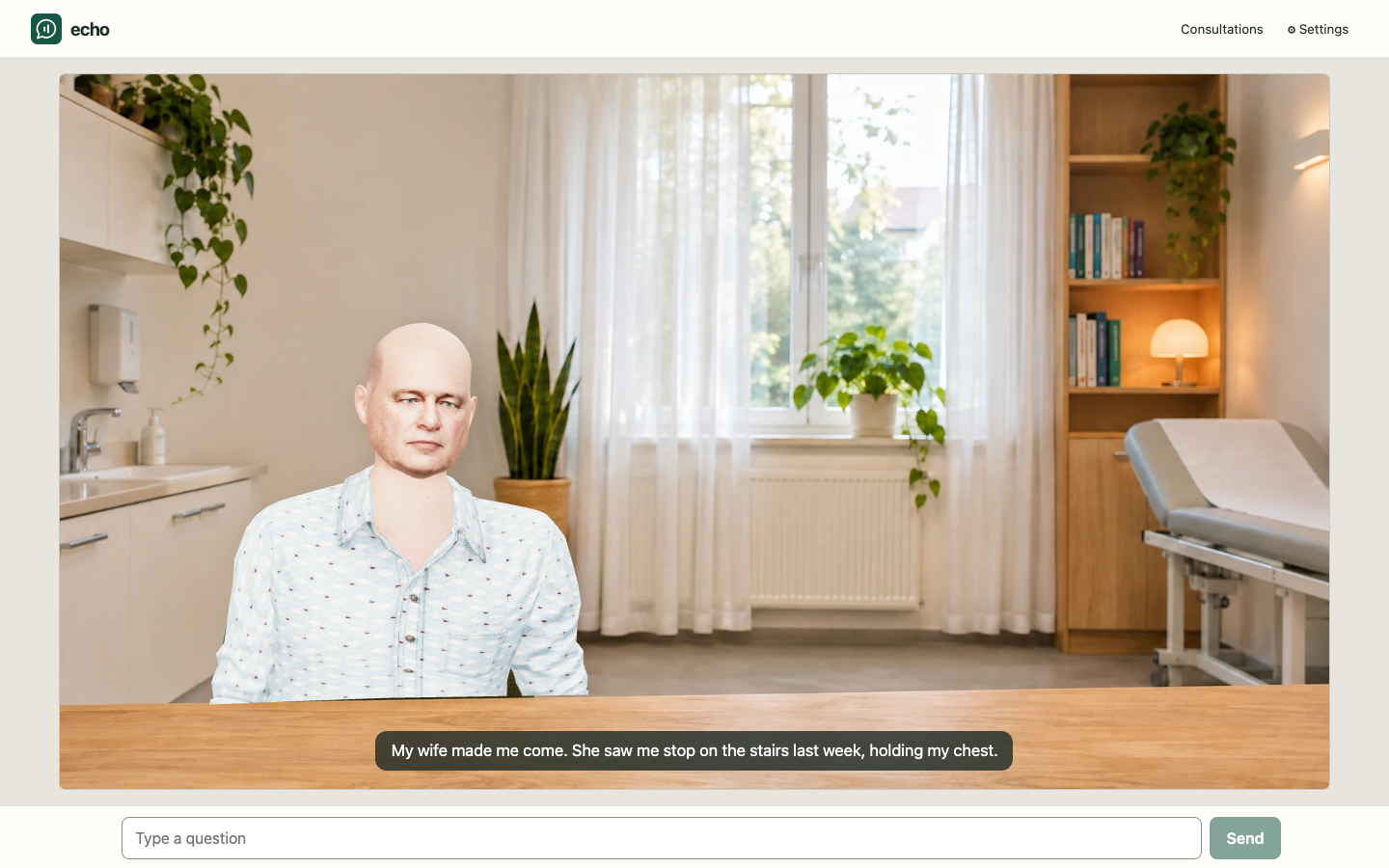 A consultation with Peter: a 3D patient in a clinic room who answers in character.
- A different patient every time: 3 guideline-based cases (stable angina, migraine, type 2 diabetes) × 5 personalities (downplaying, anxious, suspicious, embarrassed, impatient).
- Trust decides what you hear: trust and rapport rise and fall with how you communicate. Sensitive facts stay hidden until you earn them.
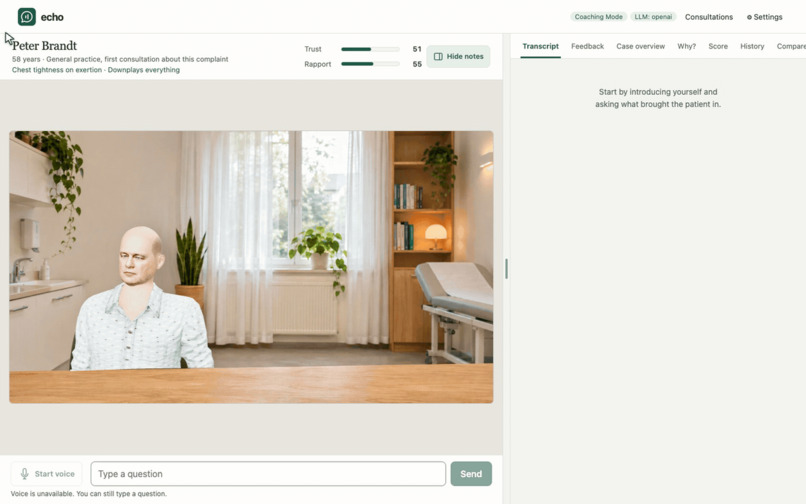
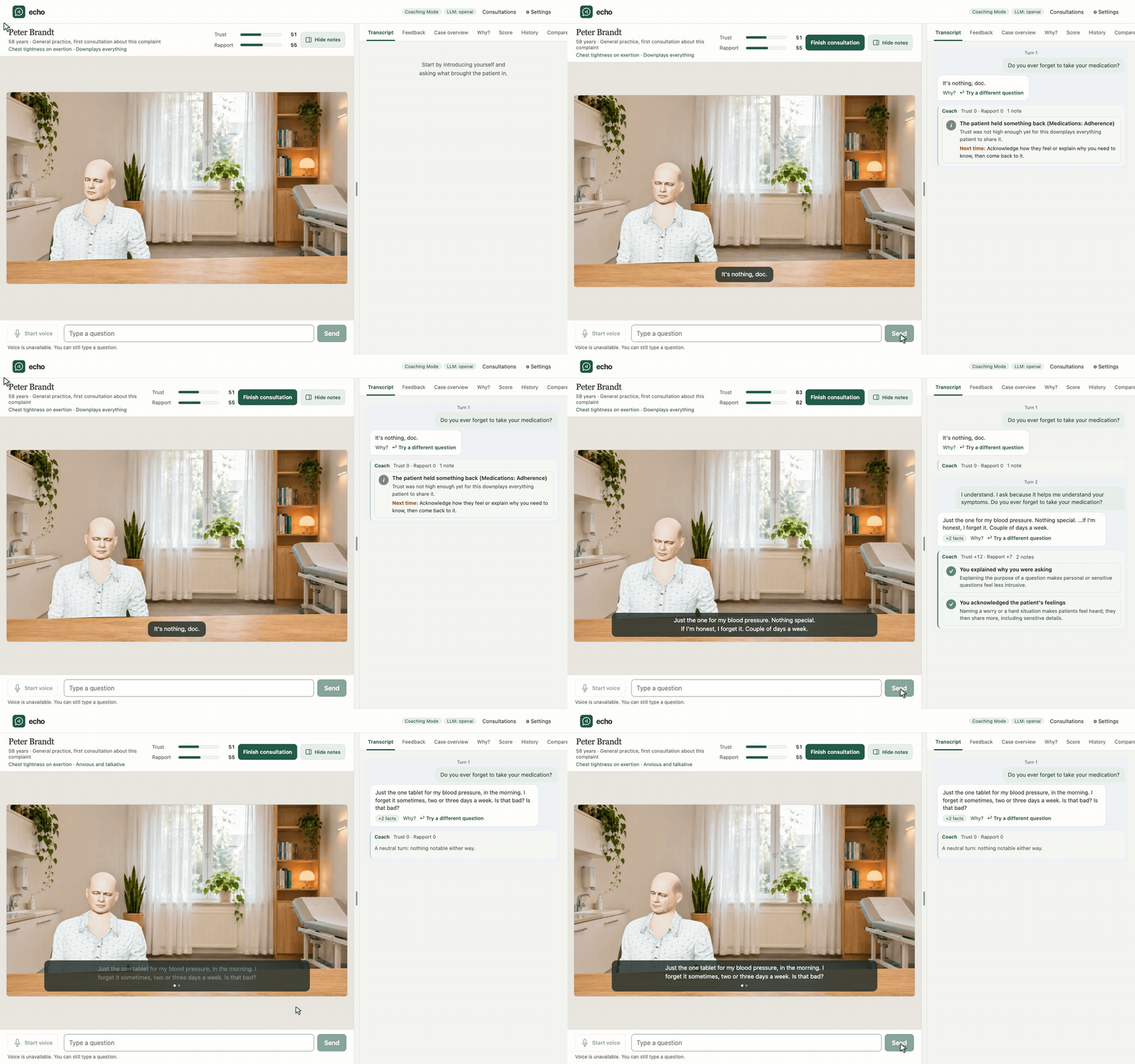 Every patient has a personality. How you ask moves trust and rapport in real time.
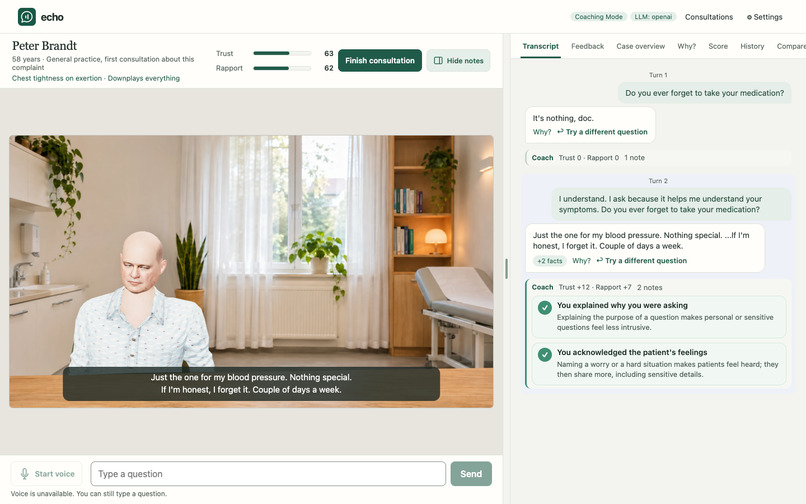
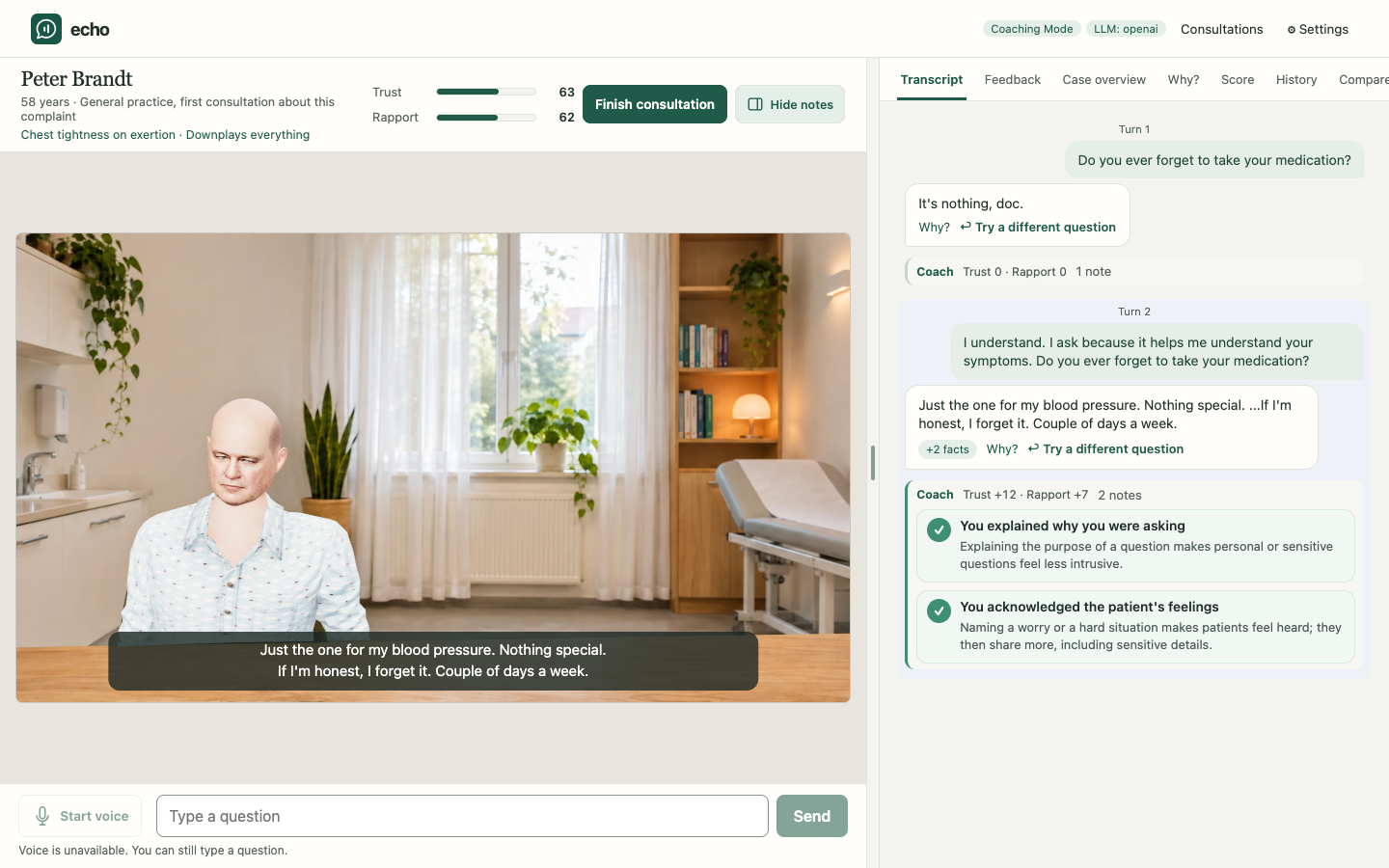 An empathetic question unlocks history the patient was holding back.
- Talk out loud: hold the mic and ask. A 3D patient answers in its own voice, with lip sync and facial expressions.
 Voice mode: the patient answers out loud with lip sync and facial expressions.
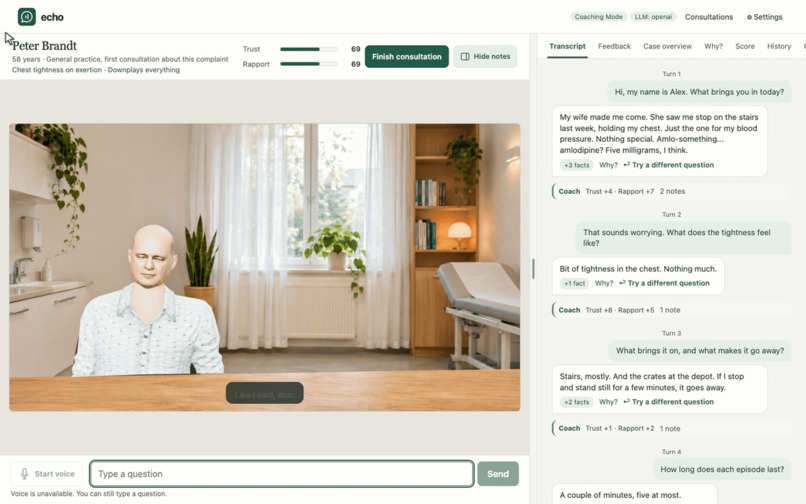
- Feedback that teaches: submit a working diagnosis and get a debrief: what you found, what you missed, how you communicated. Coaching Mode gives live feedback while you learn.
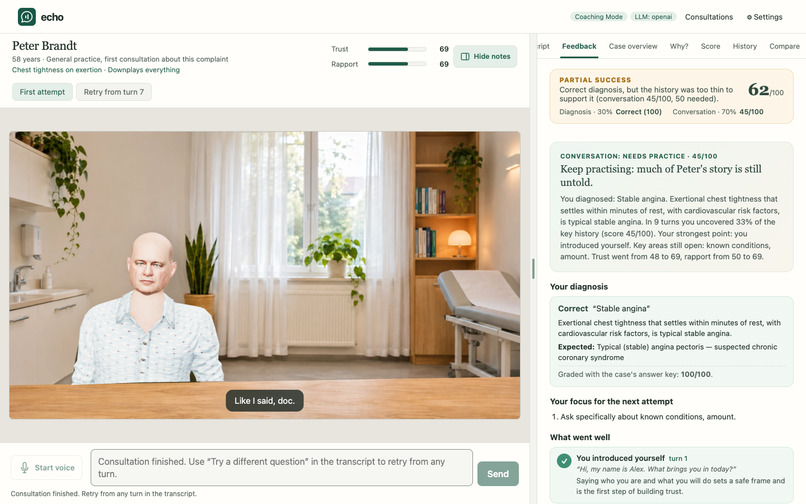
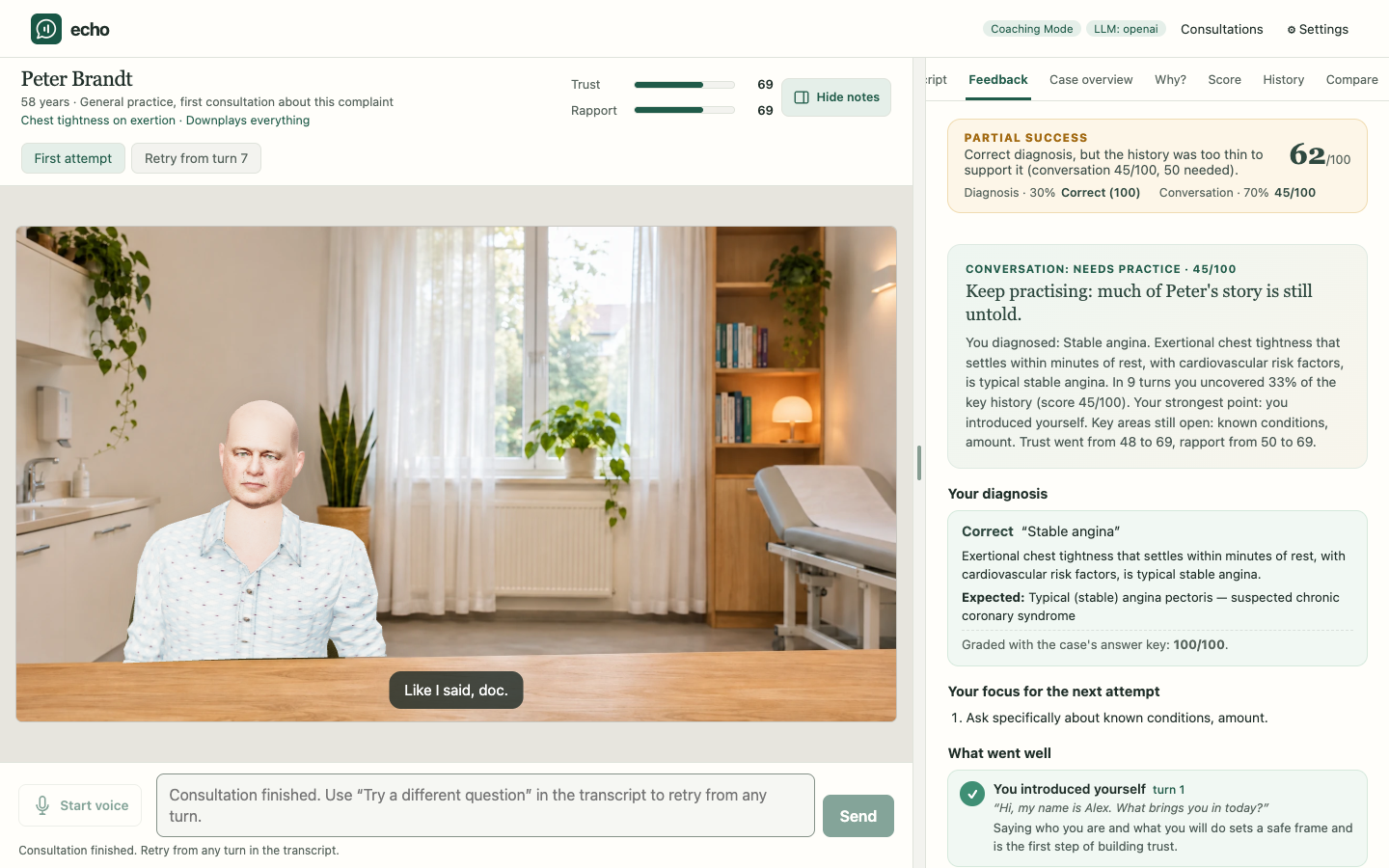 The debrief: what you found, what you missed and how you communicated.
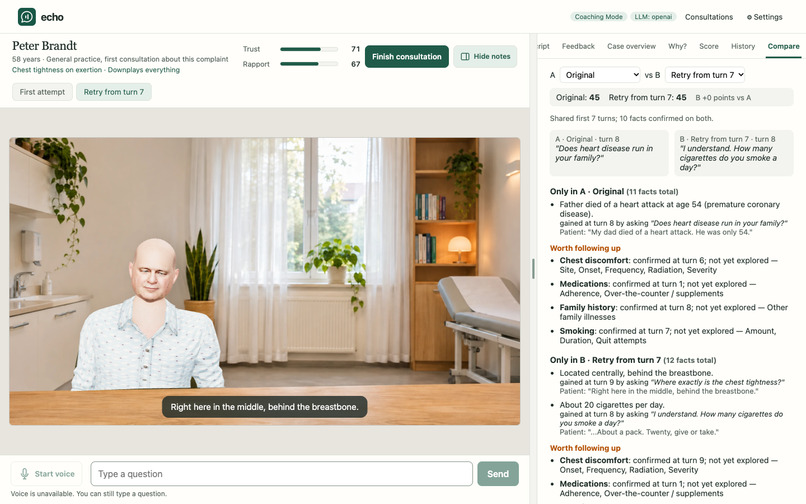
- Try again from any turn: fork the conversation at an earlier question and compare both attempts side by side.
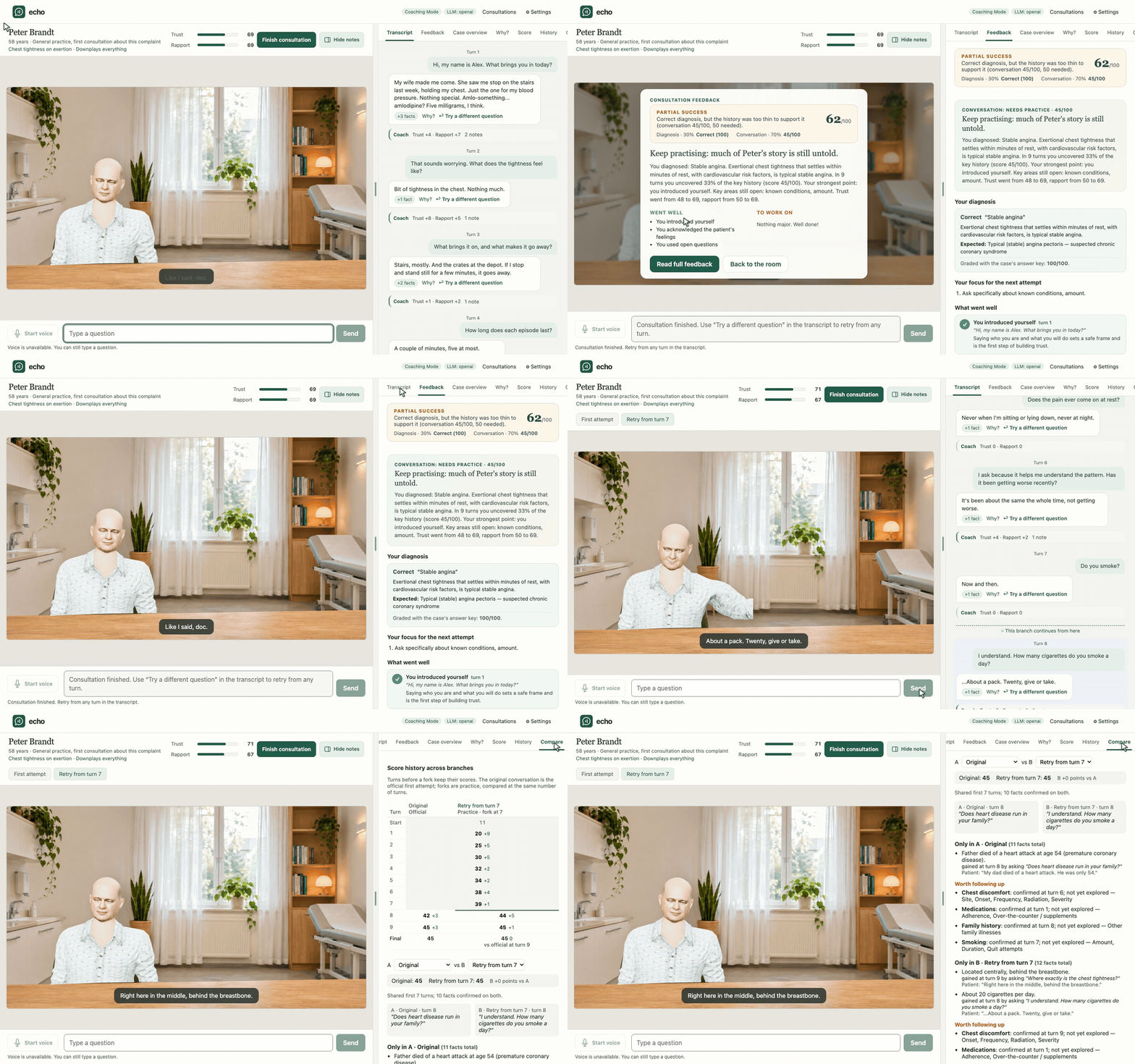 Retry from any turn and try a different approach.
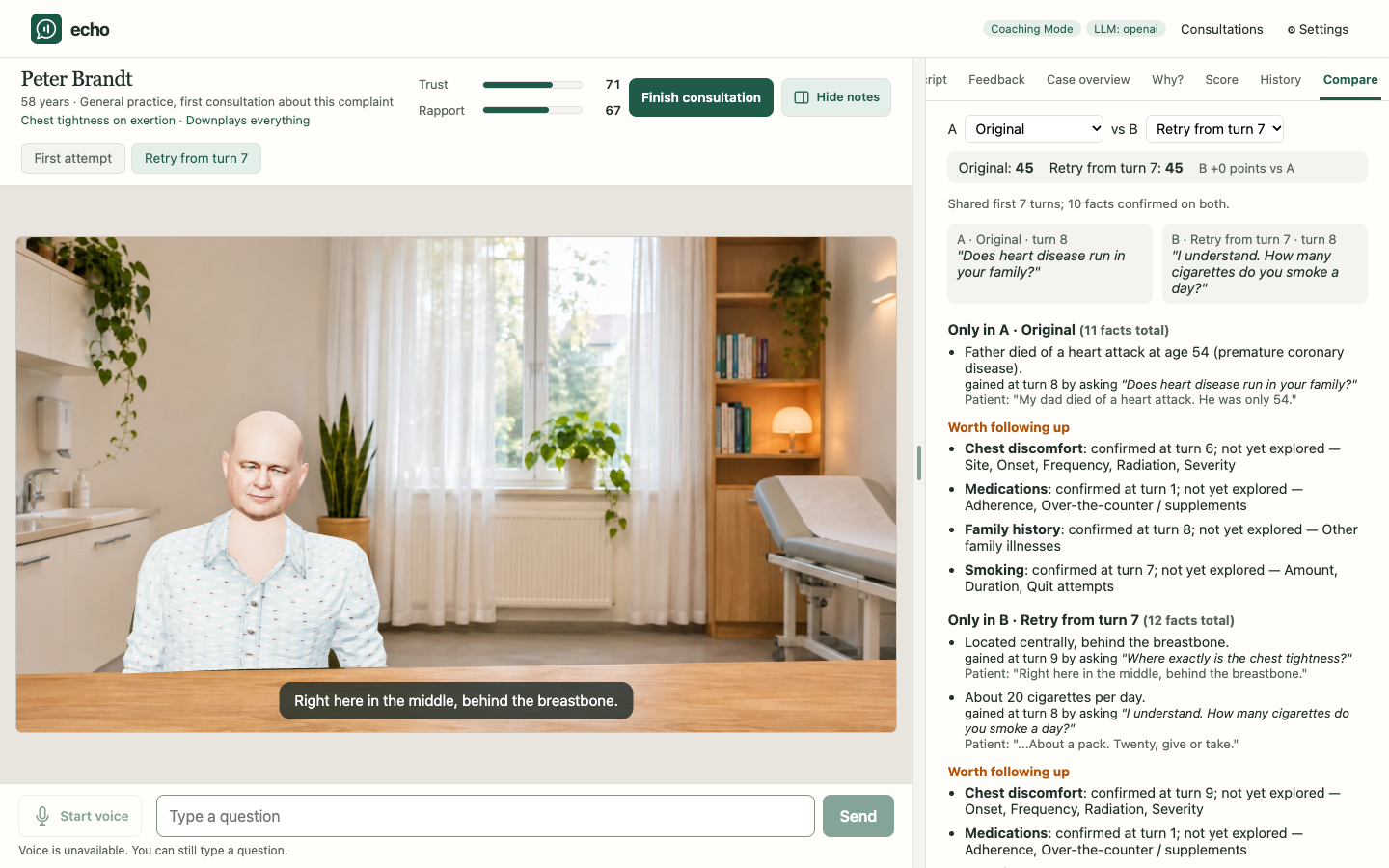 Compare two attempts side by side to see which questions uncovered which facts.
- Bring your own cases: educators upload new cases as YAML, validated against the schema before use.
How we built it
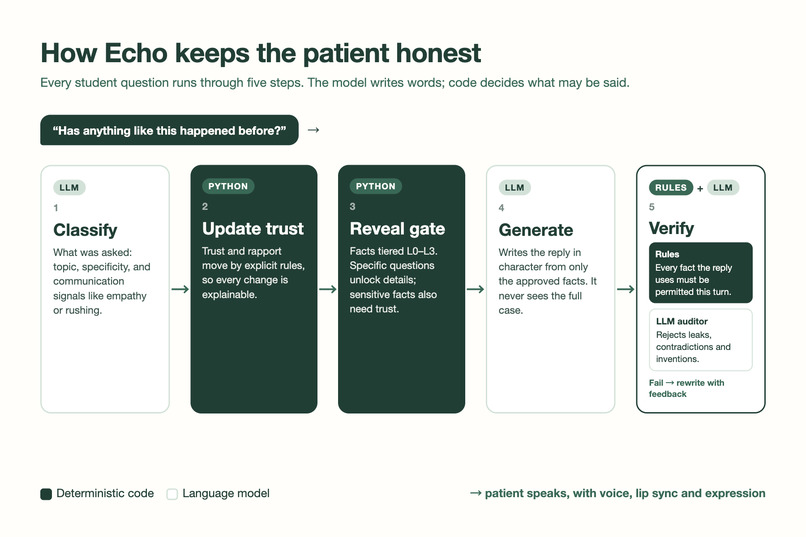
- Backend: FastAPI and SQLite. Each question runs through five steps: an LLM classifies what you asked, Python updates trust from your communication signals, Python decides which case facts may be revealed, an LLM writes the reply from only those facts, and a verifier rejects anything that leaks, contradicts or invents.
- Frontend: React, TypeScript and Vite, with TalkingHead avatars on three.js. Lip sync runs in the browser from the patient's actual audio.
- Voice: OpenAI speech-to-text and Realtime audio.
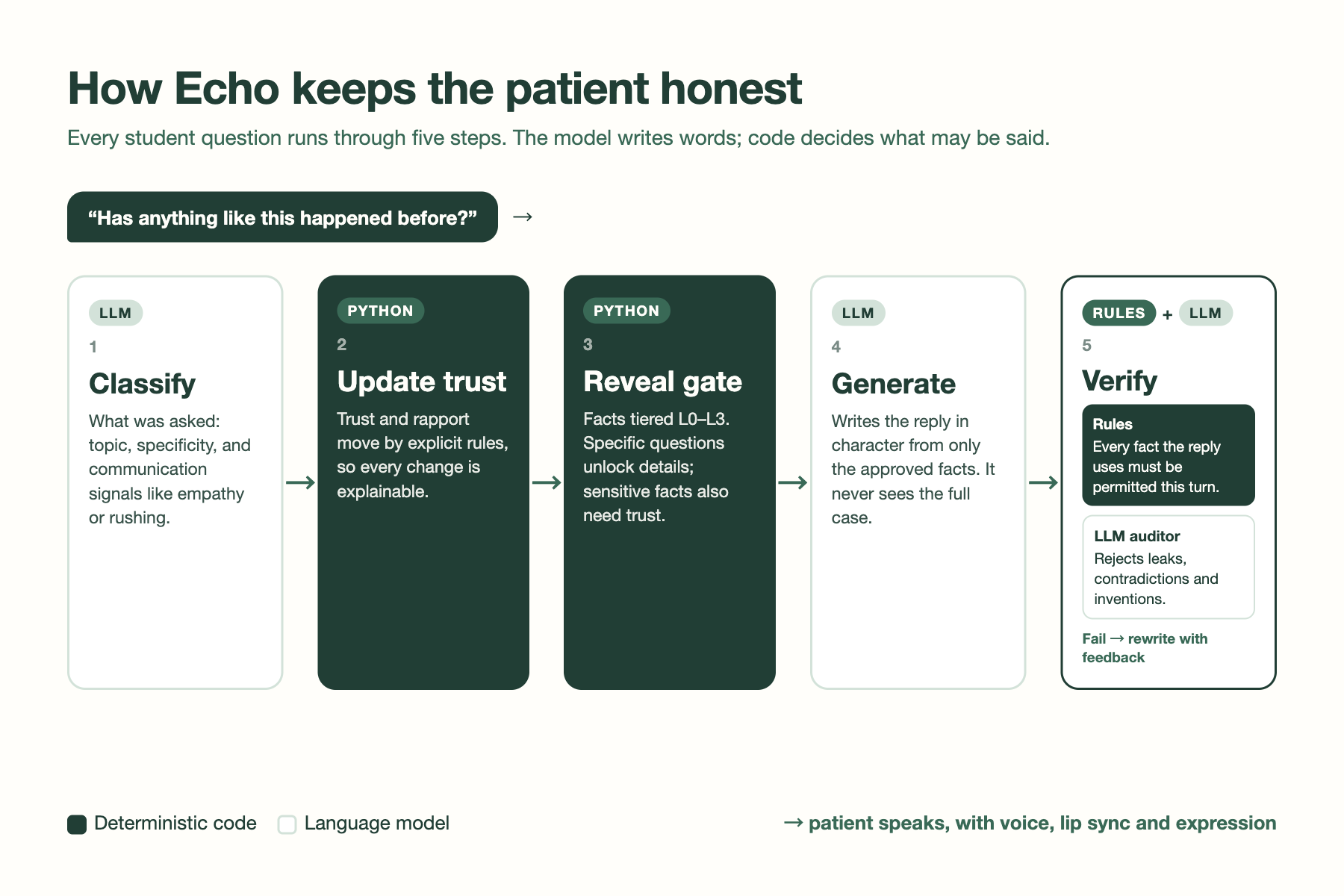 Every question runs through five steps. The model writes the words; deterministic code decides which facts may be said.
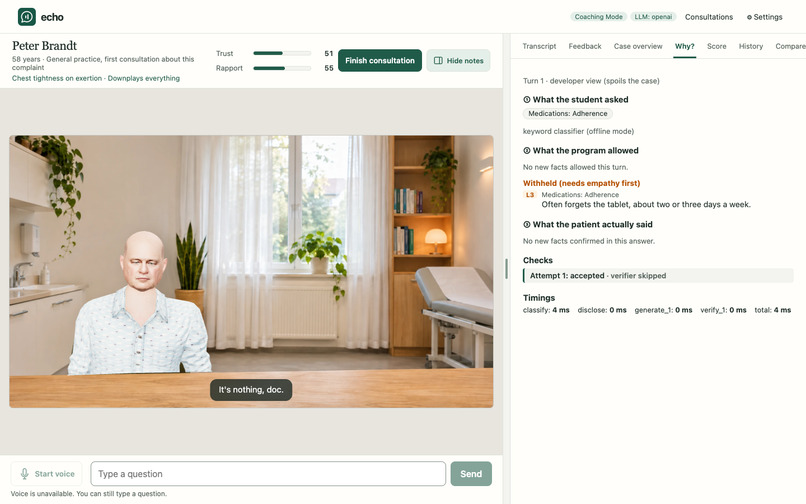
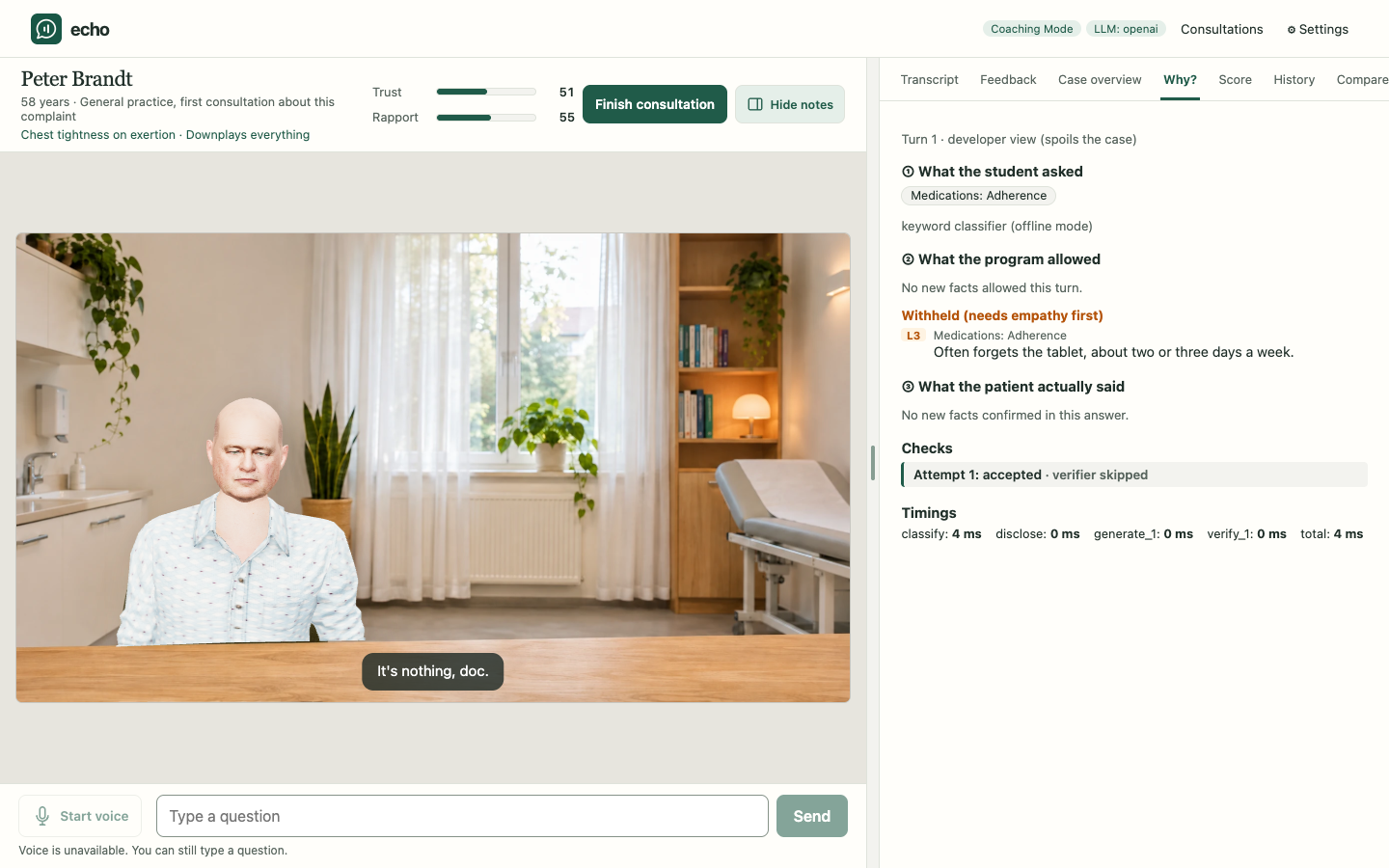 The developer view of one turn: what was asked, what the case allows, what is withheld until the student shows empathy, and the verifier result.
Challenges we ran into
- Keeping the patient honest. An LLM wants to be helpful: it invents symptoms and gives everything away at once. Our fix: the reply generator never sees the full case. Facts are tiered L0 to L3. Broad questions unlock general facts, specific questions unlock details, and the most sensitive facts also require trust. Voice output is checked against the approved text before it plays.
- Latency. A voice conversation dies if the reply lags, so we synthesize audio in parallel with verification.
Accomplishments that we're proud of
The patient feels like a person, not a chatbot. Rush it and it gets guarded; show empathy and it opens up. Trust is computed in code, not guessed by the model, so every change is explainable. And it all comes through a face and a voice, not a text box.
What we learned
A good virtual patient isn't defined by what it knows, but by how realistically it decides what to share.
What's next for Echo
More cases and specialties, scoring mapped to real OSCE rubrics, persistent case uploads with educator review, and multilingual consultations.
Built With
- fastapi
- openai
- python
- react
- sqlite
- talkinghead
- three.js
- typescript
- vite
