Inspiration
Project Story
About the Project
In recent years, emotional stress and mental health challenges have become increasingly common. Many people struggle to recognize their own emotional state, and even when they are aware of it, they often find it difficult to communicate those feelings to others. Emotional buildup can lead to stress, conflict, or decisions people later regret. At the same time, friends and family often want to help—but they may not realize when someone needs support.
This project was inspired by this gap between emotional experience and emotional communication. Emotions are deeply personal and often invisible, yet they strongly influence how we behave and interact with others. We wanted to explore how technology could help people sense, understand, and share emotions in a healthier way.
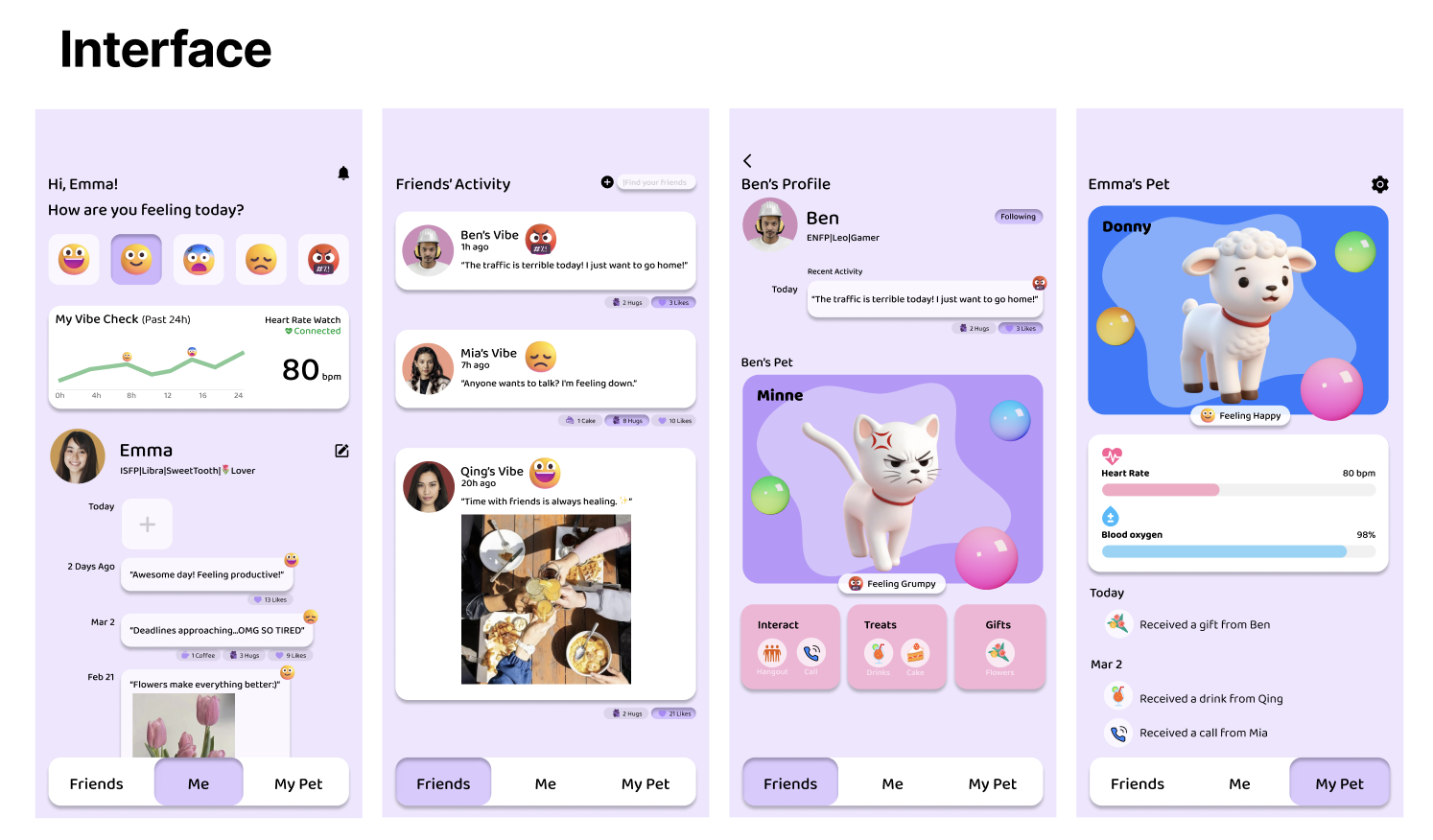
Our idea was to design a system that combines wearable sensors, emotional analysis, and a social support network. Instead of presenting emotions as raw data, the system translates emotional states into a digital companion pet that visually expresses the user’s mood. Users can choose a cat or dog avatar, and the pet’s behavior reflects their emotional condition. This makes emotional information easier to understand while maintaining a sense of warmth and playfulness.
The system collects physiological signals such as heart rate, electrodermal activity (GSR), and blood oxygen levels through wearable devices like a necklace, watch, or ring. These signals help estimate emotional states because physiological responses often correlate with stress or excitement. For example, electrodermal activity increases when the body experiences emotional arousal. Conceptually, the system analyzes signals in a simplified form such as:
$$ Emotion\ Level \approx f(Heart\ Rate, GSR, Facial\ Expression, Context) $$
In addition to passive sensing, the app also encourages users to perform a daily emotional check-in. Users can scan their facial expression through the phone camera while the wearable devices collect sensor data. The system then generates an emotional summary for the day, which is represented through the digital pet’s behavior.
One of the most important aspects of this project is the emotional support network. With mutual consent, users can share their emotional status with trusted friends or family members. Similar to the concept of “Find My,” the app allows people to understand when someone close to them might be struggling emotionally. If a friend appears stressed or exhausted, others can send small gestures of support, such as a message, a virtual hug, or even a real-world gift like coffee or dessert through integrated delivery platforms. These small actions aim to make emotional care easier and more immediate, even when people are physically apart.
Throughout the design process, we learned that emotional technology must balance insight with privacy. Emotional data is extremely sensitive, and sharing it without proper safeguards could create pressure or misunderstanding. Therefore, the system includes multiple protection mechanisms, such as consent-based sharing, privacy controls, and an emotional data expiration system that automatically deletes emotional records after a short period of time. This ensures that emotions remain temporary expressions rather than permanent digital labels.
Building this project also revealed several challenges. One challenge was designing an interface that communicates emotional information clearly without overwhelming the user with data. We addressed this by using the digital pet as a visual and emotional mediator rather than displaying raw biometric metrics. Another challenge was preventing misinterpretation of emotional states, since sensor data can never perfectly represent human feelings. To address this, the system allows users to adjust or override the detected emotional status.
Overall, this project explores how future technologies might help people develop greater emotional awareness and strengthen social support systems. By making emotions more visible while protecting user privacy, the design aims to create a healthier relationship between technology, emotional wellbeing, and human connection.
What it does
How we built it
Challenges we ran into
Accomplishments that we're proud of
What we learned
What's next for MoodPal
Built With
- app
- design
- detection
- emotion
- figma
- gsr
- mobile
- sensors
- slides
- wearable


Log in or sign up for Devpost to join the conversation.