-
-
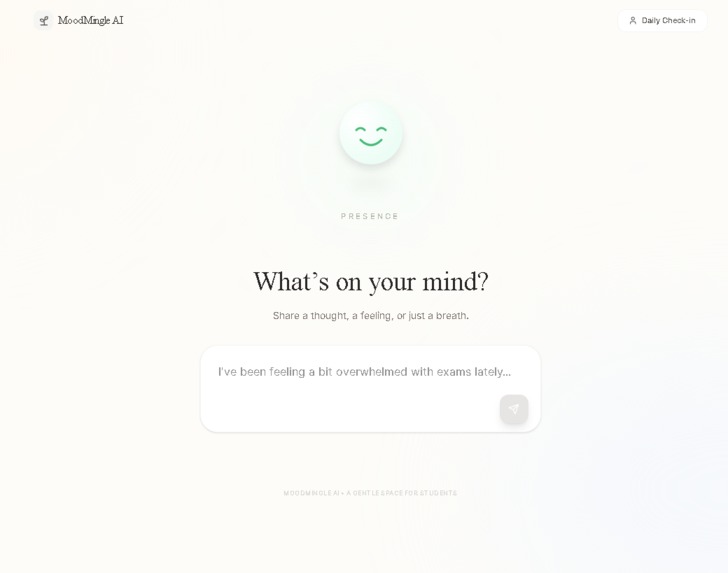
Website Image
🌱 About the Project
💡 Inspiration
Students today are constantly overwhelmed — assignments, exams, expectations, and personal struggles all pile up quietly. What stood out to us was not just the stress itself, but the fact that most students don’t pause to process what they’re feeling until it becomes burnout.
We wanted to build something that doesn’t feel like a heavy “mental health app,” but instead feels like a safe, instant space to pause, reflect, and reset.
That idea became MoodMingle AI — a tool that turns a few seconds of expression into clarity and small, meaningful action.
🧠 What It Does
MoodMingle AI allows students to:
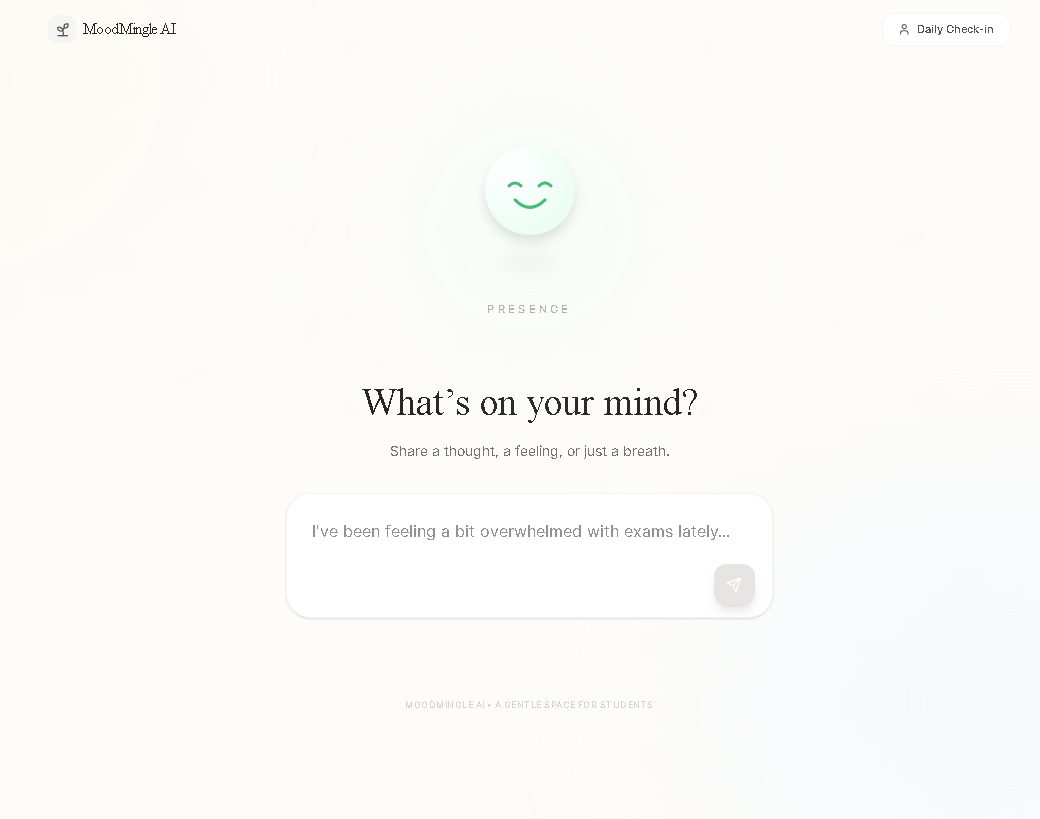
- Express their thoughts instantly through a simple text input
- Receive structured, supportive feedback in seconds
- Take small, actionable steps to improve their mental state
- Follow a progressive plan (starting with a 3-day reset, evolving into a weekly system)
The goal is simple:
Reduce overwhelm by turning emotions into clarity and action.
🛠️ How We Built It
We focused on creating a lightweight, calming web experience rather than a complex application.
Core approach:
- A minimal, distraction-free interface with soft visuals and subtle animations
AI-powered responses structured into:
- Understanding
- Insight
- Action steps
A progressive planning system that adapts over time
Tech direction (conceptually):
- Frontend built for speed and simplicity
- AI layer used for natural, human-like responses
- Lightweight backend for authentication and data storage
We intentionally avoided over-engineering and focused on experience first.
⚡ Key Design Philosophy
We treated the product not as a dashboard, but as a mental reset space.
- Calm visuals instead of data-heavy screens
- Minimal input, maximum value
- Emotional connection through UI (animations, soft colors)
- Actionable output instead of generic advice
📚 What We Learned
- Simplicity is powerful — users don’t want complex tools when they’re stressed
- AI is most effective when guided with structure, not left completely open
- Emotional products require trust-first design, not just functionality
- Small actions (like 1-minute resets) can be more impactful than big plans
🚧 Challenges We Faced
1. Avoiding Generic AI Responses We had to carefully design structured outputs so responses felt helpful, not repetitive.
2. Balancing Emotion vs Simplicity Making the UI feel warm and engaging without adding clutter was a key challenge.
3. Defining Scope It was tempting to build a full mental health platform, but we narrowed it down to:
“instant clarity + small actions”
4. Ethical Considerations We ensured the app does not position itself as therapy, but as a supportive companion tool.
🚀 What’s Next
We see MoodMingle AI evolving into:
- A personalized emotional habit system
- Anonymous insight dashboards for schools
- A scalable platform that supports student well-being at both individual and institutional levels
🧘 Final Thought
MoodMingle AI isn’t trying to solve everything.
It simply gives students something they often don’t have:
A moment to pause, understand themselves, and take one small step forward.
Built With
- api
- gemini
- html5
- typescript
- vercel

Log in or sign up for Devpost to join the conversation.