Inspiration
Moodly's cause -- fostering positive mental health -- is one very close to my own heart. I struggled with my own mental health over the last year, finding that I wasn't the best at figuring out how I was feeling before it started to impact my day. When I eventually took up journaling, I realized that I could get a feel of my emotional state on a previous day by just reading through my account of it. My verbiage, the events I focused on, the passivity of my voice, it all painted a clear picture of how I was doing.
And that got me thinking.
Did it just have to be through introspection that these patterns could be meaningful? And from that question, Moodly was born.
What it Does
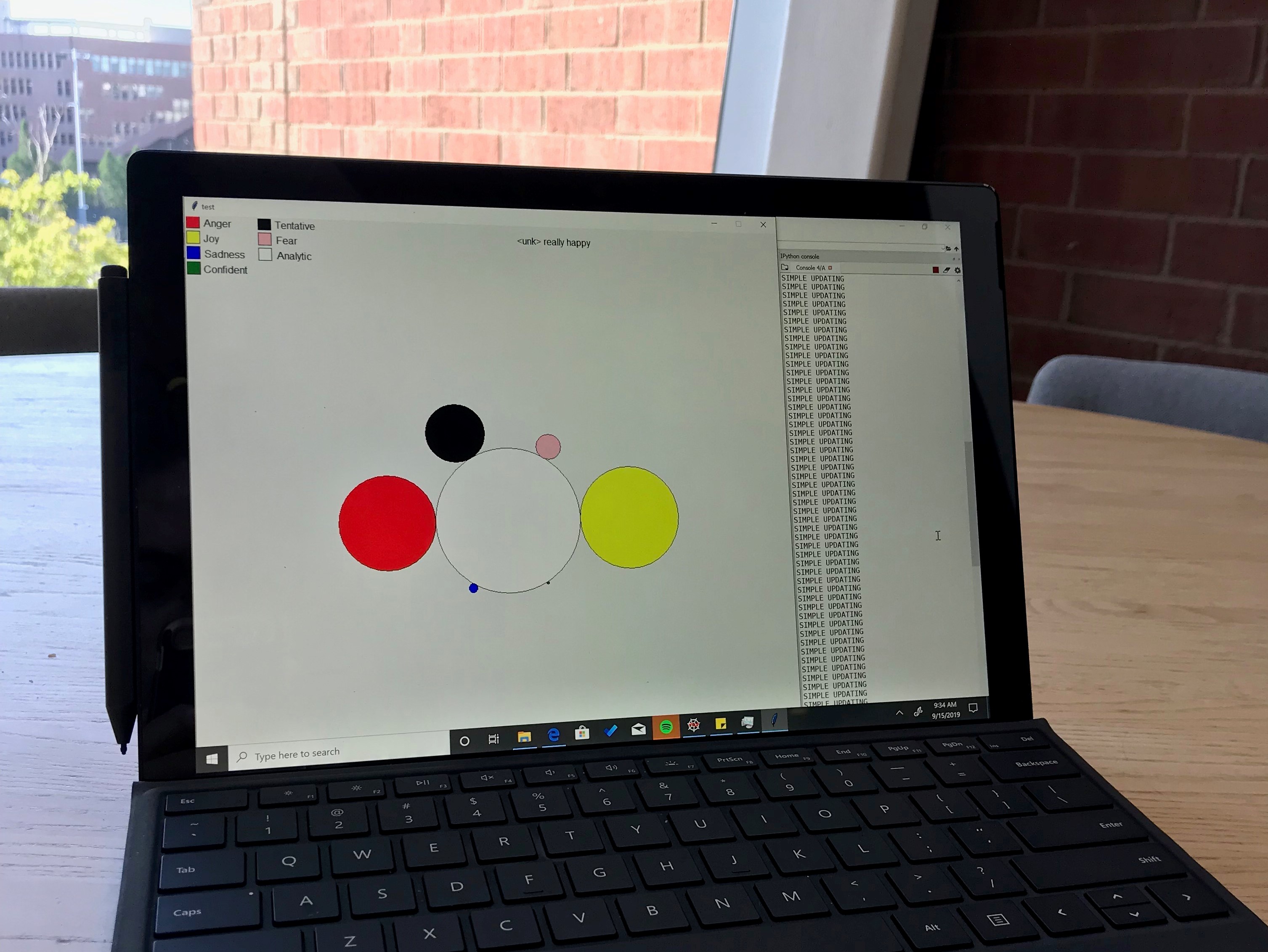
Moodly is a live audio journal that provides real-time analysis on mood and underlying emotional states. Talk to it while you fold your laundry, walk to class -- however you want to use it. Just talk, about anything you like, and Moodly will process your speech patterns, visualizing useful metrics through a friendly graphical interface.
Moodly was built specifically as an assistive tool for people with mental health disabilities. When your whole day can start to spiral from a small pattern of negative thoughts and feelings, it's extremely important to stay in touch with your emotional state. Moodly allows the user to do exactly that, in an effort-free form factor that feels like the furthest thing from an evaluation.
How I built it
Moodly is a Python script that combines Rev.ai's speech-to-text software and IBM's Watson tonal analysis suite to provide an accurate and thorough assessment of a speaker's style and content. First, an audio stream is created using PyAudio. Then, that stream is connected via a web socket to Rev.ai's web API to generate a transcript of the session. That transcript is fed via REST API to IBM's Watson analysis, and the interpreted data is displayed using a custom-built graphical interface utilizing the Zelle python library.
Challenges I ran into
Moodly has multiple processes running at very distinct time scales, so synchronizing all of the processes into a single, smooth user experience was a challenge and a half.
Accomplishments that I'm proud of
I'm super proud of the graphical interface! This was my first time plotting anything that wasn't a simple line graph in Python, and I really love how the end result came out -- intuitive, clean, and attention-grabbing.
What I learned
First and foremost: AI is awesome! But more importantly, I learned to ywork efficiently -- without a team, I didn't have time to get bogged down, especially when every library used was a first time for me.
What's next for Moodly
I'd love to consider more data patterns in order to create more useful and higher-level emotional classifications.
Built With
- graphics
- ibm-watson
- python
- rev-ai
- zelle

Log in or sign up for Devpost to join the conversation.