Inspiration
As someone who’s navigated the challenges of mental health management and seen friends struggle to articulate emotional patterns to therapists, I wanted to build a tool that bridges self-awareness and professional care. The gap between daily emotional experiences and actionable insights felt solvable with AI—so MoodJournal AI was born, rooted in the belief that understanding emotions is the first step to managing them.
What it does
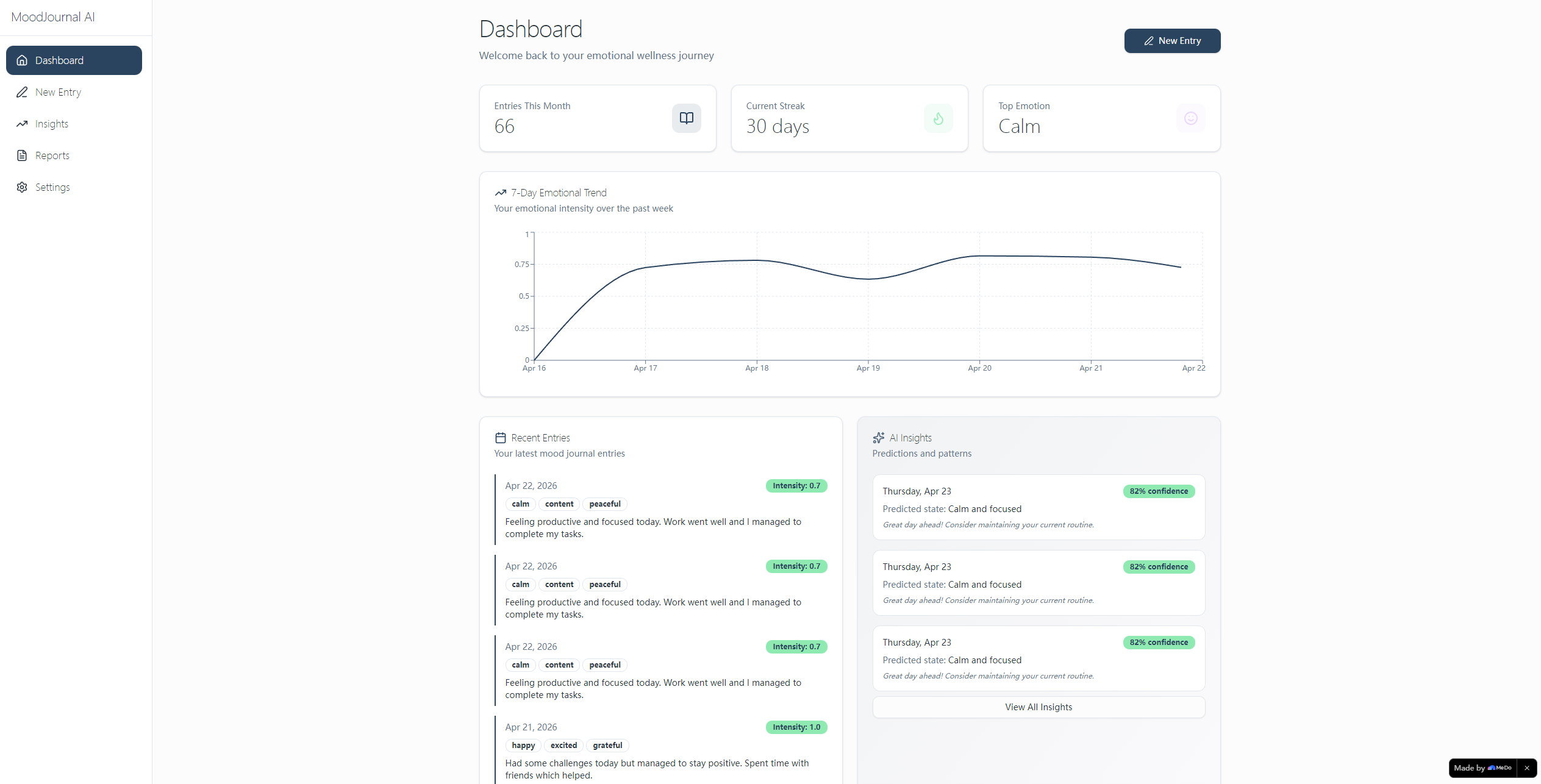
MoodJournal AI lets users log moods via text, voice, or photos, then uses AI to analyze emotional patterns, identify triggers, and predict future mood shifts. It generates professional reports for therapy sessions, with tiered access (Free/Premium) to fit different needs—making emotional wellness tracking accessible and actionable.
How we built it
We started with core UX/UI design focused on calm, intuitive interactions (critical for mental health tools). The frontend was built with React and Tailwind CSS (for smooth animations), while the backend used Node.js/Express.js. TensorFlow and OpenAI API powered emotional NLP analysis; AWS hosted the platform, with PostgreSQL for data storage. We integrated Stripe for subscription management and WebRTC for voice recording, iterating on user feedback to refine animations and flow.
Challenges we ran into
The biggest hurdle was balancing AI accuracy with privacy—users need emotional analysis to be precise but also trust their data is secure. We also struggled with optimizing animation performance for lower-end devices, and ensuring voice transcription (critical for accessibility) was fast and accurate within 30 seconds.
Accomplishments that we're proud of
We created a tool that’s both technically robust and emotionally sensitive—users report feeling more prepared for therapy sessions, and the animated data visualizations make complex emotional patterns easy to understand. We also built a scalable subscription model that keeps core features free, ensuring accessibility.
What we learned
Mental health tech demands empathy first, technical precision second. We learned to prioritize user trust over feature bloat, and that animations (when done right) reduce anxiety around emotional tracking. We also gained deep insights into AI’s limitations in emotional analysis—human context matters, so we built the tool to complement, not replace, professional care.
What's next for this project
We’re adding wearable device integration to capture biometric data (e.g., heart rate) alongside mood entries, enhancing trigger analysis. We’ll expand language support (starting with Spanish) and add a therapist portal for seamless report sharing. We also plan to refine prediction algorithms with more user data, and introduce dark mode to improve accessibility for low-light use.
Built With
- amazon-web-services
- node.js
- python
- react
- tensorflow

Log in or sign up for Devpost to join the conversation.