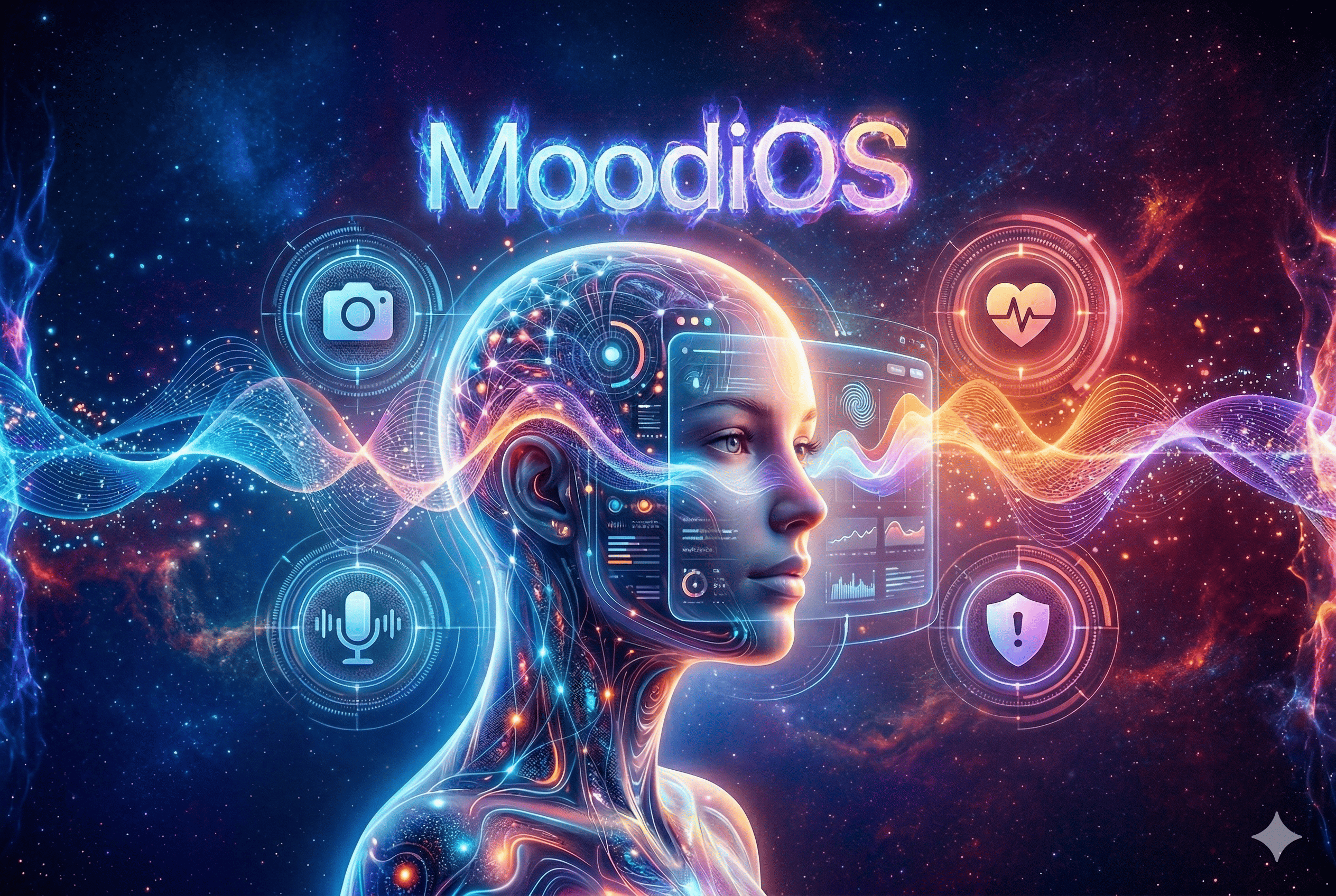
🌟 MoodiOS — The World’s First Emotion-Adaptive OS Layer
💡 Inspiration
Real human struggles → Human-centered innovation.
MoodiOS was not born inside a lab.
It was born inside the moments of real emotional exhaustion that nearly every human experiences.
- A student studying at 2 AM, exhausted yet drowning in notifications
- A developer debugging late night, overwhelmed by tabs, pressure, and fatigue
- A creator staring at a blank screen, losing inspiration
These moments feel lonely — not because people aren't around —
but because technology does not understand how we feel.
💭 The Realization
The world doesn’t need smarter machines.
It needs kinder ones.
Machines that:
- Sense
- Adapt
- Support, rather than demand
That dream became:
✨ MoodiOS
The first operating layer built around human emotion.
🧠 What It Does
🔥 Core Idea
MoodiOS reads emotions.
MoodiOS adapts to emotions.
MoodiOS protects your emotional wellbeing.
📊 Emotion Detection Signals
MoodiOS interprets subtle emotional cues through:
- typing rhythm
- gesture intensity
- interaction flow
- speed of actions
- fatigue patterns
- stress indicators
- focus duration
- environmental signals (simulated)
⚡ Real-Time Adaptation
MoodiOS transforms your device instantly:
- 🧘 Softens UI when stress rises
- 🎯 Creates distraction-free tunnels during deep work
- 🔕 Blocks noise when overwhelmed
- 🎨 Energizes UI during creativity
- ⏸ Suggests breaks during fatigue
- 🎙 Activates voice assistance for support
- 🌬 Triggers breathing guides
- 🌌 Changes WebGL particle shaders
- 🎧 Plays adaptive soundscapes
💡 Transformation
Your device is no longer a tool.
It becomes a gentle, emotionally aware companion.
🏗 How We Built It
Inspired by the human brain.
Engineered like a digital nervous system.
🧬 1. Multimodal Emotion Engine
Instead of a single signal, MoodiOS blends:
- typing behavior
- clicking patterns
- gesture speed
- focus duration
- fatigue signals
- environment simulation
- interaction flow
👉 Output: A real-time emotional vector
🧠 2. Processing & Fusion
The system generates:
- emotional state
- confidence score
- reasoning
❗ No randomness. No guessing. Only logic-driven emotion modeling.
🌍 3. Context Engine
MoodiOS understands that:
Emotion ≠ isolated signal
Emotion = context + behavior
It processes:
- light level
- noise level
- time of day
- workload
- tab switching
- attention span
- energy flow
- stress buildup
🧭 4. Decision Intelligence
Acts like digital intuition:
- Should Calm Mode activate?
- Should notifications pause?
- Should UI simplify?
- Should soundscapes play?
- Should breathing guides trigger?
Decisions feel human, not mechanical.
🎨 5. Adaptive UI Engine
UI dynamically evolves based on emotion:
- colors
- brightness
- blur
- motion speed
- particle behavior
- layout density
- glow effects
The interface feels alive.
🗣️ 6. Stress-Aware Voice Assistant
When stress rises:
"You seem stressed. Should I start Calm Mode?"
Characteristics:
- warm
- supportive
- non-intrusive
- emotionally intelligent
🎶 7. Emotion-Adaptive Soundscapes
| Emotion | Soundscape |
|---|---|
| Calm | Rain / Forest 🌧🌲 |
| Focus | Deep Hum 🎧 |
| Creativity | Spark Tones ✨ |
| Stress | Breathing Audio 🌬 |
| Fatigue | Soft Ambience 🌙 |
All transitions are smooth & crossfaded.
🌌 8. Cine-Reactive WebGL Particles
Using Three.js, MoodiOS visualizes emotion:
- Stress → tight clusters
- Calm → floating orbs
- Creativity → colorful bursts
- Joy → glowing flares
- Motivation → fast streaks
- Fatigue → dim slow particles
- Overwhelm → ultra-soft visuals
🎥 Your background becomes a living emotional canvas.
🚧 Challenges We Faced
Emotion is subtle — teaching a machine to respect it is delicate.
Key challenges:
- interpreting behavioral signals
- designing smooth transitions
- avoiding intrusive UI
- ensuring privacy
- maintaining emotional continuity
- realistic simulation
- balancing visuals + sound + logic
⚠️ Hardest Challenge
Teaching a machine how to care.
🏆 Accomplishments We’re Proud Of
- ✅ Built a multimodal emotion engine
- ✅ Created real-time adaptive UI
- ✅ Integrated WebGL cinematic particles
- ✅ Developed emotion-aware voice assistant
- ✅ Designed adaptive soundscapes
- ✅ Ensured 100% local processing (privacy-first)
- ✅ Delivered a deeply emotional user experience
💬 Most Meaningful Feedback
"It feels like my device finally understands me."
📚 What We Learned
Emotion is not a feature — it is the foundation of interaction.
Key insights:
- small UI changes reduce real stress
- emotional context drives productivity
- empathy can be engineered
- supportive tech changes behavior
- users crave emotional awareness
🚀 What’s Next for MoodiOS
🔮 Future Vision
- emotion-adaptive voice assistants
- stress-aware car dashboards
- emotional smart homes
- VR/AR emotional environments
- wearable emotional intelligence
- burnout prevention systems
- developer SDK for emotion-native apps
🌍 Our Dream
To build the world’s first Emotion-Native Operating System
A system where:
- devices feel your stress
- UI protects your focus
- digital spaces soothe your mind
- creativity is amplified
- wellbeing comes first
✨ Final Message
MoodiOS is not just software.
It is a movement.
A movement toward:
- emotionally intelligent technology
- human-first computing
- kinder digital experiences
💫 Closing Thought
This is not the future of computing —
this is the future of humanity inside computing.


Log in or sign up for Devpost to join the conversation.