-
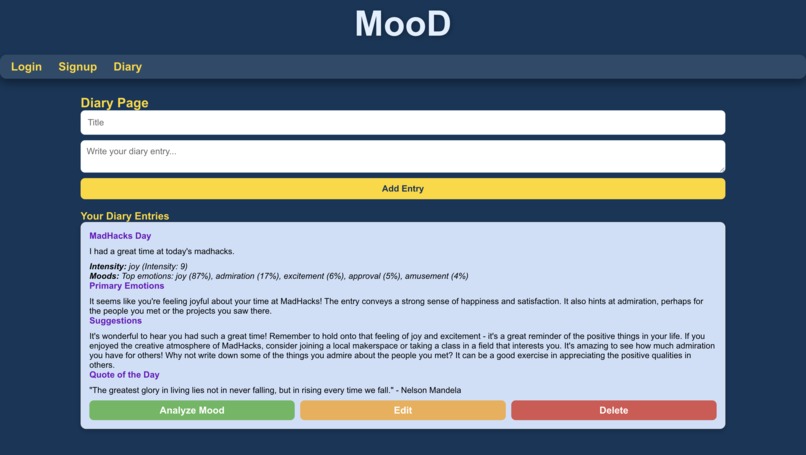
Diary Page where user writes diaries, edit diaries, delete diaries, and analyze diaries.
-
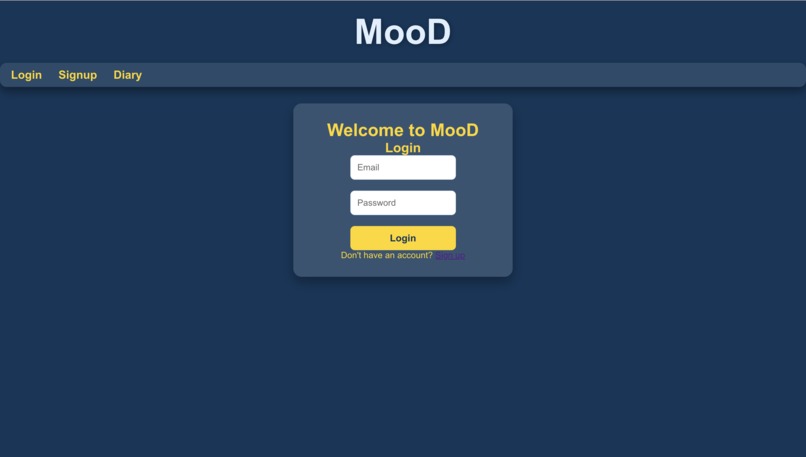
Login Page
-
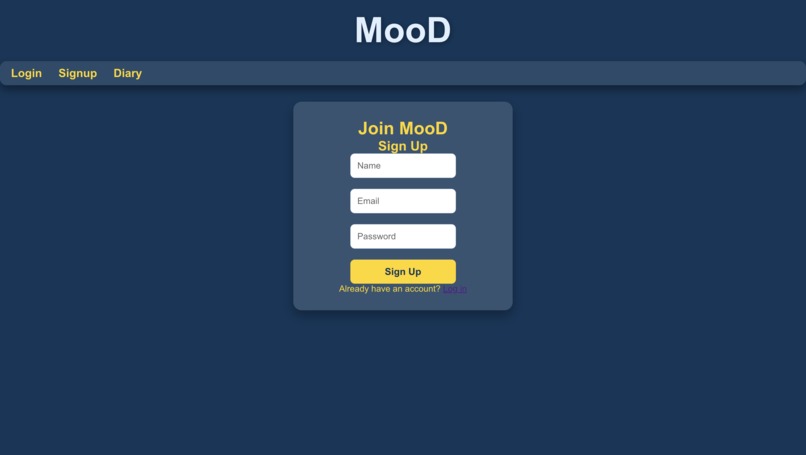
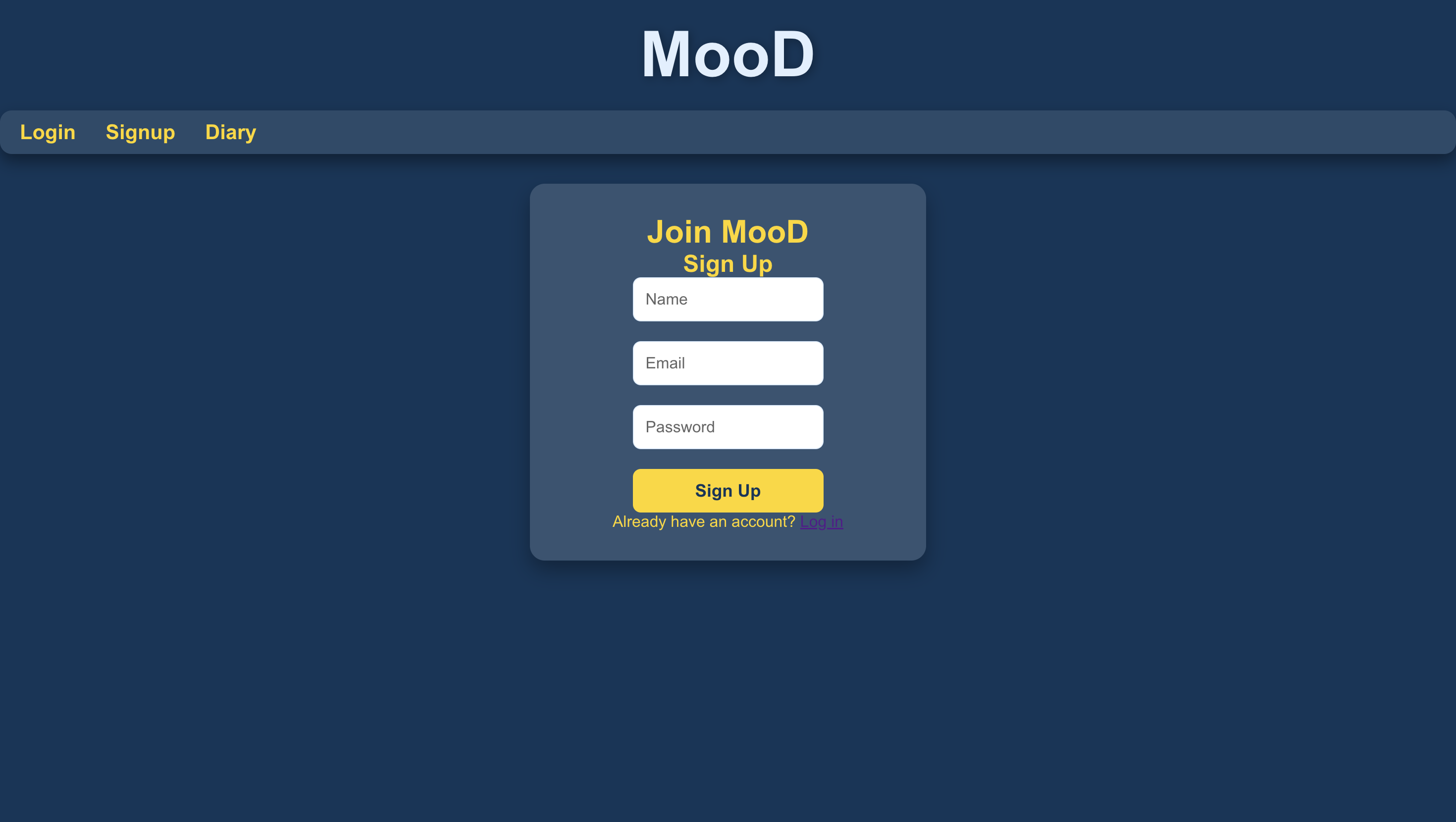
Sign Up Page

Inspiration
The inspiration behind MooD is to understand and help user manage their emotions. In today's fast-paced society, people had little time to meditate and realize what their mental feelings are. MooD is designed to provide insights from the diary tracks from the user to their emotion pattern. At the same time, help them gain AI-generated suggestions to improve well-being.
What it does
MooD allows the user to write, modify, delete and save diary entries. Then, the project would pass the diary entry to pre-trained AI in order to analyze the mental intesity of the user's feelings. After storing the data of written time, intensity and other tags, the project would ask generative AI for optimal suggests.
How we built it
Frontend: reated with React and React Router for seamless navigation, the front end includes components for writing, viewing, and analyzing diary entries, and displays visualizations of mood insights. Backend: bBuilt with Node.js and Express, the back end manages authentication, diary storage, and mood analysis requests. We also integrated a Flask microservice using Hugging Face Transformers for emotion analysis and Gemini API to generate personalized advice. Database: Used MongoDB to store user data, diary entries, mood analysis, and suggestions.
Challenges we ran into
Integrating the AI Models: Setting up and integrating both the Hugging Face and Gemini models for emotion analysis and suggestion generation presented some challenges, especially around API requests and managing response data. User Experience: Designing an interface that feels supportive and intuitive for users. Balancing the amount of information shown without overwhelming the user was also challenging.
Accomplishments that we're proud of
Comprehensive Mood Tracking: We’re proud to have built a system that allows users to track their mood over time with meaningful metrics, giving users a clear view of their emotional health.
What we learned
Building and integrating both front-end and back-end components improved our understanding of API-driven applications, from RESTful routes in Express to handling asynchronous requests in React.
What's next for MooD
Adding more detailed mood trend visualizations and insights, such as tracking changes in specific emotions over time. Working to enhance the AI-generated suggestions by incorporating more context, such as recent mood patterns or personalized suggestions based on user input.


Log in or sign up for Devpost to join the conversation.