-
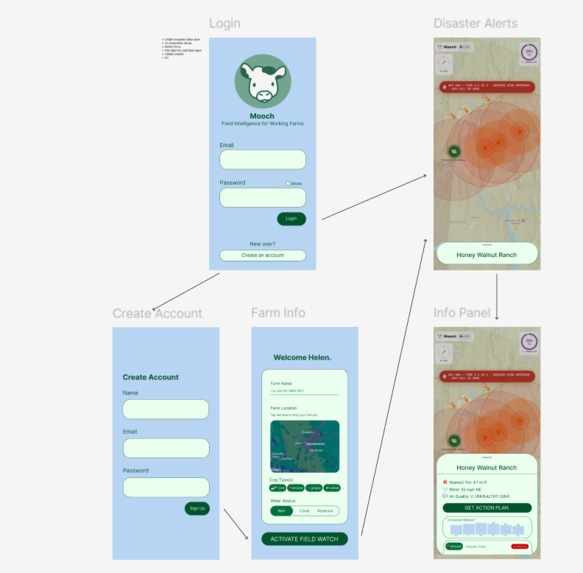
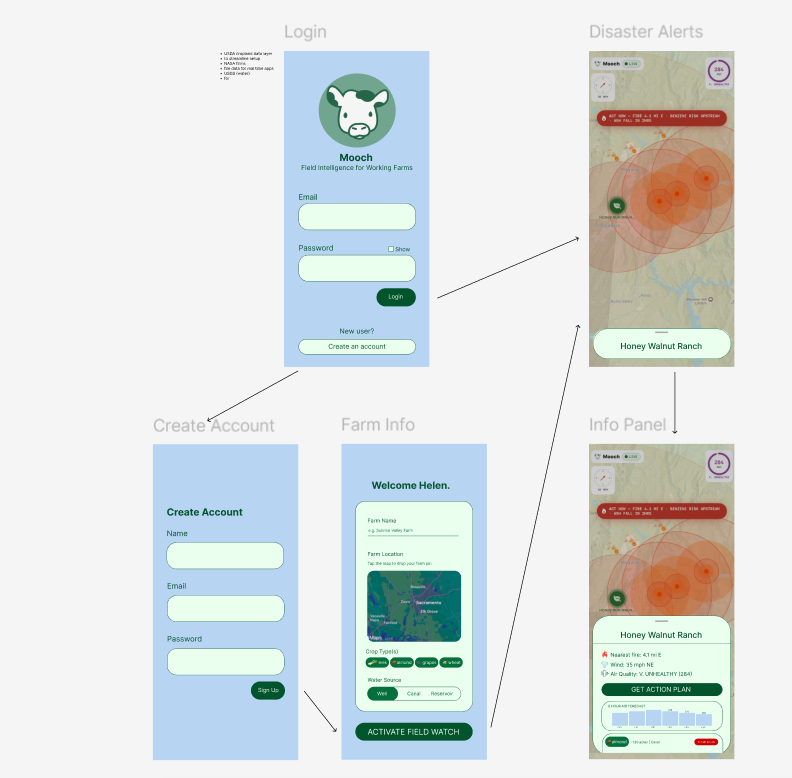
figma framework
-
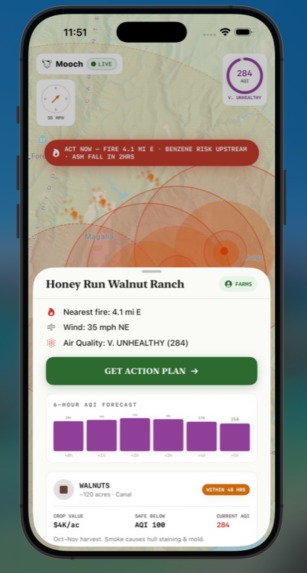
app
-
logo
-
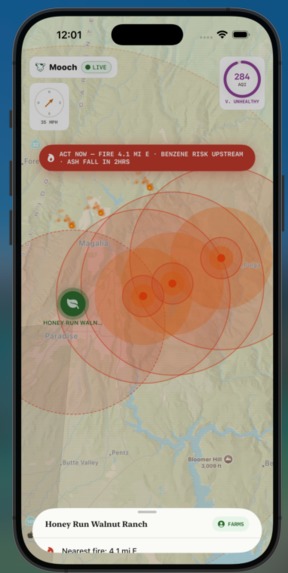
app
Inspiration
We came to Davis knowing that farming is prominent in the Central Valley, which pushed us to look for issues that affect the agricultural communities here. We kept circling back to the 2018 fire in Paradise, which despite never reaching the farms downstream, heavily impacted families via collapsed pipes that created a vacuum, sucking benzene and other carcinogens directly into the water supply. We found that the data existed, as USGS, CalFire, and EPA had different pieces of the puzzle, but no one had connected them to help the community. We built Mooch, a platform that bridges these gaps.
What it does
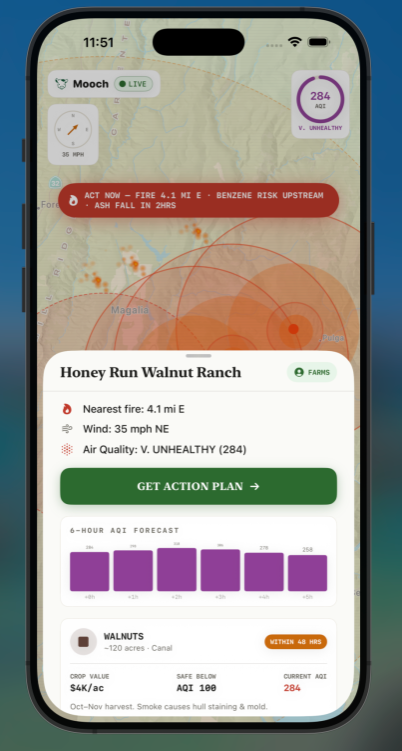
Mooch is a unified farm sentinel that pulls live data from CalFire, NASA, FIRMS, EPA, and USGS, combining it into a single, farm-specific threat view. When a fire ignites nearby, Mooch knows your crop type, your water intake location, and how threats like ash fall and pressure drops affect your specific operation. It translates raw data into simple actionable alerts, like stopping a valve, stopping overhead irrigation, and moving equipment. When it's time to act, a single tap sends a pre-written evacuation message in English and Spanish to every field worker, with a GPS pin on the evacuation zone.
How we built it
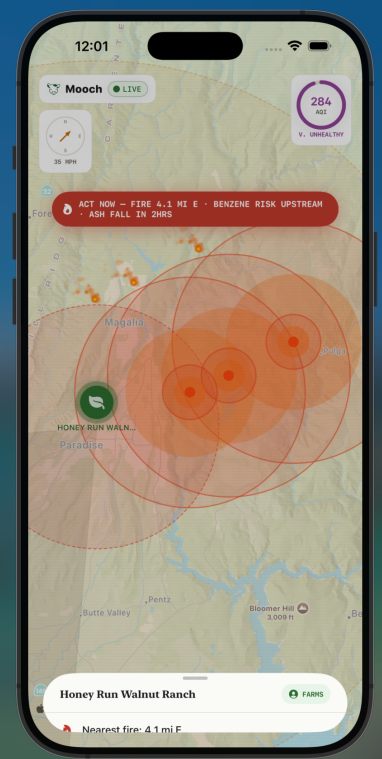
We split into two subteams: one focused on product design, the pitch, and everything you're reading right now, while the other two built and deployed the app, using MapKit for handling fire overlays and farm visualization, and Swift Concurrency powering parallel live data fetches from NASA FIRMS, the EPA's AirNow API, and USDA CropScape. The intelligence layer runs through the Claude API, which generates farm-specific action plans and role-based crew delegation messages on the fly. We also built a demo mode seeded with the Paradise fire data from November 8, 2018, so the threat scenario that inspired Mooch is the one you see in the demo.
Challenges we ran into
Time was a big challenge. We had a hard deadline and an ambitious scope, so we had to make some painful cuts on features we genuinely liked but didn't make it because a working product mattered more than a complete one. On the technical side, we ran into a fundamental problem: there are no active wildfires near Davis right now, which meant we couldn't demo the core value of the app with live data. We solved this by building a demo mode seeded with real historical data so the threat scenario you see in the demo actually happened, even if it isn't happening today.
Accomplishments that we're proud of
Honestly, shipping something that works is a big accomplishment. We came in as a group of friends in the midst of finals season (we go to SJSU), and figuring out how to split the work evenly, designing the product on one side, and engineering on the other without things falling through the cracks was its own big feat. The fact that we walked away with a genuinely functional app, a coherent pitch, and a product we'd actually want to exist in the world feels like the real win.
What we learned
On the technical side, all four of us learned how to use new tools or get better at using them this weekend. On the engineering side, the team got hands-on experience wiring together multiple live data APIs and integrating the Claude API for real-time AI-generated alerts. On the design and product side, Figma was a tool we had little experience with, so there was a lot of learning to prototype and communicate ideas visually, which made the collaboration between both subteams a lot smoother than it would've been otherwise.
What's next for Mooch
In the future, we'd like to add tracking for other environmental risks. This could mean covering floods, pest outbreaks, and other events that quietly devastate farms before anyone sounds an alarm. On the technical side, we're looking at deeper offline capabilities so the app stays useful even when cell service fails in a crisis, and extending to Apple Watch so critical alerts reach farmers wherever they are on the property. We also want to build out multi-user support per farm, so an owner, an irrigation manager, and a harvest crew lead can each have a role-specific view of the same operation.
Built With
- airnow/epa-api
- anthropic-claude-api
- core-location
- figma
- ios
- mapkit
- messageui
- nasa-firms-api
- open-meteo
- swift-concurrency
- swift-observation
- swiftui
- usda-cropscape/nass-api
- xcode


Log in or sign up for Devpost to join the conversation.