-
-
Home Page

Here is a comprehensive, project-style breakdown for your "Monte Carlo Retirement Analysis" tool, written as if it were for a project submission or a startup's "About" page.
Inspiration
Our inspiration came from a simple observation right here in Nairobi: conversations about retirement are often filled with anxiety and guesswork. Many Kenyans diligently contribute to their NSSF and Saccos, but a deep uncertainty remains. Will it be enough? Traditional retirement calculators offer a single, overly optimistic number, ignoring the volatility of real life—things like inflation, unexpected family emergencies, fluctuating investment returns, and the general unpredictability of the economy.
We saw a gap between the static financial advice people were receiving and the dynamic, often turbulent, reality they were living. The culture of mutual support is strong, but there's a growing desire for individual financial empowerment. We wanted to replace that anxiety with clarity and confidence, giving people a tool that respects the unpredictable nature of life, rather than ignoring it.
What It Does
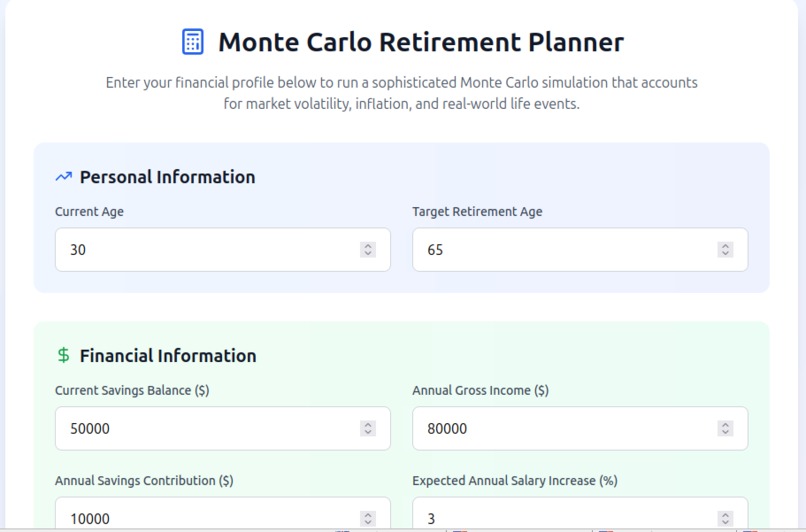
The Monte Carlo Retirement Analysis isn't a simple calculator; it's a powerful forecasting engine. It takes a user's current financial situation—age, income, savings, and investment strategy—and stress-tests it against hundreds of simulated lifetimes.
For each simulation, it introduces random, real-world events based on historical data and probabilities:
- Market Volatility: Investment returns aren't a fixed 8% a year; they fluctuate, reflecting the ups and downs of the stock and bond markets.
- Inflation: The cost of living changes, impacting the future purchasing power of savings.
- Life Events: It models the financial impact of common life events, like a sudden job loss, an unexpected medical expense, or even a small windfall.
The final output isn't a single, misleading number. It’s a probability of success. The tool tells you, "Based on your current plan and 500 different possible futures, you have a 72% chance of reaching your retirement goal." It also shows the range of possible outcomes, from the best-case to the worst-case scenarios, giving users a truly realistic picture of their financial future.
How We Built It
We built this tool on a foundation of data and proven financial modeling principles.
- Core Engine: The heart of the tool is a Python-based script that runs the Monte Carlo simulation. We used libraries like NumPy and Pandas to handle the complex calculations and data manipulation required to run hundreds of iterations efficiently.
- Financial Modeling: We defined key variables (average returns, standard deviations for different asset classes, inflation rates, probabilities of life events) by researching historical economic data, both globally and with a consideration for the local Kenyan context.
- User Interface (UI): We designed a simple web-based front-end using HTML, CSS, and JavaScript. The goal was to make a complex tool feel intuitive and accessible. Users can input their data into a simple form, and the results are displayed through clear, easy-to-understand text and data visualizations (using a library like Chart.js).
- Integration: An API (built with a framework like Flask or Django) connects the user-friendly front-end to the powerful Python back-end, allowing for seamless communication between user inputs and the simulation engine.
Challenges We Ran Into
- Balancing Simplicity and Accuracy: Our biggest challenge was making the tool both powerful and easy to use. A Monte Carlo simulation is complex, but the user experience needed to be simple. We spent a lot of time refining the input form and the final report to ensure we were providing deep insights without overwhelming the user with jargon.
- Sourcing Relevant Data: Finding reliable, long-term historical data for local investment returns and event probabilities was difficult. We had to blend data from various sources and make carefully considered assumptions to build a model that felt relevant to a user in Kenya.
- Computational Demand: Running hundreds of simulations, each over a 30-40 year timeline, is computationally intensive. We had to optimize our code significantly to ensure the tool could provide results quickly without requiring massive server resources.
Accomplishments That We're Proud Of
- Shifting the Conversation: We are most proud of creating a tool that changes the retirement conversation from "How much will I have?" to "What are my chances?" This probabilistic approach provides a much more honest and actionable framework for financial planning.
- Making a Complex Model Accessible: We successfully distilled a complex, institutional-grade financial modeling technique into a simple, free tool that anyone can use to gain a clearer understanding of their future.
- A Positive Early Response: In our initial user testing, the feedback was overwhelmingly positive. Users felt that for the first time, they had a "real" picture of their retirement prospects, which motivated them to think more critically about their savings habits.
What We Learned
- The Power of "What If": The true value of this tool isn't just seeing the final number; it's the ability to immediately see how small changes can impact your odds. We learned that allowing users to easily adjust their savings rate or retirement age and see the probability change in real-time is a powerful motivator for positive financial behavior.
- User Experience is Everything: A brilliant algorithm is useless if no one can understand it. We learned that design, clear language, and thoughtful presentation are just as important as the mathematical model itself.
- Perfection is the Enemy of Good: We could have spent years trying to perfect every single variable. We learned that it's better to launch with a robust, well-researched model and iterate based on user feedback, rather than waiting for an impossible standard of perfection.
What's Next for Monte Carlo Retirement Analysis
The journey is just beginning. Our vision is to evolve this tool into a more comprehensive personal finance co-pilot.
- Personalized Recommendations: We plan to move beyond just showing the probability of success to offering actionable advice. For example: "Increasing your monthly savings by KES 5,000 could raise your success probability from 65% to 75%."
- Integration with Local Platforms: We aim to explore potential integrations with local financial platforms to allow users to pull in their data more easily, making the analysis even more personalized and seamless.
- Broader Financial Goals: We will expand the tool to analyze other major financial goals beyond retirement, such as saving for a child's education, buying a home, or starting a business.
- Building a Community: We want to build a community around the tool, offering educational content and workshops to help Kenyans improve their financial literacy and take control of their economic futures.
Built With
- bolt
- react
- tailwind
- typescript

Log in or sign up for Devpost to join the conversation.