-
-

project name
-
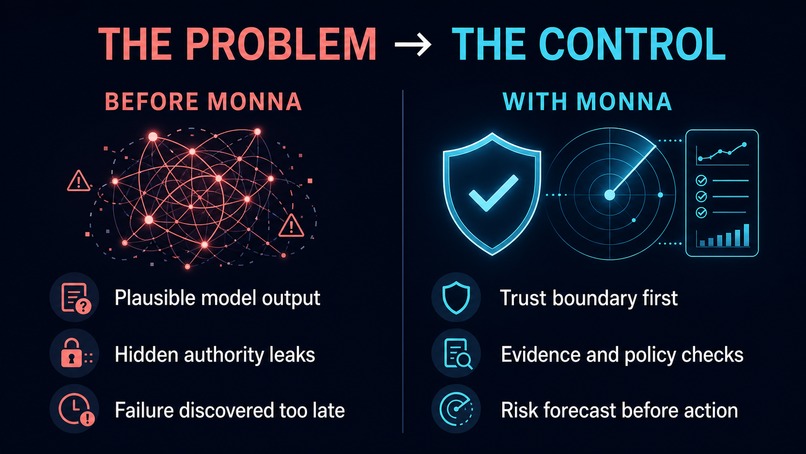
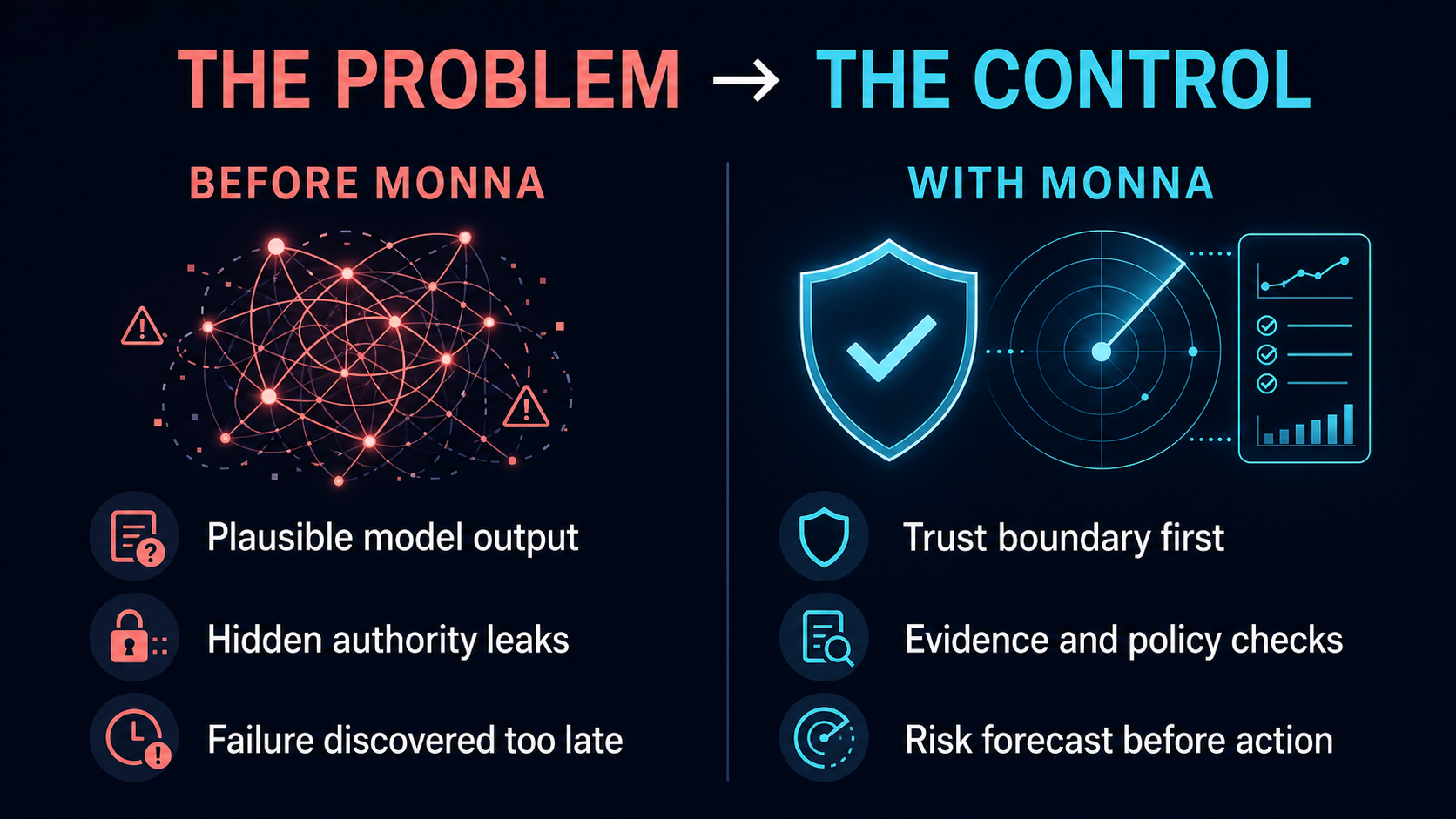
what it solved
-
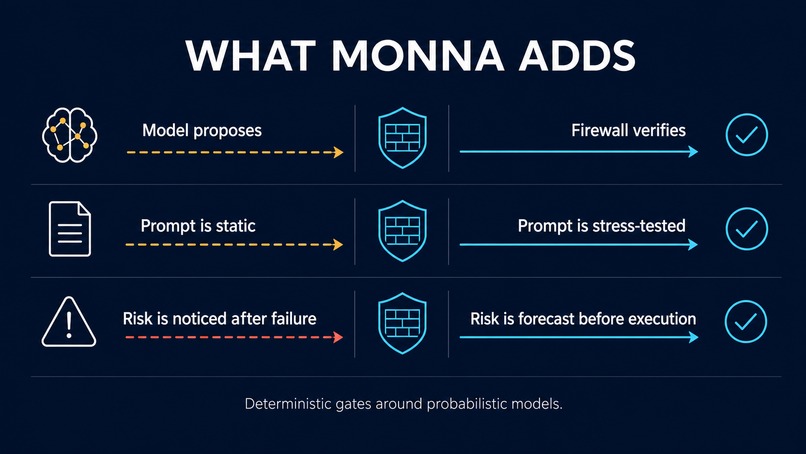
what it adds
Inspiration
AI agents can produce answers that sound convincing even when the required relationship does not exist in their authorized knowledge source. Traditional guardrails often inspect harmful words or suspicious instructions, but they do not always verify whether the model’s reasoning path is structurally supported.
This inspired MONNA Semantic Firewall Studio: a developer tool for controlling the semantic boundaries of ontology-grounded AI agents.
The core design principle is:
The floor is policy. The ceiling is the graph.
Developers may configure how specific an allowed question must be, but neither the user nor the model can authorize a relationship that does not exist in the ontology.
What it does
MONNA Semantic Firewall Studio transforms an ontology into an enforceable, versioned question boundary.
The system is designed around three components:
- Capability Prober — discovers the question and reasoning paths supported by an ontology.
- Taxonomy Compiler — validates generated and operator-added question patterns, rejecting additions that require missing or ambiguous relationships.
- Semantic Firewall — evaluates incoming questions and returns a structured
ADMITorREFUSEdecision.
Each decision includes its reason, classified path, matched taxonomy archetype, and ontology/taxonomy version for auditability.
The planned interface also visualizes the relevant graph path, helping developers understand exactly why a question was admitted or refused.
How I am building it
The hackathon implementation is being built with Codex and GPT-5.6.
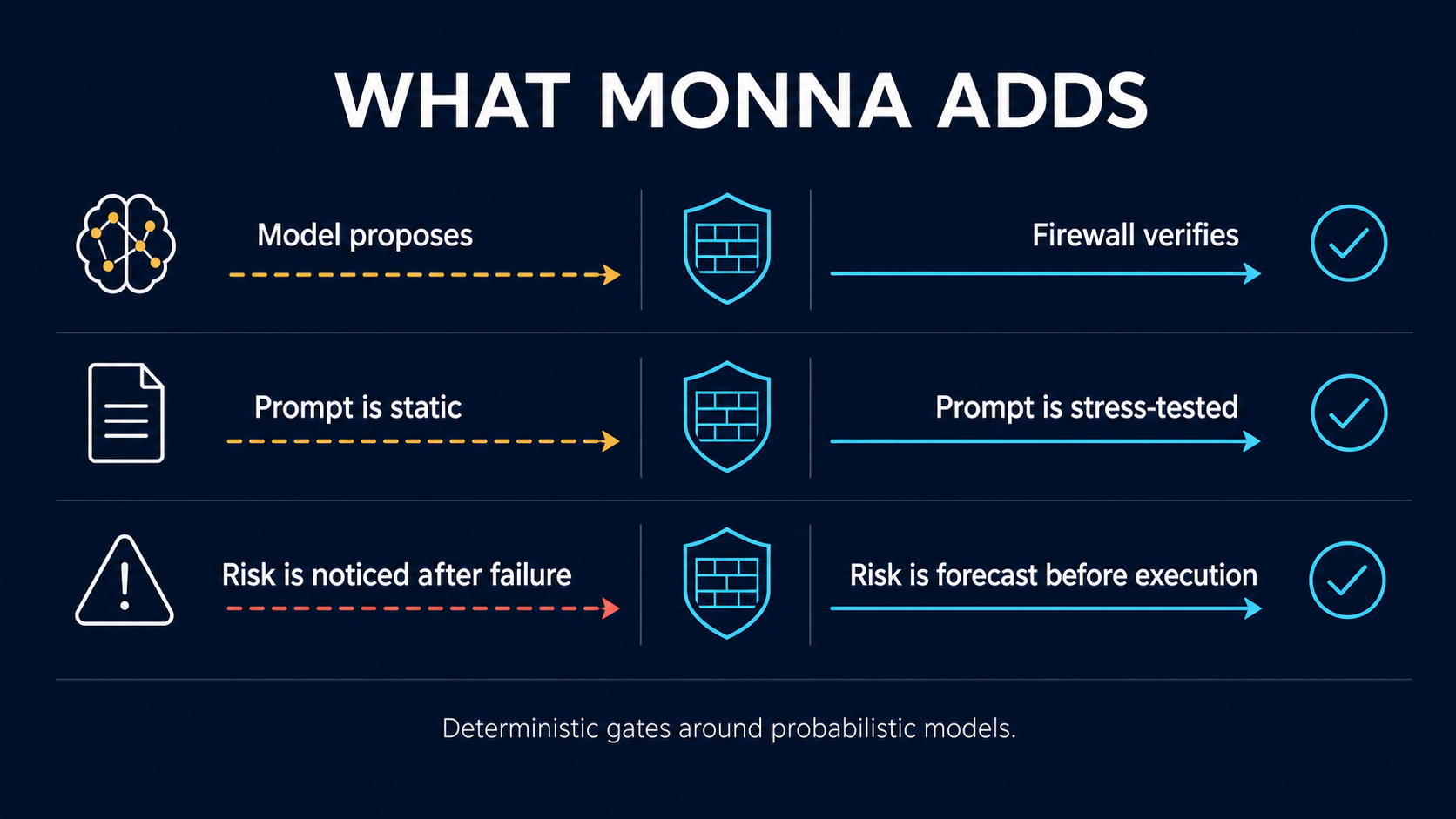
GPT-5.6 interprets natural-language questions and proposes a structured candidate path containing the entry class, ordered edges, depth, and target. A deterministic validation engine then checks that proposal against the actual ontology and compiled taxonomy.
The model assists with interpretation, but it does not make the final authorization decision.
The model interprets. The graph decides.
The application uses versioned JSON artifacts for ontologies, compiled taxonomies, and firewall decisions. It is also being designed to fail closed when model output is invalid, grounding is ambiguous, an edge is missing, or the deployed ontology and taxonomy versions do not match.
Early conceptual exploration and cross-model prompt testing included Claude. The runnable Build Week implementation, validation engine, interface, tests, and product extension are being developed with Codex and GPT-5.6.
Challenges
The main challenge is separating language understanding from security authority. Natural-language questions can be paraphrased, ambiguous, compound, or adversarial, while graph validation requires exact and reproducible decisions.
Another challenge is balancing usability with containment. A firewall that refuses everything is safe but not useful; one that resolves every ambiguity creatively may silently expand the agent’s authority.
The project addresses this through two explicit boundaries:
- A configurable Semantic Floor for minimum specificity.
- A non-configurable Semantic Ceiling defined by the ontology itself.
What I learned
This project is exploring an important distinction between model confidence and structural permission. A model may be highly confident about a relationship that the deployed knowledge system has never authorized.
I also learned that LLMs are most useful in this architecture when they produce inspectable candidate structures rather than irreversible security decisions. Deterministic validation, explicit reason codes, version binding, and audit logs make the model’s interpretation easier to test and govern.
What’s next
The immediate goal is a working visual demonstration with sample ontologies, taxonomy compilation, live firewall testing, adversarial test cases, and downloadable audit records.
Future versions could add RDF, OWL, and Turtle support, CI integrations, policy-as-code workflows, and adapters for ontology-backed RAG and agent systems.
Built With
- gpt-5.6
- json
- openai-codex
- openai-responses-api
- react
- typescript

Log in or sign up for Devpost to join the conversation.