Inspiration
Traditional recommendation demos treat cultural taste as a static list of suggestions. We wanted to turn cross-domain taste intelligence into an interactive deduction game where cultural affinities are the clues themselves. When a rare vinyl pressing, 35mm film print, or culinary manuscript vanishes, the culprit leaves behind a trail of cross-domain cultural habits.
What it does
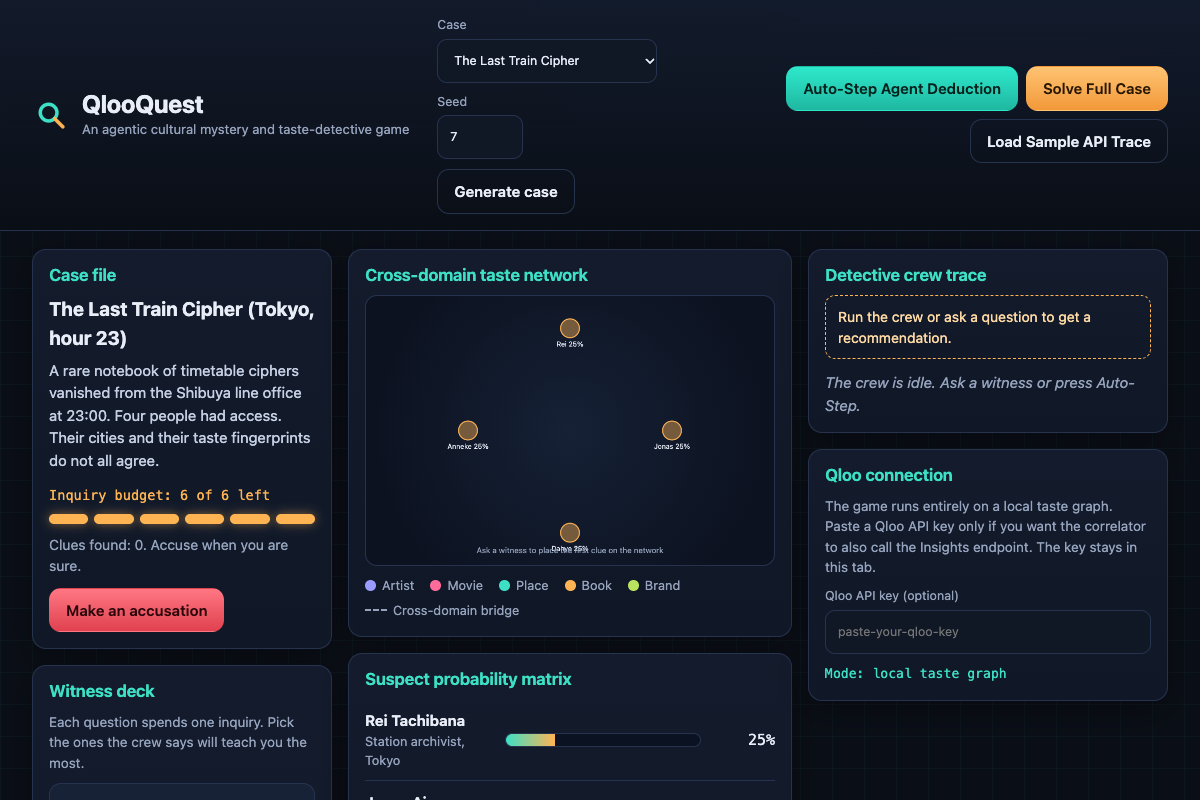
QlooQuest challenges players to solve cultural heist mysteries across a global circuit of cities (Tokyo, Paris, New York, Seoul, London, Buenos Aires, Mexico City, Berlin) within a strict 6-action interrogation budget:
- 4 Curated Mysteries + Infinite Seeded Procedural Cases: Includes The Shibuya Vinyl Heist, The Left Bank Celluloid Vanishing, The Oaxaca Mezcal Manuscript, and The Berlin Modular Synth Caper, plus deterministic seeded generation (
mulberry32) for replayable puzzles. - 4-Agent Investigative Crew:
- Taste Profiler Agent: Extracts 8-dimensional cultural taste vectors (
music,film,food,books,fashion,travel,nightlife,craft) from witness statements. - Cross-Domain Linker Agent: Queries Qloo
/v2/insightscross-domain affinity bridges to connect preferences across categories (such as linking late-night ramen bars to underground jazz clubs and neo-noir cinema). - Alibi Verifier Agent: Evaluates city-to-city transit feasibility and cultural scene overlap.
- Chief Inspector Agent: Updates the Bayesian posterior probability matrix over all 6 suspects and recommends the single highest-information witness interrogation next using Shannon entropy reduction.
- Taste Profiler Agent: Extracts 8-dimensional cultural taste vectors (
- Interactive Cross-Domain Affinity Canvas: Renders the live bipartite graph connecting extracted witness clues, cultural domains, and suspects.
How we built it
We built QlooQuest as a zero-dependency, offline-capable web application (engine.js, app.js, index.html, styles.css) backed by 105 automated unit and DOM smoke tests (node --test). The Qloo API client panel supports live Qloo /v2/insights calls when an API key is provided and falls back cleanly to a deterministic cross-domain affinity matrix offline.
Challenges we ran into
Designing mystery puzzles where every clue narrows the Bayesian suspect distribution without making the culprit trivial on turn one required carefully calibrating the cosine similarity spread across all 6 suspect taste profiles and 8 cultural domains.
Accomplishments that we are proud of
Building a complete 4-agent investigative deduction engine with Shannon entropy question ranking, interactive bipartite graph visualization, and 105 passing unit and DOM tests.
What we learned
Cross-domain cultural affinities make a compelling game mechanic because real cultural taste naturally clusters across music, film, food, and literature in ways players can reason about intuitively.
What is next for QlooQuest
Adding multiplayer co-op detective lobbies and live Qloo entity search so players can generate custom mysteries around any city or artist.
Built With
- bayesian-inference
- canvas-2d
- css3
- html5
- javascript
- multi-agent-systems
- qloo-api
