Tagline
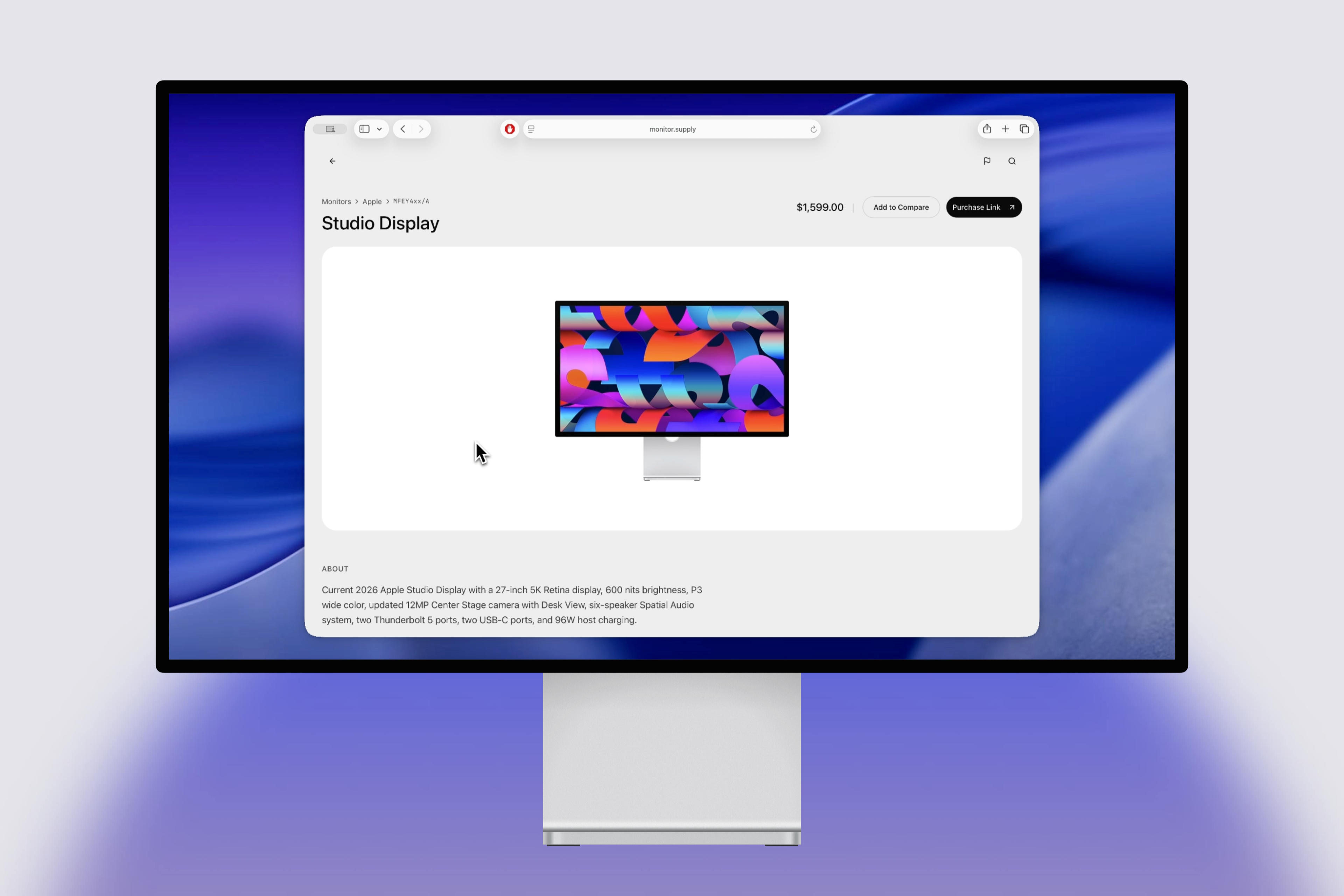
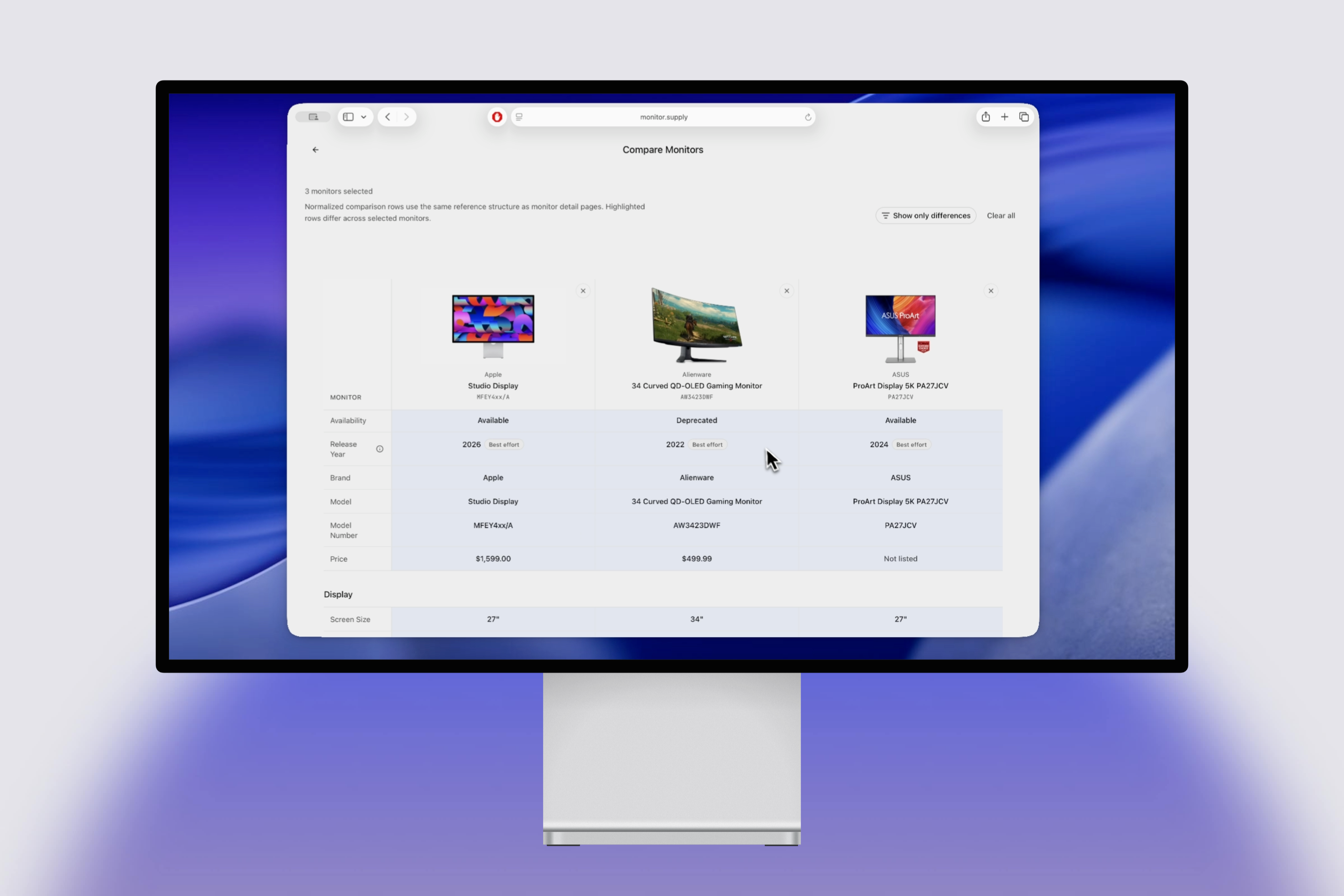
Monitor Supply lets you compare any monitor from any brand on the same standardized, marketing-free specs , apples to apples, in one place , powered by a self-maintaining, fully transparent data pipeline that Codex built brand by brand.
Inspiration
Buying a monitor is harder than it should be. Today, most people have only two choices, and neither is great. You go brand by brand , ASUS, Dell, LG, Samsung , each with its own filters, its own layout, and its own marketing vocabulary ("HDR Pro," "HDR Black," "DisplayHDR True Black," "Fast IPS") that's engineered to be un-comparable to the brand next door. Or you Google "best monitor for Mac / for developers / for design" and get listicles built from whatever sponsored or review units a site happened to receive. The genuinely rigorous review sites test each unit by hand, which is exactly why their catalogs stay small. There has never been a single place where you can compare every monitor using the same standards. That's what we wanted to build , one standardized spec database for every monitor (think GSMArena, but for displays) . So a normal person can find the right display in minutes instead of decoding spec sheets across a dozen tabs.
What it does
Monitor Supply standardizes and compares displays across brands. Right now it indexes 1,164 monitors across 12 brands (ASUS, Dell, LG, Samsung, Apple, BenQ, AOC, Alienware, HP, Gigabyte, MSI, Koorui) in the US market, each normalized to the same 37-field spec sheet.
- One standardized spec table. We pull each brand's data, strip the marketing language, and normalize every spec to industry standards. So "HDR Pro" and "DisplayHDR 600" land on the same comparable axis. Filter by screen size, resolution, panel type, refresh rate, stand, and more, across all brands at once.
- Derived metrics that actually matter. PPI, a Retina rating, launch year, and use-case fit , computed consistently, not copied from a brochure.
- 13 curated buyer categories (Gaming, Creative, 4K+, High Refresh, OLED, Ultrawide, Portable, Best for Mac, Eye Care, and more) for people who don't think in spec sheets. The categories are hand-curated starting points, and because every filter is transparent, you can see exactly what each one selects for and layer your own filters on top.
- Apple-style explainer pages for every spec. Want to know what HDR actually means, which standards exist, and which matters for you? There's a one-pager for that , for HDR, resolution, refresh rate, and more , written in terms of what real people care about, not the physics.
- Honest, open data. Public Catalog Status and Data Pipeline pages show, per brand, when we last fetched, how often we refresh, how many monitors we index, and how complete each one is across core, buying, and deeper details. Every spec shows how we got it , pulled from the brand or inferred , and where something's missing, we say so and let you send a correction.
How we built it
Building the web app was the easy part , we'd designed a clean UI a while back. The real challenge was the data. Over the past two weeks, Codex and GPT-5.6 built the system that how do you fetch specs for over a thousand monitors across a dozen brands for the first time. Then keep them current forever as models launch, get renamed, and go out of stock , when every brand's site is structured completely differently?
Codex built that entire ingestion system. It built it to last:
- Brand-by-brand reverse engineering. For each brand, Codex figured out how that brand actually serves its catalog and specs. For 9 of the 12 brands it didn't need to scrape at all , those exposed fully structured catalog data. It discovered the underlying feeds and APIs powering their own product pages and reused them.
- A tiered spec model (Core facts / Buying facts / Deep details). Codex classified every spec by importance: Core facts (brand, screen size, native resolution, panel type, native refresh rate) and Buying facts (HDR, brightness, ports, USB-C power delivery) are required to list a monitor at all; Deep details (color depth and gamut, response time and VRR, VESA and dimensions, power draw) route to cross-checking or human review before publishing. It cleanly separated what's deterministic (regex and parsers for Core facts straight off the product listing), what needs model review (Buying facts and Deep details pulled from individual product pages, then reviewed by Codex for sanity), and what needs a human (ambiguous or missing data). It even generated a review dashboard so a human can approve those edge cases.
- A reusable "onboard a brand" skill. The centerpiece: we hand it nothing but a brand's homepage link, and a Codex skill , planned with GPT-5.6's stronger reasoning (Sol), executed with a lighter, faster GPT-5.6 (Terra) for the simpler pages , reverse-engineers that brand's data source and writes a repeatable pipeline for it. It then runs the pipeline twice and verifies the second run produces no incremental changes, proving idempotency.
- CI/CD-style observability. Every ingestion run tracks which stages passed and failed, surfaced like a pipeline status. So onboarding a brand is a system, not a one-off import.
- Multimodality where the data hid. For HP, Codex realized some Buying facts and Deep details weren't on the web page at all , they lived in PDF spec sheets . So it used GPT-5.6's multimodality to read the specs straight out of the PDFs.
The most fun part: we built almost all of this from a phone. Codex ran on a headless Mac mini with no display attached, and we drove it in voice mode through Codex remote in the ChatGPT app , talking to it, handing it a homepage URL, and letting it figure out the rest on the machine.
Why a public, repeatable pipeline instead of a one-time scrape
Anyone can scrape a thousand monitors one time. Most catalogs become outdated because they are only snapshots in time. So we made two choices instead: each brand's pipeline can be safely re-run, and its status is public , how complete the data is, how fresh it is, and where each number came from. That honesty is the product. A comparison site is only worth trusting if you can see how it knows what it claims, and where it doesn't. We'd rather show a blank cell and ask you for help than dress up a guess as a fact.
Challenges we ran into
- Every brand is a different problem. Different catalog structures, different spec vocabularies, and the real data living in different places , a JSON feed, plain HTML, or a PDF.
- No marketing gets to slip through. Turning "HDR Pro"-style language into values you can actually compare, without ever mislabeling anything, meant trusting strict parsers for the specs that must be exact and setting the rest aside for review instead of publishing on a hunch.
- Making the pipelines safe to re-run was the hardest part. To be sure a refresh wouldn't quietly rewrite the catalog, we run each brand twice and compare the results. So a run that should change nothing provably changes nothing.
Accomplishments we're proud of
- A live catalog of 1,164 monitors across 12 brands, each cleaned up into the same standard spec sheet , every core fact filled in, and everything else openly tracked so you can see what's still missing.
- A brand-onboarding skill that turns a single homepage link into a working pipeline you can safely re-run; 11 of the 12 brands run that way today.
- Public pages that let anyone check how fresh and complete our data is.
- We built the whole ingestion backbone just by talking to Codex , much of it from a phone.
What we learned
Codex works best when you give it a messy real-world problem and a clear definition of success , it does its sharpest work inside tight rules. Matching the model to the job mattered too: heavier GPT-5.6 reasoning to plan the skill, a lighter, faster one for the simple parsing. And the boring parts , the re-run checks, tracking where each number came from, a lane for human review , are what turn a one-time scrape into something you can trust.
What's next
Wire the pipeline into Codex schedules so the whole catalog refreshes itself continuously and hands-free. Onboard more brands (the skill makes each new one cheap). Expand beyond the US. And close the loop on purchase , add a direct buy link (e.g. Amazon) to every monitor so going from comparison to checkout is one click.
See it live
Everything above is live and ready to try right now at https://monitor.supply. Browse the full catalog, filter across every brand at once, read the spec guides, and open the public Catalog Status and Data Pipeline pages to see exactly how each brand's data is fetched and how fresh it is.
Built With
- codex
- gpt-5.6
- next.js
- node.js
- python
- typescript
- vercel

Log in or sign up for Devpost to join the conversation.