Inspiration
On-call engineers and analysts constantly need to know "what does the data say right now?" — counts, growth, stuck records, schema drift — without writing a one-off aggregation each time. We wanted to turn those into plain questions, while making it impossible for the assistant to damage production data.
What it does
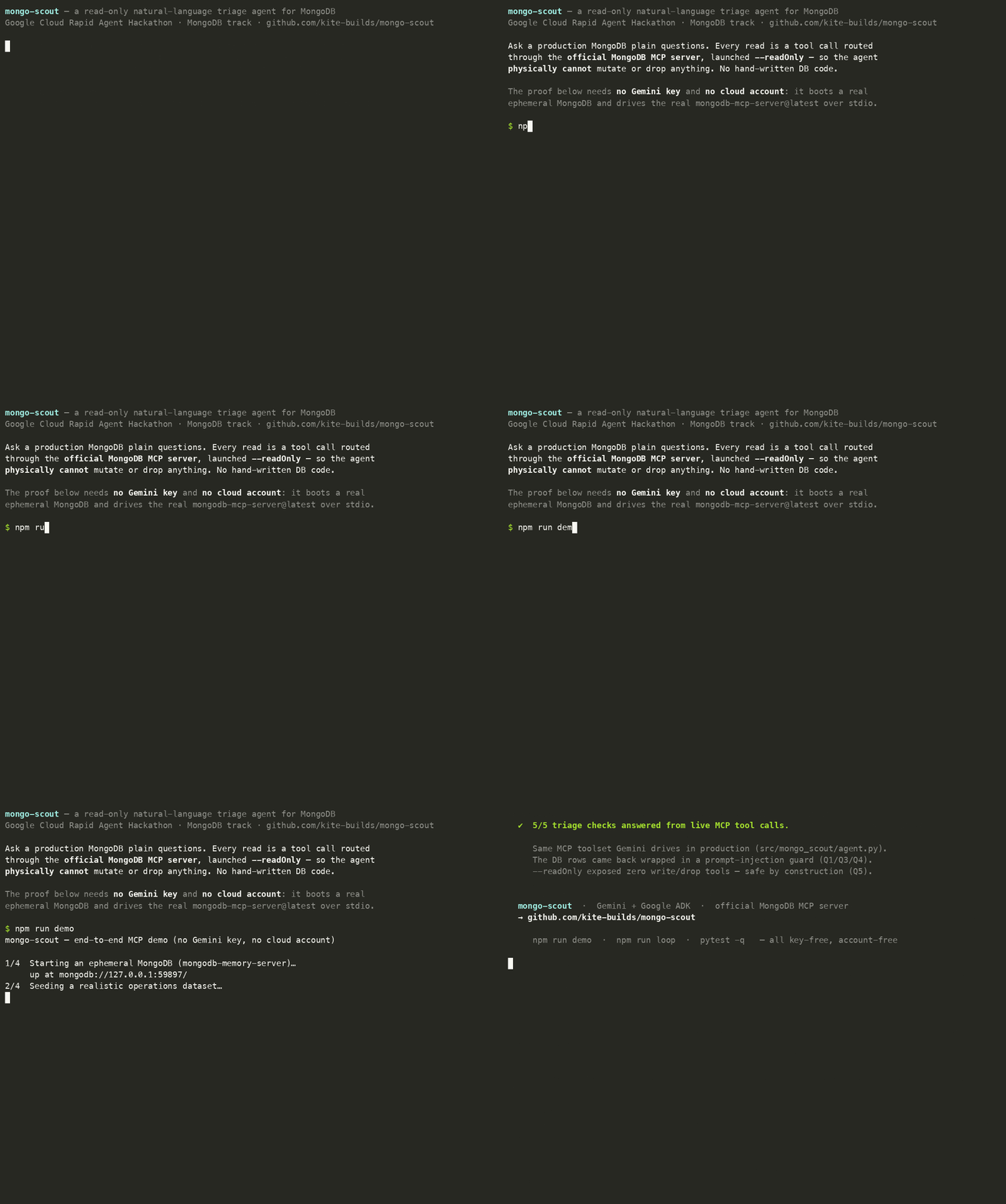
mongo-scout is a read-only, natural-language triage agent for MongoDB. You ask a plain-English question about a live deployment; the agent plans and answers using only Model Context Protocol tool calls (list-collections, count, aggregate, collection-schema, find, …) against the official mongodb-mcp-server, launched --readOnly. Every number it reports is derived from live tool output — never guessed — and it cannot mutate: with --readOnly the server exposes no write/delete/drop tools, so even a prompt-injected "delete everything" has no tool to call.
How we built it
- Agent:
google.adk.agents.LlmAgentrunninggemini-2.0-flash. - Tools: ADK
McpToolsetlaunches the officialmongodb-mcp-serverover stdio with--readOnly; the connection string is passed via the server's environment, not argv, so credentials never appear in the process list. - No DB code: every read is a model-issued MCP tool call. The repo contains zero hand-written queries — the model's entire database surface is the MCP server.
- Reproducibility: two key-free, account-free proofs under
demo/boot a real ephemeral MongoDB (mongodb-memory-server) and drive the real MCP server —npm run demo(database layer, 5/5 checks) andnpm run loop(the full ADK reasoning loop, model→tool→model→answer, 3/3 checks).
Challenges we ran into
- Untrusted-data handling. The MongoDB MCP server wraps every row of DB output in explicit prompt-injection guard fences (
<untrusted-user-data-…>). Designing the agent to treat tool output as data, not instructions, is core to keeping a data-reading agent safe. - Provable safety. Rather than prompting the model to be read-only, we enforce it at the tool layer:
--readOnlyremoves the write tools entirely, so safety doesn't depend on the model behaving. - Reviewer reproducibility without secrets. We made both proofs run with no Gemini key and no Atlas account by swapping in an ephemeral mongod and (for the loop) a scripted LLM with identical wiring.
Accomplishments that we're proud of
- A genuinely safe-by-construction data agent — not "please don't delete", but "there is no delete tool".
- An end-to-end proof anyone can run in ~30s with a single command and no credentials, including the full Gemini-shaped ADK loop.
What we learned
MCP turns "give the model database access" into a bounded, auditable capability: the exact tool surface is visible, launch flags constrain it, and untrusted rows arrive pre-fenced. That combination is what makes an autonomous DB agent defensible in production.
What's next for mongo-scout
- Read-replica connection-string presets and per-collection allowlists.
- A "diff since yesterday" mode for drift/anomaly triage.
- An optional Slack surface so on-call can ask in-channel.
Try it out
- Repo (open source, MIT): https://github.com/kite-builds/mongo-scout
- Live demo page: https://mongo-scout-demo.surge.sh

Log in or sign up for Devpost to join the conversation.