Inspiration
Small businesses often manage their financial operations across disconnected tools: one system for invoices, another for payments, spreadsheets for tracking transactions, and separate processes for chasing overdue payments and identifying financial risks.
This fragmentation makes it difficult for business owners to understand their financial position, respond quickly to problems, and coordinate routine financial work.
We wanted to build something more connected: a financial operating system where business data, payment operations, AI agents, risk analysis, and human approvals work together.
What it does
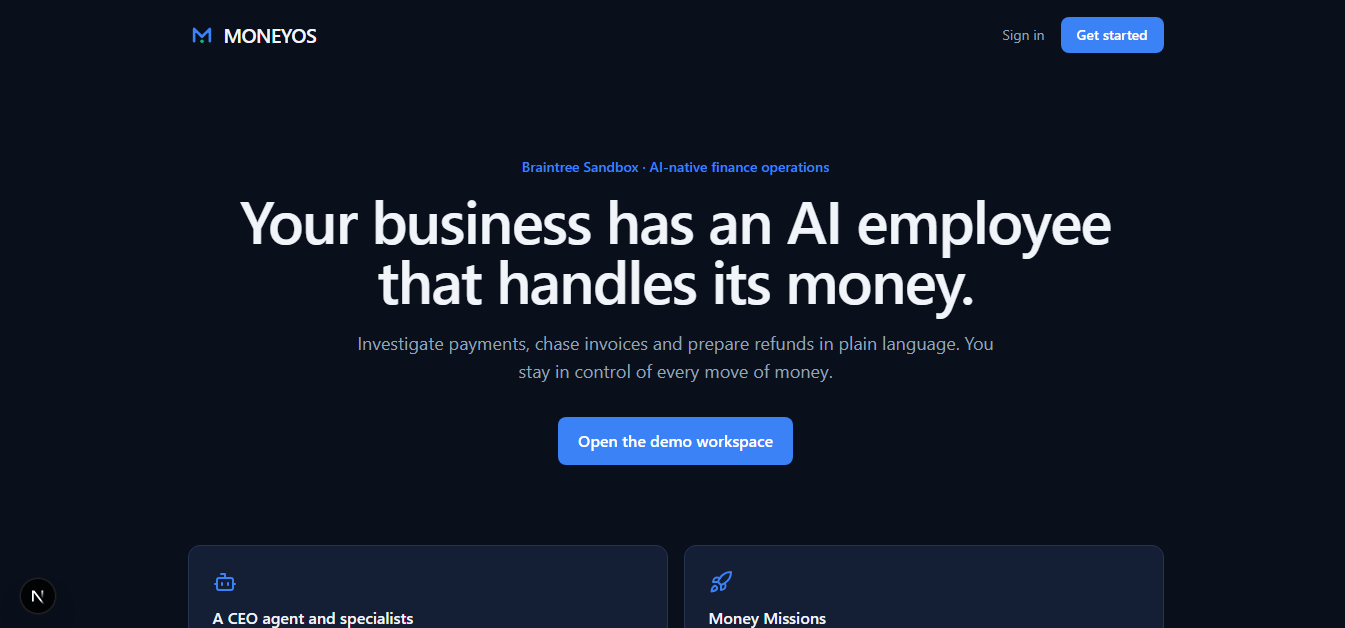
MONEYOS is an AI-assisted financial operating system designed for small businesses.
It brings financial visibility and operational workflows into one application:
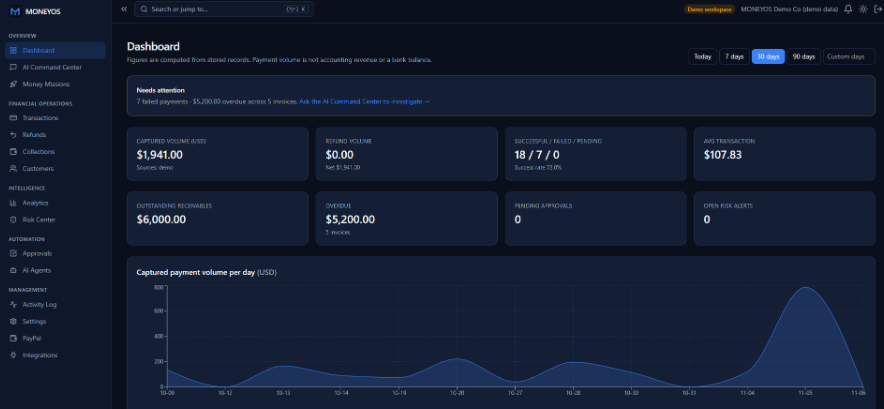
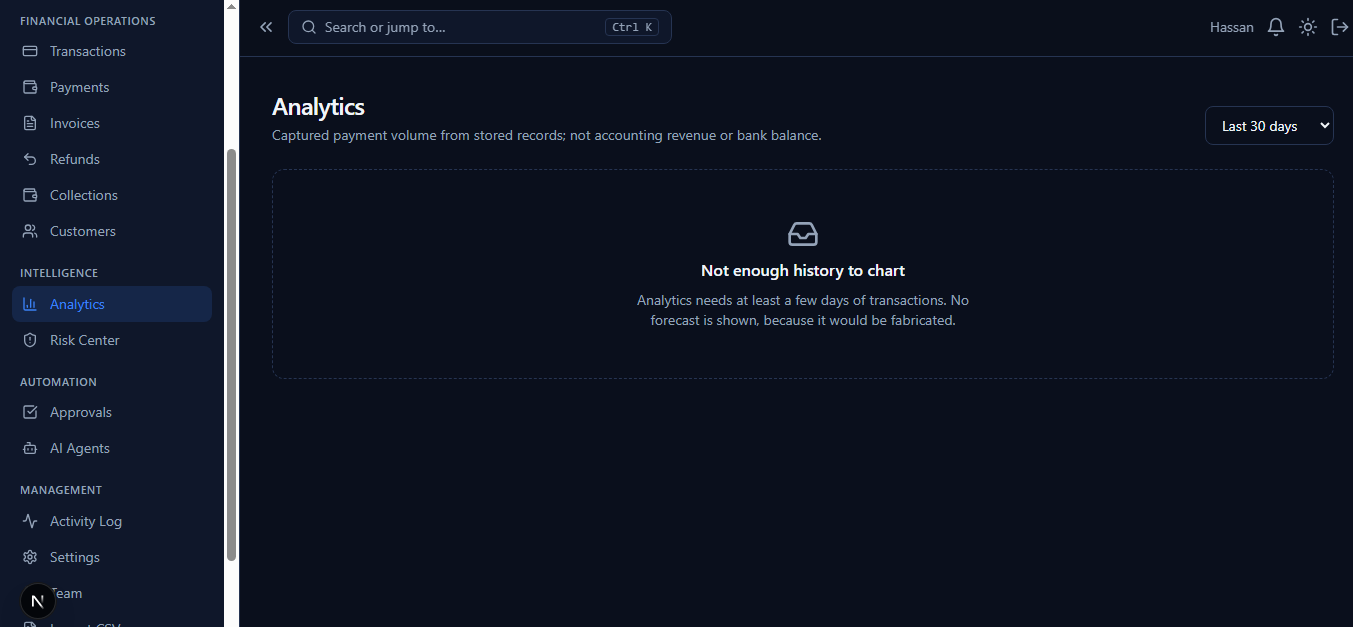
Dashboard and Analytics: Review financial activity, transaction summaries, and business performance.
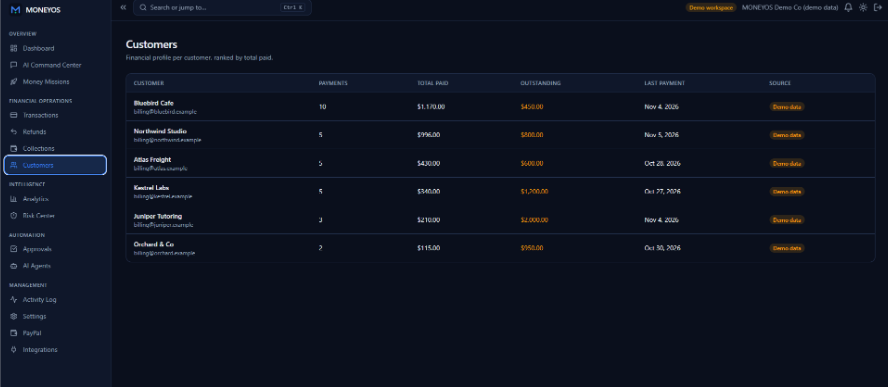
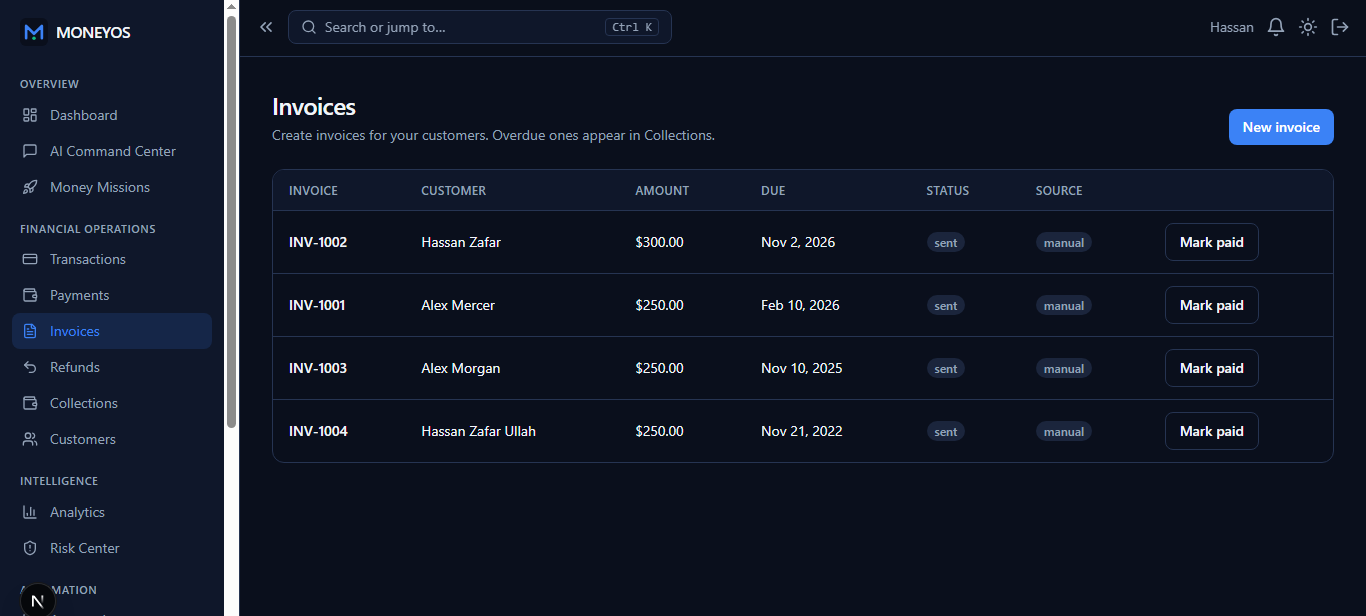
Customers and Invoices: Manage customer records and create and track invoices.
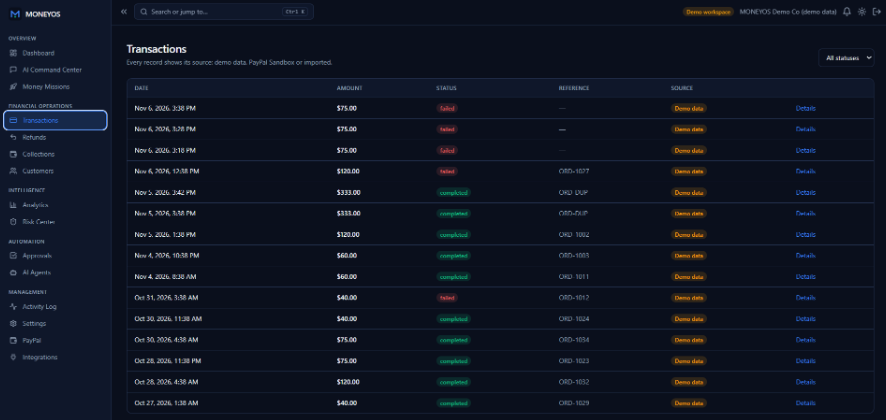
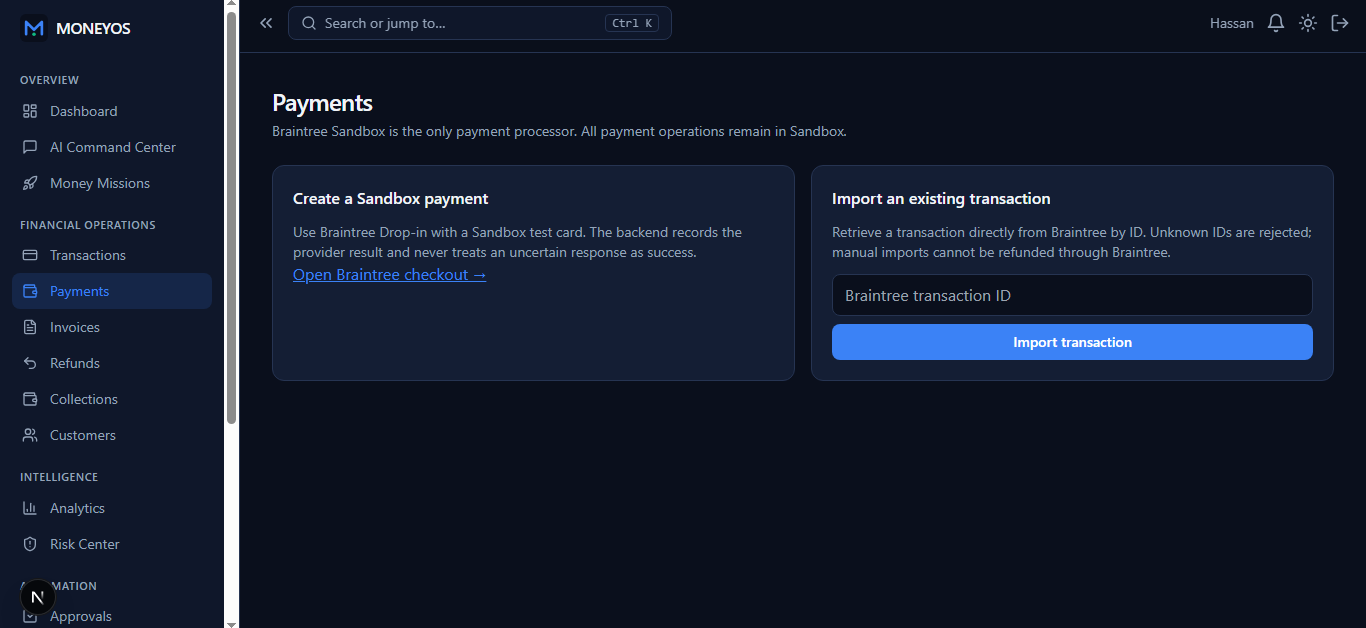
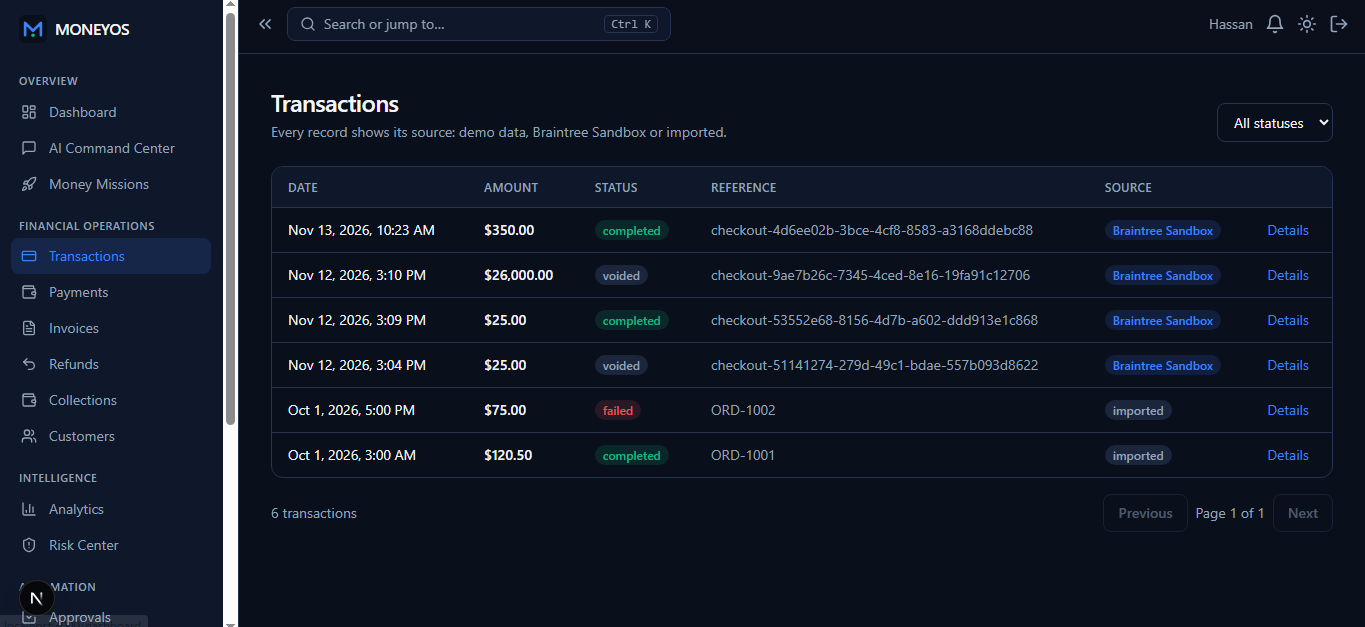
Payments and Transactions: Process payments through Braintree Sandbox and inspect transaction records.
Refunds: Handle supported refund and void workflows.
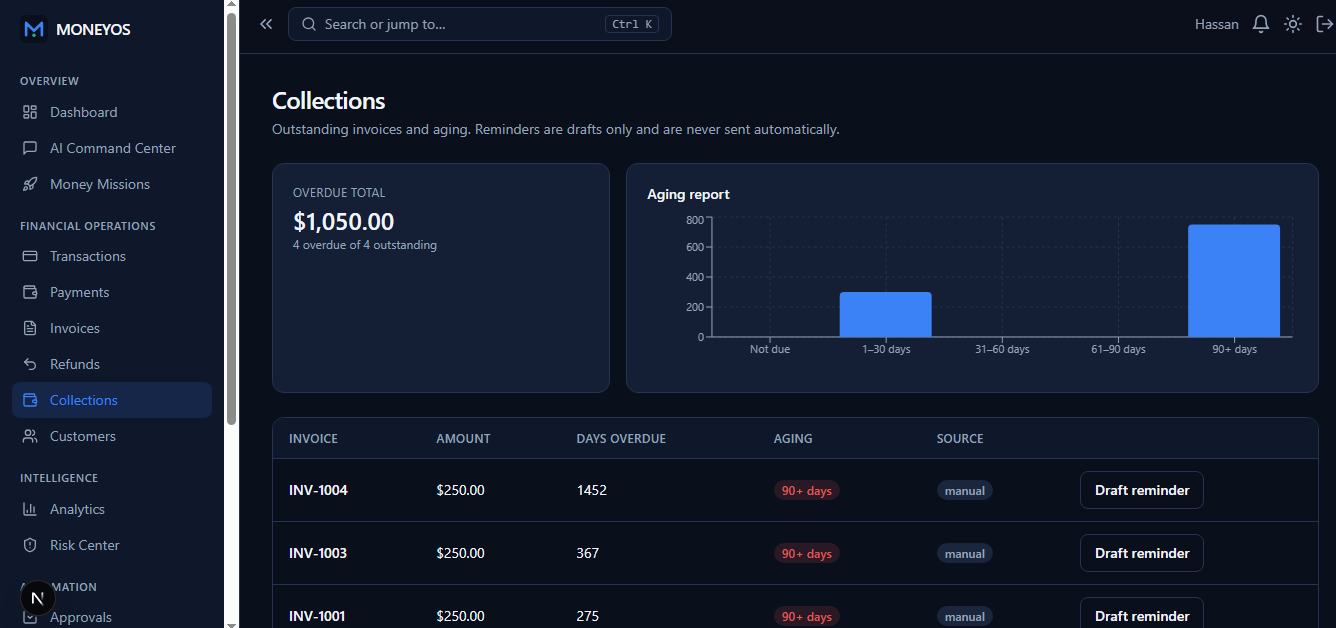
Collections: Identify overdue invoices and prepare collection reminders.
Risk Center: Review risk alerts and investigate potentially problematic financial activity.
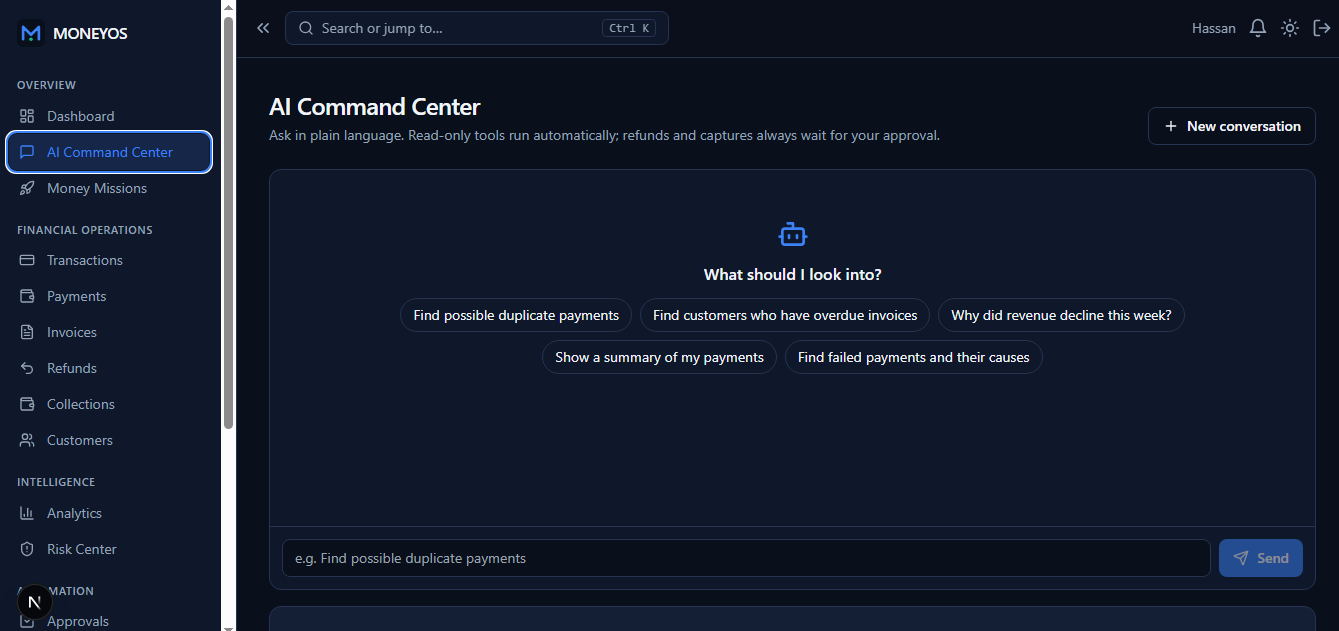
AI Command Center: Use natural-language requests to investigate business finances and initiate supported workflows.
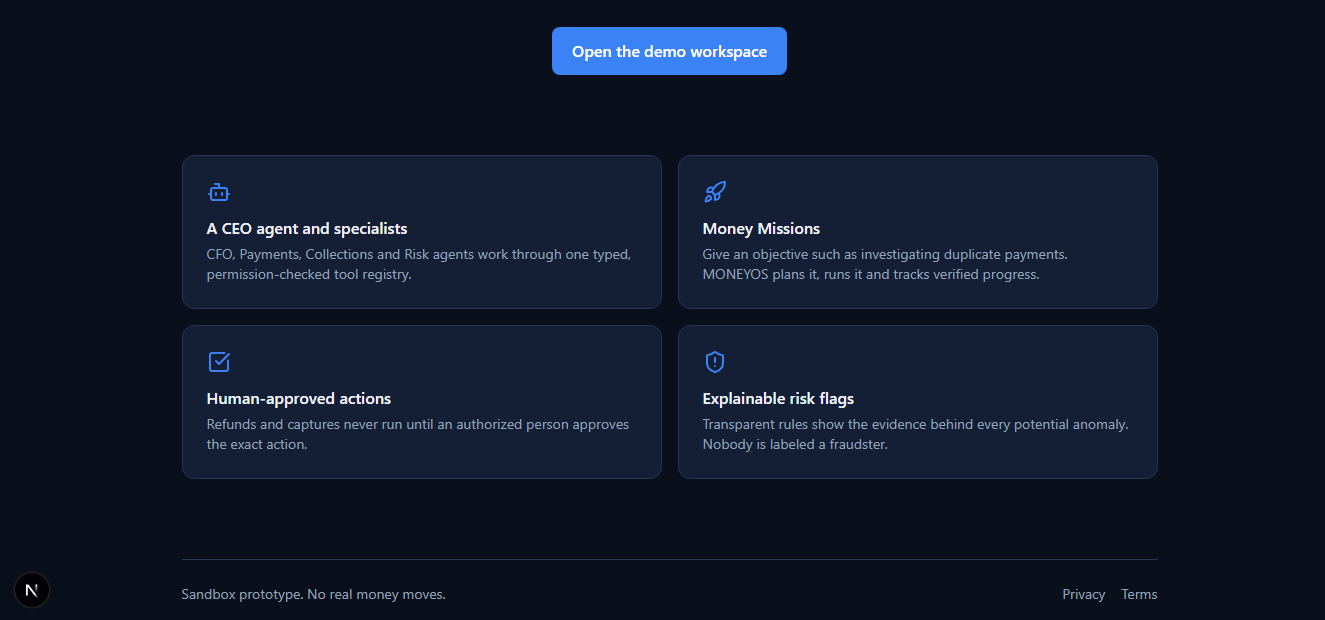
AI Agents: Coordinate specialist CFO, Payments, Collections, and Risk agents through a CEO orchestrator.
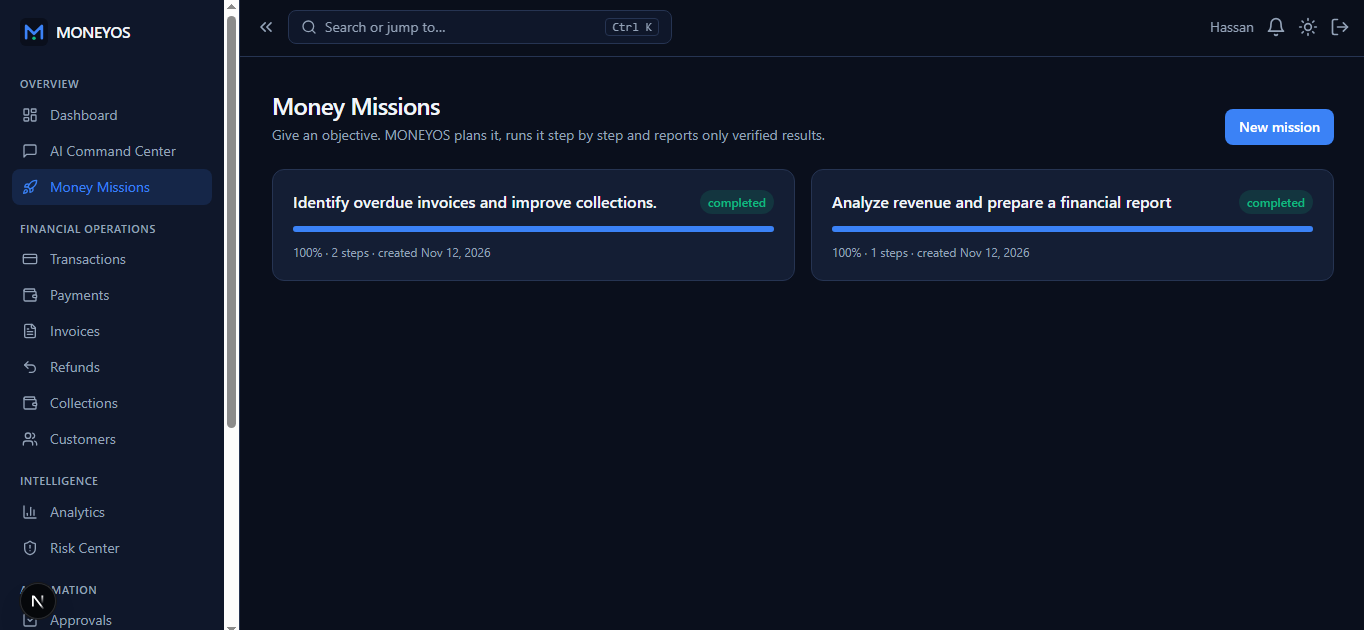
Money Missions: Create staged workflows that interpret objectives, select authorized tools, prepare actions, request approval where needed, and record outcomes.
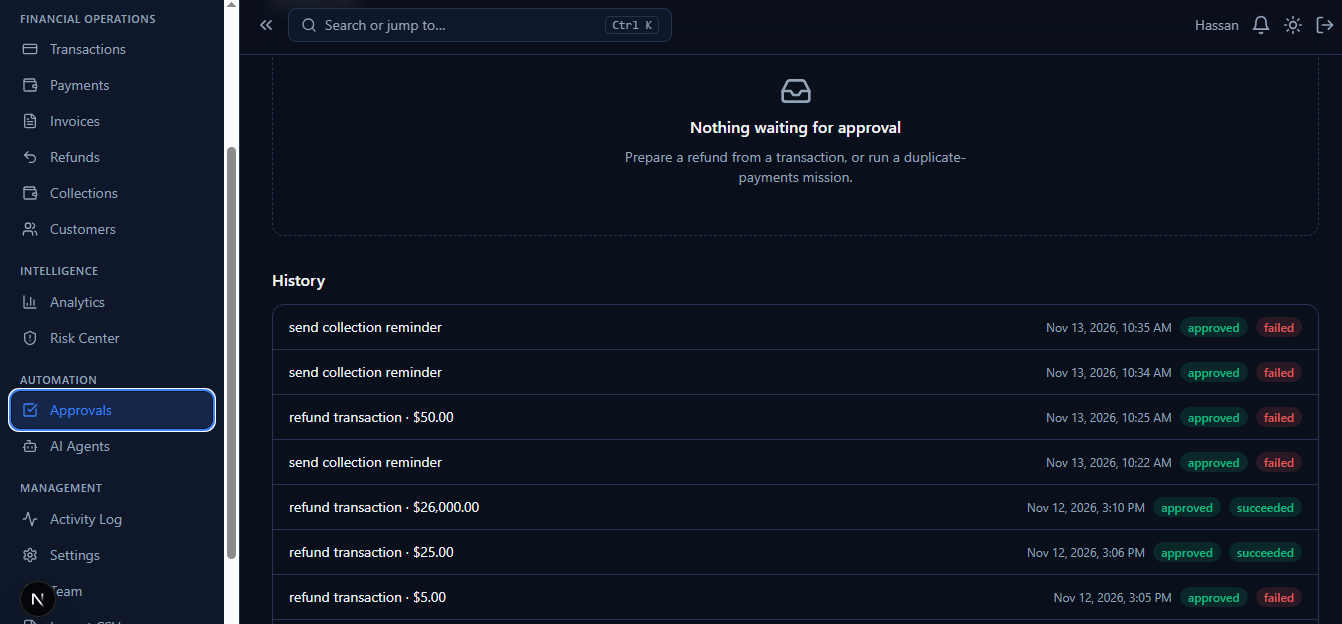
Human Approvals: Keep sensitive financial operations under authorized human control.
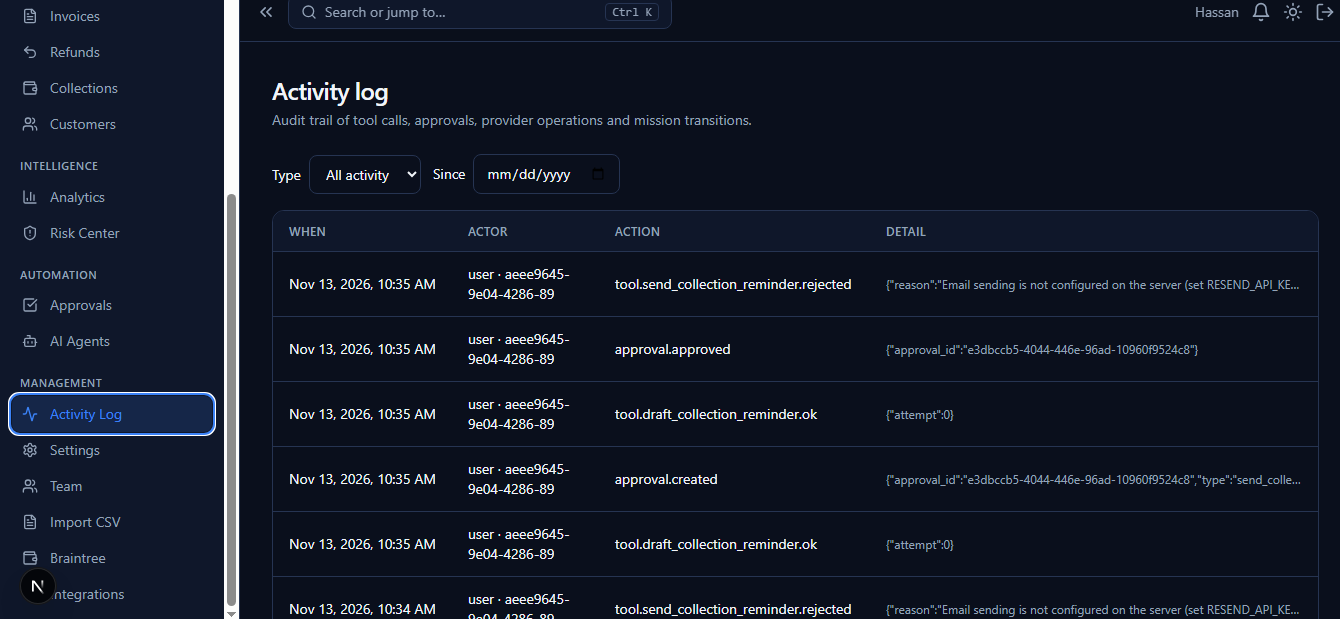
Activity Log: Maintain a record of relevant business and system activity.
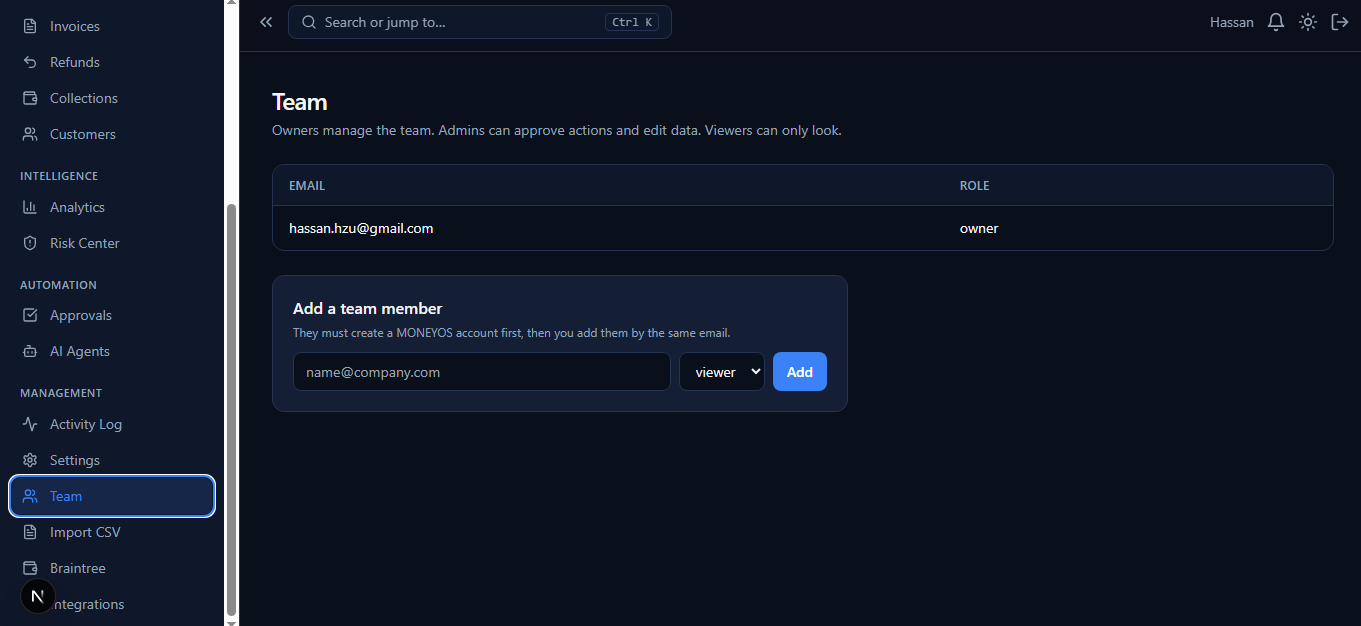
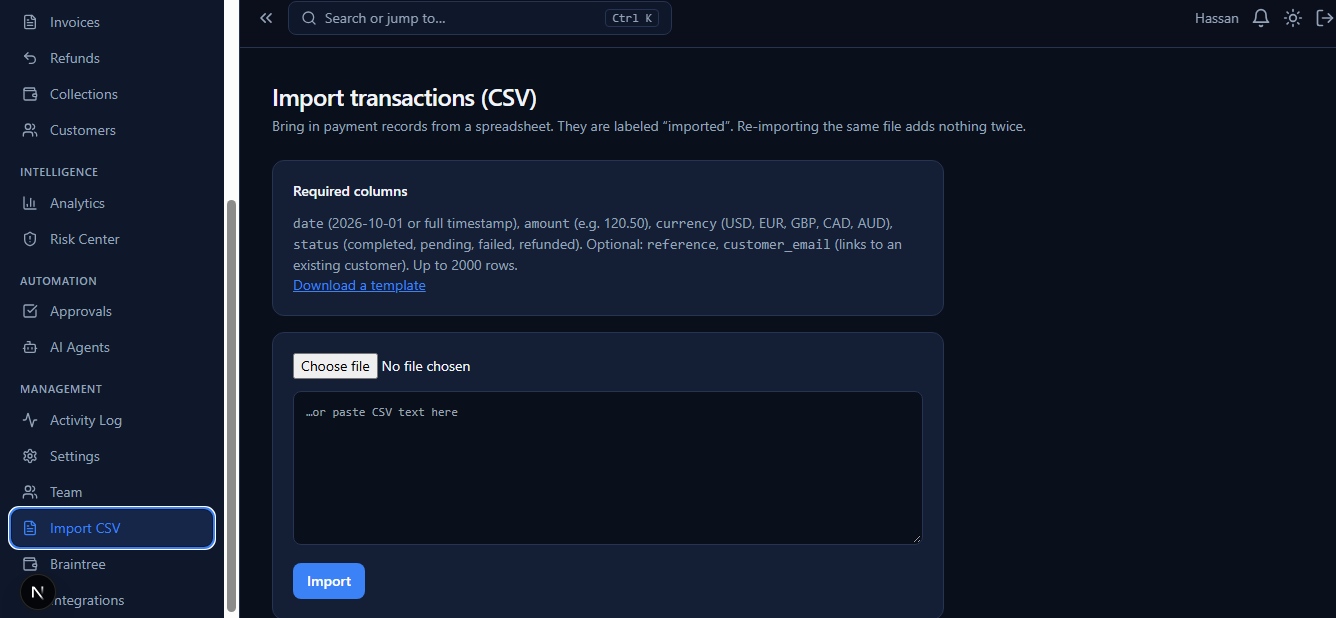
CSV Import and Business Management: Import records and manage business settings, memberships, and roles.
PayPal and Braintree integration
MONEYOS uses Braintree Sandbox, a PayPal service, as its payment processor.
The application integrates the Braintree Python SDK and Braintree Drop-in checkout experience. Users can perform Sandbox checkout, retrieve existing Braintree transactions by transaction ID, inspect transaction outcomes, and use supported refund and void operations.
Payment operations remain in Sandbox. The application does not process live-money transactions.
The backend records provider outcomes and is designed to avoid treating uncertain payment responses as successful transactions. This makes payment state and reconciliation important parts of the financial workflow.
AI implementation
MONEYOS uses Google Gemini native function calling to support natural-language financial requests and tool-assisted workflows.
A CEO orchestrator coordinates specialist agents: CFO: Financial analytics and business performance insights. Payments: Payment and refund-related operations. Collections: Receivables and collection workflows. Risk: Risk analysis and alert-related operations.
The system uses permission-aware tools and structured actions rather than allowing an AI model unrestricted access to financial operations.
Sensitive actions can require human approval. Approval records are bound to the intended action, expire, and are designed for single use.
A deterministic rules-based mode is also available as an offline alternative to live Gemini responses.
How we built it
The application combines a modern web frontend with a Python API backend and a PostgreSQL database.
Technology stack:
Next.js, React, and TypeScript Python, FastAPI, and Pydantic PostgreSQL / Supabase SQLAlchemy and Alembic Google Gemini native function calling Braintree Python SDK and Braintree Drop-in UI
The frontend provides the financial workspace, while the backend handles business logic, database operations, payment-provider communication, AI orchestration, authorization, and workflow execution
Challenges we ran into
One of the biggest challenges was designing AI workflows that could assist with financial operations without giving an AI agent unrestricted authority over sensitive actions.
We addressed this through structured tool definitions, permission checks, approval-gated actions, and explicit workflow states.
Another challenge was handling payment-provider outcomes reliably. A payment request is not always equivalent to a confirmed successful transaction, so provider results and transaction states must be handled carefully.
We also worked on connecting separate financial capabilities into coherent workflows rather than treating each page as an isolated feature.
Accomplishments that we're proud of
What we learned
Building MONEYOS strengthened our understanding of payment-provider integration, Sandbox testing, API design, database migrations, authentication, authorization, AI function calling, multi-agent orchestration, and human-in-the-loop automation.
Most importantly, we learned that useful AI in financial software is not simply about generating answers. It must work with real application data, use constrained tools, respect permissions, and keep people in control of consequential actions.
What's next for MONEYOS — AI Financial Operating System
Our next priorities include deeper end-to-end testing, expanded reconciliation and webhook verification, stronger multi-tenant security validation, and further refinement of the AI-assisted financial workflows.
MONEYOS is our step toward making financial operations more connected, intelligent, and manageable for small businesses.
Built With
- ai-agents
- alembic
- automation
- braintree
- fastapi
- financial
- function-calling
- google-gemini
- next.js
- payments
- postgresql
- python
- react
- sqlalchemy
- supabase
- typescript
