Inspiration
As two college students who prioritize financial well-being, we wanted to better understand whether our spending habits and financial decisions were setting us up for long-term success. Managing and tracking expenses can often feel tedious, overwhelming, and time-consuming, especially for young adults balancing multiple responsibilities. We set out to create an all-in-one platform that not only simplifies financial tracking but also encourages young adults to take ownership of their finances. Our goal was to design a tool that makes financial planning engaging and educational.
What it does
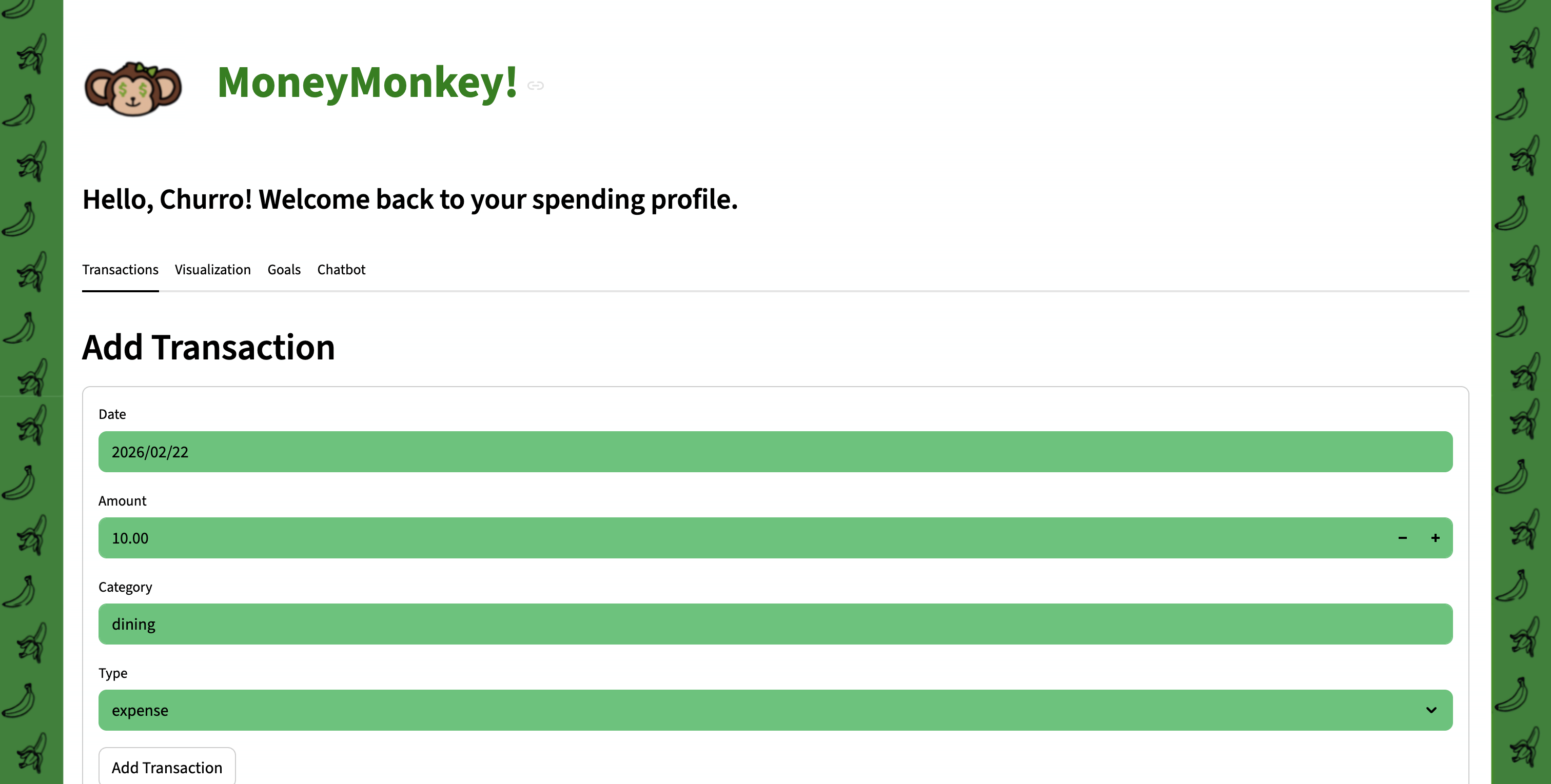
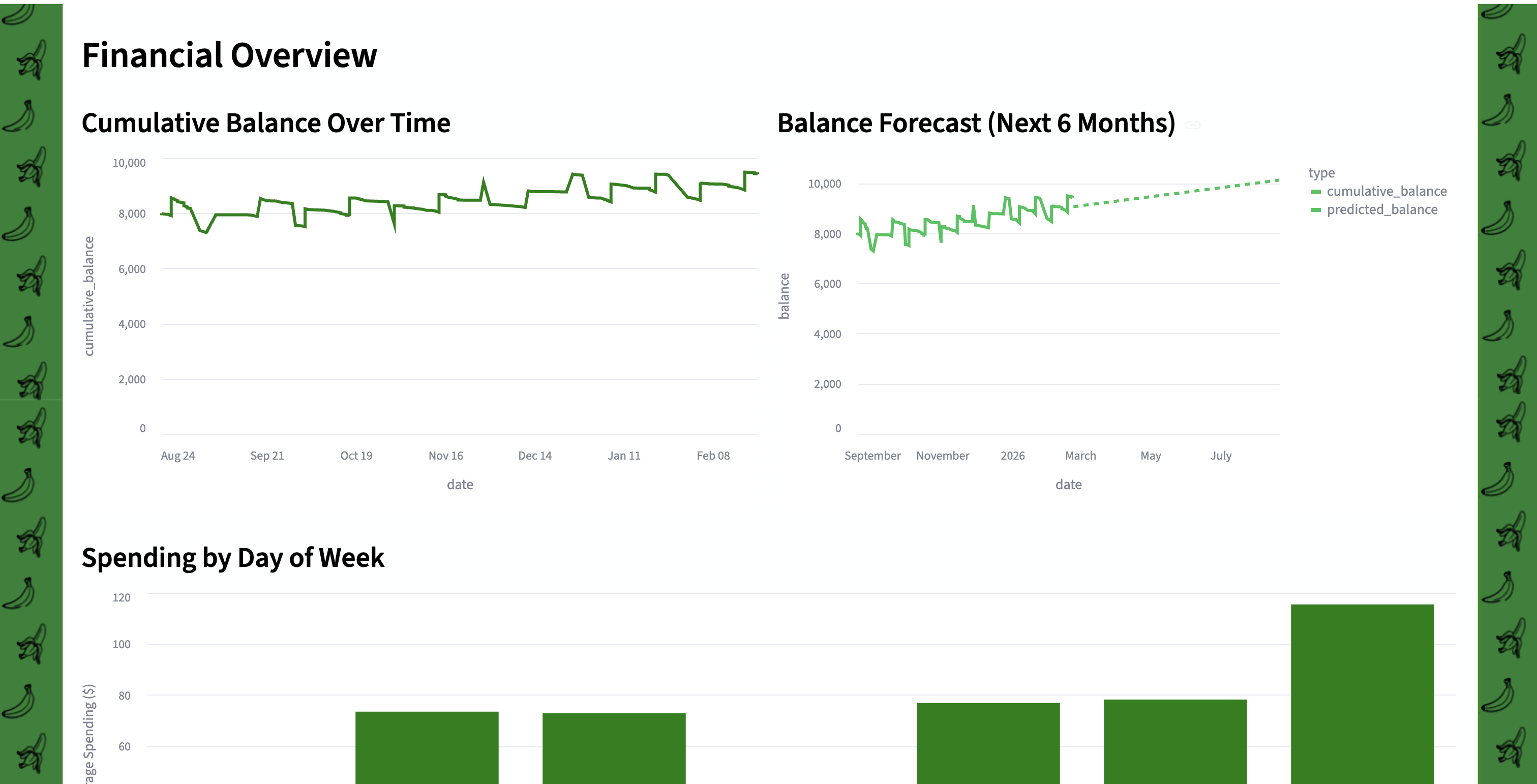
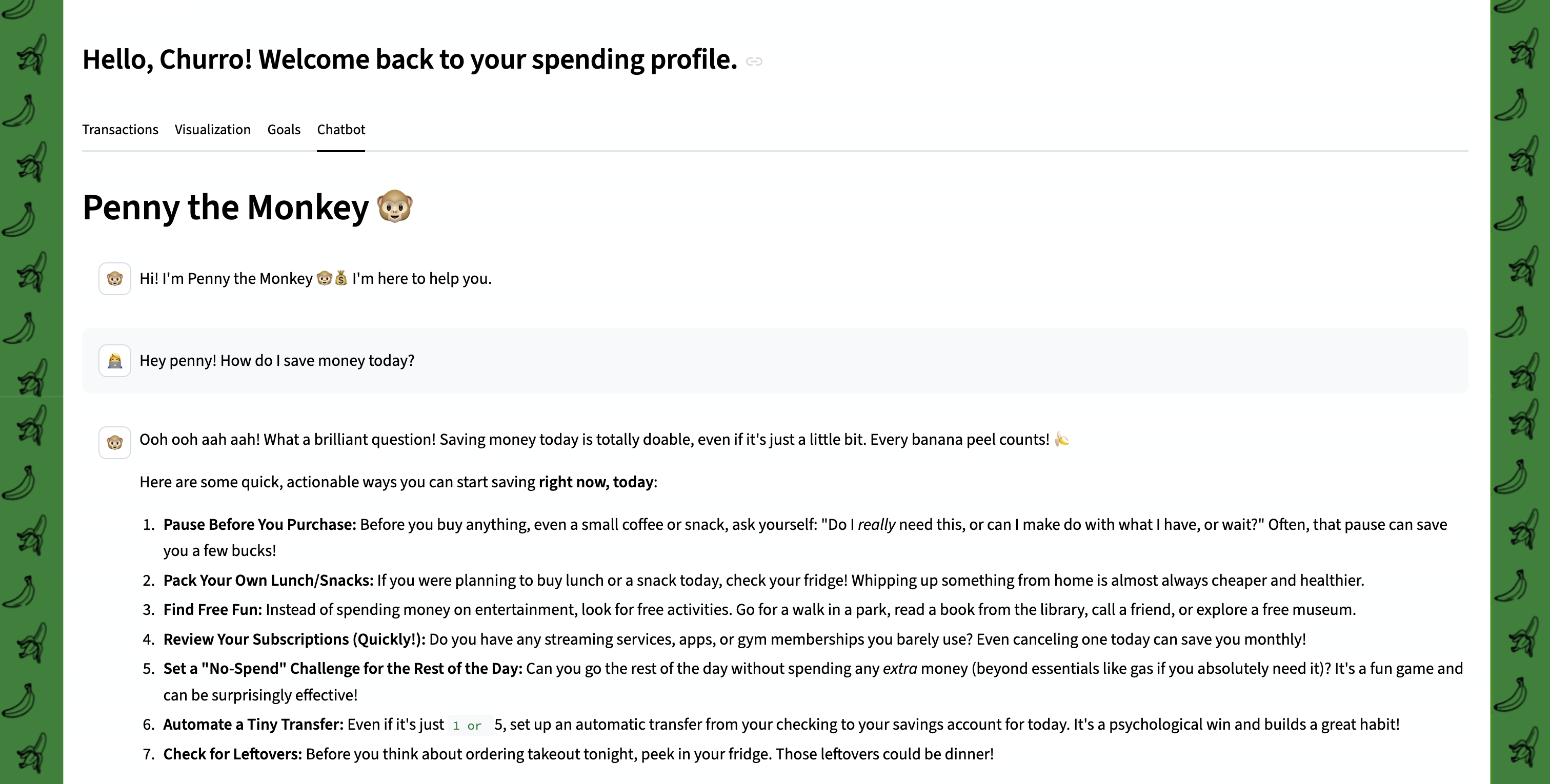
MoneyMonkey is an all-in-one financial tracking and goal-setting platform designed to help young adults better understand and improve their financial habits. Users can log income and expenses, visualize their cumulative balance over time, and analyze spending patterns by day of the week to identify trends. The platform generates a six-month balance forecast using regression analysis, allowing users to see where their current financial trajectory may lead. It also enables users to set savings or spending-reduction goals, automatically breaking them into manageable checkpoints and tracking progress in real time. To provide a more comprehensive view of financial well-being, MoneyMonkey calculates a financial health score based on how well the user is sticking to their goal and projected balance trends. Additionally, the built-in AI assistant, Penny the Monkey, offers conversational guidance and financial insights, making the experience both interactive and educational.
How we built it
MoneyMonkey was developed using Streamlit for a fast and interactive frontend experience, paired with a Python backend for data processing, analytics, and forecasting. The architecture allows for easy scaling and maintenance.
Backend: Written in Python, using pandas and NumPy for efficient data management, financial calculations, and forecasting. Transaction data is stored in a CSV file, ensuring simplicity and portability. The app includes modules for goal tracking, monthly and daily checkpoint generation, and financial health scoring.
Forecasting & Analytics: Utilizes polynomial regression to predict future balances over the next 6 months, identifying trends and top spending categories. Spending analytics are further visualized by weekday to highlight patterns in expenses.
Goal Management: Supports both saving goals and spending reduction goals, generating actionable checkpoints with automatic progress tracking and visual completion indicators.
Chatbot Integration: Integrated with the Google GenAI Gemini API, providing a conversational financial assistant (“Penny the Monkey”) that answers user questions, offers guidance, and interprets financial data in real-time.
Design: Used Figma and Canva to ensure a user-friendly and responsive UI/UX.
Challenges we ran into
Initially, we aimed to incorporate a machine learning model to generate dynamic and behavior-based six-month financial projections. However, given the time constraints and the steep learning curve associated with implementing and properly training such a model, we recognized that this approach would compromise the stability and completeness of our project within the timeframe. But rather than abandoning the projection feature entirely, we chose to pivot and a different strategy. We implemented a linear regression model to forecast future balances, allowing us to preserve the functionality of predictive insights while ensuring reliability and clarity. Although the technical approach changed, the purpose of the feature remained intact.
Accomplishments that we're proud of
We are proud of what we were able to accomplish in a short amount of time. Building a fully functional and user-friendly application from concept to execution required much learning and collaboration. MoneyMonkey demonstrates a real potential to support young adults in managing their personal finances and working towards their financial goals. Seeing a tool we built actually have potential to be used by our peers and provide real value is especially rewarding. This project also marked our first experience developing both a backend and frontend system and successfully integrating them into a cohesive application. Bringing those components together into a working product was a big moment for us and taught us much about building full stack projects from idea to product.
What we learned
Throughout the development of MoneyMonkey, we gained hands-on experience building a full-stack application by integrating both frontend and backend components into one system. While we had prior experience working with Python for backend development, this was our first time using Streamlit to design and implement an interactive user interface and connect it to our backend in real time. We also learned how to construct and manage our own dataset using Excel, including writing formulas to generate and structure data effectively. In addition, we developed practical experience using Git and GitHub for collaborative development. We were able to work independently in separate environments and efficiently merge our changes through version control.
What's next for MoneyMonkey
In the future, we plan to advancing the projected forecast program by integrating a machine learning model that can identify patterns in user behavior, time-based spending patterns, and category-based trends. Rather than relying on linear regression, this approach would allow for more adaptive and personalized financial projections that evolve with the user’s habits over time. We also intend to implement a user authentication system, allowing individual accounts and protected data storage. This would allow users to optionally connect their bank accounts directly to MoneyMonkey through a secure financial data integration service, eliminating the need for manual entry and ensuring real-time accuracy. Additionally, we plan on introducing a rewards system similar to credit card programs. Through partnerships with financial institutions, users could earn incentives such as cashback, points, or savings bonuses for maintaining healthy financial habits and achieving their goals. This would not only increase engagement but also provide tangible benefits for responsible financial behavior.


Log in or sign up for Devpost to join the conversation.