-
-
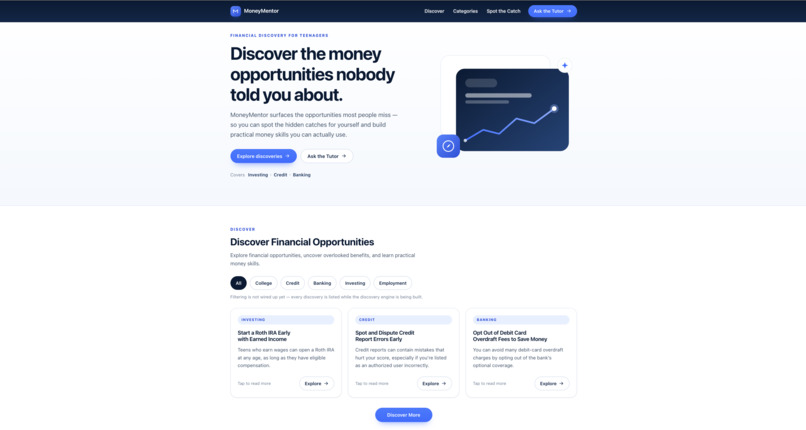
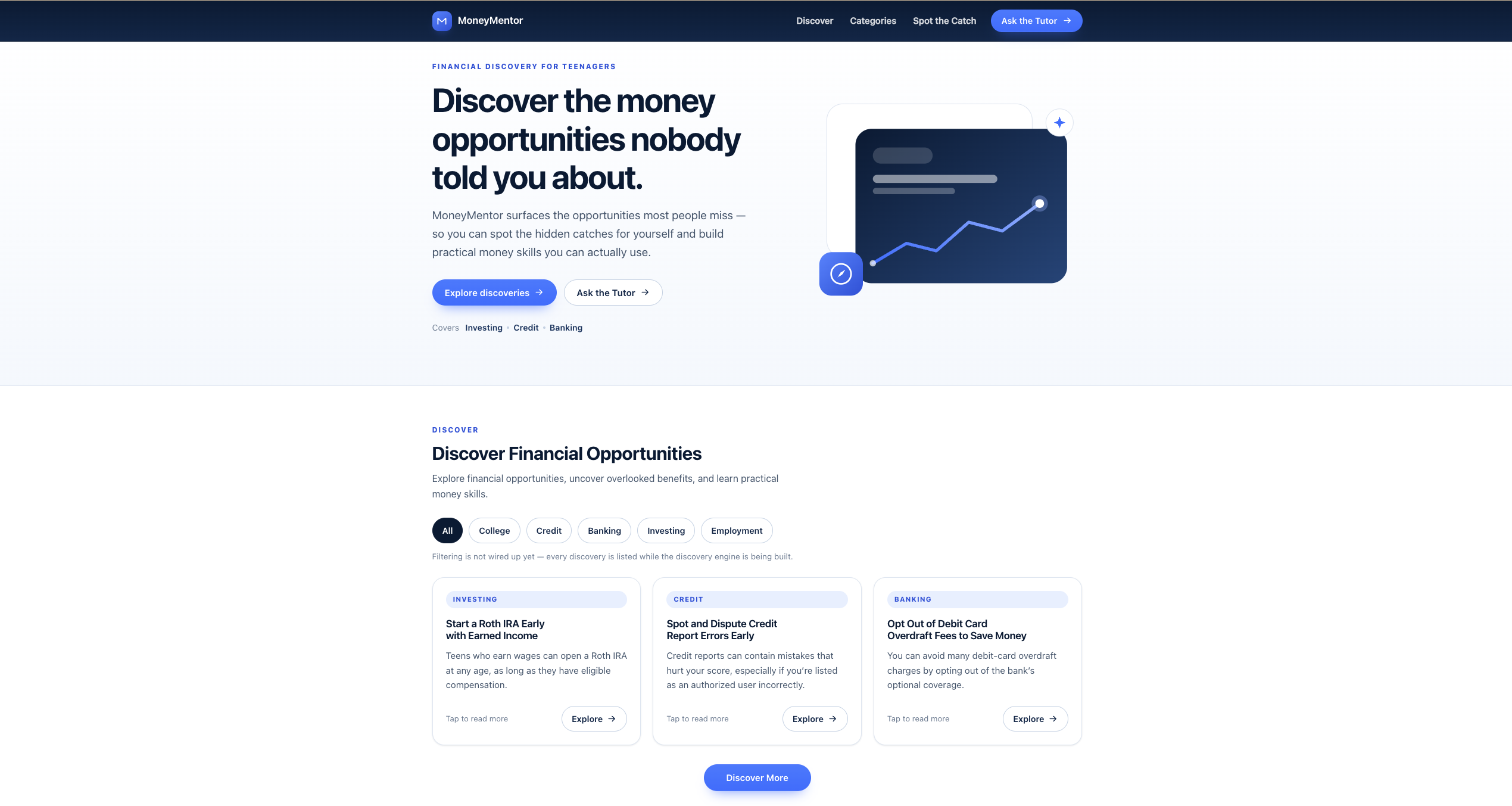
Home page
-
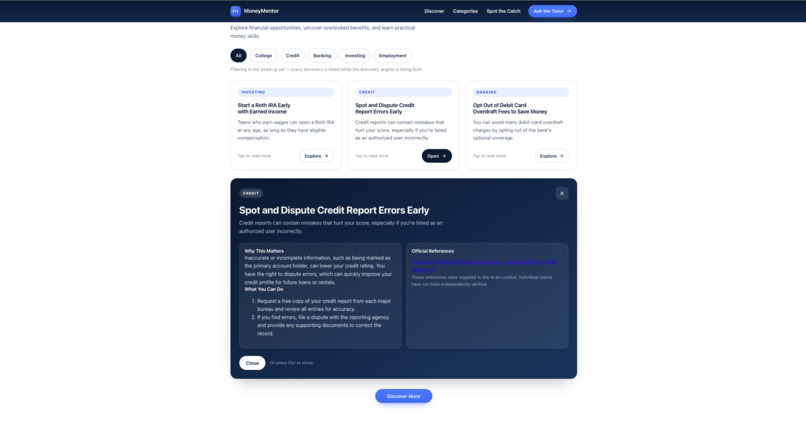
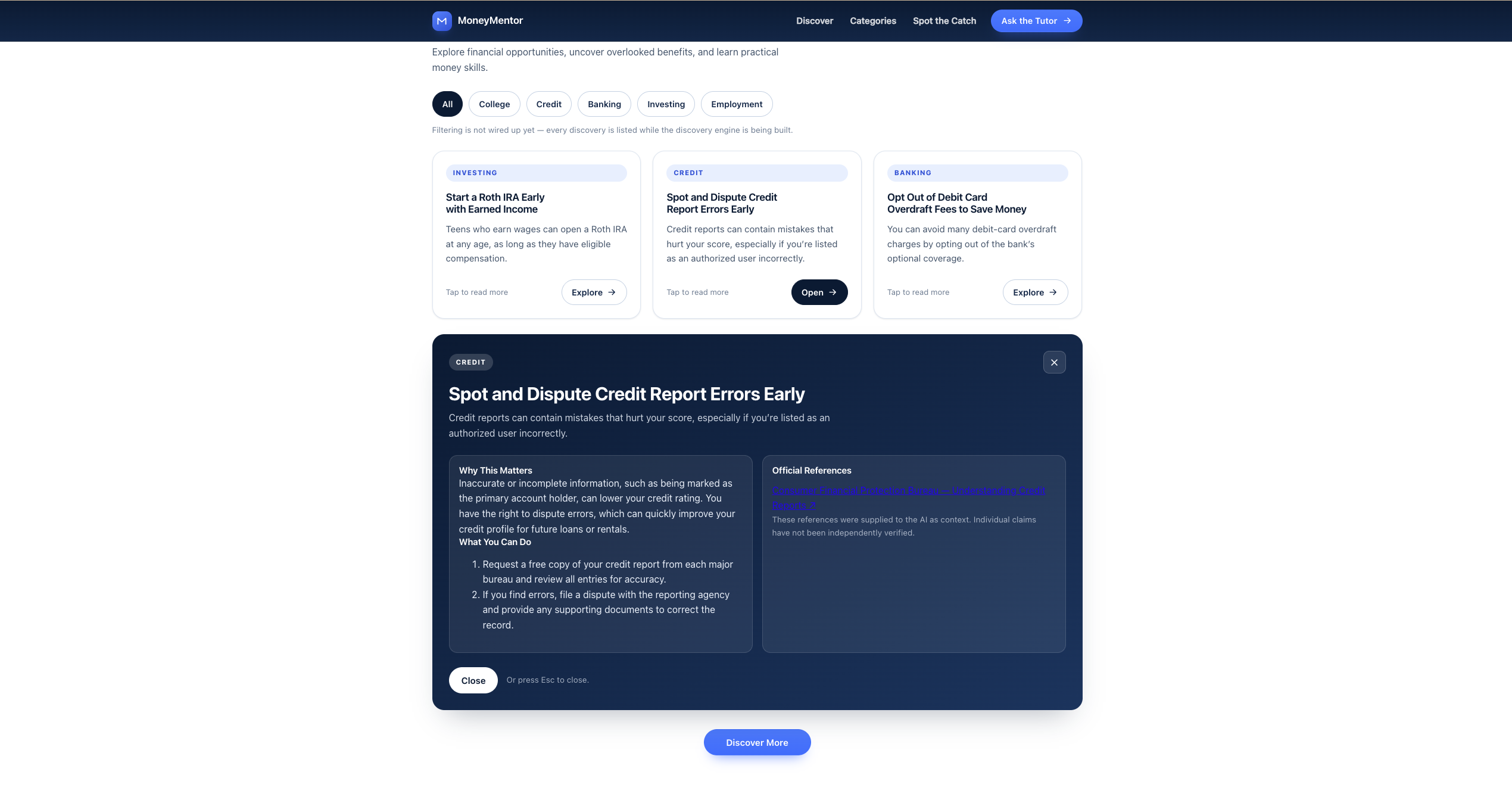
Discoveries and information
-
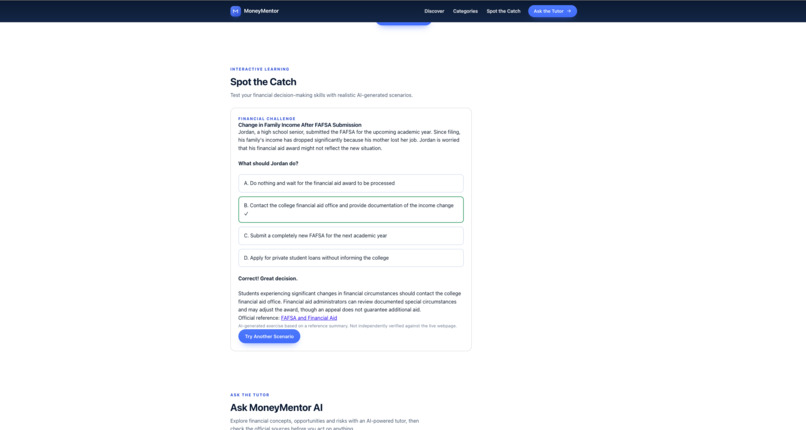
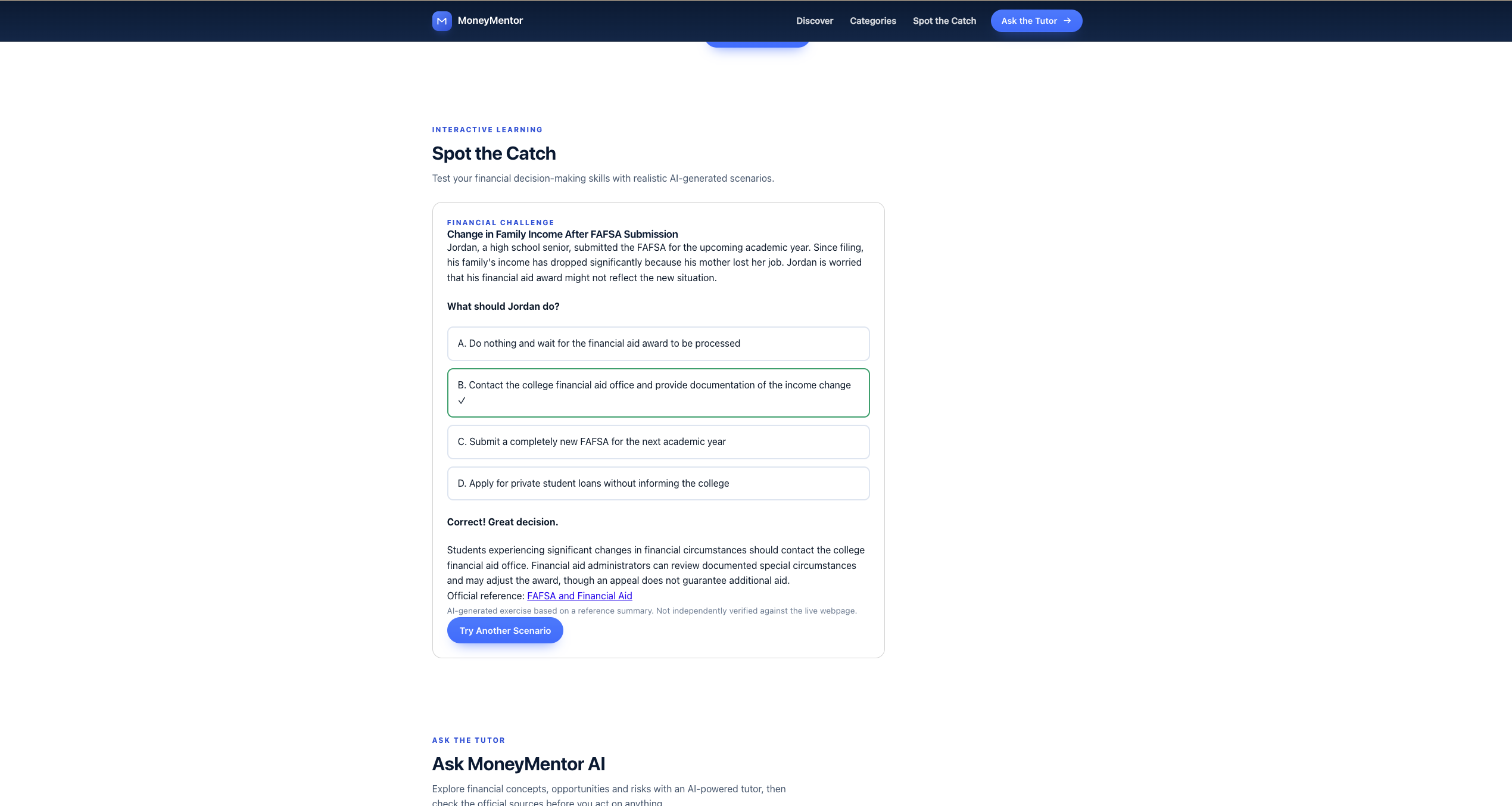
Spot the catch trivia
-
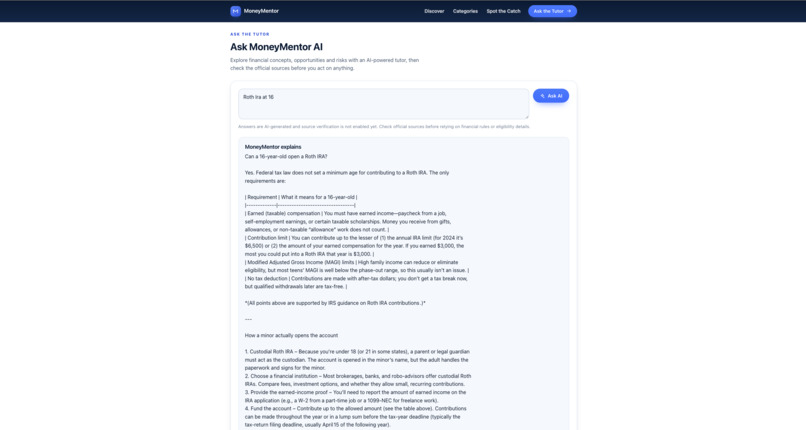
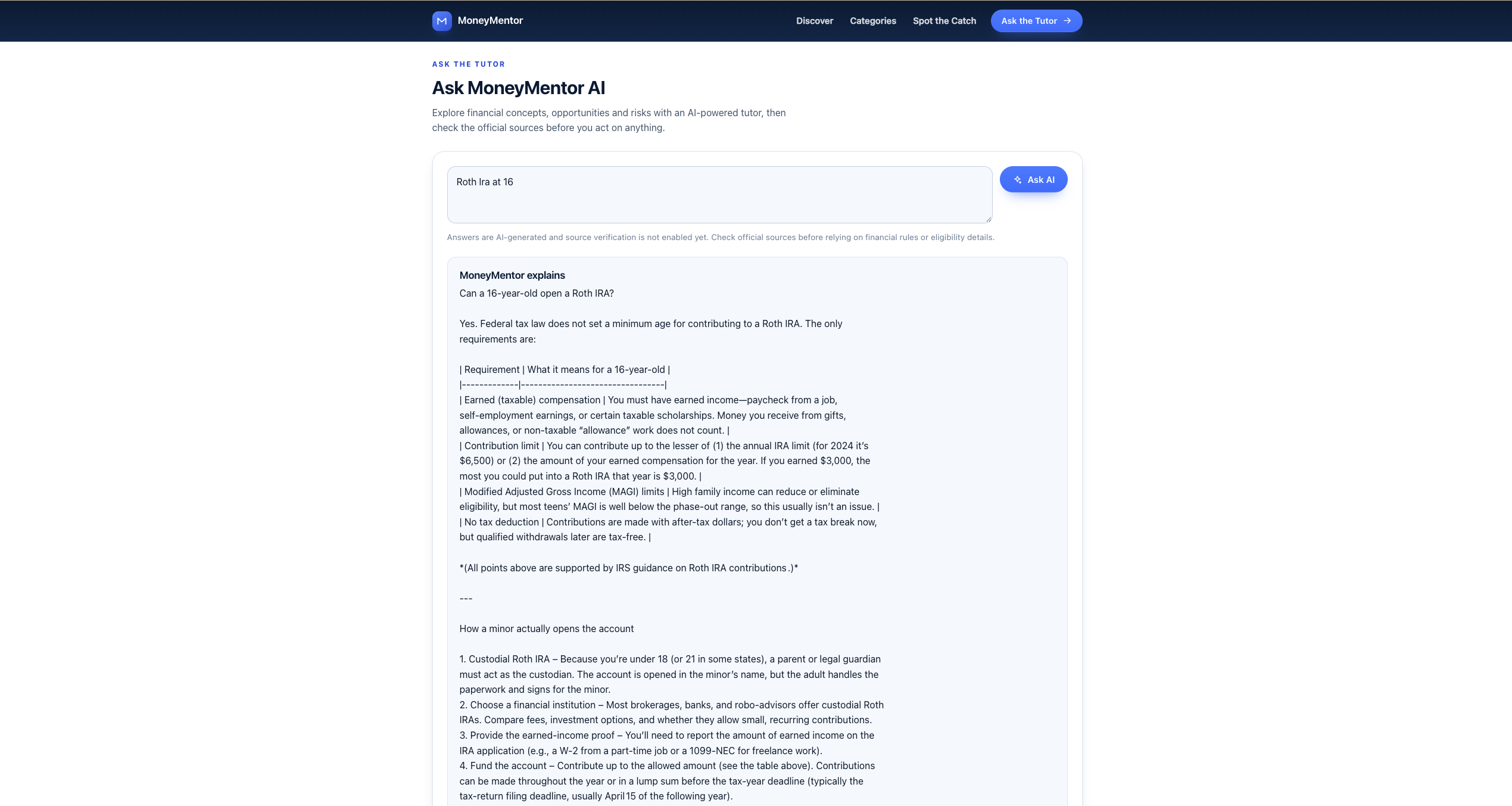
AI tutor and response pt1
-
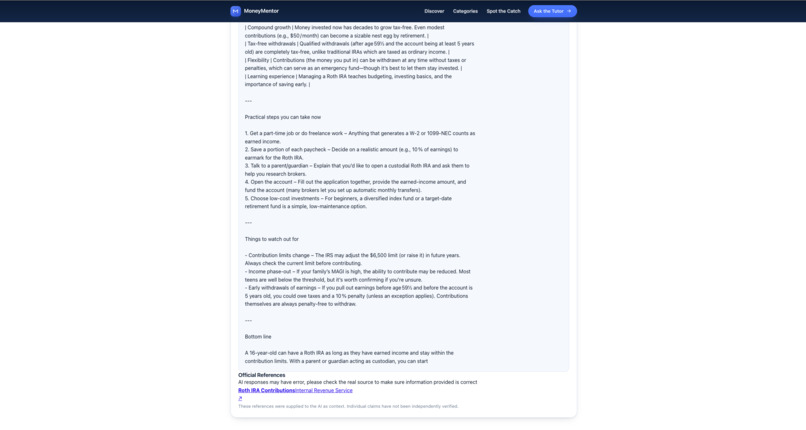
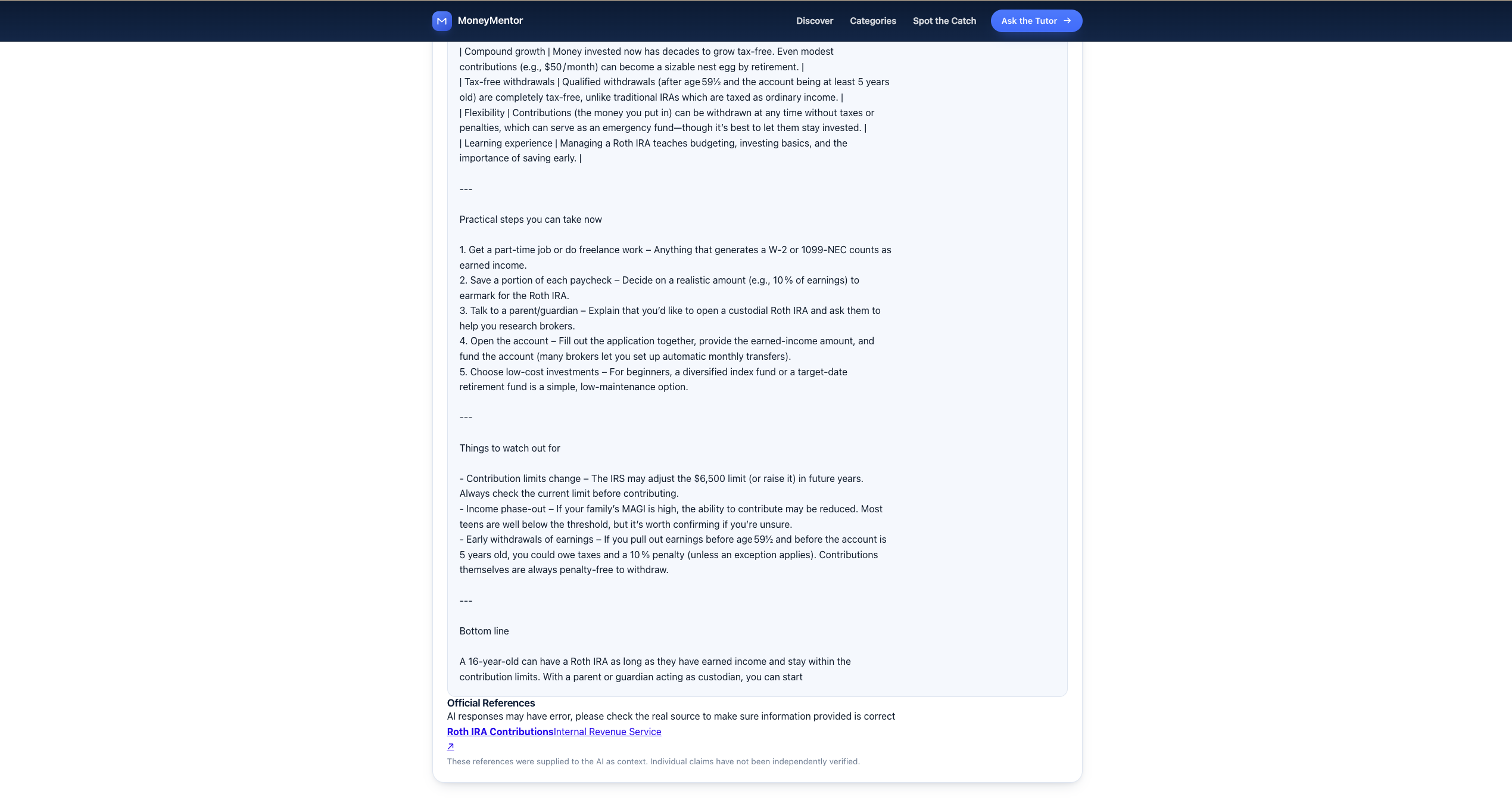
AI tutor and response pt2
MoneyMentor — Financial Education for Teens
Inspiration
The inspiration for MoneyMentor came from a conversation with one of my friends who was already a senior in high school but wasn't aware of FAFSA (Free Application for Federal Student Aid). I was surprised that something so important to paying for college could be unfamiliar to a student preparing to graduate.
That experience made me realize that many teenagers might be missing out on financial opportunities simply because they don't know those opportunities exist. While financial information is available online, students often have to know exactly what to search for to find it.
I wanted to create something that could introduce teenagers to financial concepts and opportunities before they even knew to ask about them. That's how MoneyMentor started.
What It Does
MoneyMentor is an AI-powered financial education web application designed to help teenagers discover financial opportunities, understand financial concepts, and practice making informed decisions.
The application currently includes three main features:
1. Financial Discovery Cards
Instead of requiring users to search for financial information, MoneyMentor introduces them to different financial topics and opportunities through AI-generated discovery cards.
These cards cover subjects such as college financial aid, credit, banking, investing, and employment. Each card provides an explanation, practical action steps, and relevant official financial resources. Users can also generate additional discoveries using the Discover More feature.
2. Ask MoneyMentor AI
The AI Tutor allows students to ask questions about financial topics using natural language. It provides explanations designed to make complicated financial concepts easier for teenagers to understand.
The application uses Groq Cloud for AI-generated responses and incorporates curated financial evidence when relevant information is available.
3. Spot the Catch
Spot the Catch is an interactive financial decision-making activity. It generates realistic scenarios that challenge users to choose between different financial decisions.
After selecting an answer, users receive feedback and an explanation that helps them understand the reasoning behind the decision.
Together, these features aim to make financial education more accessible, engaging, and proactive.
How I Built It
I developed MoneyMentor using React, JavaScript, Vite, Node.js, Express, and Groq Cloud.
React was used to build the frontend interface, while Node.js and Express handle the backend API requests. Groq Cloud powers the AI-generated explanations, financial discoveries, and interactive scenarios.
Freebuff provided initial examples for several UI components, which I used as a starting point while working on the application's overall design and functionality.
To make MoneyMentor more reliable, I researched financial information from official sources such as the Consumer Financial Protection Bureau (CFPB), Internal Revenue Service (IRS), Federal Student Aid, Federal Deposit Insurance Corporation (FDIC), and Investor.gov.
I organized selected information into a financial evidence library and connected it to the backend so the AI could use relevant evidence when generating educational content.
I also worked on integrating the different features, debugging API errors, testing the application, and improving the user experience.
Challenges I Faced
Integrating AI
One of my biggest challenges was connecting the Groq API to MoneyMentor and ensuring the frontend and backend communicated properly. I encountered issues involving API requests, environment variables, and errors that prevented certain features from working. Troubleshooting these problems helped me better understand how APIs and backend systems function.
Developing the User Interface
Another challenge was expanding the interface beyond the initial examples provided by Freebuff. I wanted to create an application that matched my vision rather than simply displaying a basic template. This involved working with React components, modifying layouts, and integrating interactive functionality.
Creating Features Beyond a Chatbot
I wanted MoneyMentor to stand out from applications that simply add an AI chatbot to a website. This motivated me to work on Financial Discovery Cards and Spot the Catch, which help students encounter new information and actively practice financial decision-making. Developing these features pushed me to think more carefully about how technology could address the original problem.
Connecting Reliable Financial Sources
Financial information requires accuracy, especially when dealing with topics such as taxes, loans, and financial aid. Initially, restricting the AI to a small evidence library meant it couldn't answer some broader financial questions. I worked on improving the system so it could provide more flexible explanations while still incorporating available official-source information.
One limitation I discovered was that providing links to trusted websites does not automatically mean every AI-generated statement has been independently verified.
What I Learned
Building MoneyMentor taught me a lot about both software development and financial education.
I gained a better understanding of React, JavaScript, backend development, API integration, debugging, and connecting different parts of a web application.
I also learned how important it is to think beyond whether a feature works technically and consider whether it actually helps solve the user's problem.
Most importantly, I learned that integrating AI responsibly requires balancing flexibility with accuracy, especially when presenting financial information that students might rely on.
What's Next
I want to continue developing MoneyMentor by improving its ability to retrieve and verify information from official financial sources.
I also hope to introduce more personalized financial discoveries based on a student's interests, age, and educational goals, helping users find opportunities that are specifically relevant to them.
My long-term goal is to make MoneyMentor a platform that helps teenagers become more financially informed and confident before entering adulthood.
Final Thoughts
MoneyMentor started with a simple realization: students can't take advantage of opportunities they don't know exist.
Through this project, I wanted to address that problem by creating a tool that doesn't just answer financial questions but encourages teenagers to explore, discover, and learn.
I hope MoneyMentor can help more students find opportunities they might otherwise miss and develop the knowledge needed to make better financial decisions.

Log in or sign up for Devpost to join the conversation.