Inspiration
Financial decisions do not come with a practice mode.
Everyone interacts with money, but not everyone has the same confidence when it comes to budgeting, saving, credit, debt, investing, taxes, insurance, and long-term financial planning.
The problem is not that financial information does not exist. There is an enormous amount of it online. The problem is that it is often scattered across different websites, videos, apps, calculators, and articles. Even after finding the information, knowing a definition does not necessarily mean someone understands how to apply it.
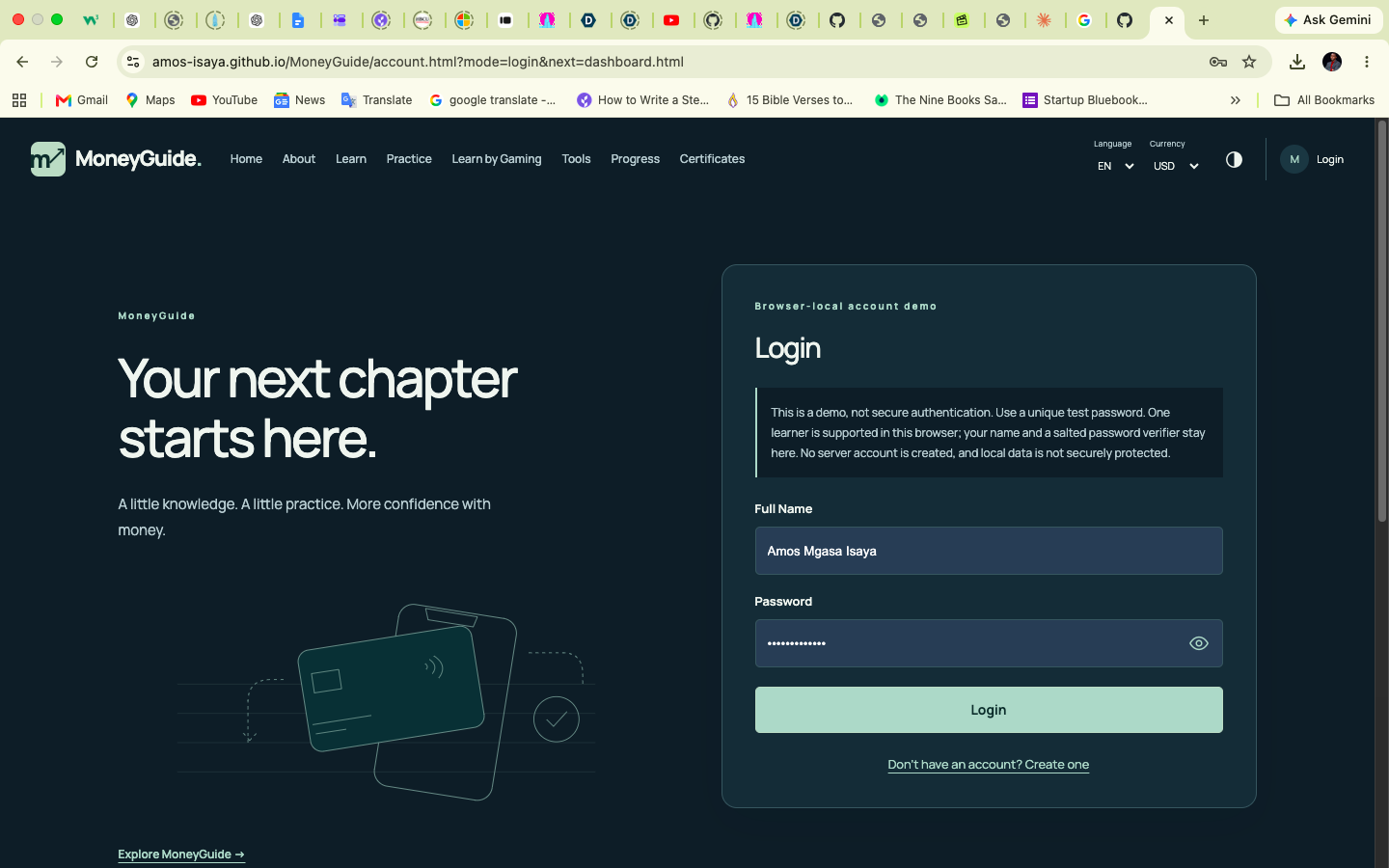
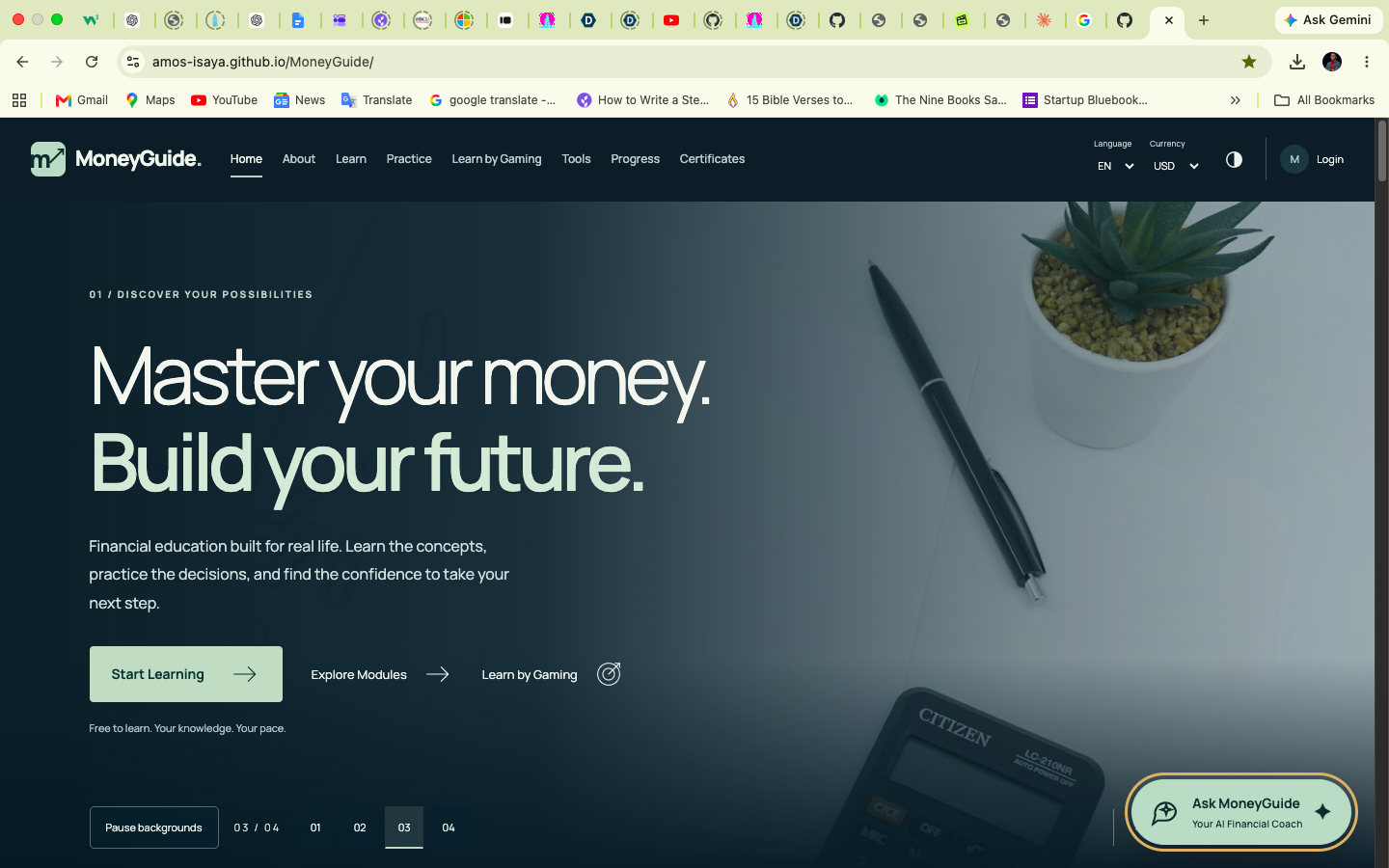
That inspired us to build MoneyGuide — a financial-literacy learning platform that brings structured education, practice, practical tools, progress tracking, and context-aware AI guidance into one experience.
Our goal is simple:
Learn money. Practice decisions. Build financial confidence.
What it does
MoneyGuide creates a personalized financial-learning journey.
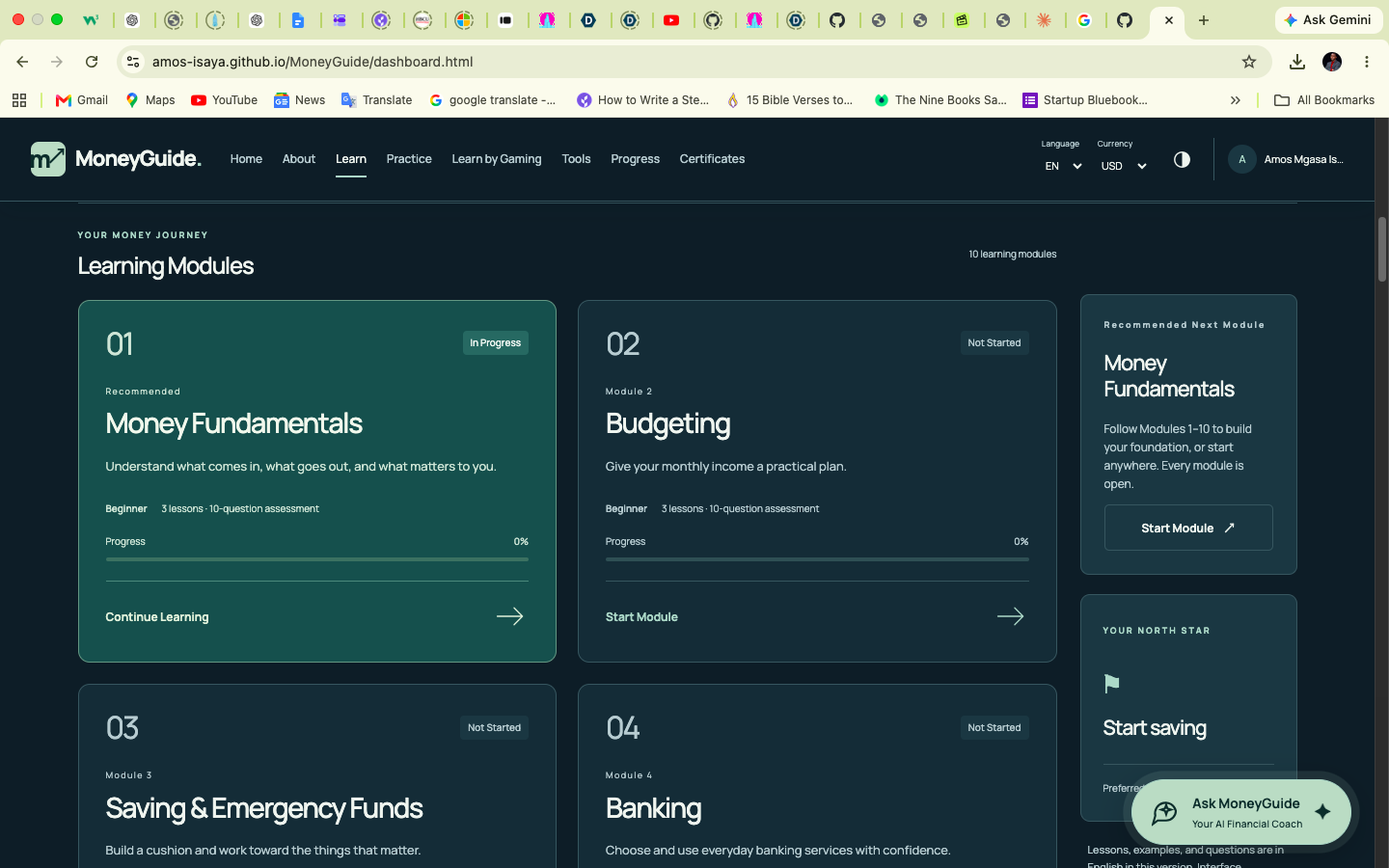
Users begin by providing learning context such as their financial goal, knowledge level, preferred currency, and language. They can then explore 10 financial-literacy modules covering:
- Money Fundamentals
- Budgeting
- Saving & Emergency Funds
- Banking
- Credit & Credit Scores
- Debt & Loans
- Investing Basics
- Taxes & Income
- Insurance & Financial Protection
- Financial Planning & Wealth Building
Instead of only reading financial information, learners can reinforce their understanding through flashcards, knowledge checks, assessments, and practical financial tools.
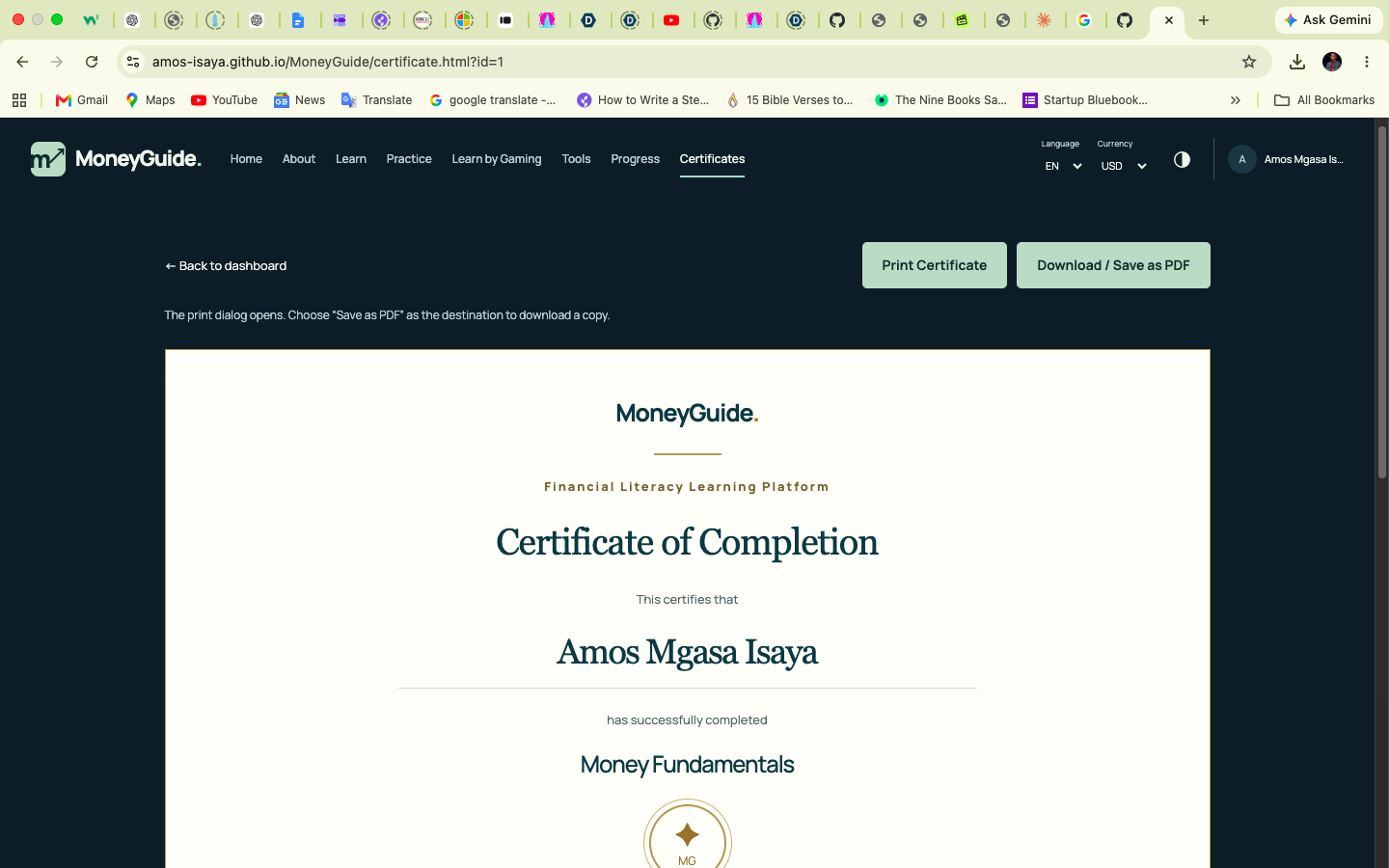
MoneyGuide also tracks progress through completed modules, XP, levels, assessment results, and certificates, creating a structured learning journey rather than a collection of disconnected financial articles.
NVIDIA Nemotron Integration
One of the most important parts of MoneyGuide is our integration of NVIDIA Nemotron.
We did not want to simply attach a blank chatbot to a financial education website.
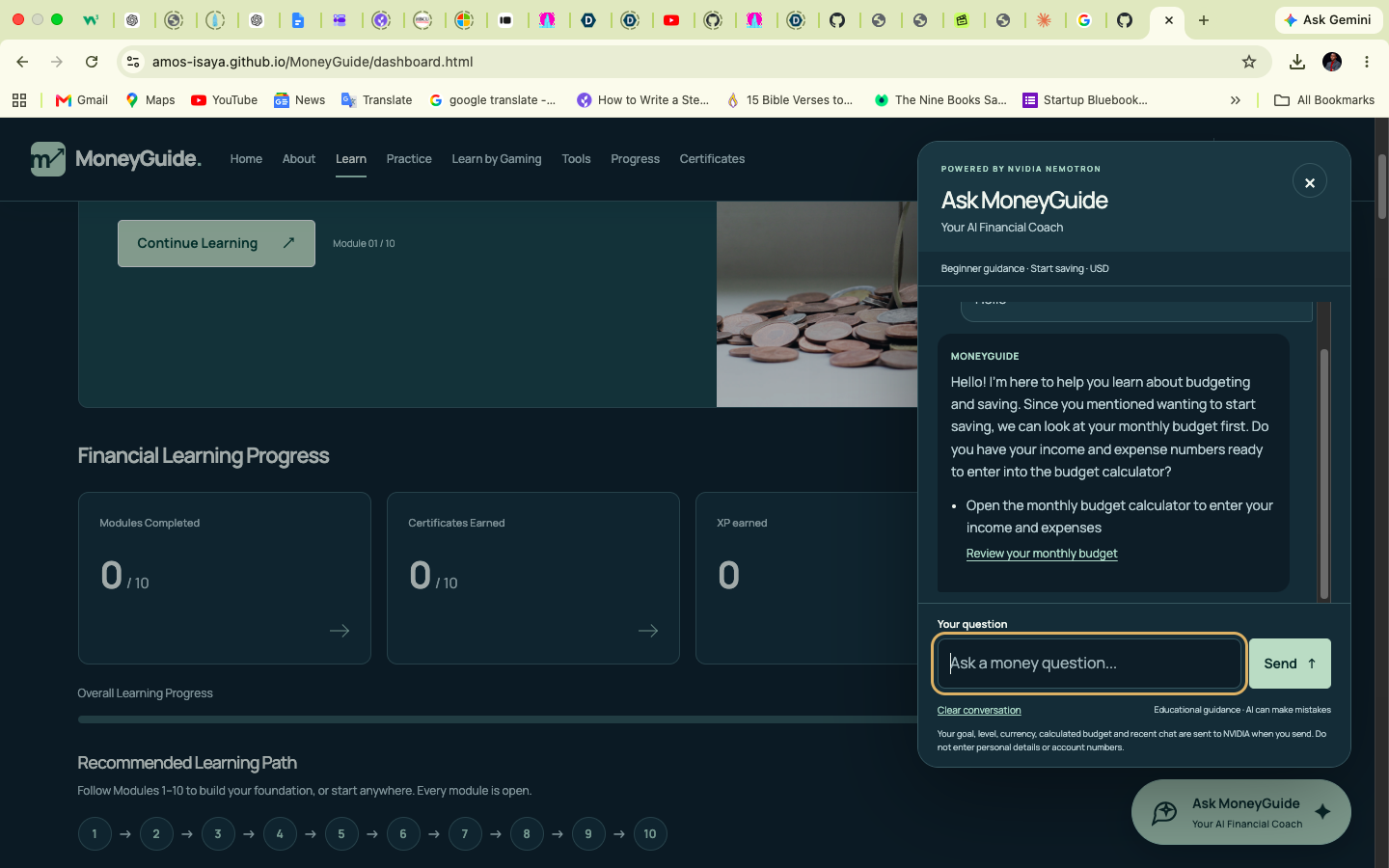
MoneyGuide can provide Nemotron with learning context already selected by the user, such as:
- Financial goal
- Knowledge level
- Preferred currency
For example, a learner may have:
Level: Beginner
Goal: Start saving
Currency: USD
When that learner asks a financial question, MoneyGuide can provide this context alongside the question so Nemotron can generate a more relevant educational explanation without requiring the learner to repeat all of that information in every prompt.
This makes the AI part of the learning experience rather than simply a standalone chat box.
Our financial tools handle deterministic calculations, while Nemotron focuses on contextual explanation and financial education.
How we built it
We built MoneyGuide as a web-based financial-learning experience using web technologies including HTML, CSS, and JavaScript, with NVIDIA Nemotron integrated as the AI layer.
We designed the application around a simple learning flow:
Personalize → Learn → Practice → Ask → Track Progress
The platform stores learner preferences and learning progress so different parts of the experience can respond to the learner's journey.
We also designed MoneyGuide to support multiple languages and currency preferences so the concept can eventually serve learners from different backgrounds.
Challenges we ran into
One of our biggest challenges was figuring out how to use AI in a meaningful way.
It would have been easy to add a chatbot and call the project AI-powered. Instead, we wanted the AI to understand the learning context already available inside MoneyGuide.
Connecting the learner's selected goal, knowledge level, and currency to the Nemotron experience required us to think about how the application and AI should work together.
Another challenge was scope. Financial literacy is a huge subject, and there were many features we wanted to build. During the hackathon, we had to balance ambition with creating a complete experience that actually worked.
As three first-time hackers, we also learned how important it is to divide responsibilities, test continuously, communicate as a team, and prioritize working functionality over adding endless features.
What we learned
SteelHacks taught us much more than how to build a web application.
We learned how to take a broad problem, narrow it into a product, divide development responsibilities, integrate an AI model into an existing experience, test our assumptions, and build under a deadline.
Most importantly, we learned that adding AI to a product is not enough by itself. The AI needs context and a clear purpose.
For MoneyGuide, that purpose is education.
What's next for MoneyGuide
MoneyGuide started as a hackathon project, but we see opportunities for the concept to grow.
Future development could include deeper personalization, additional financial simulations, richer learning analytics, expanded multilingual content, more interactive practice experiences, and additional accessibility features.
Beyond individual learners, the platform could potentially support financial-literacy education for schools, colleges, employers, community organizations, and financial institutions.
We believe financial education should help people understand their choices rather than make those choices for them.
Money is universal. Financial confidence should be too.
Built With
- api
- css
- github
- html
- javascript
- nemotron
- nvidia
- rest


Log in or sign up for Devpost to join the conversation.