-
-
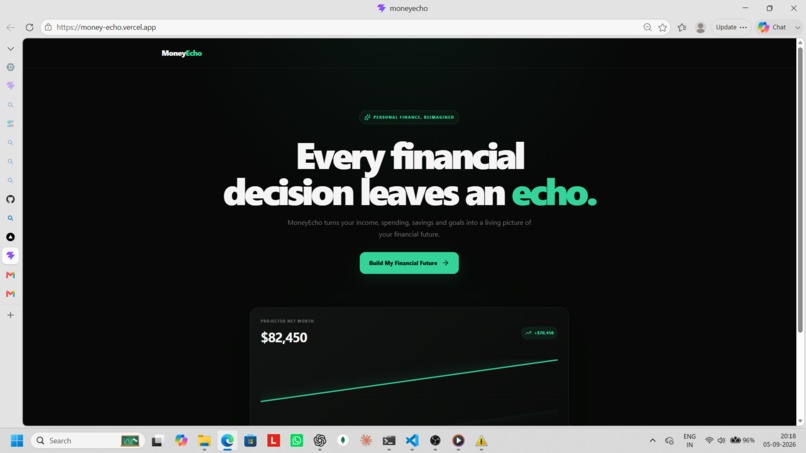
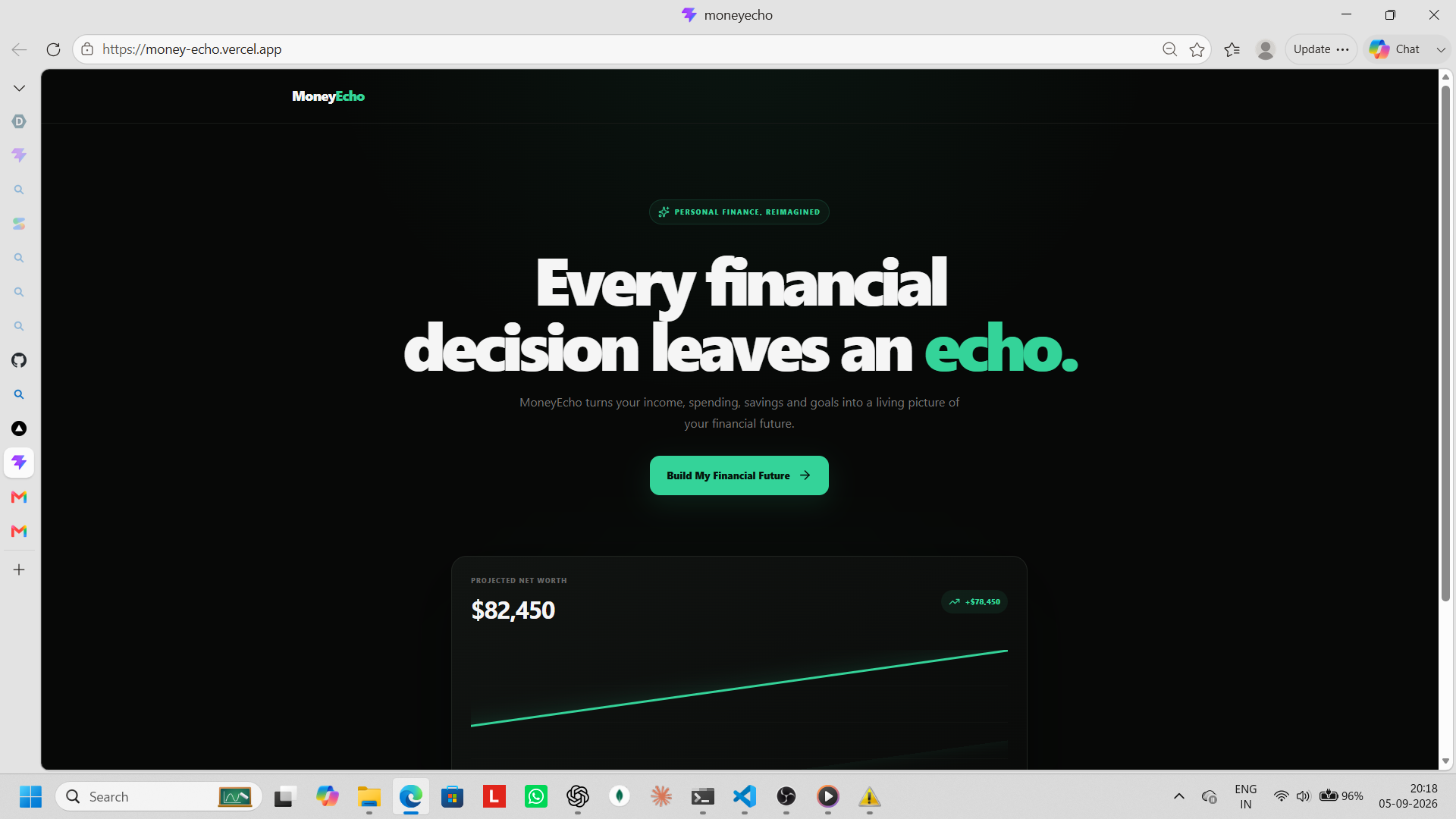
Landing Page
-
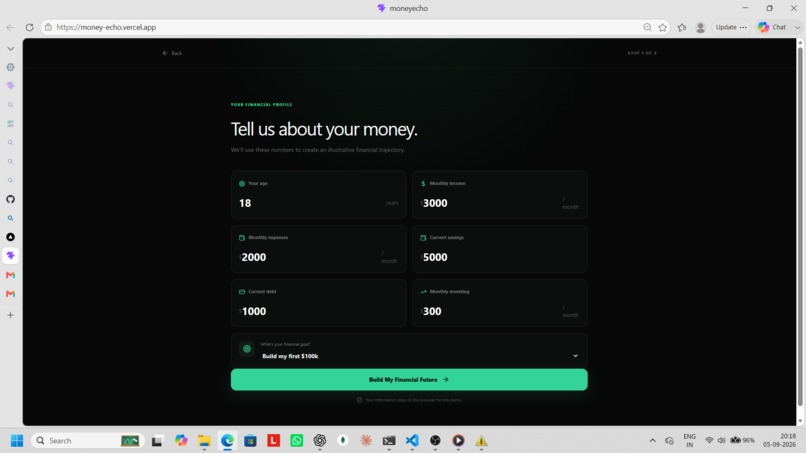
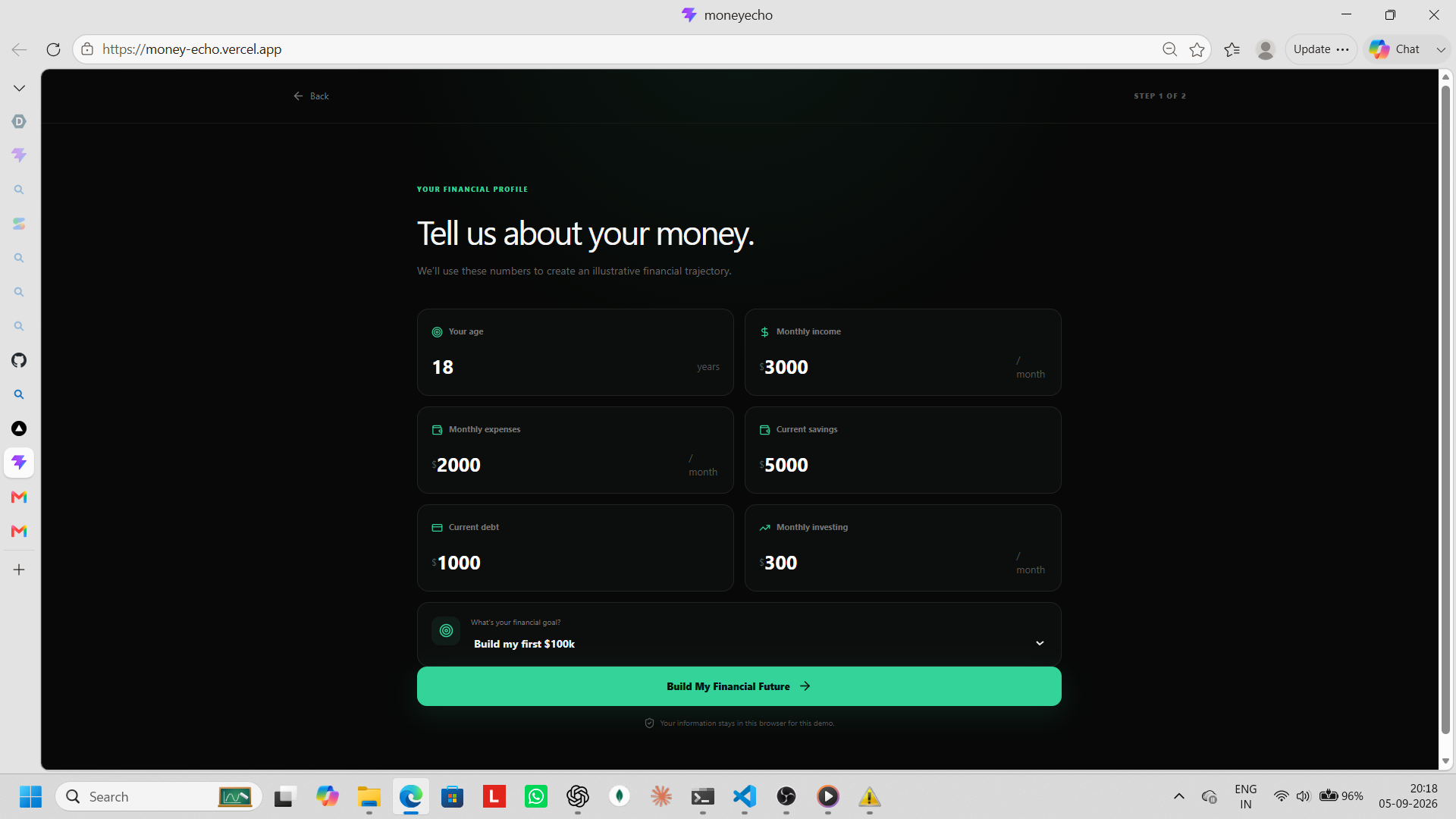
Financial Profile
-
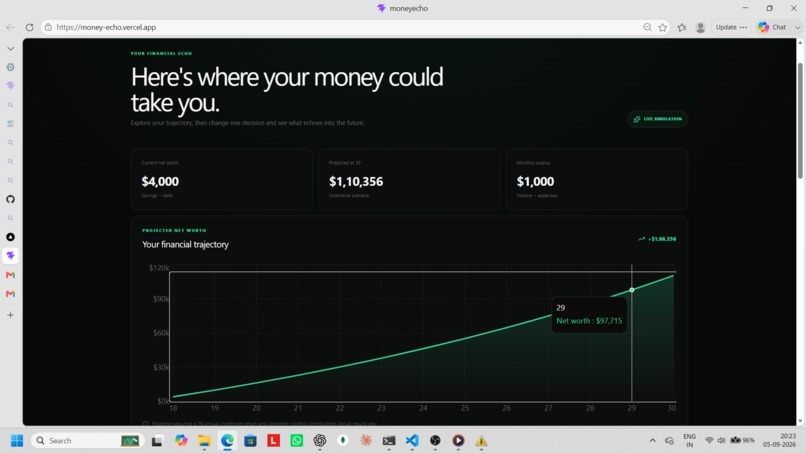
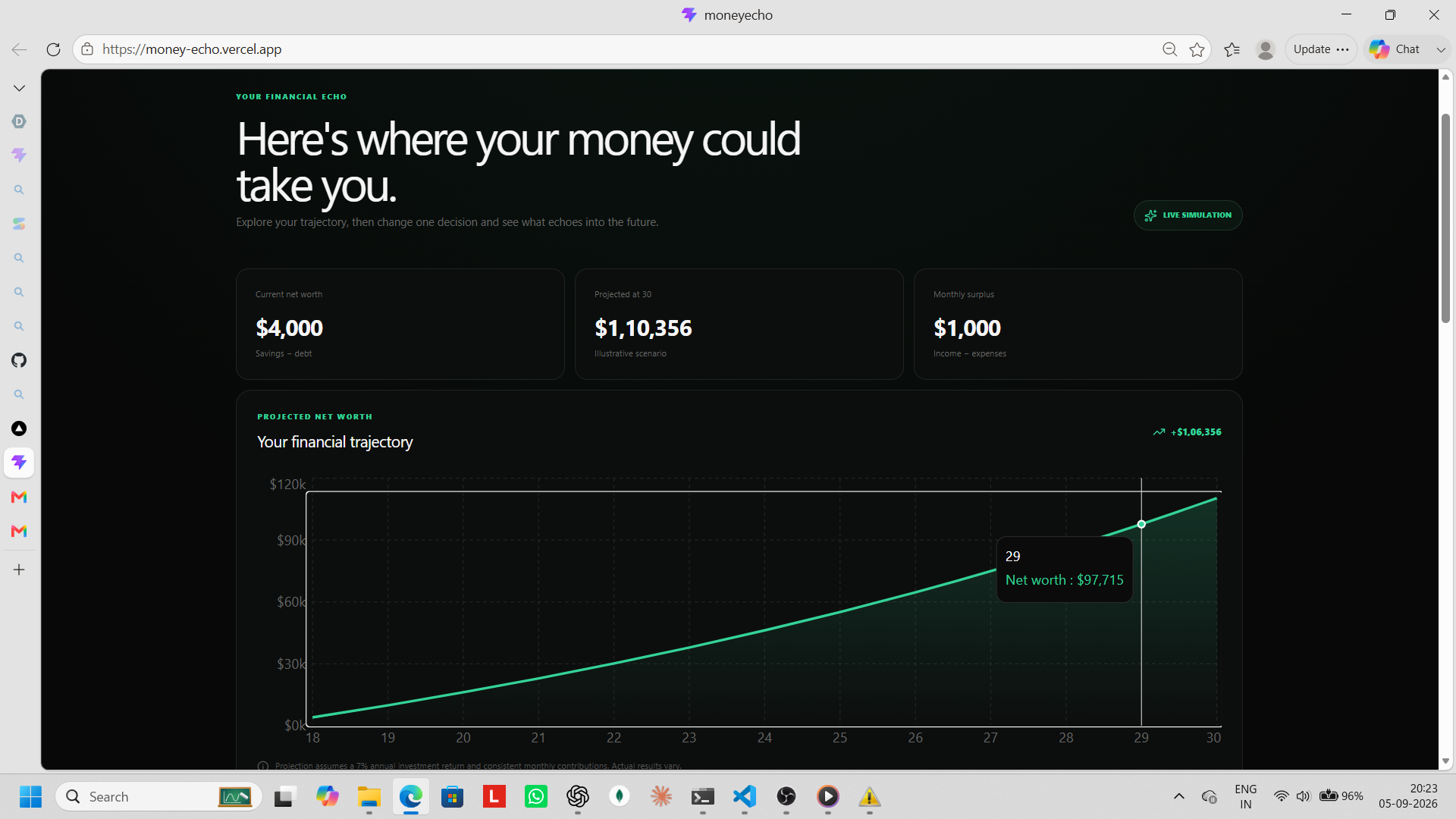
Financial Dashboard & Tracker
-
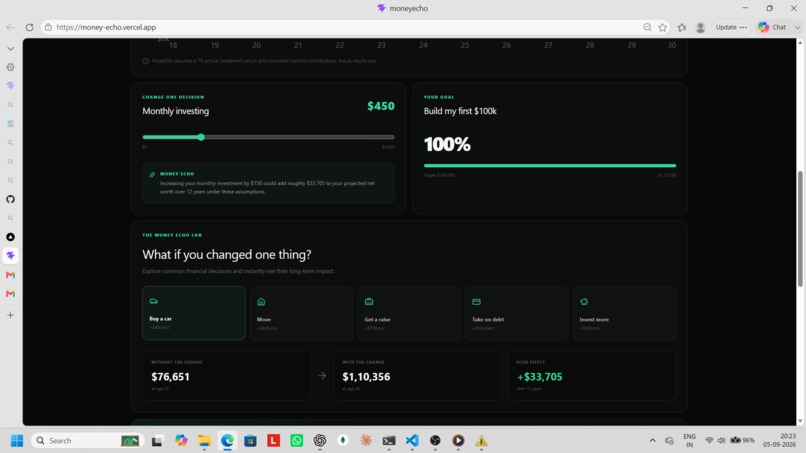
Financial Dashboard & Tracker
-
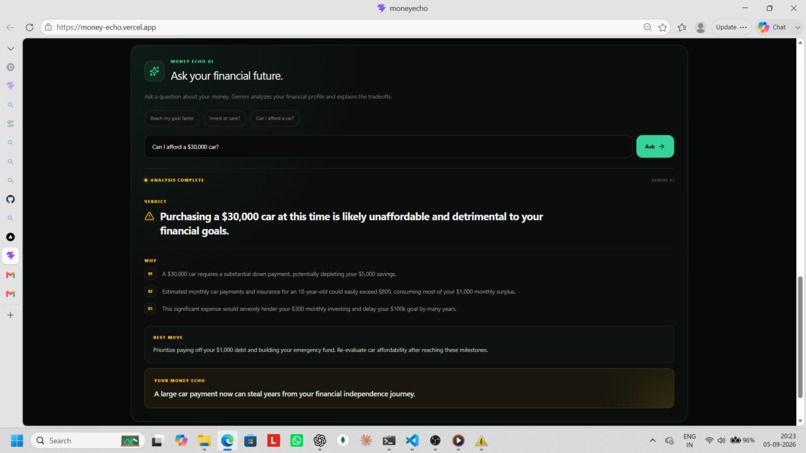
AI Financial Coach
Inspiration
MoneyEcho started with a simple problem: most personal finance apps tell you what your money looks like today, but they don't make it easy to understand how a decision you make today can affect your financial future.
We wanted to make that future feel visible.
For example, spending an extra $400 every month on a car may not feel like a huge decision. But when that decision is repeated for years, it can have a meaningful impact on savings, investing, and long-term goals.
That led us to our core idea:
Every financial decision leaves an echo.
Instead of simply telling users what they should do, MoneyEcho lets them experiment with different choices and see how their projected financial future changes.
What it does
MoneyEcho is an interactive financial simulator with an AI-powered financial coach.
Users first create a financial profile by entering their:
- Age
- Monthly income
- Monthly expenses
- Savings
- Debt
- Monthly investments
- Financial goal
MoneyEcho then creates an illustrative 12-year net-worth projection based on the user's current financial situation.
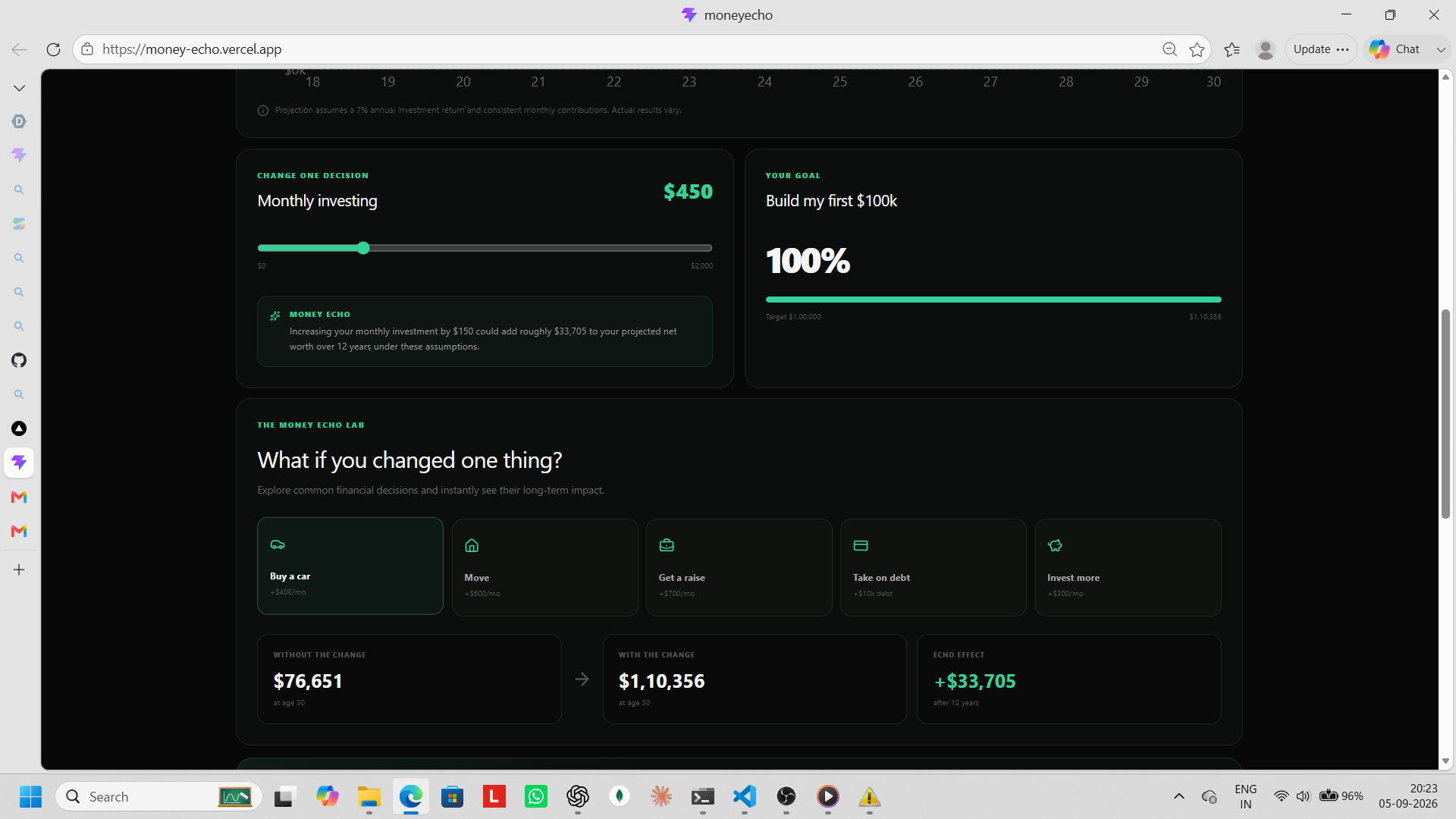
The user can change their monthly investment amount using a slider and immediately see how the projected trajectory changes.
The Money Echo Lab takes this idea further. Users can simulate decisions such as:
- Buying a car
- Moving to a more expensive home
- Getting a raise
- Taking on additional debt
- Investing more each month
The app compares the original projection with the new scenario and shows the financial difference at the end of the simulation.
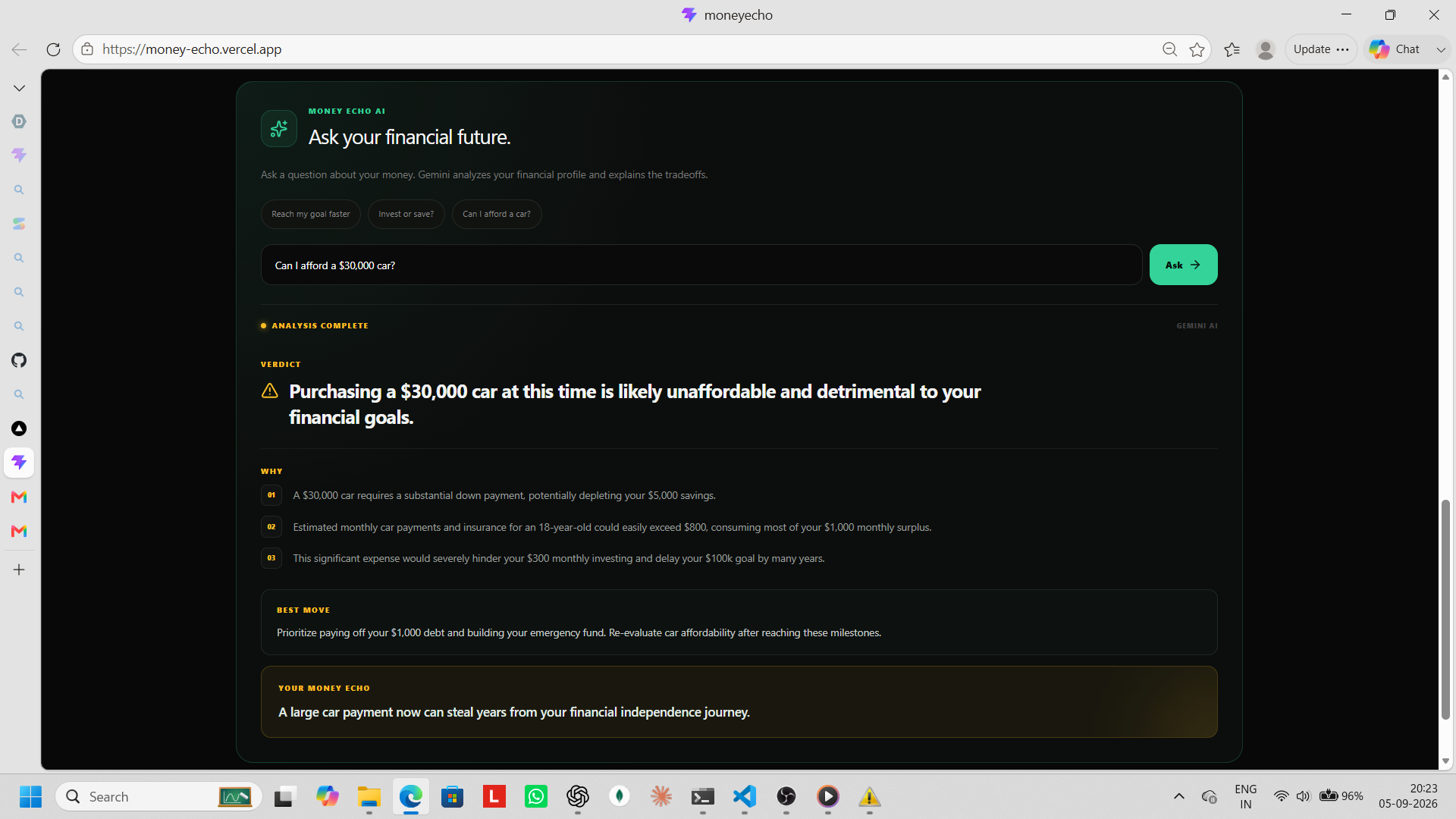
MoneyEcho also includes a Gemini-powered AI financial coach. Users can ask questions such as:
"Can I afford a $30,000 car?"
"Should I invest more or save more?"
"How can I reach my first $100k faster?"
Instead of producing a long generic chatbot response, Gemini analyzes the user's actual financial profile and returns a structured response:
Verdict → Why → Best Move → Your Money Echo
The AI also uses different visual signals for positive, neutral, and warning situations so users can quickly understand the result.
How we built it
We built MoneyEcho as a full-stack React application.
Frontend
The frontend was built with:
- React
- Vite
- Tailwind CSS
- Custom CSS
- Recharts
- Lucide React
Recharts is used to visualize the user's projected net worth over time.
The interface was designed around a dark fintech aesthetic with an emerald accent color, keeping the experience focused on the financial numbers and decisions.
Backend
We built a lightweight Node.js and Express backend to handle communication with Gemini.
The Gemini API key is kept on the server rather than exposed in the React frontend.
Financial simulation
The simulator calculates an illustrative financial trajectory using monthly compounding.
We use a 7% annual return assumption for the investment projection and convert that into a monthly rate.
The simulator also considers the user's available monthly surplus so the model does not simply assume that a user can invest an unlimited amount.
For example:
$$ Monthly\ Surplus = Income - Expenses $$
and the investment contribution is constrained by that available surplus.
The purpose isn't to predict someone's exact future. It is to make the direction and potential impact of financial decisions easier to understand.
AI
Gemini is used as the financial decision coach.
We designed the AI prompt to:
- Use the user's actual numbers
- Explain tradeoffs
- Avoid generic financial articles
- Keep responses concise
- Clearly distinguish estimates from facts
- Avoid guaranteeing investment returns
- Return structured JSON that the frontend can control
This allowed us to make Gemini feel like part of the MoneyEcho product instead of simply embedding a chatbot.
Challenges we ran into
One of our biggest challenges was making the AI response useful without making it feel like a generic chatbot.
Our first responses were too long and contained unnecessary explanations. For a financial dashboard, users don't want to read an entire article every time they ask a question.
We solved this by changing the AI output into a structured format with four sections:
VERDICT
The direct answer.
WHY
The important financial factors behind the answer.
BEST MOVE
A practical next step.
YOUR MONEY ECHO
A memorable explanation of the long-term impact.
Another challenge was making sure the financial simulation was simple enough for users to understand while still showing meaningful long-term effects.
We decided that the core interaction should always remain simple:
Change one decision → see the projection change.
We also had to think carefully about financial accuracy. MoneyEcho uses assumptions for demonstration purposes, so we clearly label projections as illustrative rather than guaranteed financial outcomes.
Accomplishments that we're proud of
We're proud that MoneyEcho is more than a budgeting calculator.
The main experience connects three different layers:
Calculate → Simulate → Explain
The calculator creates the financial trajectory.
The simulator lets users change decisions.
Gemini explains the tradeoffs.
The Money Echo Lab is probably the feature we're most proud of because it makes our concept immediately understandable.
A user can click "Buy a car", "Move", or "Invest more" and immediately see how that decision changes their projected financial future.
We also built the AI response so that the interface communicates the type of decision being made. A favorable situation can receive a positive signal, while a potentially harmful financial decision can receive a warning.
This makes the experience feel more like a financial product and less like a traditional AI chat interface.
What we learned
We learned that personal finance becomes much easier to understand when people can see consequences instead of just numbers.
A monthly expense of $400 doesn't necessarily feel significant when viewed in isolation.
But seeing how that expense can affect a 12-year projection creates a completely different perspective.
We also learned that AI is most useful when it is connected to structured data.
Instead of asking Gemini a generic question like:
"Is buying a car a good idea?"
MoneyEcho gives Gemini the user's financial context and asks it to explain the decision using those numbers.
That makes the response much more relevant.
We also learned that good fintech UX should reduce complexity rather than add more of it. The goal wasn't to build the most complicated financial model possible. The goal was to make the consequences of a decision understandable in seconds.
What's next for MoneyEcho
MoneyEcho is currently a prototype, but we see a lot of potential for it to become a more complete financial decision platform.
Our next steps would include:
- Bank account and transaction integrations
- Real-time expense tracking
- Debt payoff simulations
- Emergency fund recommendations
- Inflation-adjusted projections
- Tax-aware calculations
- Multiple investment return scenarios
- Best-case, expected-case, and conservative projections
- More personalized AI financial plans
- Goal timelines and milestones
- Comparing multiple financial decisions side-by-side
We also want to make the simulations more realistic by allowing users to adjust factors such as investment returns, inflation, interest rates, loan terms, and recurring expenses.
Business Potential & Market Advantage
How it can make money
MoneyEcho can use a freemium model. The core simulator can be free, while premium users can access advanced AI coaching, detailed financial plans, unlimited scenarios, goal tracking, and advanced financial simulations.
In the future, MoneyEcho could also explore partnerships with financial services, while keeping the experience transparent and user-focused.
Why it's unique
Most personal finance apps focus on tracking the past - what you spent, saved, or invested.
MoneyEcho focuses on understanding the future.
Users can change a real-life financial decision and immediately see how it could affect their long-term financial trajectory.
Decision → Simulation → Impact → Better Decision
The combination of an interactive financial simulator and an AI coach makes MoneyEcho more than a budgeting app.
Our market advantage
- Simple: Complex financial concepts are turned into easy-to-understand visual results.
- Interactive: Users can experiment with different financial decisions instead of just viewing data.
- Personalized: The AI uses the user's actual financial profile to explain tradeoffs.
- Action-focused: MoneyEcho doesn't just show numbers - it helps users understand what they can do next.
- Highly expandable: The platform can grow into debt planning, savings goals, investment planning, and major life-decision simulations.
Our goal is to make MoneyEcho a financial decision engine that helps people think beyond today and understand the potential consequences of their choices.
That's the idea behind MoneyEcho.
Every financial decision leaves an echo.
Built With
- express.js
- financial-simulation
- fintech
- generative-ai
- google-gemini-api
- javascript
- lucide-react
- node.js
- personal-finance
- react
- recharts
- tailwind-css
- vite


Log in or sign up for Devpost to join the conversation.