-
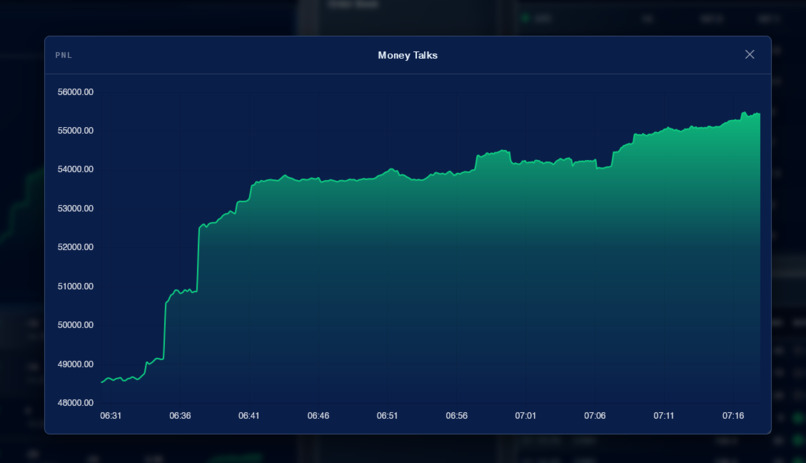
Market Graph
-
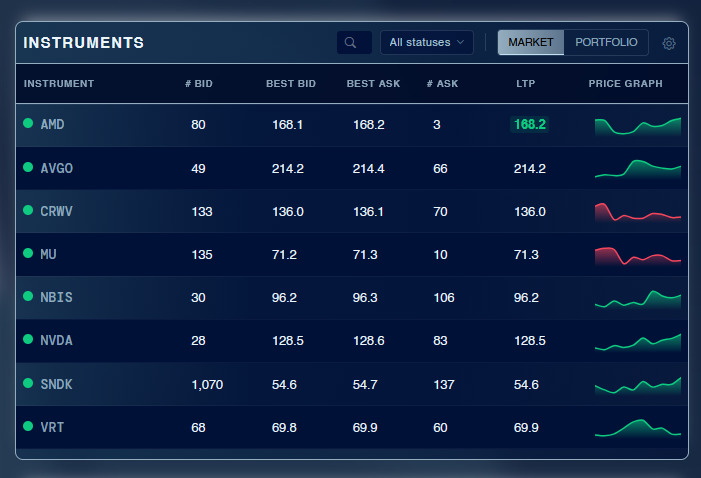
Stock Instruments
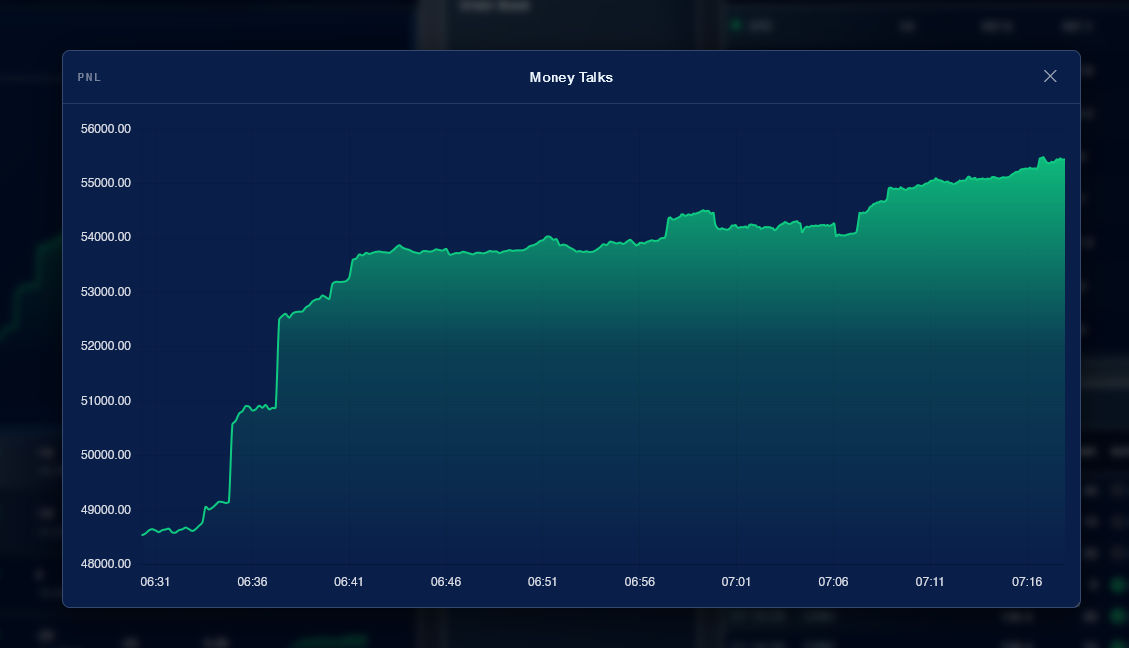
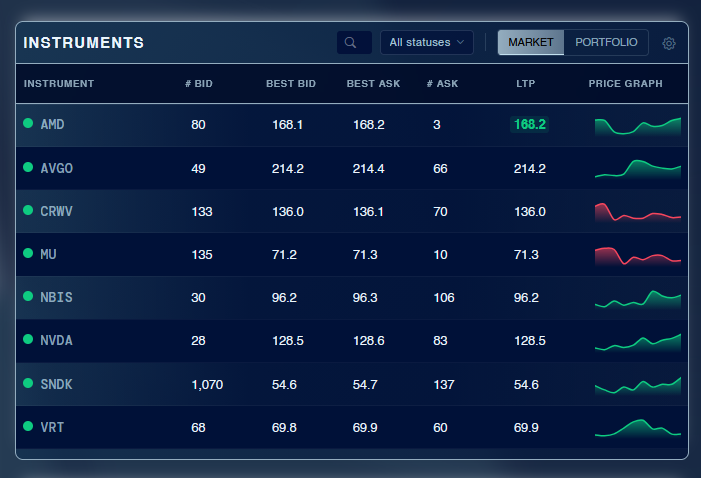
Inspiration
What can an order book tell us before the next price update arrives?
Optiver’s challenge gave us eight stocks, a shared simulated exchange and strict trading limits. We started by observing how prices, orders and trades interacted. We found that some stocks consistently followed others, and that the exchange’s market makers used recognisable sequences when changing their quotes.
That became the idea behind Money Talks: study the market’s behaviour, identify opportunities we could explain, and build an execution system fast enough to act on them.
What it does
Money Talks trades autonomously on Optibook using four complementary strategies:
- Leader–follower trading: when a leader stock jumps, it trades a related follower while its quotes still lag behind.
- Down-jump sniping: it takes stale bids during the brief window between a market maker posting its new bid and its new ask.
- Adaptive market making: it quotes follower stocks during quieter periods, adjusts prices for inventory and fill quality, and withdraws vulnerable quotes when it detects a jump warning.
- Ordinary repricing opportunities: it takes stale quotes left behind when a leader’s market maker updates its prices between jumps.
The system tracks positions, resting orders and pending requests together. Its strategies share a request budget, and every order is checked against available position capacity. A performance check can disable a leader–follower relationship if its observed trades stop paying.
How we built it
We split the system into two cooperating layers.
Python handles strategy and operations: fair-value estimates, leader–follower relationships, quote planning, inventory management, fill analysis, configuration and recovery. Our final launch configuration runs the main strategy loop at a target interval of five milliseconds.
A Rust gateway handles the most time-sensitive reactions. It sits between the Python client and the exchange, monitors market-data and execution messages, and sends cancellations and immediate-or-cancel orders directly when a relevant event arrives. Critical reactions can therefore proceed independently of the Python strategy loop.
We researched the market using public order events, trade data and practice-session recordings. Exchange timestamps helped us distinguish signal timing, processing delays and execution delays. We used that evidence to refine our strategies, request priorities and infrastructure settings.
Configuration files let us compare variants and keep fallback configurations ready without rewriting the strategy during a run.
Challenges we ran into
Opportunities could expire before the next polling cycle. Moving critical reactions into the network path helped us compete for trades that remained available for only milliseconds.
Orders and fills arrive concurrently. A cancellation can race with a fill, and an accepted order is not necessarily an executed trade. We had to reserve outstanding and pending volume while coordinating Python actions with the native gateway.
More CPU activity sometimes made us slower. Our container had a hidden CPU-time limit. Continuously spinning reader threads exhausted that budget and caused pauses across the container. Restricting busy polling to the measured event window reduced throttling while keeping that window responsive.
Good-looking results required careful interpretation. We separated mock results from live practice, analysed individual strategy contributions and checked how fill value changed after execution. We rejected ideas whose apparent advantage disappeared with more observations or carried excessive inventory risk.
Accomplishments that we're proud of
- Building a complete research-to-execution pipeline during the hackathon, from market recordings to an integrated Python and Rust trading system.
- Identifying the market maker’s cancellation sequence as an early warning to withdraw exposed quotes before a jump.
- Recording a practice benchmark in which the Rust path reacted before the tuned Python path on all 59 compared book updates.
- Combining jump trading, stale-quote opportunities and quiet-period market making under coordinated position and request controls.
- Adding practical safeguards, including inventory-aware quoting, pair-level performance checks, reconnect handling and fallback configurations.
What we learned
The strongest improvements came from understanding the market and measuring the whole system. A faster calculation was useful only when it changed whether an order reached an opportunity in time. Reducing CPU usage could improve latency, and a successful fill still needed a sensible exit.
We also learned to question attractive results. Profits measured shortly after entry are different from completed-trade profits, and a few jump-heavy sessions can make a strategy look more consistent than it is. Recording events, comparing alternatives and studying failure cases helped us make better decisions.
Working across research, Python strategy development and Rust execution also taught us the importance of clear interfaces: every component needed a consistent understanding of orders, positions and available capacity.
What's next for Money Talks
We want to improve how much value we capture from each opportunity while keeping inventory and execution risk controlled. Our next steps are to measure missed opportunities by cause, refine follower exits, and evaluate how quiet-period trading affects capacity for the next jump.
We also want to test the strategies across more independent sessions and changing competitor behaviour, with clearer attribution of completed-trade PnL, drawdown and execution quality.
The goal is a system whose performance we can explain and reproduce across different market conditions.
