Inspiration
Bridge was inspired by a very specific kind of silence: the silence between people who care deeply about each other, but do not have the same language for difficult emotions.
That idea first came from immigrant family dynamics, especially in Asian households, where love is often expressed through care, sacrifice, and responsibility rather than direct emotional language. A child may want to talk about stress, depression, loneliness, or emotional pain, but the conversation can fall apart before it even begins. Not because nobody cares, but because both sides are speaking from different emotional and cultural worlds.
As we built the project, we realized this problem is much bigger than one family structure. The same gap shows up between parents and children across cultures, between partners in a difficult moment, between friends after a falling out, and really between any two people separated by a language gap or an emotional gap.
That broader insight shaped Bridge. We wanted to build something that helps one honest conversation happen when it otherwise might never happen at all.
What it does
Bridge is an AI-mediated translator for difficult human conversations.
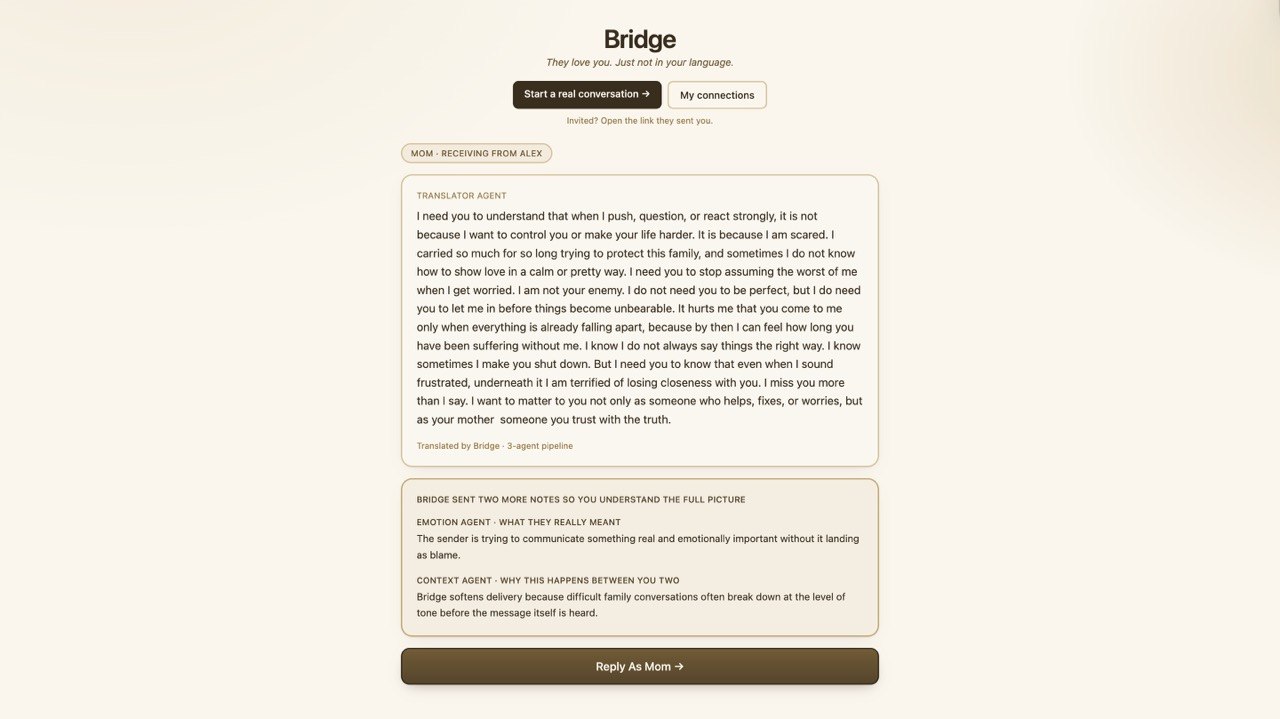
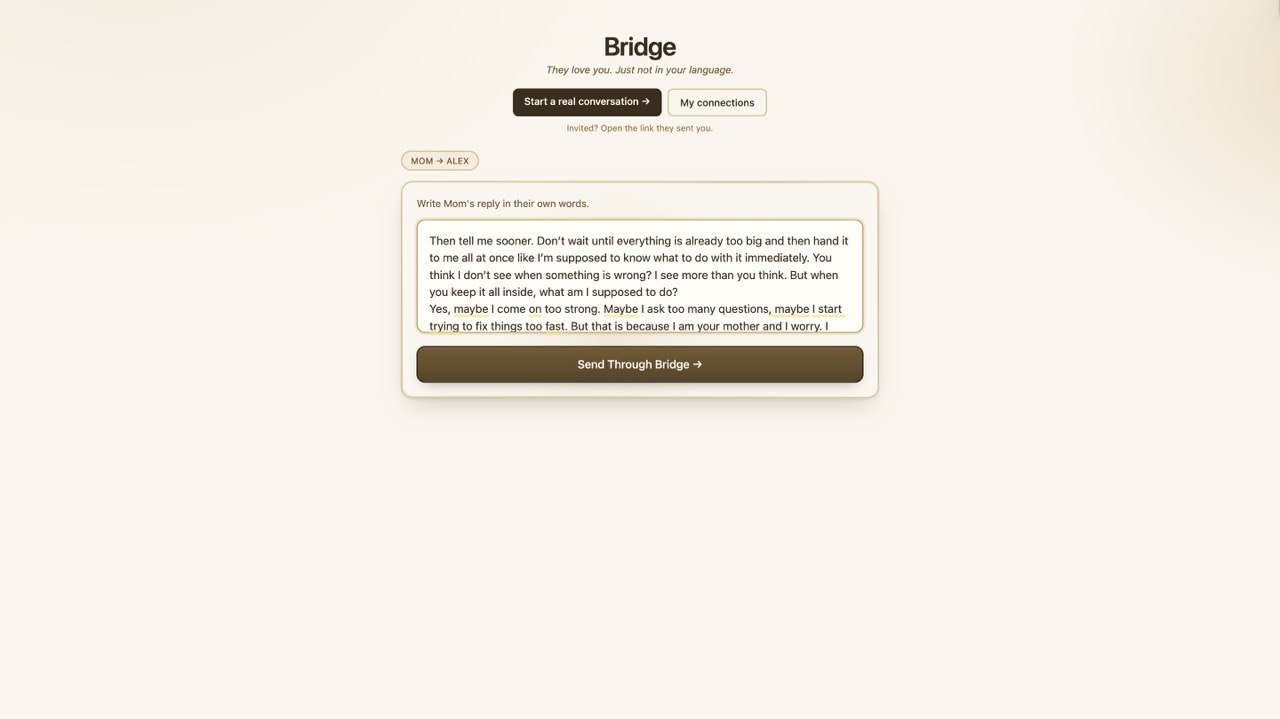
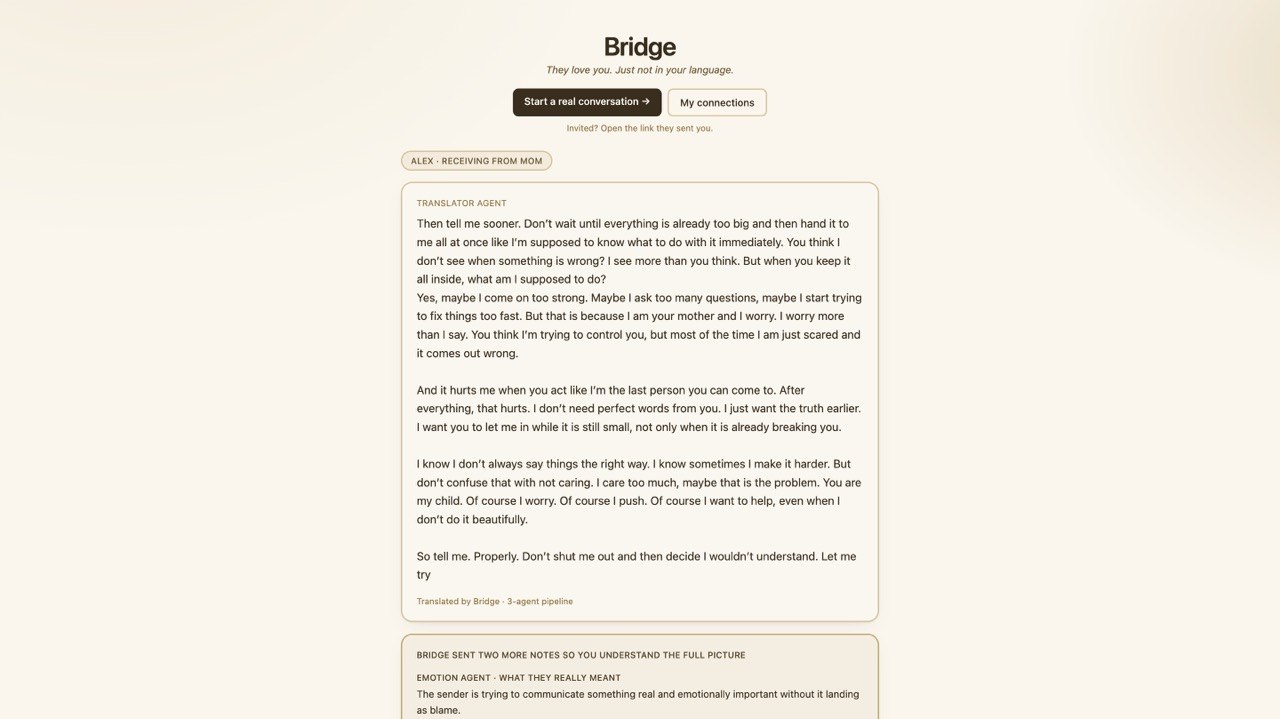
When one person writes a raw message, Bridge creates three outputs for the receiver:
- An emotional interpretation of what the sender really means underneath the words
- A cultural context layer explaining why this kind of communication gap may be happening
- A translated version of the message that preserves the sender's truth while making it easier for the receiver to understand
The goal is not to make messages sound generic or polished. The goal is to preserve honesty while making the message more receivable. Bridge can support family conversations, cross-cultural parent-child communication, tense moments between partners, or reconnecting after conflict between friends. It is not therapy, and it does not replace real human connection. It simply lowers the barrier to one hard conversation.
How we built it
We built Bridge as a lightweight full-stack prototype:
- Frontend: Next.js 14 with the App Router, TypeScript 5, React 18, Tailwind CSS 3.3, PostCSS, Autoprefixer, and
qrcode.react - Backend: Python 3.13 with FastAPI, Uvicorn, Pydantic v2,
pydantic-settings, andpython-dotenv - AI: Google Gemini 2.5 Flash through the
google-genaiSDK - Testing: Playwright
- Deployment setup: Vercel for the frontend and Railway for the backend
- Database: none in the current prototype; the focus was the translation pipeline and end-to-end demo flow
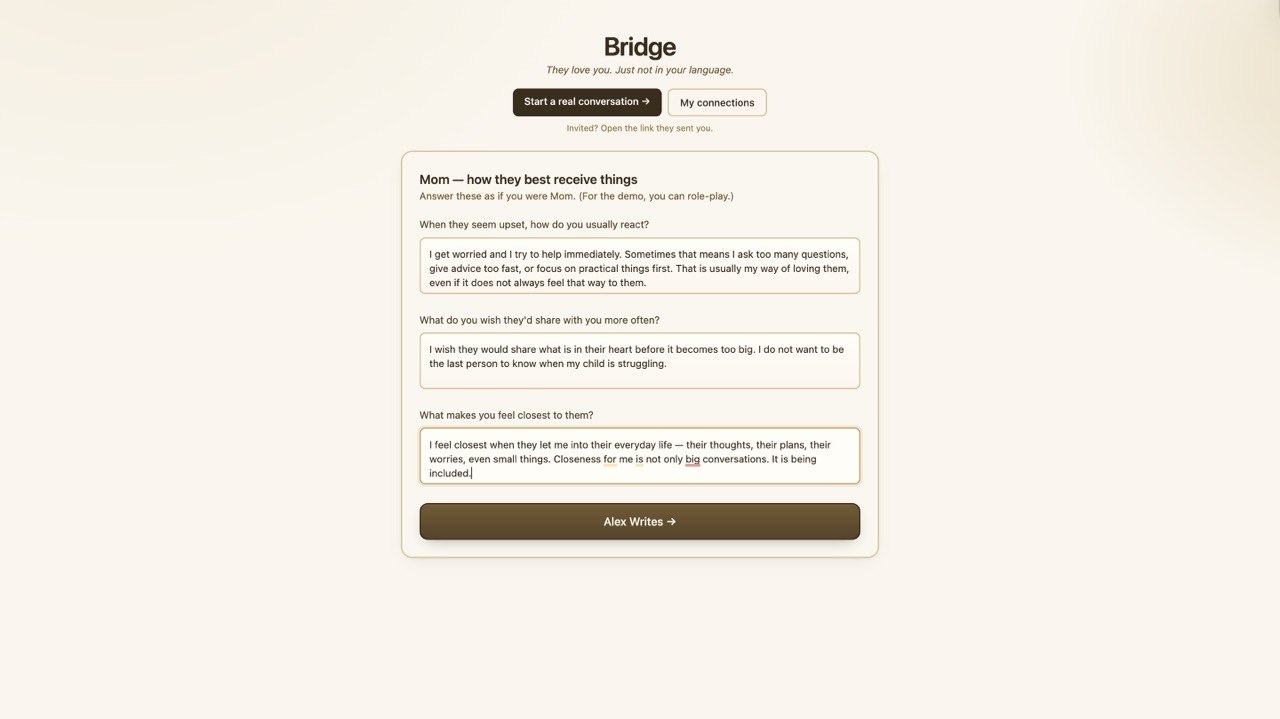
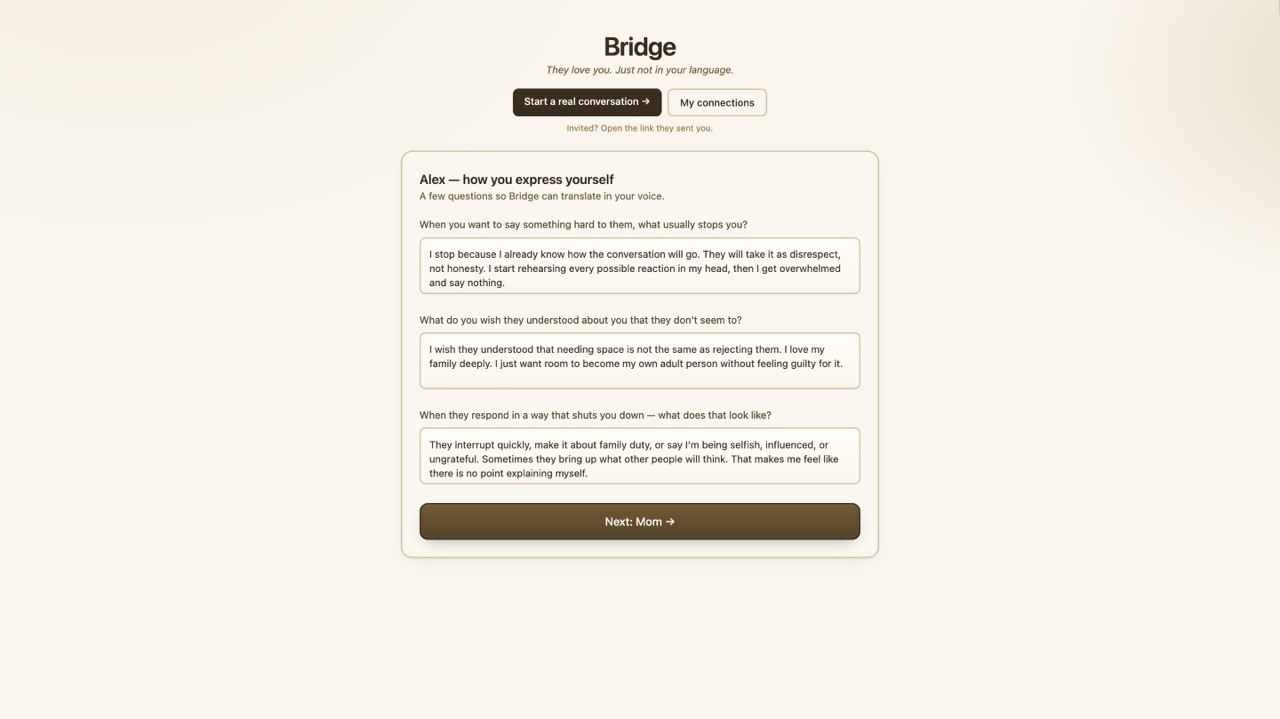
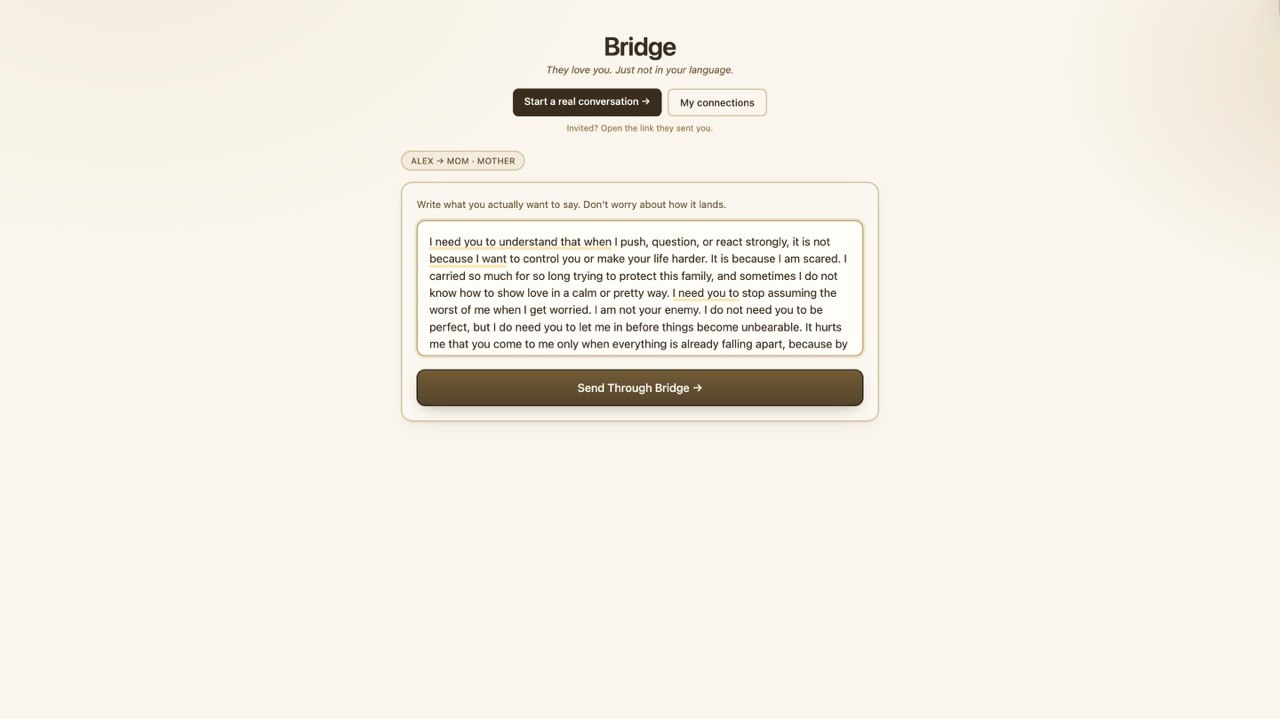
The frontend guides the user through a simple conversation flow. First, each side is described through a few onboarding questions about how they express themselves and how they best receive emotional messages. Then one side writes a raw message, sends it through Bridge, and sees the translated result. The receiver can then reply through the same process in reverse. The structure is intentionally flexible so it can apply to many relationship types, not just one.
On the backend, we used a three-agent pipeline instead of a single prompt:
- An Emotion Interpreter identifies what the sender is truly feeling
- A Cultural Context Agent explains the family or generational pattern behind the message
- A Translator Agent rewrites the message so it lands better without losing the sender's voice
We also added a basic crisis gate so that if the system detects signals of self-harm or immediate danger, it stops the normal flow and returns a safer response instead.
Challenges we ran into
The hardest challenge was realizing that this is not just a language problem. It is a tone problem, a trust problem, and a safety problem.
We had to figure out how to make the AI rewrite a message without making it sound fake. If the model softened the message too much, it became emotionally dishonest. If it stayed too close to the original, the message might still fail to land. We also had to think carefully about cultural nuance, because the same sentence can carry very different meanings depending on family roles, romantic dynamics, friendship history, upbringing, and emotional norms.
Another challenge was scope. We were building for a hackathon, so we focused on proving the core experience rather than building a full production product. That meant prioritizing the translation pipeline and end-to-end demo over things like accounts, persistence, or a full messaging system.
Accomplishments that we're proud of
We are proud that Bridge feels like more than a simple chatbot demo. It has a clear point of view, a meaningful user problem, and a product flow that matches that problem.
We are especially proud of:
- building a working full-stack prototype with a real frontend and backend
- designing a three-agent AI pipeline with distinct roles instead of relying on one generic prompt
- creating an interaction flow that feels calm, intentional, and human-centered
- adding a basic safety checkpoint for crisis-related messages
- grounding the idea in a real social and emotional problem, not just a technical novelty
Most importantly, we are proud that the project stays focused on helping people feel understood rather than simply showing off AI output.
What we learned
We learned that AI becomes much more useful in sensitive situations when its role is narrow and intentional.
Breaking the system into emotional interpretation, cultural framing, and translation made the output more coherent and trustworthy. We also learned that product design matters just as much as prompting. For a project like this, the user experience has to feel respectful, clear, and emotionally safe across many types of relationships, not just one specific use case.
We also learned that some of the most meaningful applications of AI are not about automation or efficiency. They are about reducing friction in human connection.
What's next for Bridge
The current version of Bridge is a prototype that proves the core idea, but there is a lot more we would want to build next.
Our next steps would include:
- adding persistent conversations and user accounts
- enabling real delivery between two people on separate devices
- improving personalization over time based on communication patterns
- strengthening safety and escalation behavior
- expanding multilingual and cross-cultural support
- creating relationship-specific modes for parent-child conversations, couples in conflict, and friendships after rupture
Long term, we want Bridge to help people have the conversations they keep postponing with the people they care about most. If it helps one more child call home, one more partner explain hurt without escalation, or one more friendship recover after a painful misunderstanding, then it has done its job.
Built With
- autoprefixer
- dotenv
- fastapi
- gemini
- next.js
- playwright
- postcss
- pydantic
- python
- qrcode
- react
- tailwind
- typescript
- uvicorn
- vercel

Log in or sign up for Devpost to join the conversation.