Inspiration
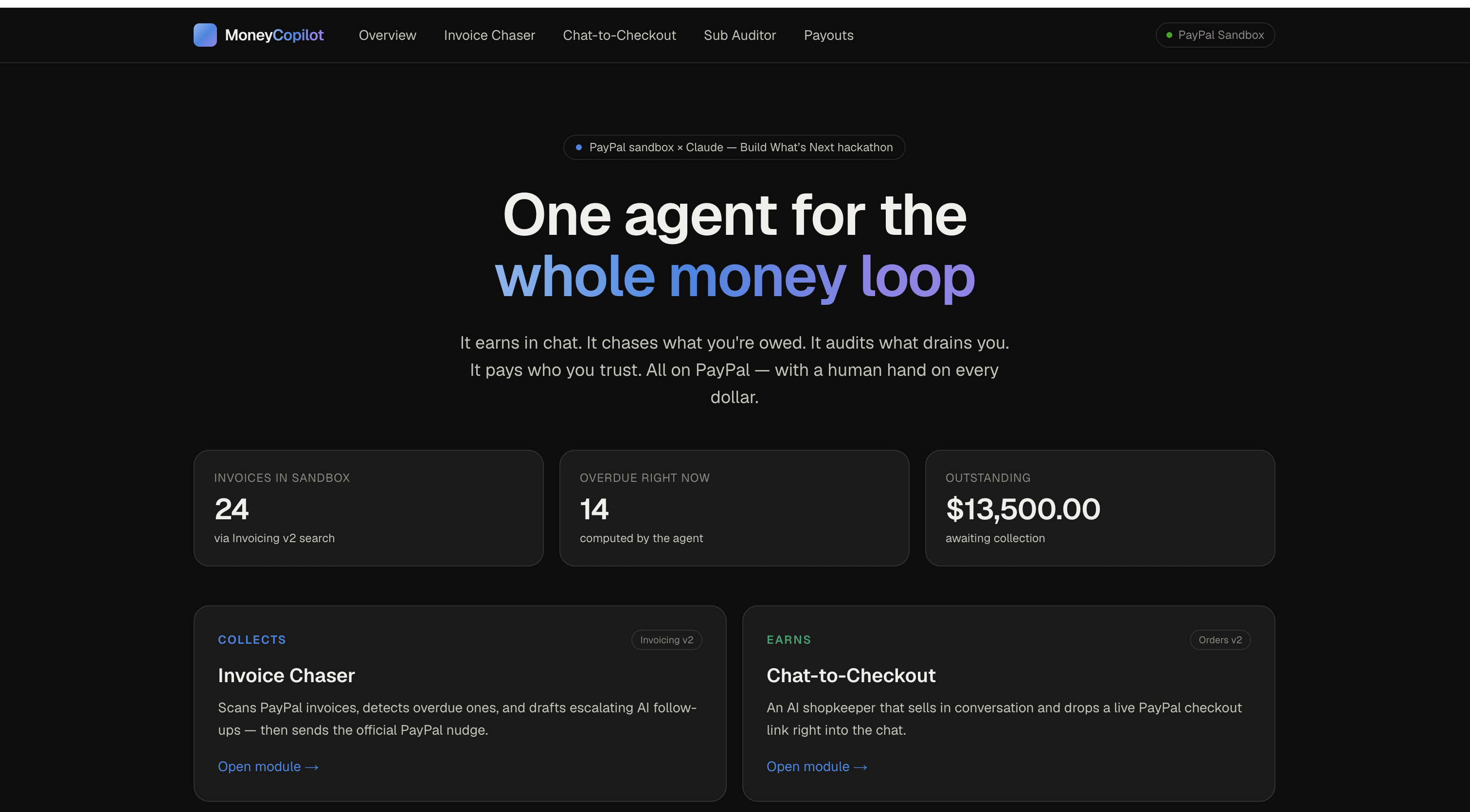
In 2025, PayPal partnered with OpenAI and Perplexity to put payments inside AI conversations. That convinced us agentic money isn't a gimmick — it's the next interface. But every demo we saw did one thing. Real money management is a loop: you earn, you collect, you audit, you pay. We wanted one AI agent that runs the entire loop on PayPal — with a human hand on every dollar. https://ai-money-copilot.onrender.com/
What it does
AI Money Copilot is four agents in one app, all on PayPal's sandbox APIs:
- Invoice Chaser — scans your PayPal invoices, computes who's overdue (PayPal has no "overdue" status — our agent owns that logic), drafts escalating follow-ups with AI (friendly → firm → final notice), and sends official PayPal reminders. When a customer pays, it reconciles instantly.
- Chat-to-Checkout — an AI shopkeeper that sells in conversation. Describe what you want; it searches real products live via Channel3 (real prices, real merchants) and mints a PayPal checkout right in the chat.
- Subscription Auditor — PayPal has no "list all subscriptions" API, so the Copilot keeps its own ledger, pulls live status, and AI-classifies each subscription as HEALTHY, AT_RISK, or ZOMBIE. Cleanup happens only on a human click.
- Payout Manager — write a payout rule in plain English ("pay every contractor for approved tasks, cap any payment at $90"); AI compiles it into exact payout items; nothing moves until a human approves; then one Payouts batch pays everyone.
How we built it
Next.js 16 + TypeScript + Tailwind + Framer Motion, with Claude via the Vercel AI SDK for drafting, auditing, and rule compilation. Four PayPal REST APIs (Invoicing v2, Orders v2, Subscriptions v1, Payouts v1) behind a single token-cached client. The chaser agent streams its work as NDJSON so the UI animates every step live. Sponsor stack: Render (hosting), Channel3 (real product search), AG Grid (invoice table view), Postman (committed API collection). Every AI feature has a deterministic fallback, so the demo never hard-fails.
Challenges we ran into
- Geography bites in the sandbox too: our first sandbox business account was India-based — it couldn't send invoices (USD blocked, INR unsupported) or payouts at all. We debugged cryptic INR_FOREIGN_CURRENCY and PAYOUT_NOT_AVAILABLE errors before rebuilding on a US sandbox account.
- The API you expect doesn't exist: there is literally no endpoint to list a merchant's subscriptions. We turned the gap into the feature — the Copilot maintains the ledger PayPal doesn't.
- PayPal ignores custom reminder text: the Invoicing remind endpoint overrides your subject/note with system text, so we route the AI-drafted message through our own channel and use /remind as the official nudge.
- Client-side prices can't be trusted: for Channel3 purchases we re-fetch the price server-side at buy time, so a tampered client can't change what gets charged.
Accomplishments that we're proud of
Four PayPal APIs working end-to-end in one coherent product; real payments completing in sandbox (checkout → capture → confetti); an agent whose every step streams live on screen; and a safety posture we believe in — AI drafts and plans, humans approve everything irreversible.
What we learned
Payments APIs are where "move fast" meets reality: country rules, missing endpoints, and immutable system emails all shaped the product. The best agentic UX isn't full autonomy — it's an agent that does the tedious 95% and presents a human with one clear, informed click for the 5% that moves money.
What's next for Money Copilot
Webhook-driven reconciliation (instant PAID instead of polling), spending-policy guardrails with hard caps and a kill switch, a full audit-log page ("every dollar has a paper trail"), PayPal's official MCP server + Agent Toolkit integration, and multi-merchant support so freelancers and small teams can run their whole money loop from one place.
Built With
- ag-grid
- anthropic
- channel3
- claude
- framer-motion
- nextjs
- node.js
- paypal
- paypal-orders
- paypal-payouts
- paypal-subscriptions
- postman
- react
- render
- rest-api
- tailwindcss
- typescript
- vercel-ai-sdk
