-
-
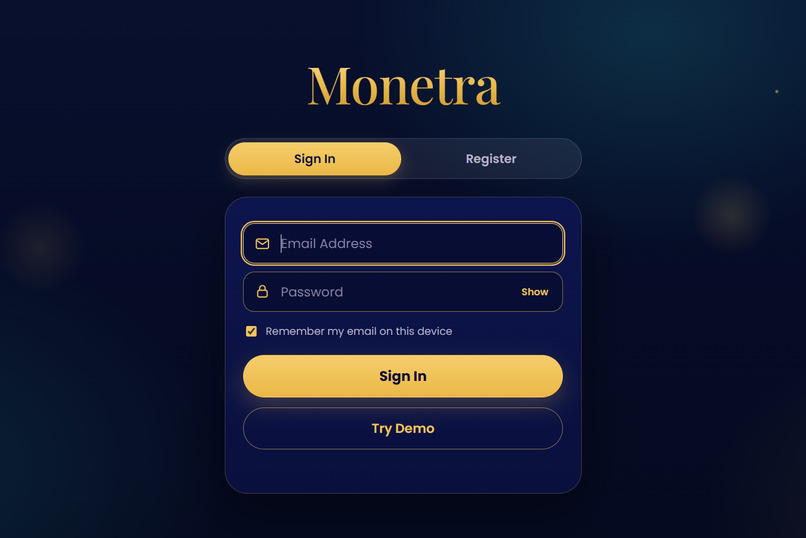
Judges can press Try Demo to explore Monetra instantly, with no sign-up.
-
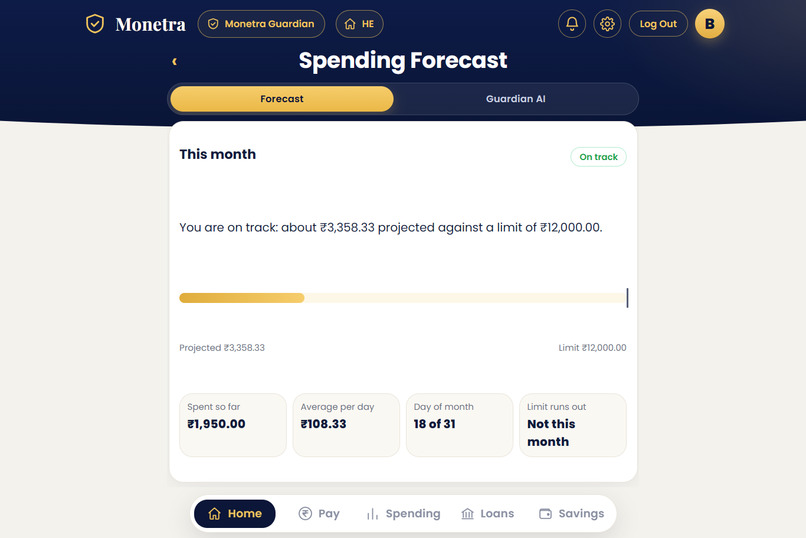
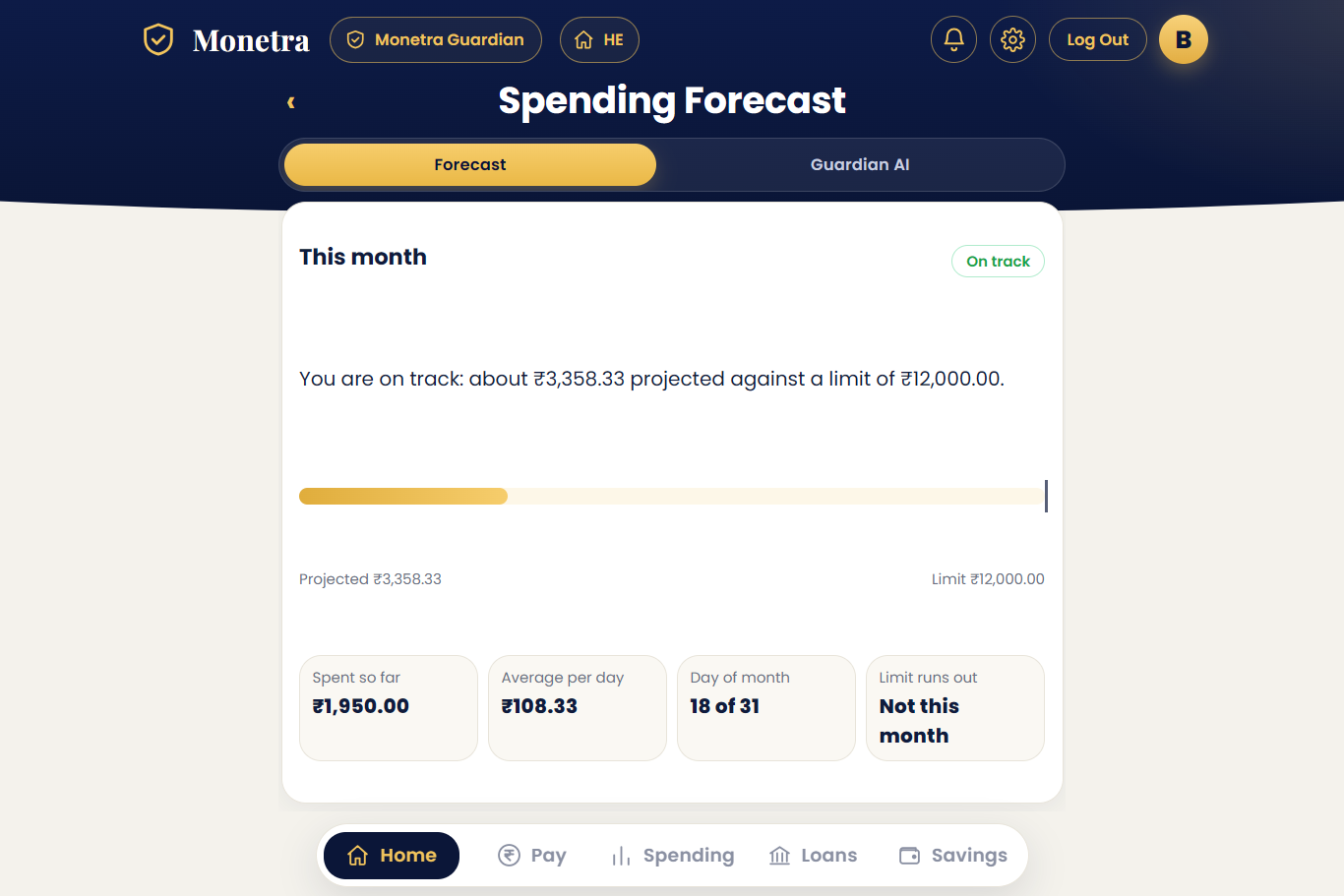
Month-End Forecast: on track, with the projected spending against the monthly limit.
-
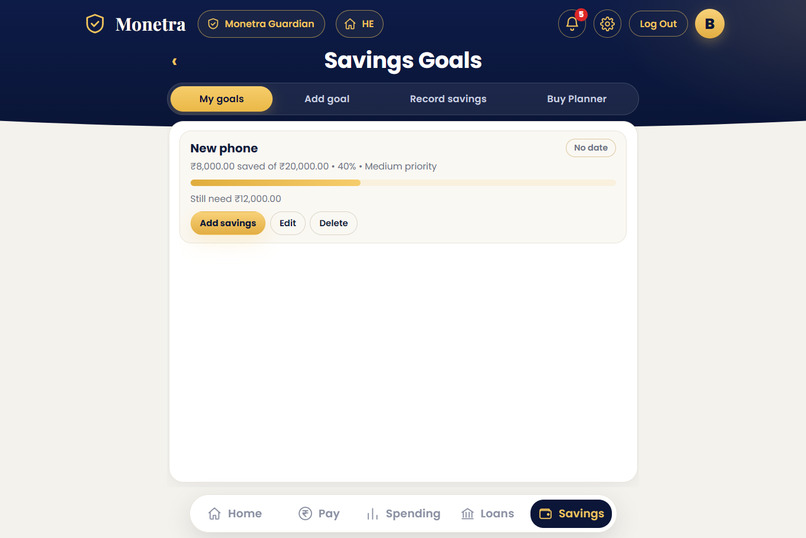
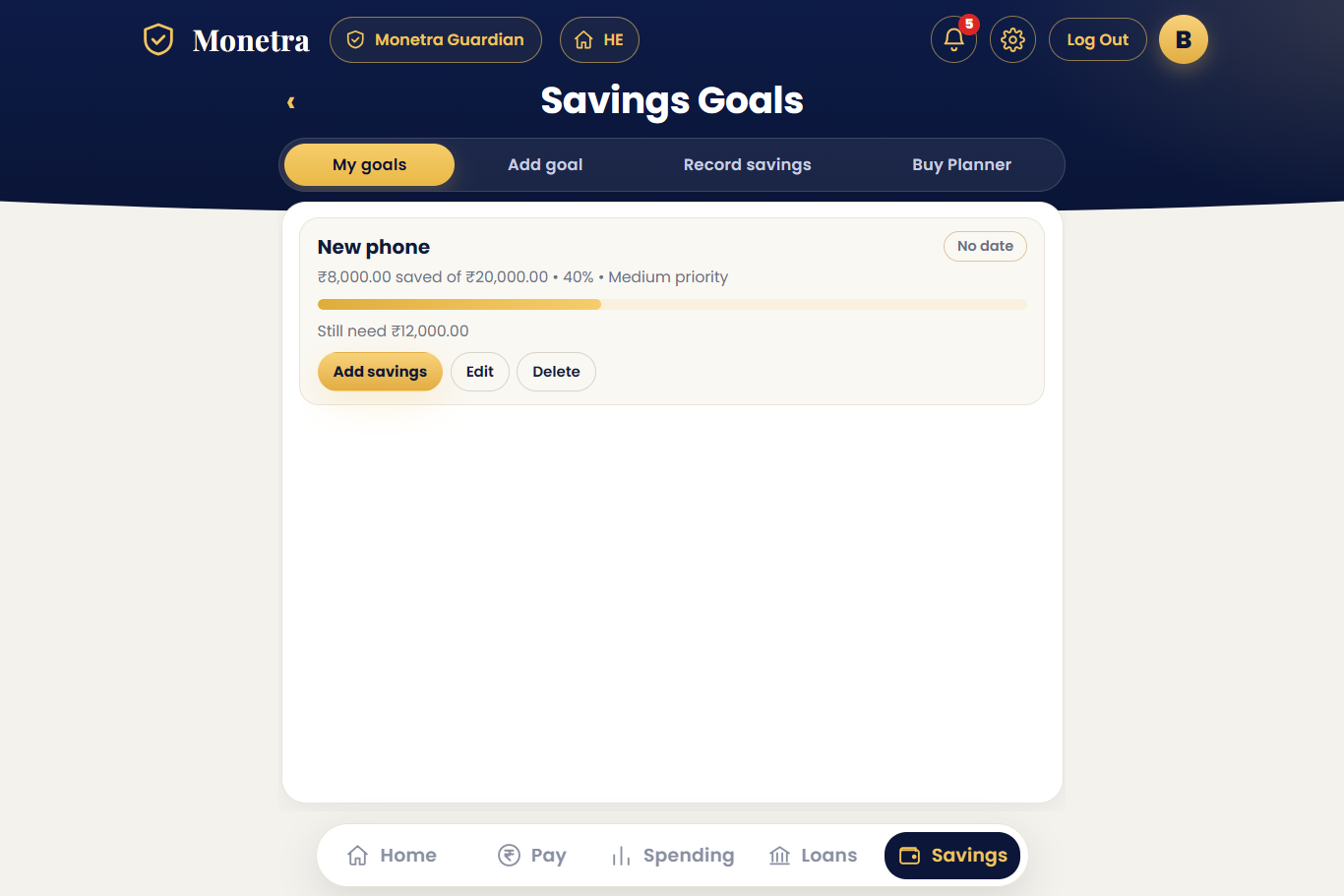
Savings Goals: progress toward a new phone, ₹8,000 of ₹20,000 saved.
-
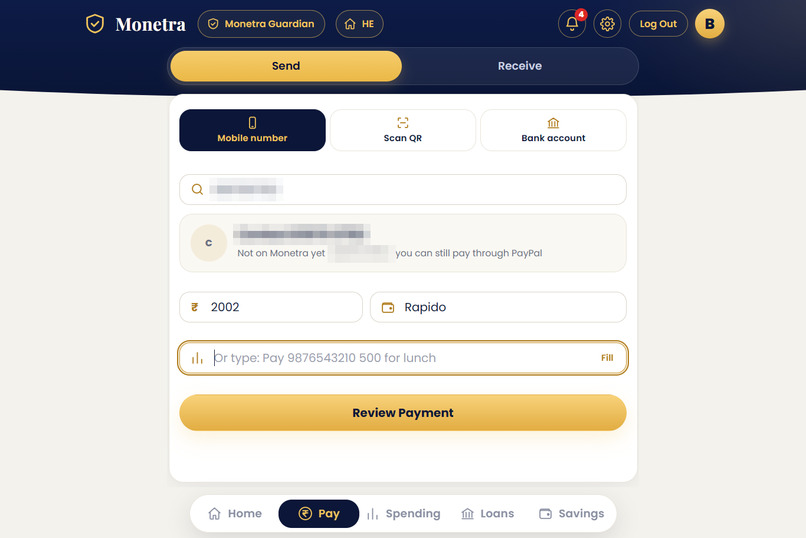
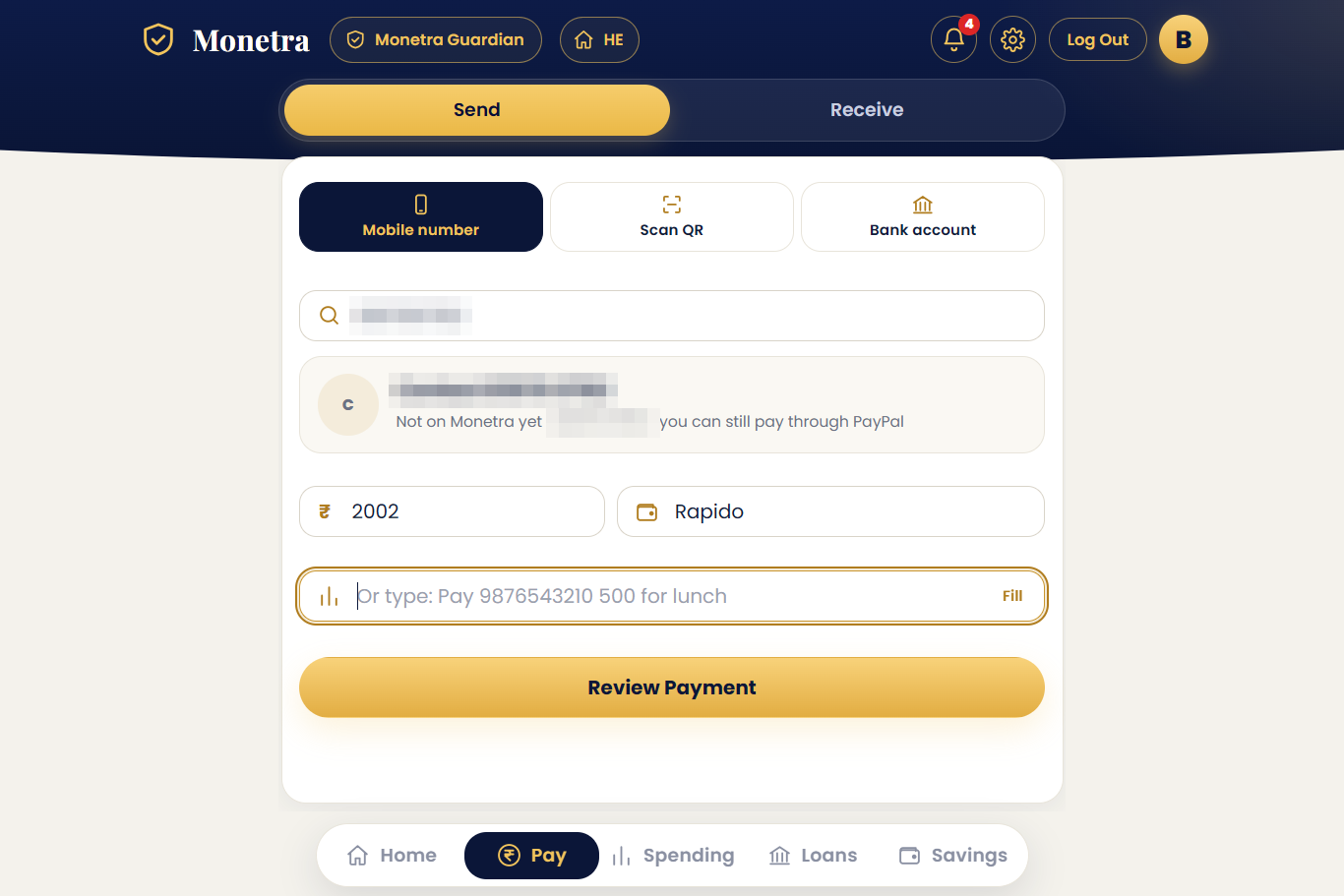
Send money by mobile number, QR scan or bank account. Every payment is reviewed first.
-
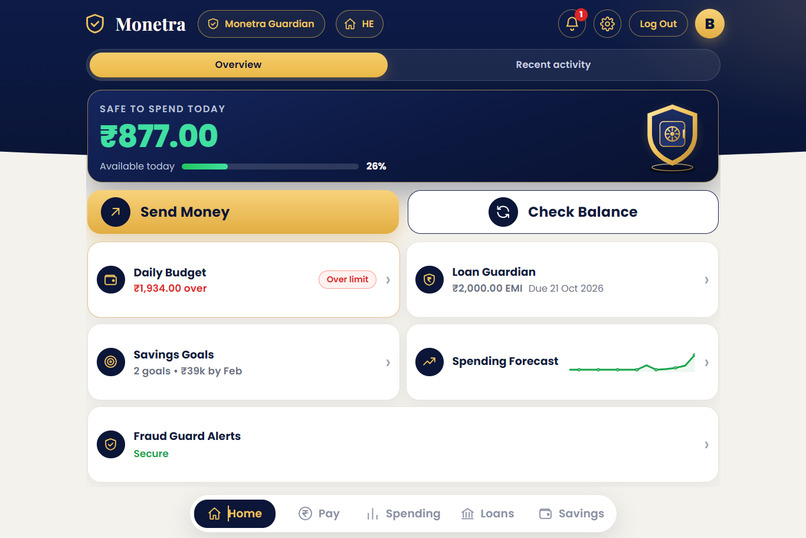
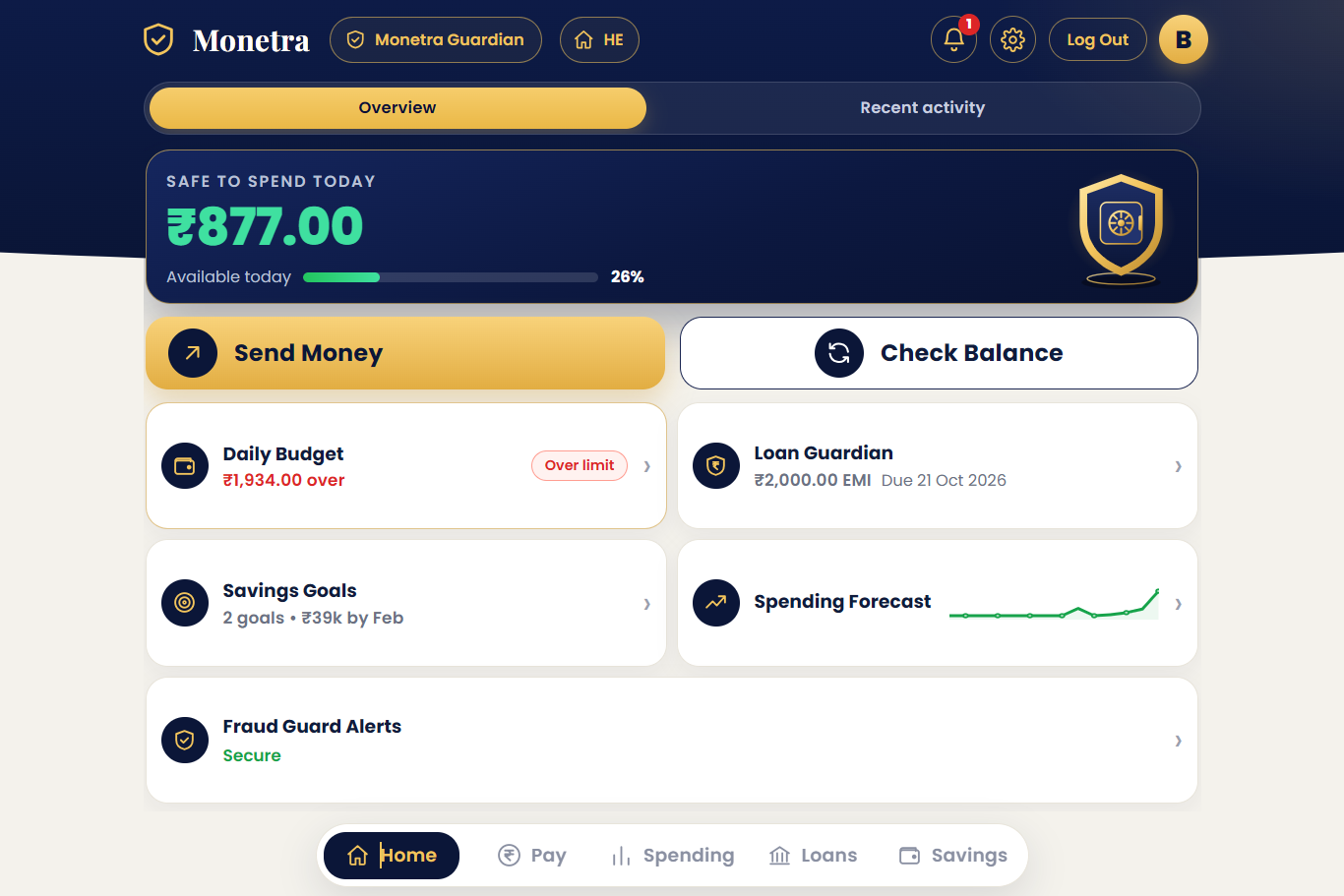
Home shows Safe to Spend Today, the daily budget, the next EMI and fraud alerts.
-
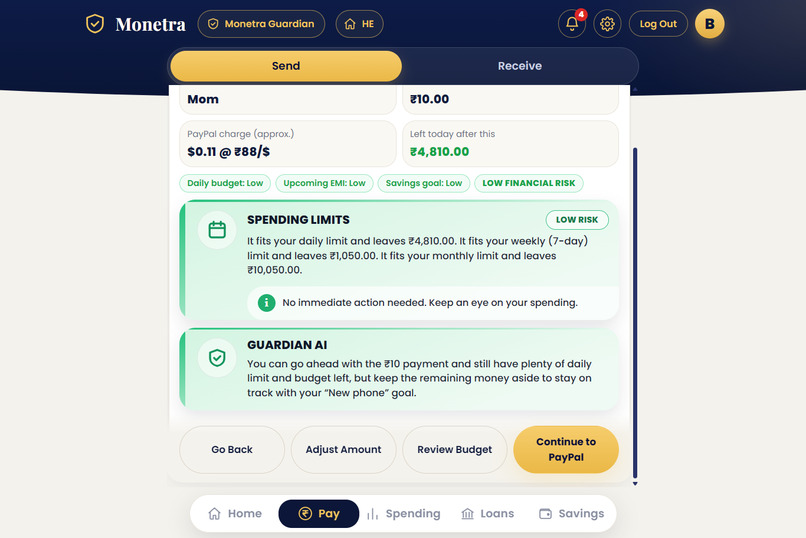
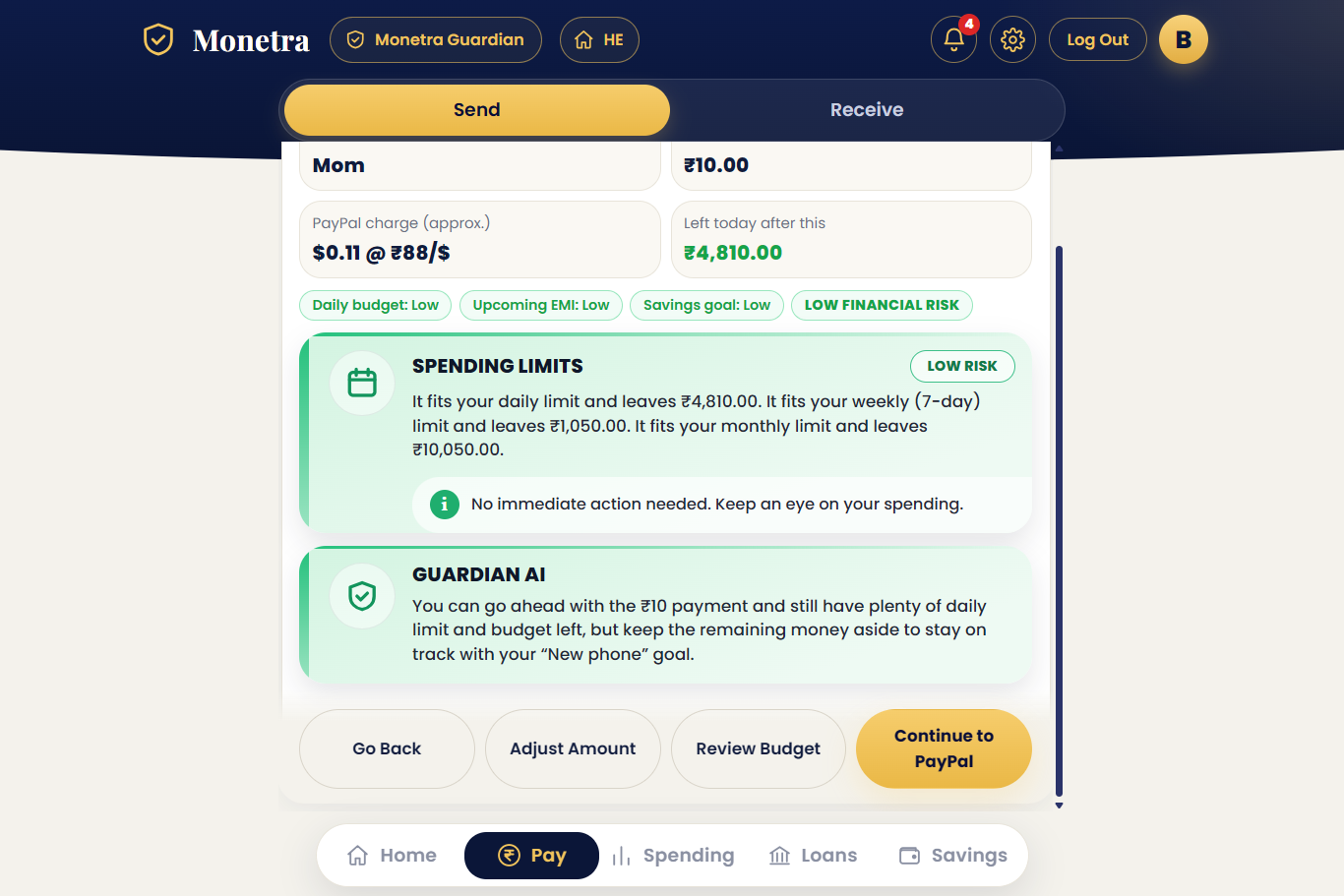
A small payment that fits your limits is shown as LOW risk. Monetra does not cry wolf.
-
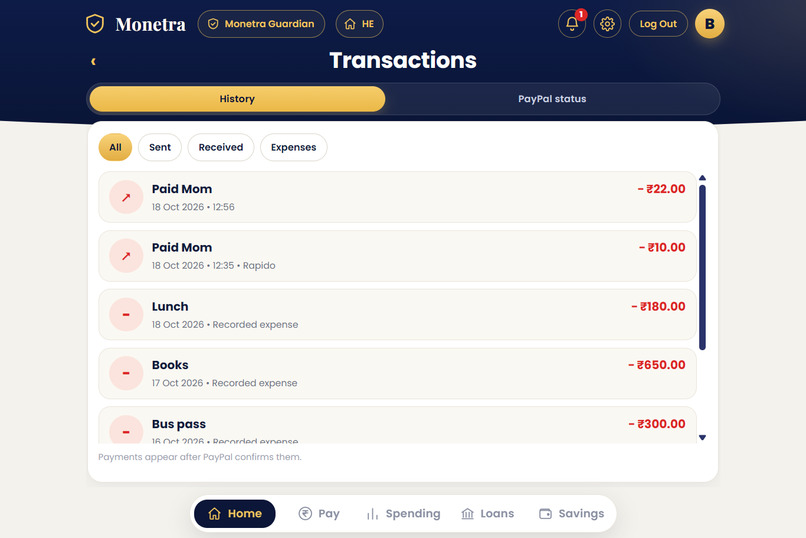
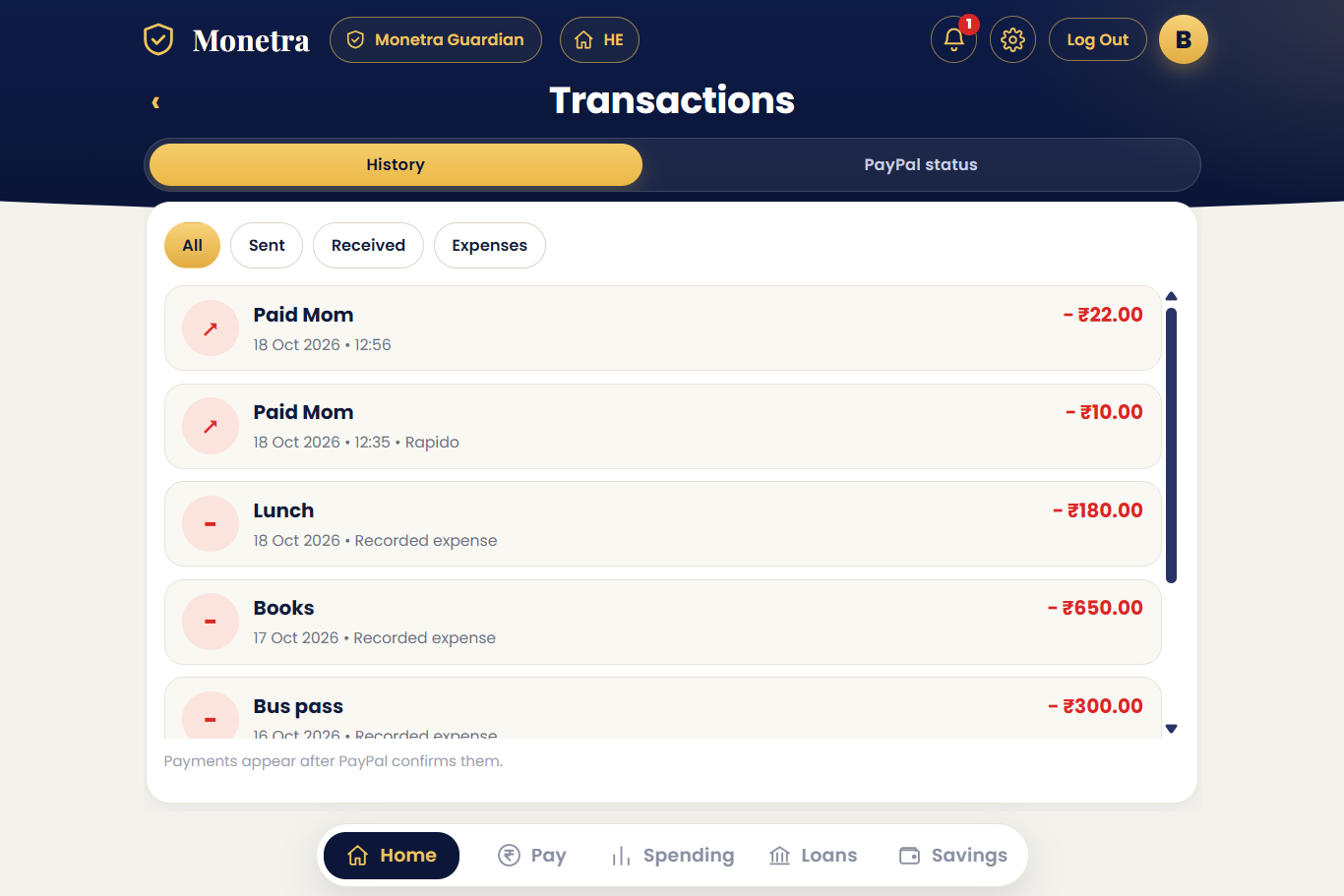
One history for PayPal payments and recorded expenses.
-
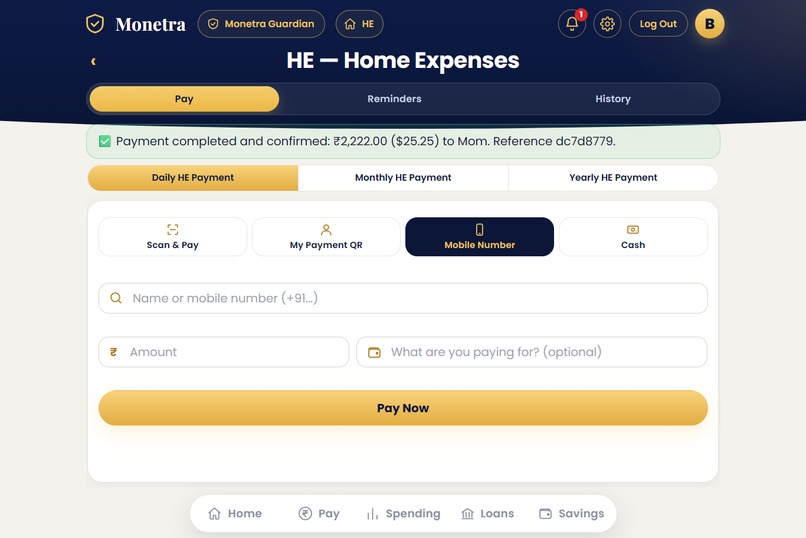
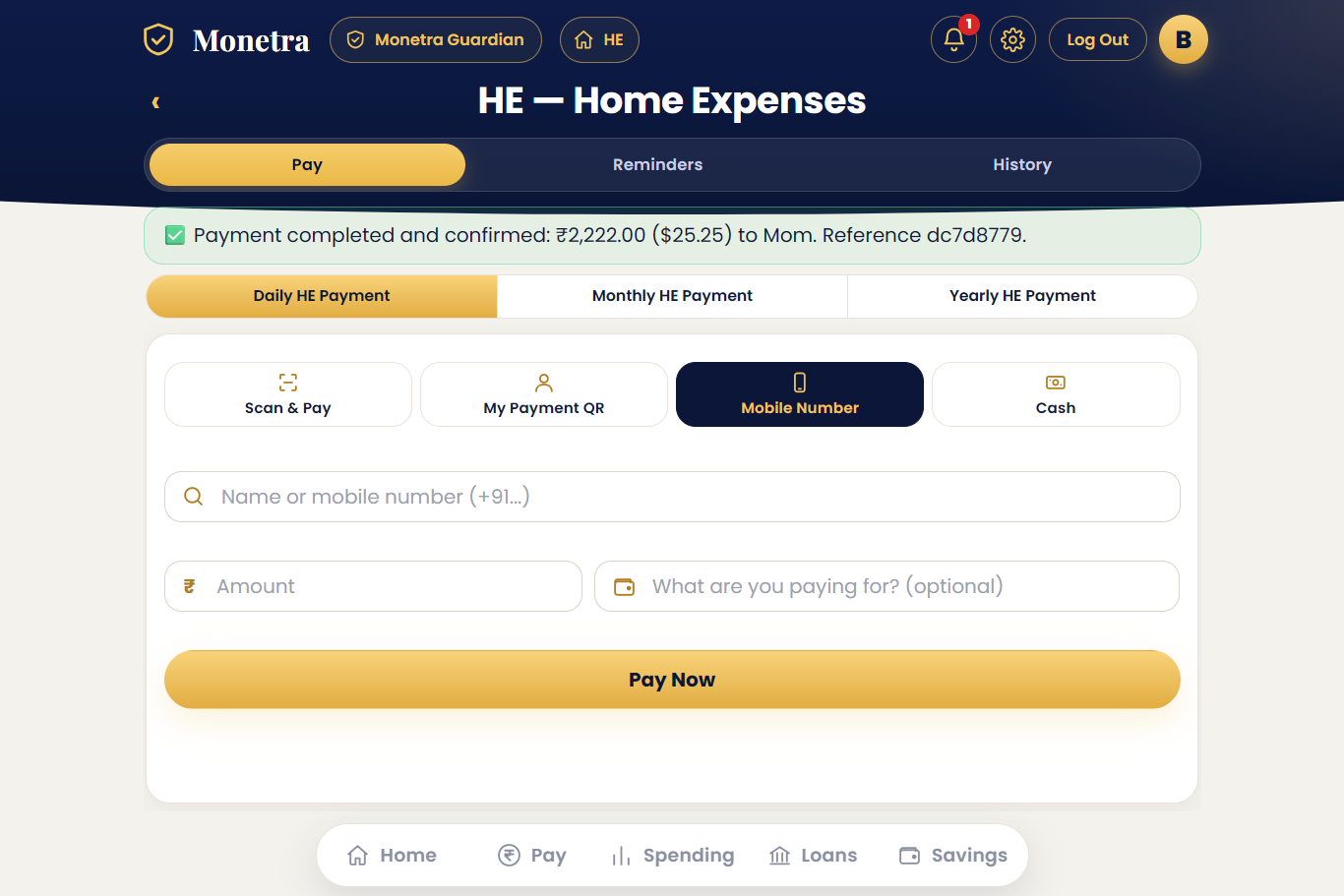
Home Expenses: a household payment completed and confirmed through PayPal.
-
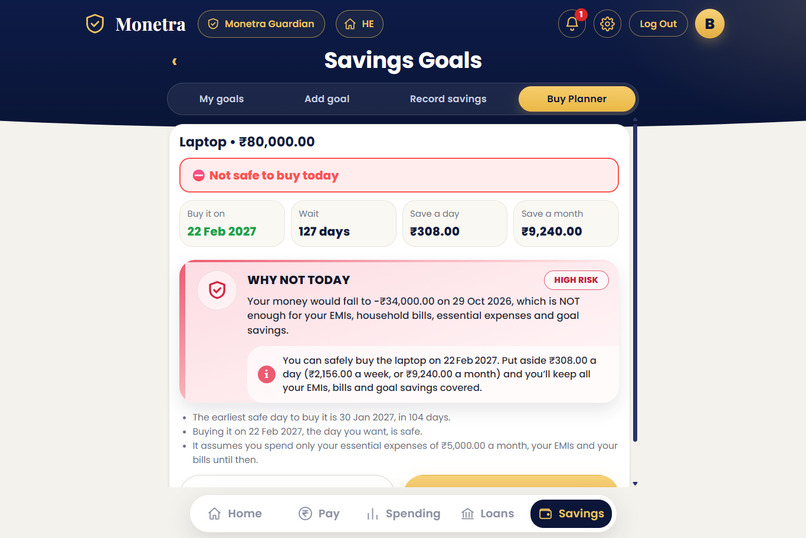
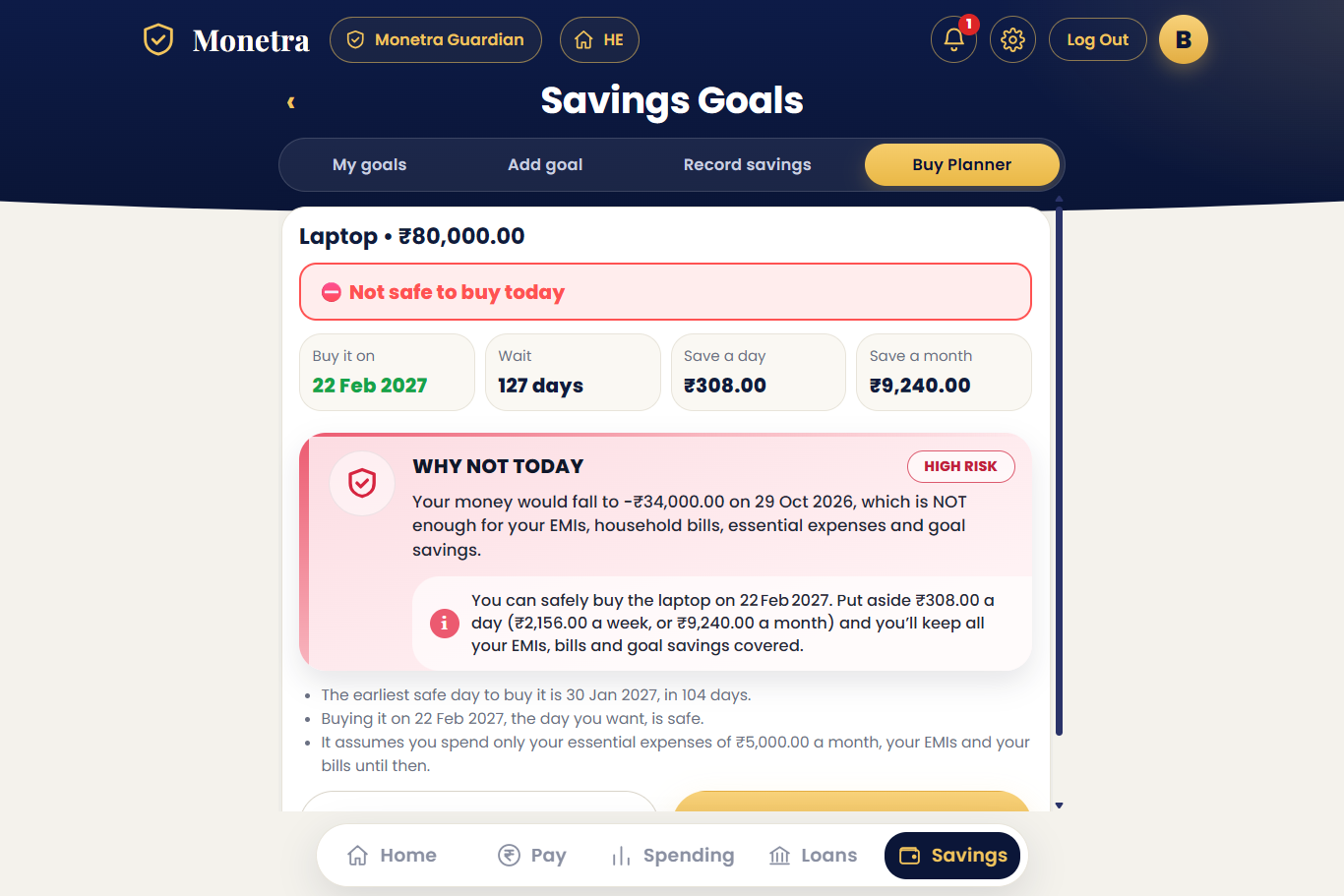
Smart Buy Planner: an ₹80,000 laptop is not safe today. It gives the safe date and a daily saving plan.
-
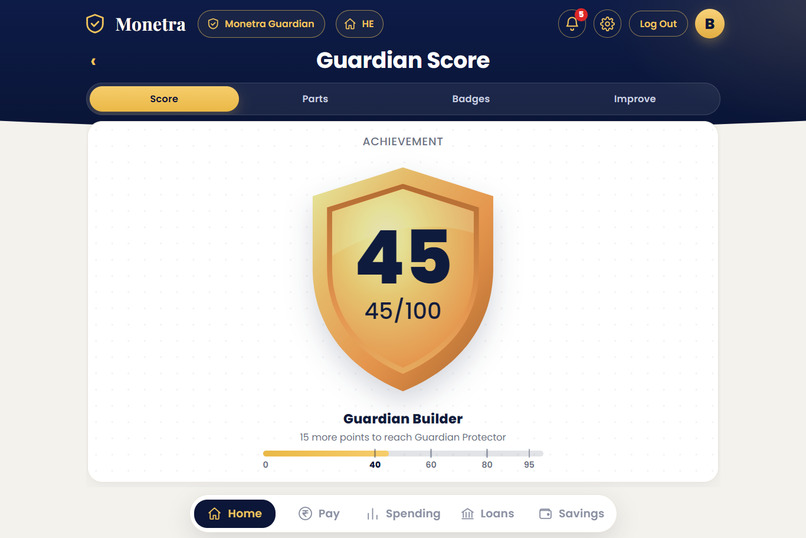
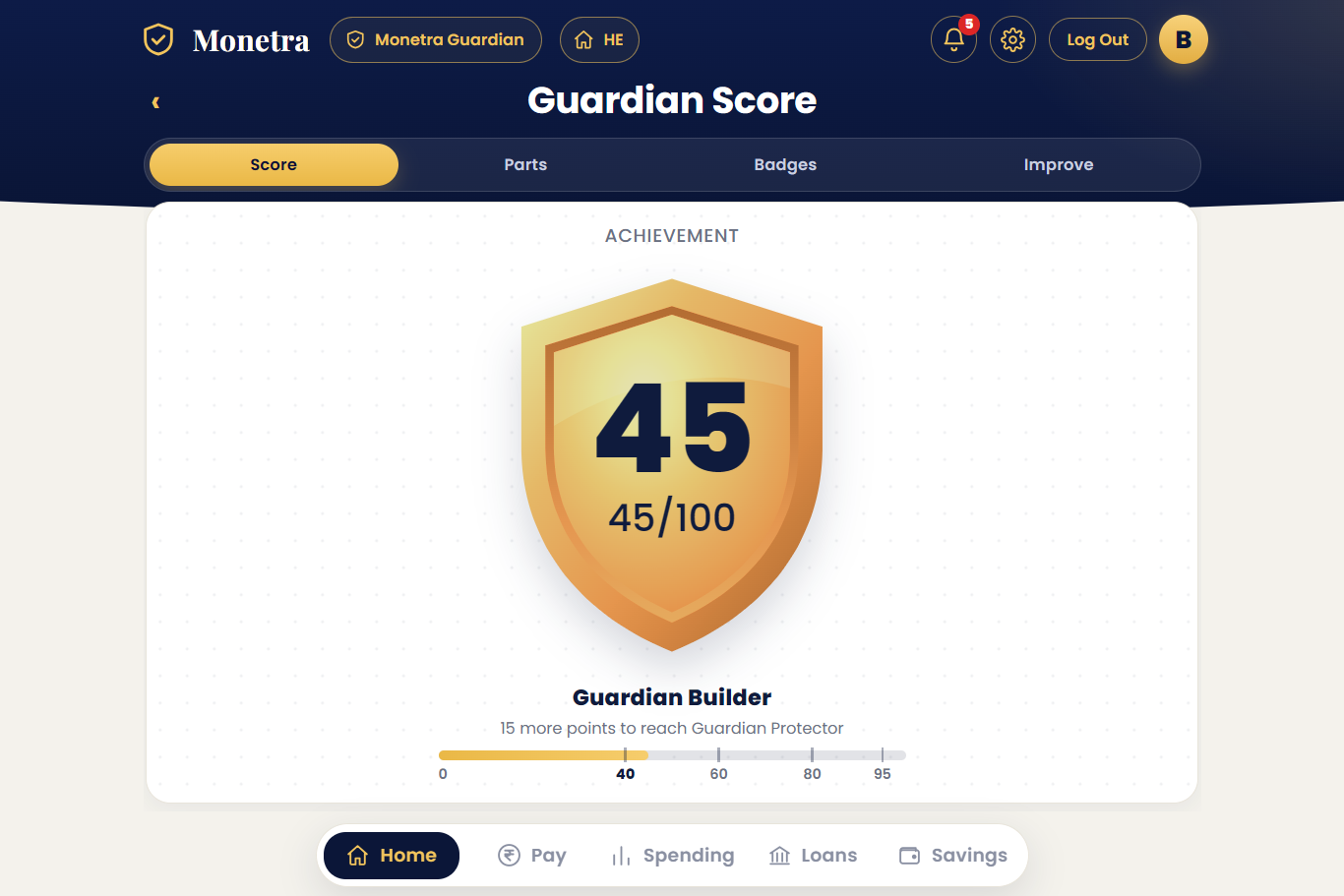
Guardian Score from 0 to 100 for spending discipline, EMIs, payment risk and savings.
-
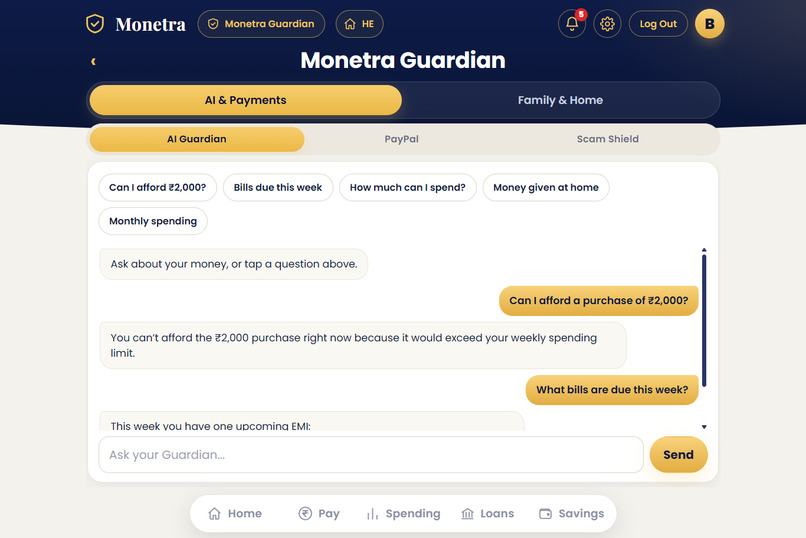
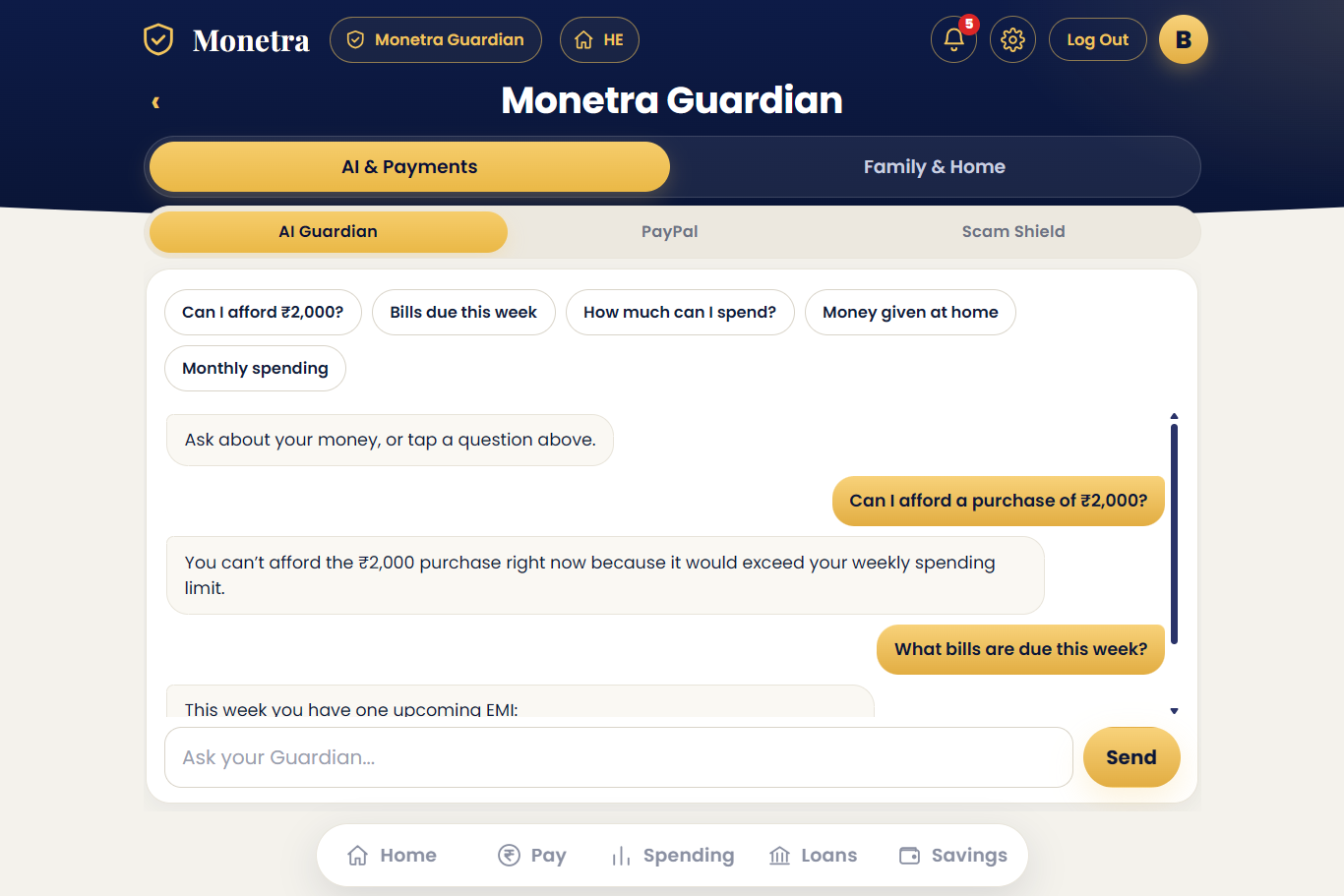
Guardian AI answers from your real figures: ₹2,000 would break your weekly limit.
-
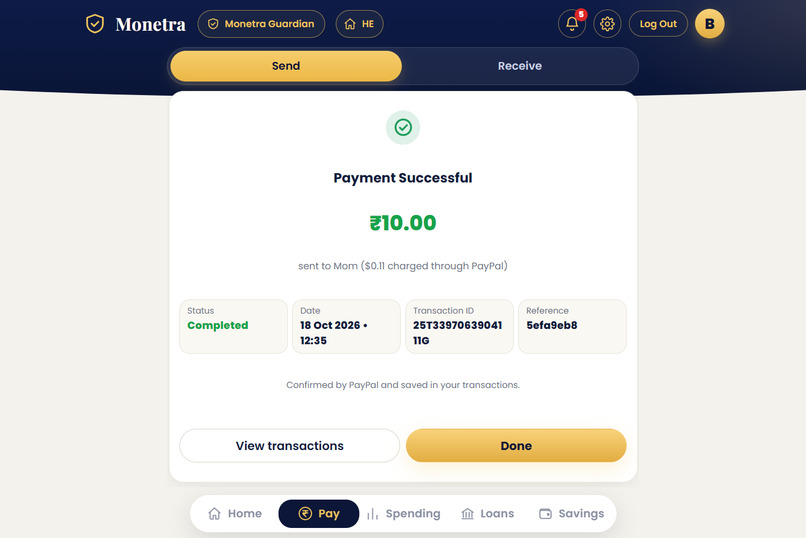
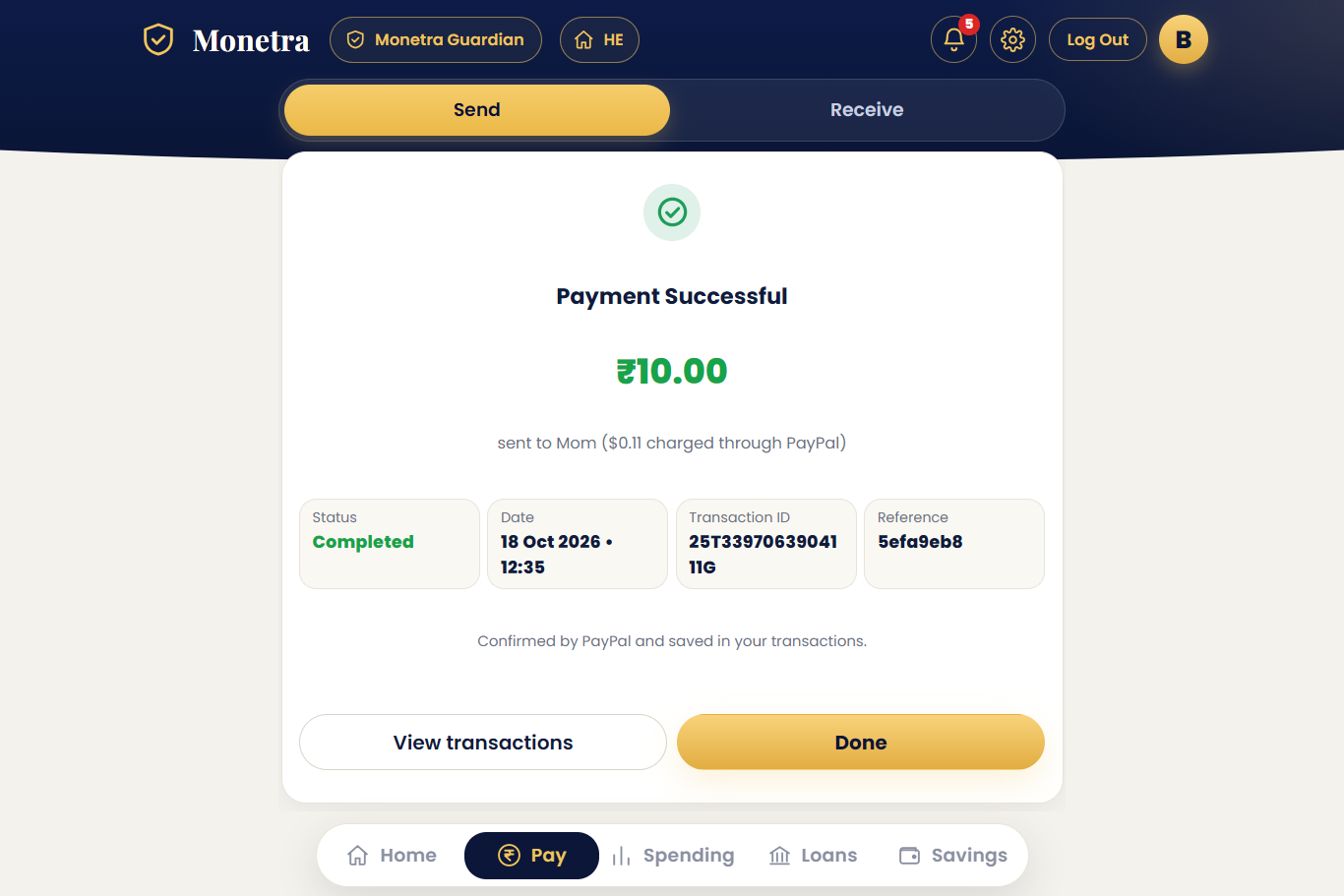
Payment Successful is shown only after the backend confirms the capture with PayPal, with the transaction ID.
-
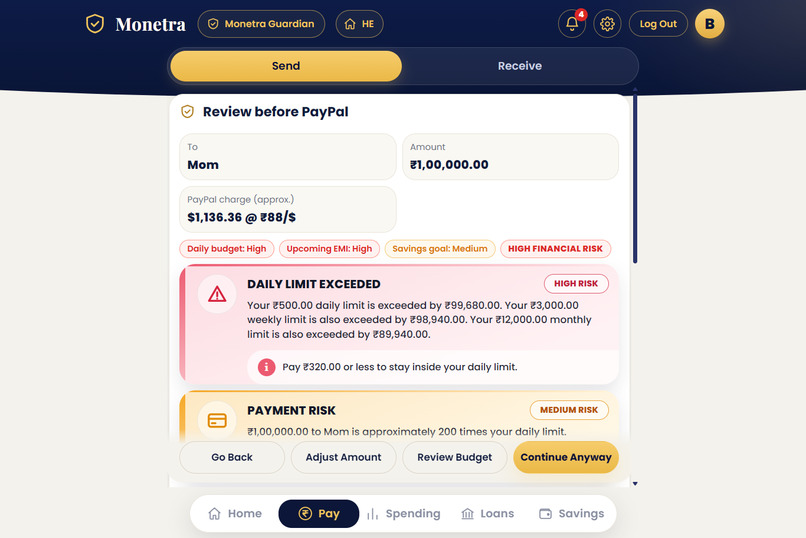
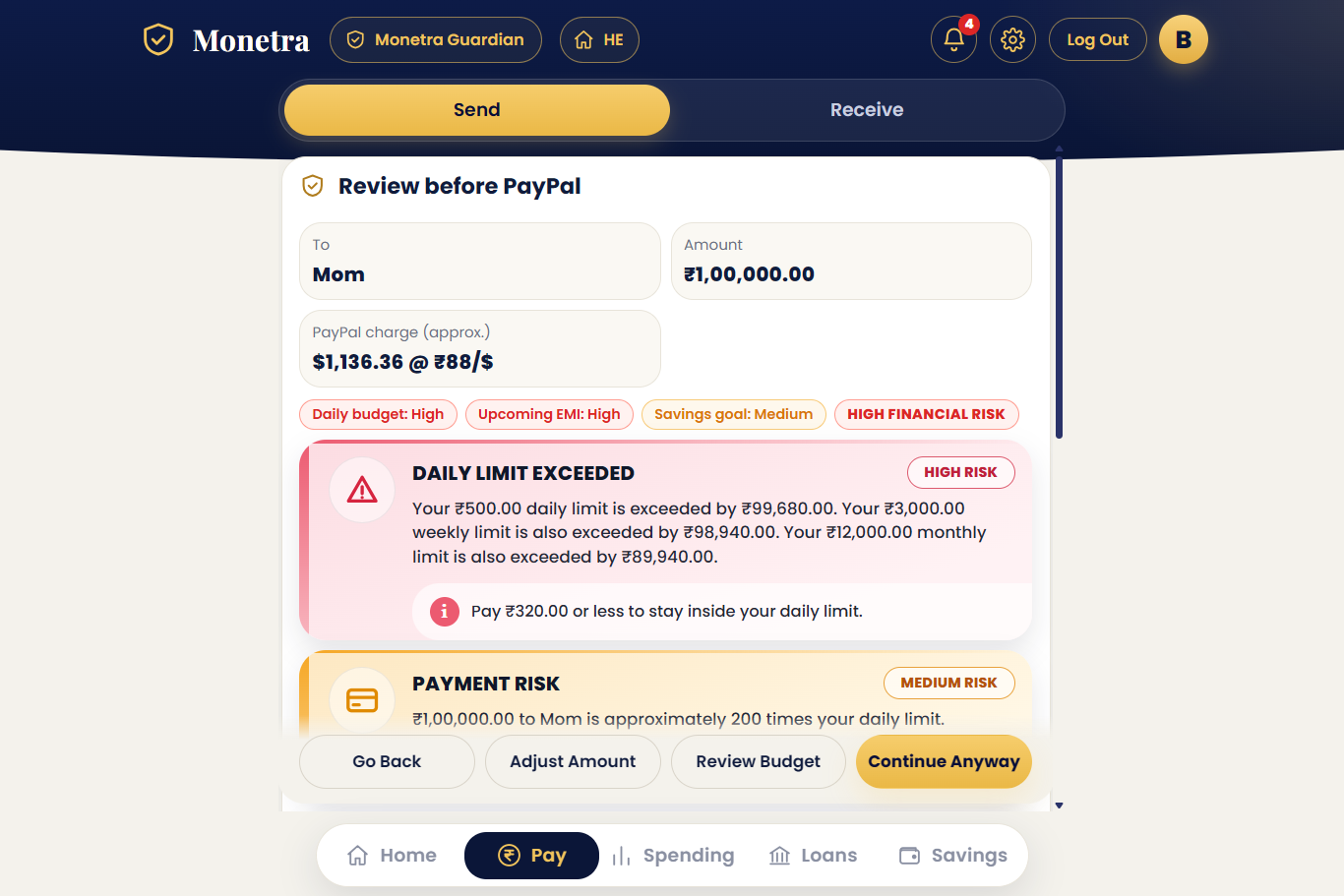
Before PayPal opens, a ₹1,00,000 payment is flagged HIGH risk: it breaks the daily, weekly and monthly limits.
-
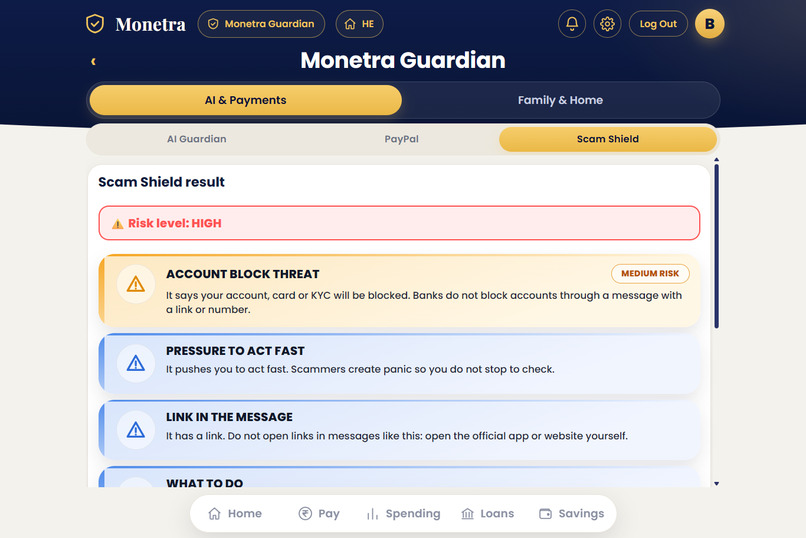
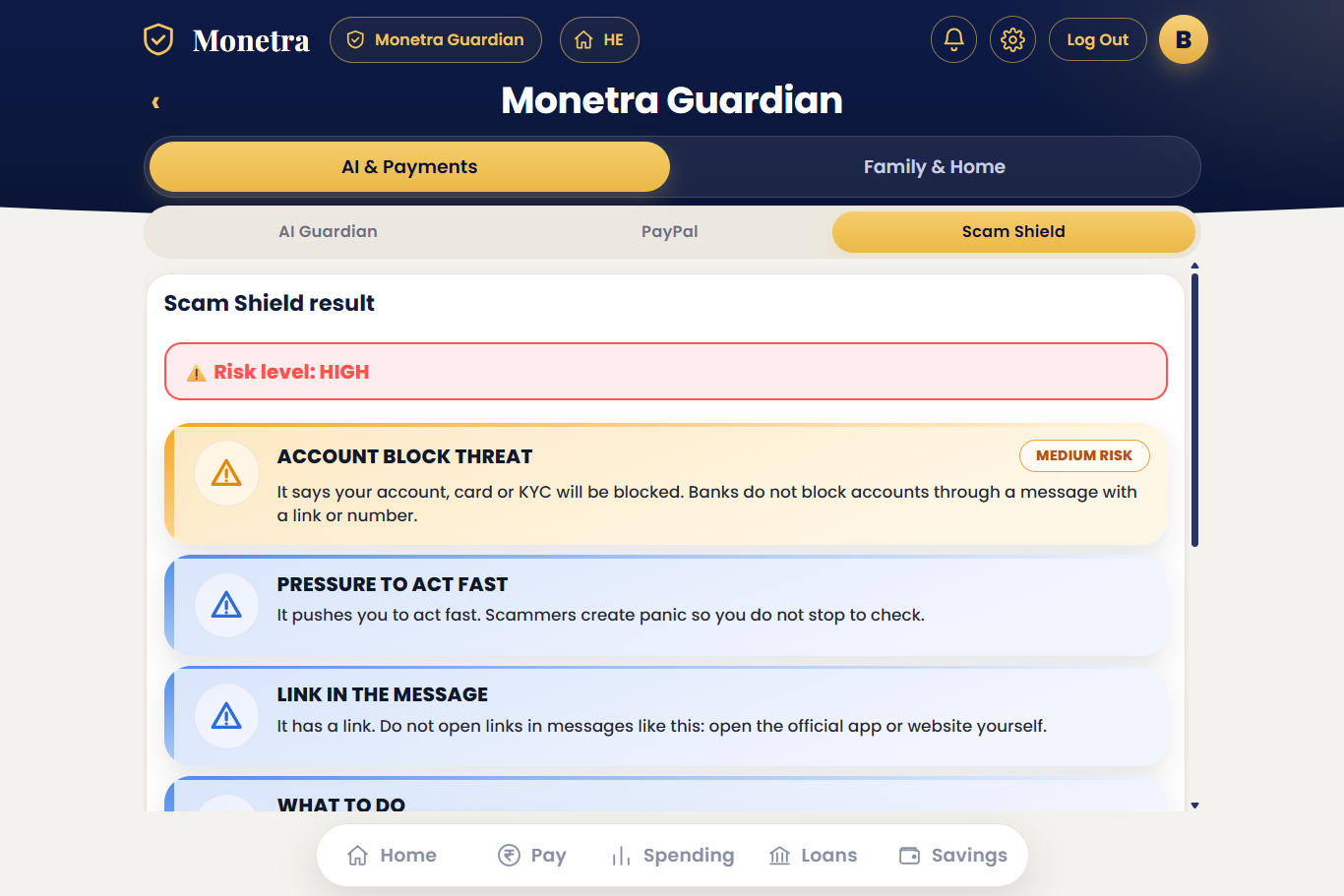
Scam Shield rates a suspicious SMS as HIGH risk and explains every warning sign.
-
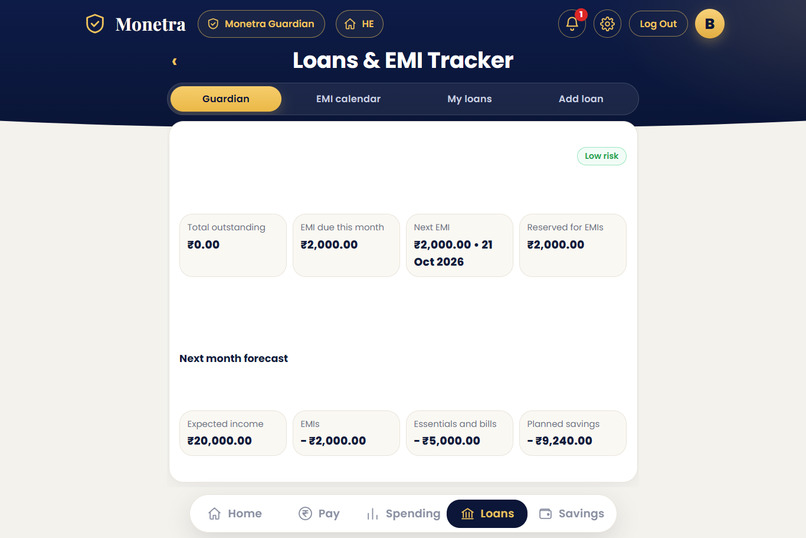
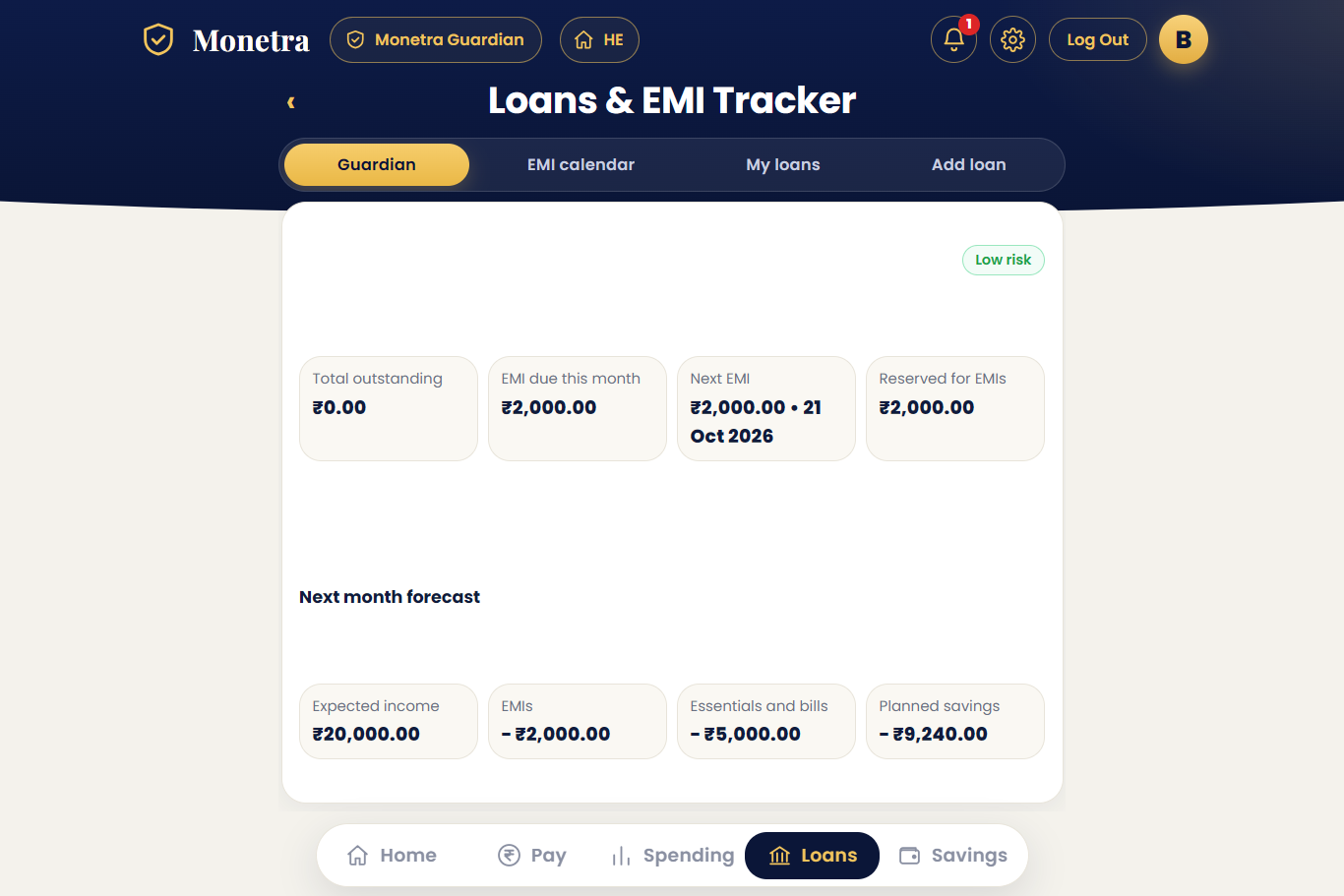
Loans & EMI Tracker: the next EMI, the amount set aside for it, and next month’s forecast.
Inspiration
Most financial apps tell you where your money went. Monetra helps you decide where it should go next.
Picture a student sending ₹9,000 home. The payment app will process the transfer, but it won't warn them that it breaks their ₹500 daily limit by ₹8,800, lands days before a ₹2,000 laptop EMI, and pushes a savings goal further away. They find out next week, when the EMI is due.
The moment that matters is the payment itself, and that is exactly where most tools are silent. Expense trackers explain the damage afterwards; bank apps only see the bank account, not the cash paid for rent, the money given at home, or the EMI on a phone. We built Monetra for students and families in India to put those consequences on the screen before the money moves.
What it does
Monetra is a financial guardian that sits in front of PayPal. Its rule is simple:
AI advises. You decide. PayPal processes. The backend verifies.
The journey of every payment
- You prepare a payment: to a mobile number, a scanned QR code, or a bank account.
- Monetra checks it first: against your daily, weekly, and monthly limits, upcoming EMIs and household bills, your savings goals, and fraud signals such as an unusually large amount or several payments in a few minutes.
- You see the consequences: color-coded cards (red HIGH, amber MEDIUM, green LOW), each saying what would go wrong and what you could do instead. A payment that fits your situation is shown as low risk; Monetra does not cry wolf.
- You decide: Go Back, Adjust Amount, Review Budget, or Continue Anyway. Nothing moves until you choose.
- PayPal processes it through PayPal Checkout.
- The backend verifies it: Monetra shows Payment Successful, with the PayPal transaction ID, only after its server has confirmed the capture with PayPal.
Categorizing transactions after the fact can only tell you what happened. Monetra changes what happens.
Built around four moments
Before you spend
- Financial Guardian: the pre-payment risk review above, on every payment.
- Safe to Spend Today: the amount you can spend without touching EMIs, bills, goal savings, or your emergency buffer.
- Spending Limits: daily, weekly, monthly, and yearly limits with live status.
- Loans & EMI Tracker: every EMI and due date in one calendar, with a daily saving plan to cover them.
Protecting you
- Scam Shield: paste a suspicious SMS or WhatsApp message and get a LOW, MEDIUM, or HIGH rating, the exact words that gave it away, and what to do. The message is not saved.
Planning ahead
- Smart Buy Planner: "Can I buy this ₹90,000 laptop?" It answers with the earliest safe date and how much to put aside each day or month.
- Savings Goals and a Month-End Forecast that the Guardian AI explains in plain words.
- Guardian Score: 0 to 100 for spending discipline, EMI readiness, payment risk, and savings, with daily and weekly badges.
- AI Guardian Chat: answers questions like "Can I afford ₹2,000?" from your own figures. It can prepare a payment for you to review, but it cannot send money.
Running the household
- Home Expenses (HE): family and household payments by mobile number, QR, or cash, with daily, monthly, or yearly schedules, reminders, and a payment history.
These are one system, not separate tools: the limits, EMIs, goals, and household bills you record are exactly what the Financial Guardian checks before your next payment.
Try it
- Live demo: https://monetra-tgjl.onrender.com. Press Try Demo on the sign-in page; no sign-up needed.
Note: The demo uses free hosting, so if the server has been idle, the first visit may take up to 3 minutes to load. Subsequent visits should be much faster.
- Video (under 3 minutes): https://youtu.be/GrEqjp720z0
- Code: https://github.com/yadunandan22022006-06/Monetra
Three things to try:
- Prevent: send ₹9,000 to a number and read the risk review. Then press Go Back.
- Pay: send ₹50, complete the PayPal Sandbox checkout with the buyer login in the testing instructions, and check the transaction ID.
- Protect: paste a suspicious SMS into Scam Shield.
How we built it
Monetra is a Java 21 / Spring Boot 4.0 application with an H2 database and a plain HTML, CSS, and JavaScript front end. It runs on Render as a Docker web service defined in a render.yaml Blueprint, with all keys and secrets in Render's environment variables.
A payment pipeline that can't be talked into a false success
- The server owns the amount. Orders are created through PayPal Orders API v2 by the backend, never by the browser. Amounts are entered in rupees and charged in USD through PayPal Sandbox at a rate shown to the user before checkout.
- Success means a verified capture. A payment is marked complete only when PayPal reports the capture as completed, in the expected currency, for the expected amount. Pending, failed, or cancelled payments are never shown as successful.
- No double charges. Capture runs under a per-payment lock on the server instance, an already-captured payment returns its stored result instead of capturing again, and repeated Pay clicks within a short window reuse the same order.
- Signed webhooks. PayPal events reach Monetra's HTTPS endpoint on Render and are processed only after PayPal's verification endpoint confirms the signature. So a payment is still confirmed even if the user closes the tab before returning.
- Payouts: sending money onward to a receiver's PayPal email is implemented with the Payouts API; successful receiver payouts have not yet been confirmed.
Java calculates, AI explains
Every rupee figure (limits, EMIs, forecasts, scores, risk amounts) is computed in Java with decimal arithmetic. The language model never does the math; it receives the computed figures and explains them.
The Smart Buy Planner shows why this matters. For each day $t$ of the next 12 months it projects your balance $B(t)$: today's balance, plus income on payday, minus EMIs, household bills, essential expenses, and goal savings. The earliest safe day to buy something with price $P$ is
$$ d^{*} = \min \Big{\, d \;:\; \min_{t \ge d} B(t) \;-\; \text{buffer} \;\ge\; P \,\Big} $$
In plain words: the purchase is safe only from the first day after which your balance would never fall below your emergency buffer, even counting every future EMI and bill. A purchase that is "affordable today" but breaks a payment in three weeks is correctly flagged.
The live site uses Groq-hosted gpt-oss-120b for explanations; Ollama with Llama 3.2 runs locally during development, and Claude is also supported. A validation step rejects AI replies that change a figure, soften a breached limit, or drop a warning, and the app falls back to rule-based explanations when the AI is unavailable. Validation reduces the risk of a misleading answer; it cannot guarantee every answer is right.
Testing and security
- 211 automated tests run on GitHub Actions against simulated PayPal, bank, and AI servers. They prove Monetra's logic: risk rules, capture checks, webhook handling, duplicate protection, and sign-in. They do not prove PayPal's own behavior, which is why we also tested on the live site.
- Real Sandbox runs on the deployed app: PayPal Sandbox checkouts completed end to end, and a signed Sandbox webhook event was accepted by the live server.
- Passwords are hashed, sign-in attempts are rate-limited, responses carry security headers, and secrets never live in the code.
Challenges we ran into
- Defining "success" honestly. The browser's return from PayPal can be slow, lost, or repeated. We moved the truth to the server: capture verification, signed webhooks as a second path, and a clear "Confirming your payment" state in between, so the user is never told "paid" too early or charged twice.
- Sandbox configuration. Payments fail quietly when the seller account, currency, credentials, or webhook setup disagree. Getting all four aligned, and turning failures into clear messages, took careful debugging.
- Keeping AI out of the arithmetic. Language models change numbers without warning. Separating calculation from explanation, then validating the explanation, solved this without giving up natural-language advice.
- Free-tier hosting. On a 512 MB server, Spring Boot needed JVM memory tuning to stay stable, and the app has to survive cold starts and restarts that reset its data.
- Not inventing what we can't see. Live bank balances need business verification for India's Account Aggregator network. Instead of faking a number, Check Balance clearly says it is not set up yet.
Accomplishments that we're proud of
- It really pays. PayPal Sandbox checkouts completed on the deployed site, each ending in a transaction ID shown only after server-side verification.
- It really listens. The live server accepted a signed PayPal Sandbox webhook event after PayPal verified it.
- It warns before, not after. Every payment passes through the risk review before PayPal opens, and the user stays in control of the decision.
- The numbers are trustworthy. Financial figures come from tested Java code, not from a language model.
- It is honest about its limits. Unavailable features say so, and the limitations are documented.
- It is tested. 217 automated tests run on every push.
What we learned
- A payment has more than two outcomes. Approved, captured, pending, cancelled, unconfirmed, and failed each need different handling, and the user deserves to know which one happened.
- AI is most valuable when it explains decisions made by code, not when it makes them.
- In finance, honesty is a feature. Never claim a payment succeeded before it is confirmed, and never show a balance you cannot verify.
What's next for Monetra: Think Before You Pay
- Live bank balances through India's Account Aggregator network once business verification is complete; the integration is built and tested against a sandbox.
- Persistent production storage, such as Render Postgres, so user data survives restarts, and database-level duplicate protection so payments stay safe across multiple server instances.
- Confirmed receiver payouts, completing the path from payer to receiver.
- Testing with real students and families to tune limits, warnings, and explanations to how people actually spend.
Monetra's principle is simple: show people the consequences before they pay, prove what works, and be honest about what remains.

Log in or sign up for Devpost to join the conversation.