Inspiration
Monbra started from a simple question: what if AI agents felt less like hidden automation and more like a company you can understand, manage, and improve?
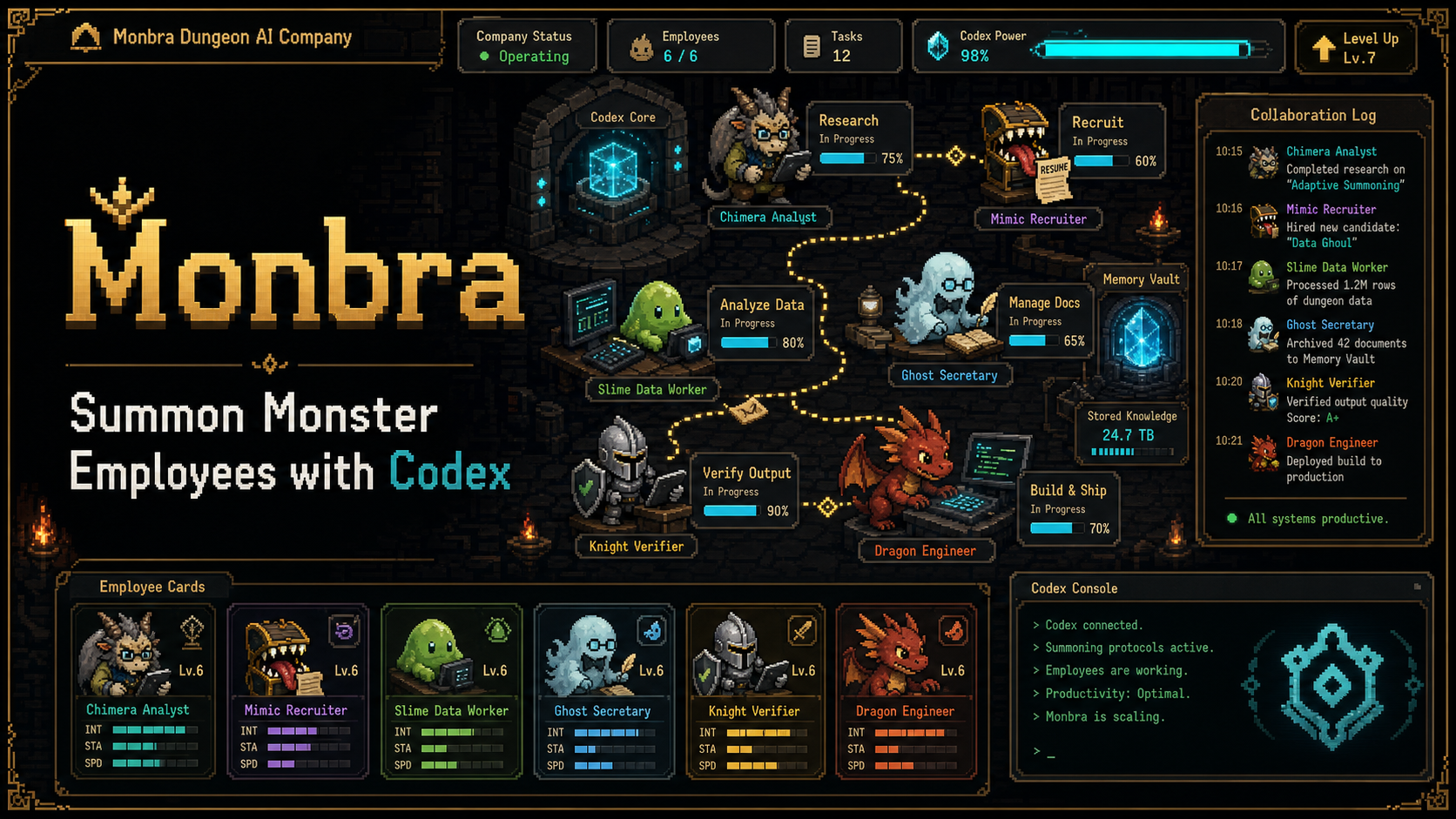
Instead of showing agents as abstract bots, Monbra turns them into monster employees working inside a dungeon-themed AI company.
What it does
Monbra lets a user summon AI employees, assign a job, watch specialist agents collaborate, and preserve the outcome as reusable memory.
The current prototype focuses on a local-first learning experience:
- choose a monster employee from an AI employee library
- send a work request
- orchestrate specialist help through an agency-style workflow
- visualize participation, handoffs, and communication logs
- store outputs so later jobs can recall useful context
How I built it
I used Codex heavily while building the app, debugging the workflow, designing the UI, writing documentation, and preparing release checks.
The project combines a local web UI, agent orchestration, work logs, and memory-style output so users can see not just the final answer, but the process that produced it.
Challenges
The hardest part was making agent workflows understandable and trustworthy. A normal AI response hides too much. Monbra exposes job IDs, participating employees, handoffs, final answers, and memory traces so the user can understand what happened.
Another challenge was product framing. This is not positioned as a polished SaaS. It is a learning-focused local prototype for understanding how an AI company can be built and operated.
What I learned
A playful metaphor can make agentic workflows easier to reason about. Users understand employees, roles, handoffs, review, and company memory faster than they understand raw orchestration diagrams.
What's next
Next steps include a stronger work-in-progress UI, experience/level-up style progress, safer approval flows using a shadow CEO concept, and smoother onboarding for collaborators across Windows, macOS, and Linux.

Log in or sign up for Devpost to join the conversation.