-
-
-
filter
-
scanning
-
dash board
Inspiration
Commercial and industrial buildings are facing a growing water challenge: rising utility costs, stricter environmental pressure, flood risk in some regions, and water scarcity in others. For Grundfos, the problem is not only building the right water reuse solution, it is also identifying which buildings are the best prospects at scale.
We wanted to build a tool that answers a simple but valuable question:
If Grundfos wanted to prospect an entire state, which buildings should they target first, and why?
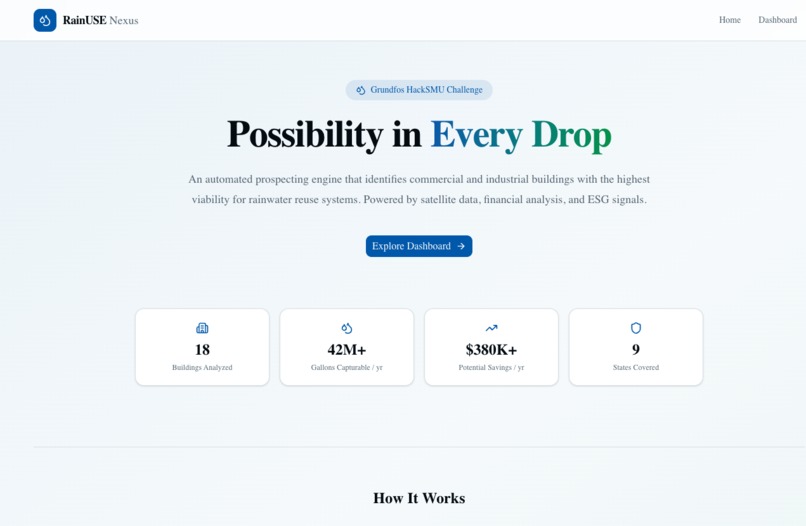
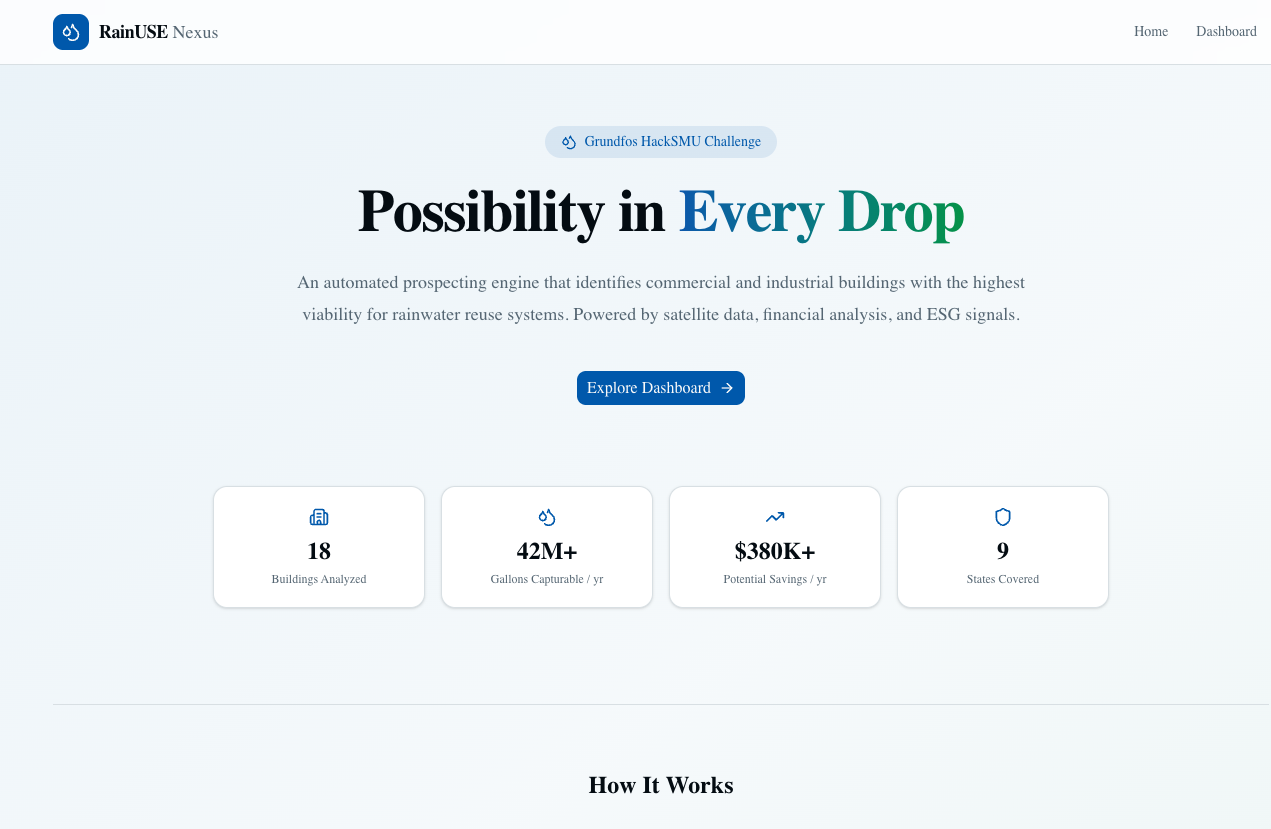
That led us to build RainUSE Nexus, an automated prospecting engine that screens large commercial and industrial buildings for rainwater reuse viability.
What it does
RainUSE Nexus is a web-based prototype that helps identify promising buildings for commercial rainwater reuse systems.
The workflow is:
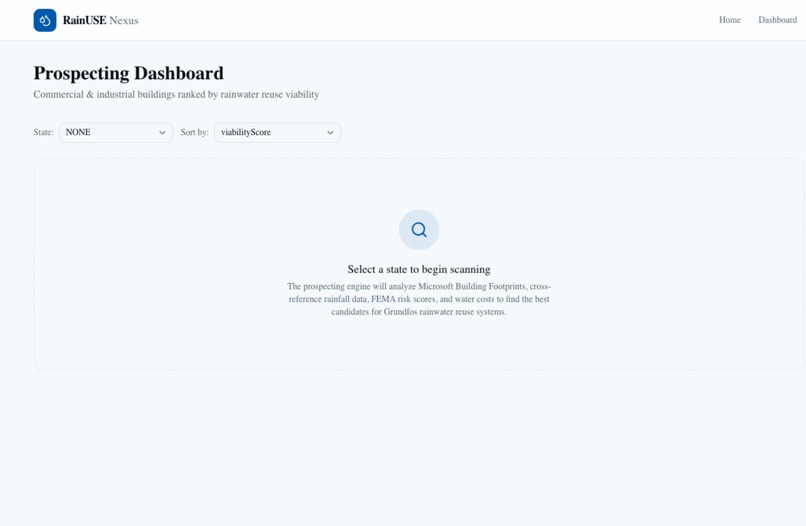
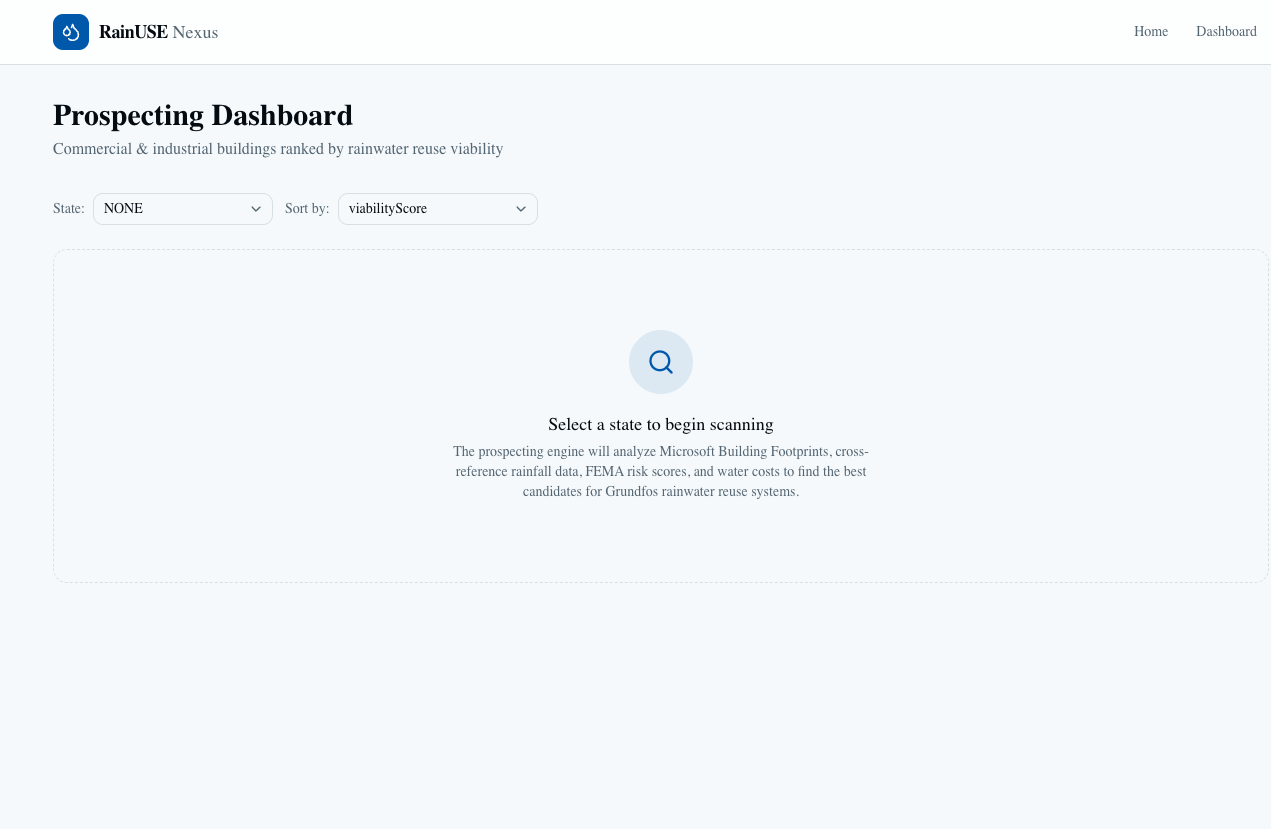
- A user selects a U.S. state.
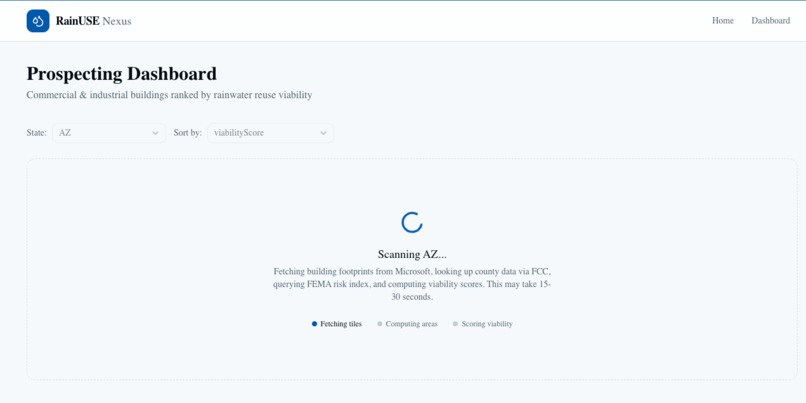
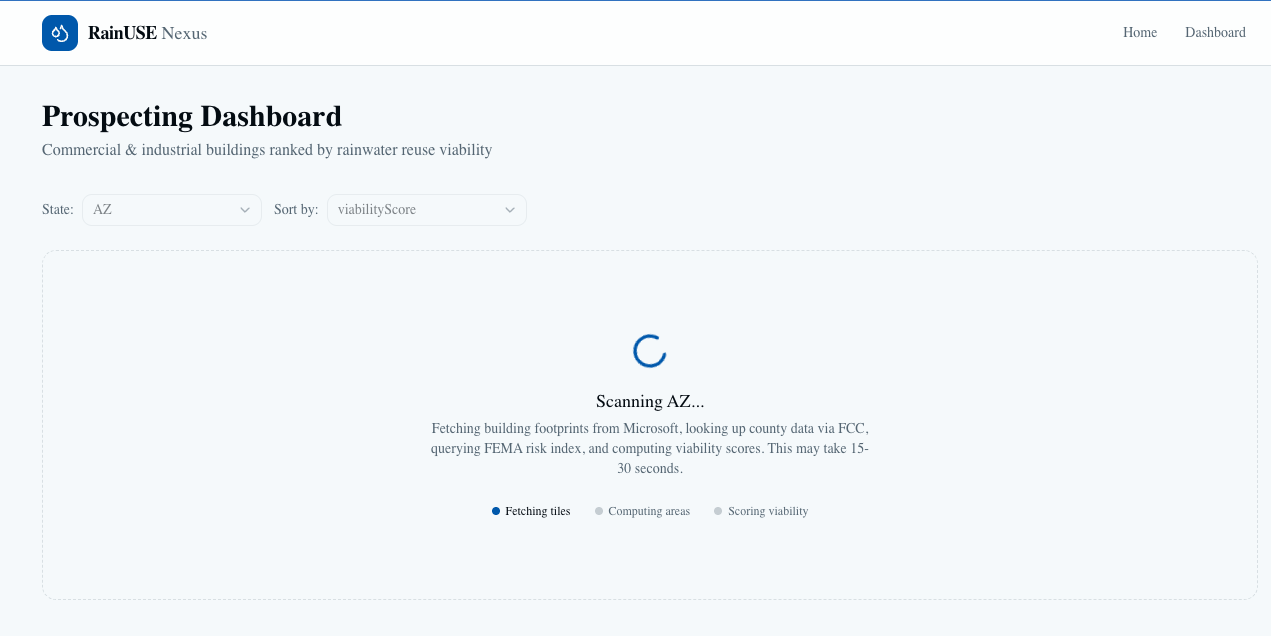
- The system scans real building footprint data and filters for large roof catchment areas.
- It enriches those candidates with rainfall, county-level context, and risk/cost signals.
- It computes a viability score for each building.
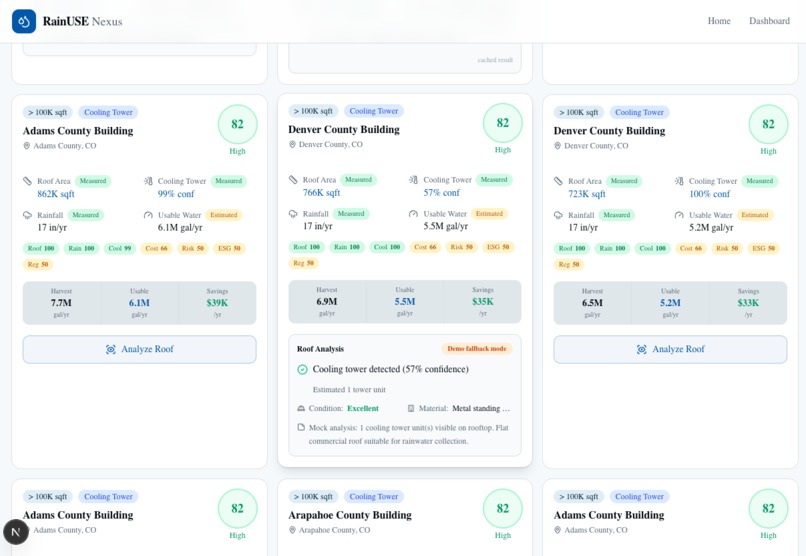
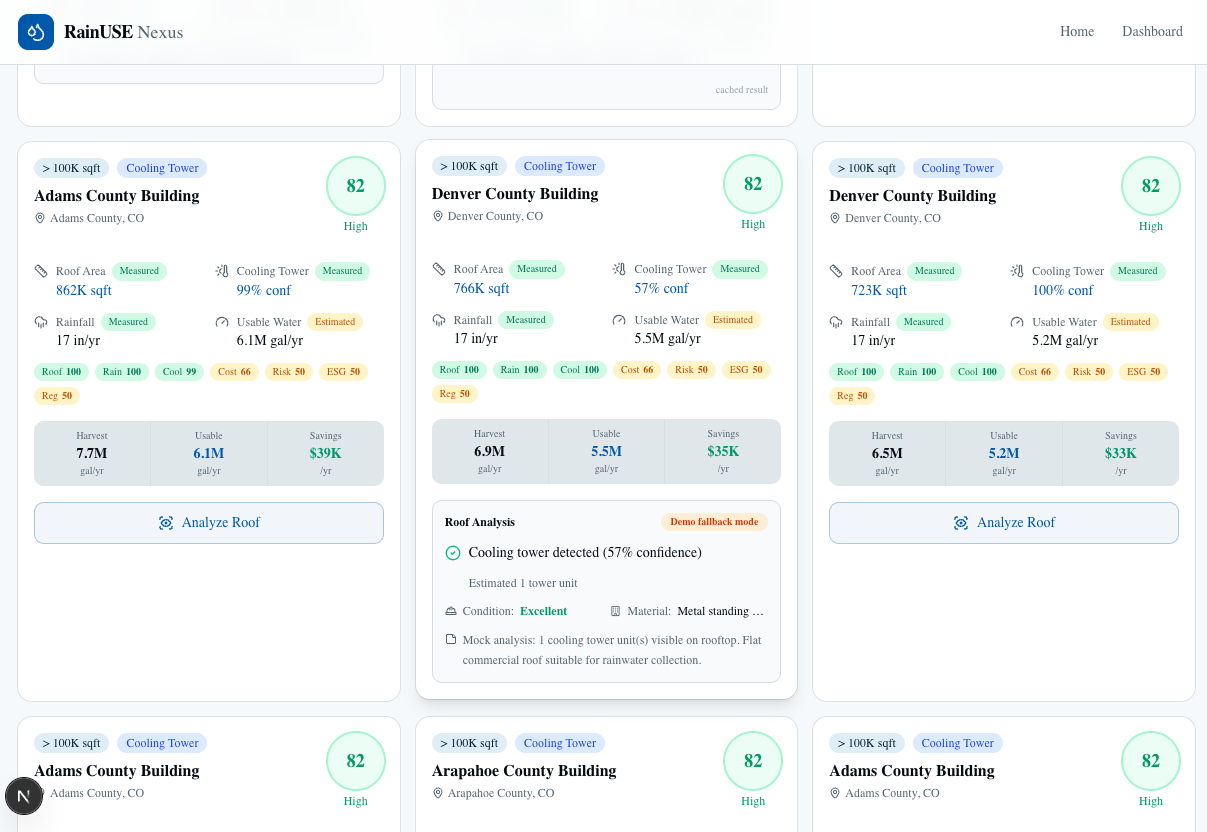
- It returns the top-ranked candidates in a clean dashboard.
For each building, the app estimates:
- roof catchment area
- annual harvestable rainwater
- usable water potential
- screening-level annual savings
- a final viability score out of 100
The goal is to help Grundfos move from slow, manual prospecting to a ranked, data-driven shortlist of buildings worth pursuing.
How we built it
We built the frontend using Next.js, React, TypeScript, Tailwind CSS, and shadcn/ui to create a fast, polished dashboard experience.
On the backend, we created API routes that:
- scan Microsoft building footprint data tile by tile
- filter buildings by large roof area
- look up county and rainfall context
- compute a weighted viability score
- return ranked candidates for a selected state
We also designed a separate rooftop analysis API route for AI-assisted cooling tower detection. That endpoint is built to:
- fetch rooftop satellite imagery
- analyze the image with a Claude-based prompt
- return structured rooftop signals such as cooling tower detection, confidence, roof condition, and notes
To keep the project runnable even without private API keys, the AI rooftop analysis route supports a graceful mock fallback mode.
The scoring logic
Our scoring engine combines multiple factors into a single screening score:
- roof area suitability
- rainfall / harvest potential
- cooling tower confidence
- water cost proxy
- resilience / risk context
- ESG signal
- regulatory support
The system also computes:
- annual harvestable gallons
- usable gallons after utilization assumptions
- annual savings as a screening estimate
I intentionally label savings as a screening estimate rather than a guaranteed ROI, because final yield depends on site engineering and real operating conditions.
Challenges we ran into
One of the biggest challenges was dealing with large-scale geospatial data in a hackathon timeframe.
A few examples:
- state-wide building scans can become heavy very quickly, especially for large states like Texas
- external county/risk services can time out or return inconsistent response formats
- some resilience data integrations needed graceful fallback behavior
- the AI rooftop-analysis backend was implemented, but full frontend wiring was still in progress
Another challenge was balancing real data with demo reliability. We wanted the project to be ambitious, but also honest and runnable.
What we learned
We learned a lot about:
- geospatial data pipelines
- screening large building inventories efficiently
- structuring a ranking engine that combines physical, environmental, and business signals
- designing around unreliable external APIs
- building a hackathon project that is both technically ambitious and practically demoable
I also learned that the hardest part is not just building a model , it is turning multiple imperfect signals into a workflow that feels useful for real business decisions.
Accomplishments that we're proud of
I am proud that RainUSE Nexus is more than a static mockup.
I built:
- a polished landing page and prospecting dashboard
- a real state-scan backend flow
- real large-roof candidate filtering from building footprint data
- a viability scoring pipeline with harvest and savings estimates
- an AI rooftop-analysis endpoint designed for cooling tower detection
- a system architecture that remains functional even when optional AI keys are missing
What's next
If I continue this project, the next steps are:
- tighten state-only geographic filtering
- improve resilience/risk integration with a more stable FEMA data source
- fully wire the rooftop AI analysis into the dashboard UI
- add cached featured candidates for faster demos
- expand provider, incentive, and utility-rate enrichment
My vision is for RainUSE Nexus to become a true state-by-state prospecting engine that helps Grundfos quickly identify the highest-value commercial buildings for water reuse.
Built With
- anthropic
- api
- building
- claud
- claude
- climate
- css
- fcc
- fema
- footprints
- mapbox
- microsoft
- next.js
- noaa
- node.js
- normals
- nri
- react
- tailwind
- typescript
- us

Log in or sign up for Devpost to join the conversation.