-
-
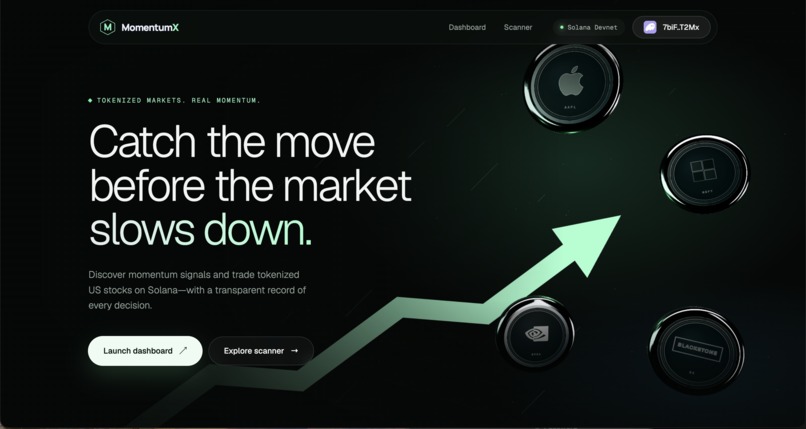
Hero
-
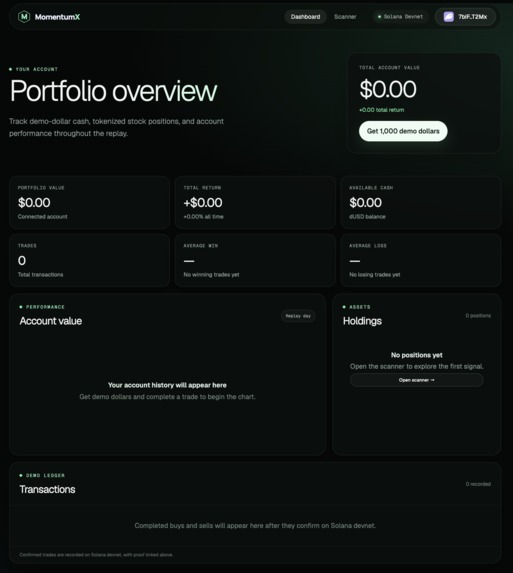
dashboard
-
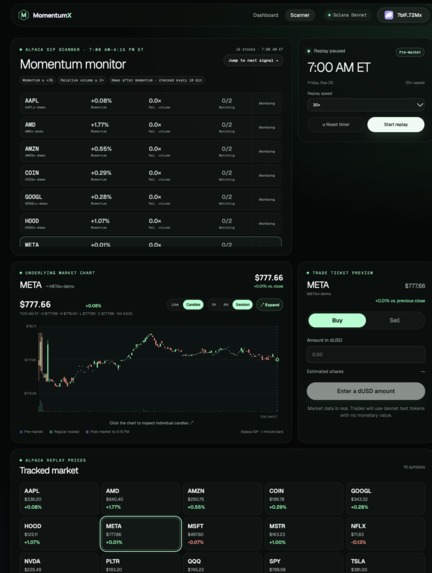
scanner
Inspiration
MomentumX was inspired by a simple problem: access to U.S. markets is still uneven. People outside the United States may face currency instability, limited brokerage options, high fees, or complicated onboarding just to gain exposure to major American companies.
We imagined a user like Sofia in Argentina, someone who already uses digital dollars to protect her savings and now wants a clearer path toward investing. Tokenized stocks can make that experience more accessible, while Solana makes transactions fast and inexpensive.
But access alone is not enough. Investors also need help discovering opportunities and understanding whether their decisions are working. That led us to combine tokenized market exposure, a real-data momentum scanner, and transparent portfolio analytics in one application.
MomentumX’s stock tokens are demo assets that track underlying prices; they do not represent legal ownership of company shares.
What it does
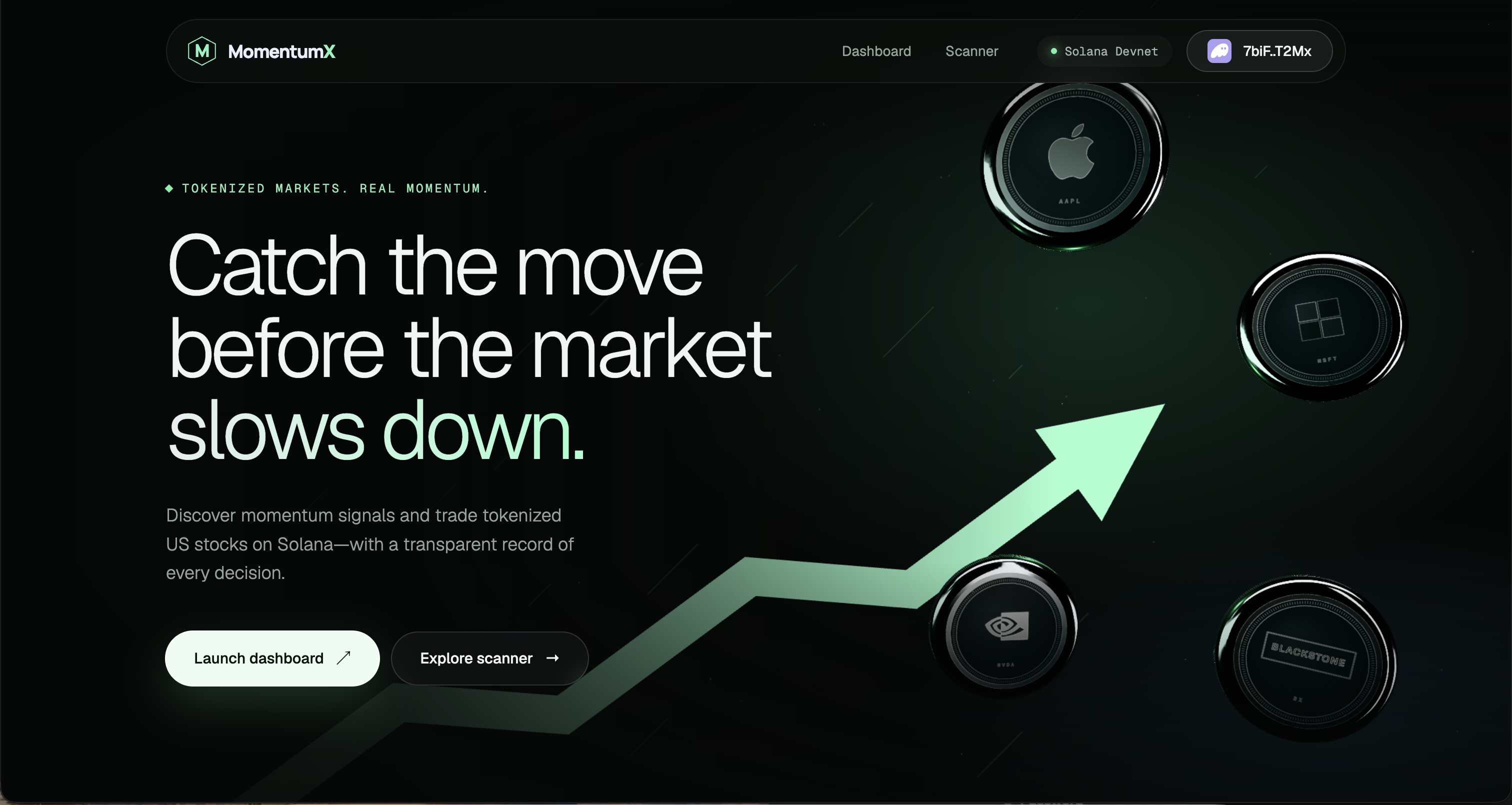
MomentumX is a Solana-powered platform for discovering, trading, and evaluating tokenized U.S. stocks.
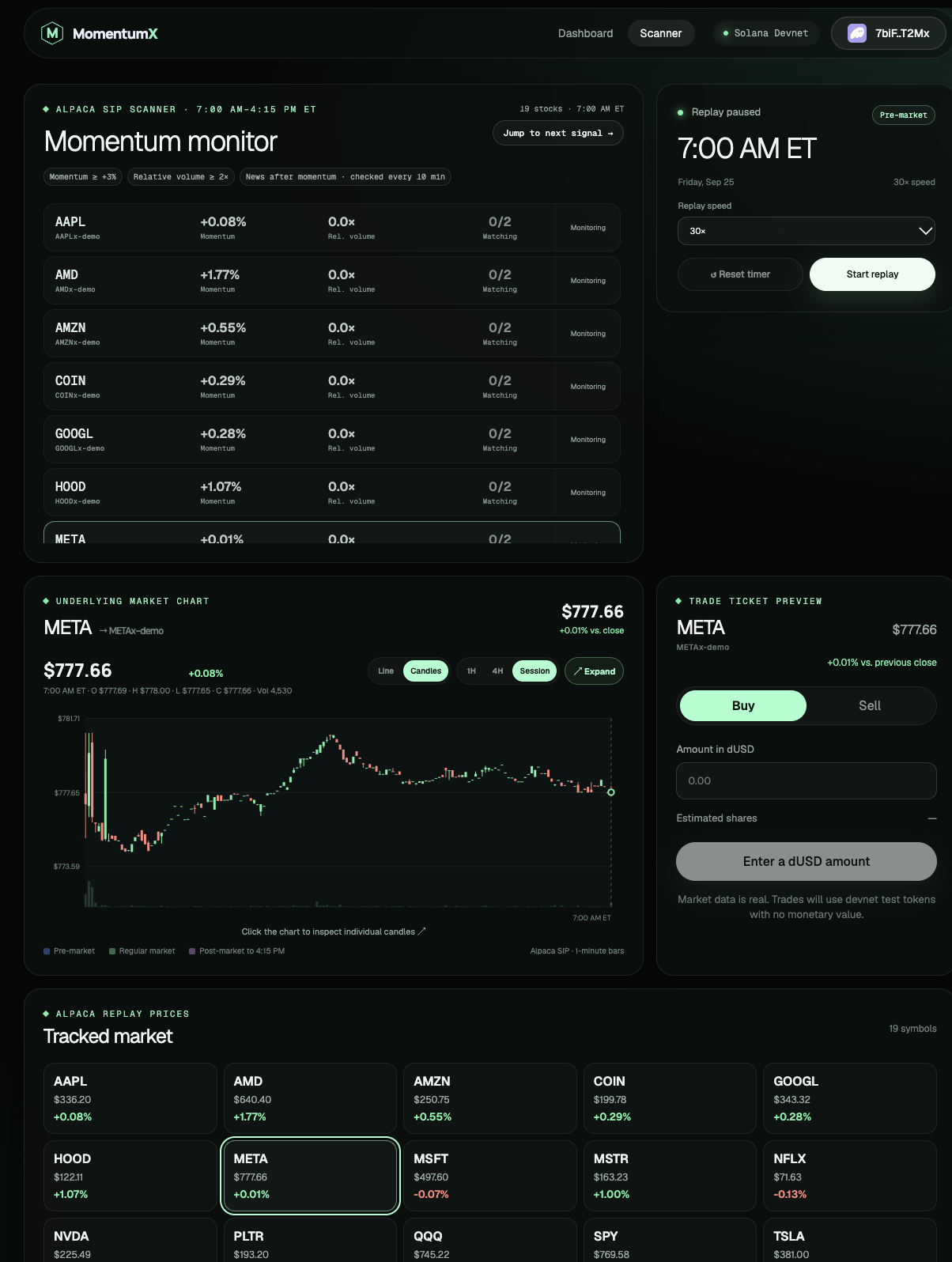
Users connect with Phantom instead of creating a traditional account. They can receive demo dollars, monitor 19 supported stocks, inspect price charts and market news, and buy or sell tokenized assets through a Solana devnet vault.
The momentum scanner identifies stocks satisfying two conditions: price change from close must be up 3% and relative volume has to be 2x of its average daily volume.
When a stock develops momentum, MomentumX reveals relevant company news available at that point in time. This helps users understand what may be driving the movement without leaking future information.
Because markets were closed during the hackathon, the application replays real Alpaca market data from Friday, September 25, 2026, minute by minute. Users can pause the market, change its speed, or jump directly to the next alert.
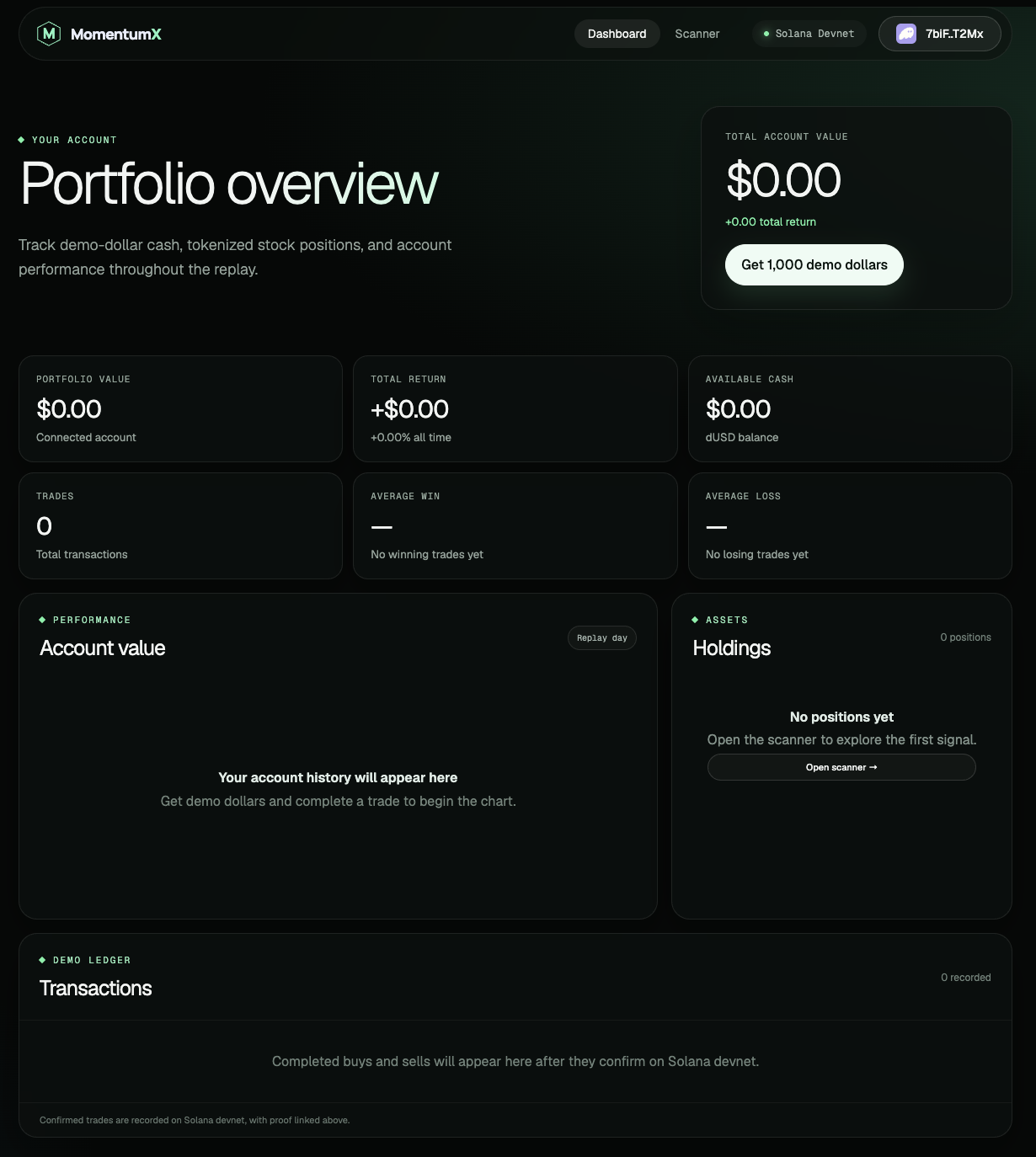
After trading, the dashboard displays holdings, cash, account value, realized and unrealized profit or loss, average wins and losses, an equity curve, and a transaction history with Solana Explorer links.
How we built it
We built MomentumX as a full-stack application with three main layers:
A React, TypeScript, and Vite frontend A Python and FastAPI backend Solana devnet execution through Phantom and a custom vault
The frontend includes a momentum monitor, replay controls, candlestick and line charts, a trade ticket, a portfolio dashboard, and a transaction ledger. It polls a synchronized market snapshot so prices, signals, and replay time remain consistent.
The backend loads real one-minute Alpaca SIP bars, 20-day volume baselines, and Finnhub company news into SQLite. A replay clock moves through the trading session while the scanner calculates price change and relative volume for every supported stock.
When a user submits a trade, the backend builds an unsigned Solana transaction. Phantom signs it first, and the vault then co-signs, pays the network fee, submits the transaction, and waits for confirmation.
A buy executes atomically by burning the user’s dUSD and minting the corresponding demo stock token. A sell performs the reverse operation. Every successful trade is a real Solana devnet transaction.
SQLite serves as the accounting source of truth, while Solana executes and verifies trades. Portfolio performance uses average-cost accounting.
Challenges we ran into
One of our first challenges was that the market was closed during the hackathon and judging period. We solved this by building a deterministic replay system using real minute-level data instead of presenting fabricated signals.
Working with real data introduced another challenge: the market did not follow our original demo story. AKAM produced a strong alert but faded after its opening gap. We adjusted our scripted trades and live demo plan to match the data rather than forcing a misleading result.
The Solana vault was our biggest technical unknown. Phantom had to sign before the backend could safely co-sign and submit the transaction. Phantom also displayed simulation warnings for our custom devnet tokens even when Solana’s own simulation succeeded. We tested several transaction layouts before confirming that the issue came from Phantom’s handling of the demo tokens.
Reliable submissions were also difficult. A network timeout could occur after a transaction reached Solana but before the frontend received a response. We added idempotent quote submission, transaction-signature recovery, and retry logic so the same trade could not execute twice.
Finally, frequent frontend polling exposed SQLite concurrency issues. We moved to one database connection per thread and enabled write-ahead logging, eliminating intermittent API failures under load.
Accomplishments that we're proud of
We are most proud that the complete workflow works end to end:
connect Phantom → receive demo dollars → discover momentum → inspect the chart and news → sign a trade → confirm it on Solana → view the updated portfolio and P/L
Our scanner successfully found three genuine signals in the replay data: AKAM and DDOG at 9:30 AM and MSFT at 9:41 AM.
We also created 20 Solana devnet tokens—dUSD and 19 demo stock tokens—and made every completed trade independently verifiable through Solana Explorer.
Beyond the basic demo, we implemented several reliability features that are easy to overlook in a hackathon project: atomic swaps, expiring quotes, duplicate-submission protection, synchronized market snapshots, no-look-ahead news handling, average-cost accounting, and a minute-by-minute equity curve.
What we learned
We learned that financial applications depend as much on consistency and trust as they do on interface design. Prices, signals, news, trades, and portfolio values must all correspond to the same moment in time.
We also learned that blockchain transactions require careful coordination between wallet signatures, backend signatures, blockhash expiration, confirmation states, and retry behavior. A successful on-chain transaction does not always produce a successful HTTP response, so resilient recovery must be designed from the beginning.
Working with real market data taught us to let the evidence shape the story. Our initial assumptions about which stocks would make good demo trades were not always correct once we examined the minute bars.
Most importantly, we learned how frontend, backend, market data, accounting, and blockchain systems can work together to create an investment experience that feels approachable while remaining transparent.
What's next for MomentumX
Our next step is to move from a replay-based devnet prototype toward a secure, live product for eligible non-U.S. users.
We plan to:
Route production trades through Jupiter to supported real tokenized assets Add live market data and real-time scanner alerts Verify jurisdiction and issuer eligibility before enabling trading Add audited contracts, stronger vault security, and production monitoring Include token metadata so assets display correctly inside Phantom Expand portfolio analytics and risk-management tools Improve mobile accessibility and multilingual support Add configurable watchlists, scanner thresholds, and notifications
Our long-term vision is for MomentumX to become a transparent bridge between global users and tokenized financial markets; helping people not only access opportunities, but understand and measure every decision they make.
Built With
- css
- fastapi
- python
- react
- solana-sdk
- three.js
- typescript


Log in or sign up for Devpost to join the conversation.