Momentum — Project Story
From dreaming to doing, one brave step at a time.
Inspiration
We have all been there: ambitious goals, endless planning, but somehow never starting. The problem is not a lack of motivation or discipline. It is the gap between inspiration and action. Traditional productivity apps focus on optimization, long-term planning, and rigid habit tracking, which often increases overwhelm rather than reducing it.
Momentum was born from a simple question: what if we could help people start before they feel ready?
Instead of asking "Did you stay consistent?" we ask "What is one small, brave action you can take today?" This shift from guilt-driven streaks to identity-based progress became the foundation of the app. We wanted to build something that feels like a supportive friend, not a demanding taskmaster.
The hackathon provided the perfect opportunity to bring this vision to life: a focused sprint to create something real, monetizable, and genuinely helpful.
What It Does
Momentum is a personal growth app that helps ambitious people close the gap between inspiration and action.
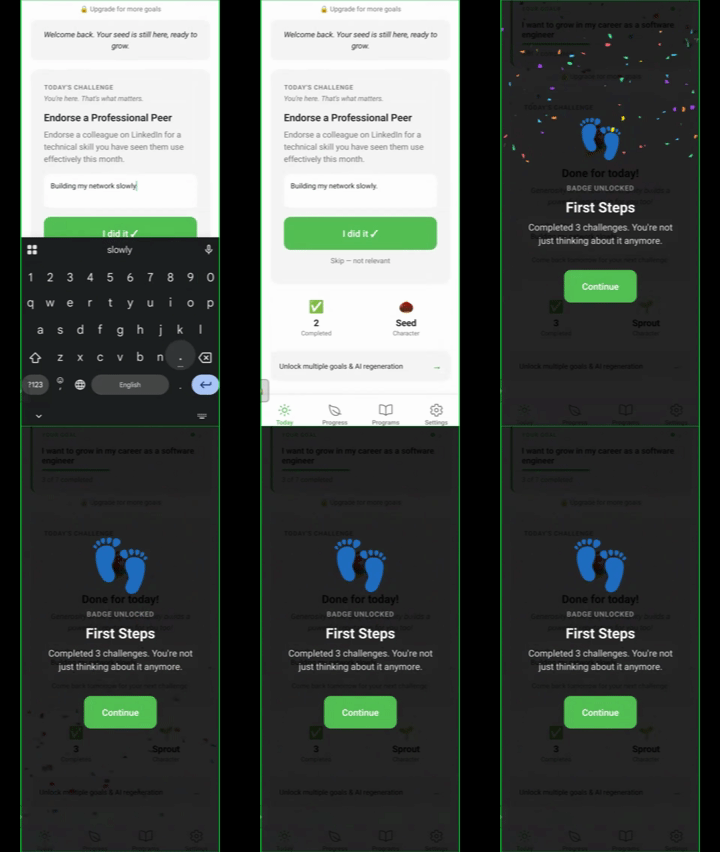
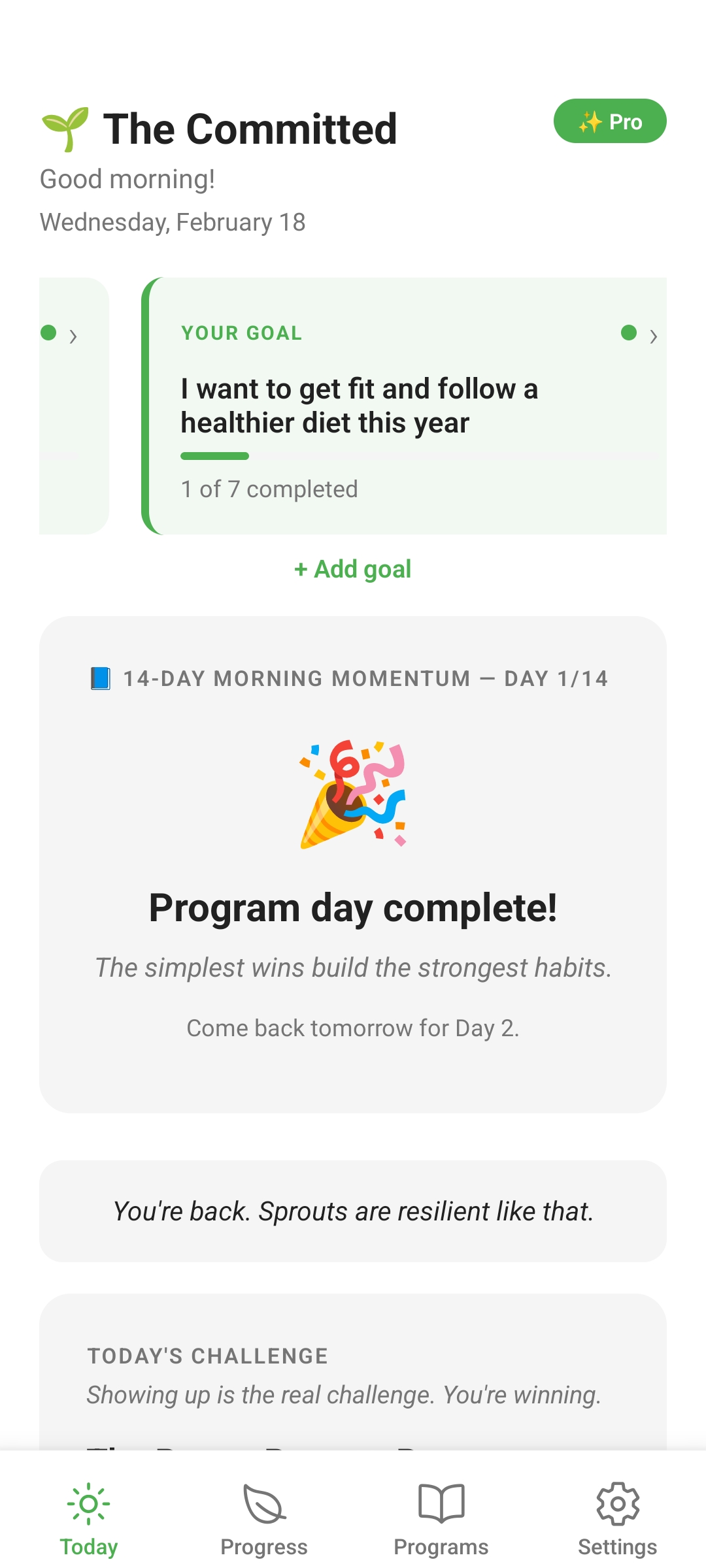
Daily Micro-Challenges
Each day, users receive one small, achievable challenge designed to take 5 to 10 minutes. These are not generic tasks — they are AI-generated, personalized actions based on the user's specific goals and focus areas. Examples:
- "Put your gym shoes by the door"
- "Write one sentence about a goal you have been avoiding"
- "Save $1 today"
Character-Based Progress
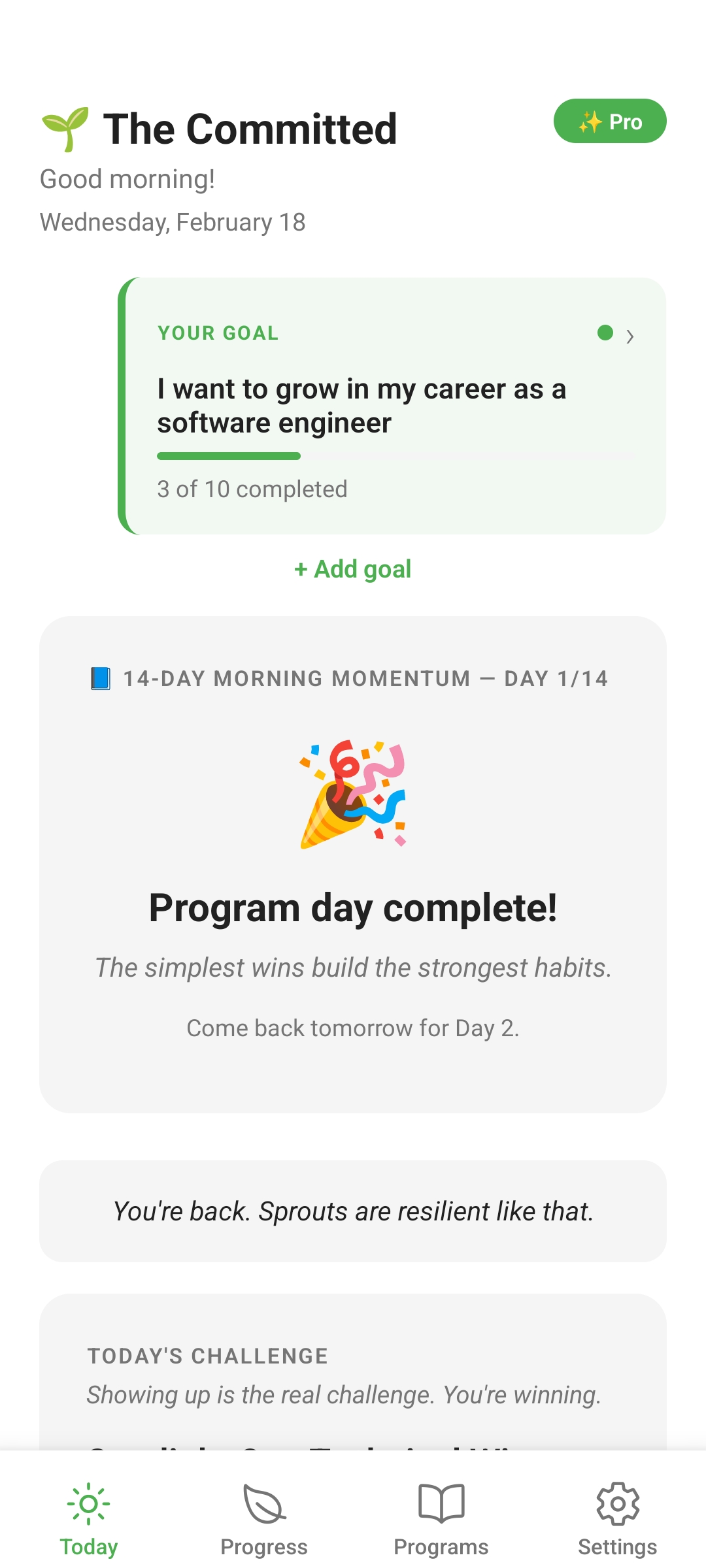
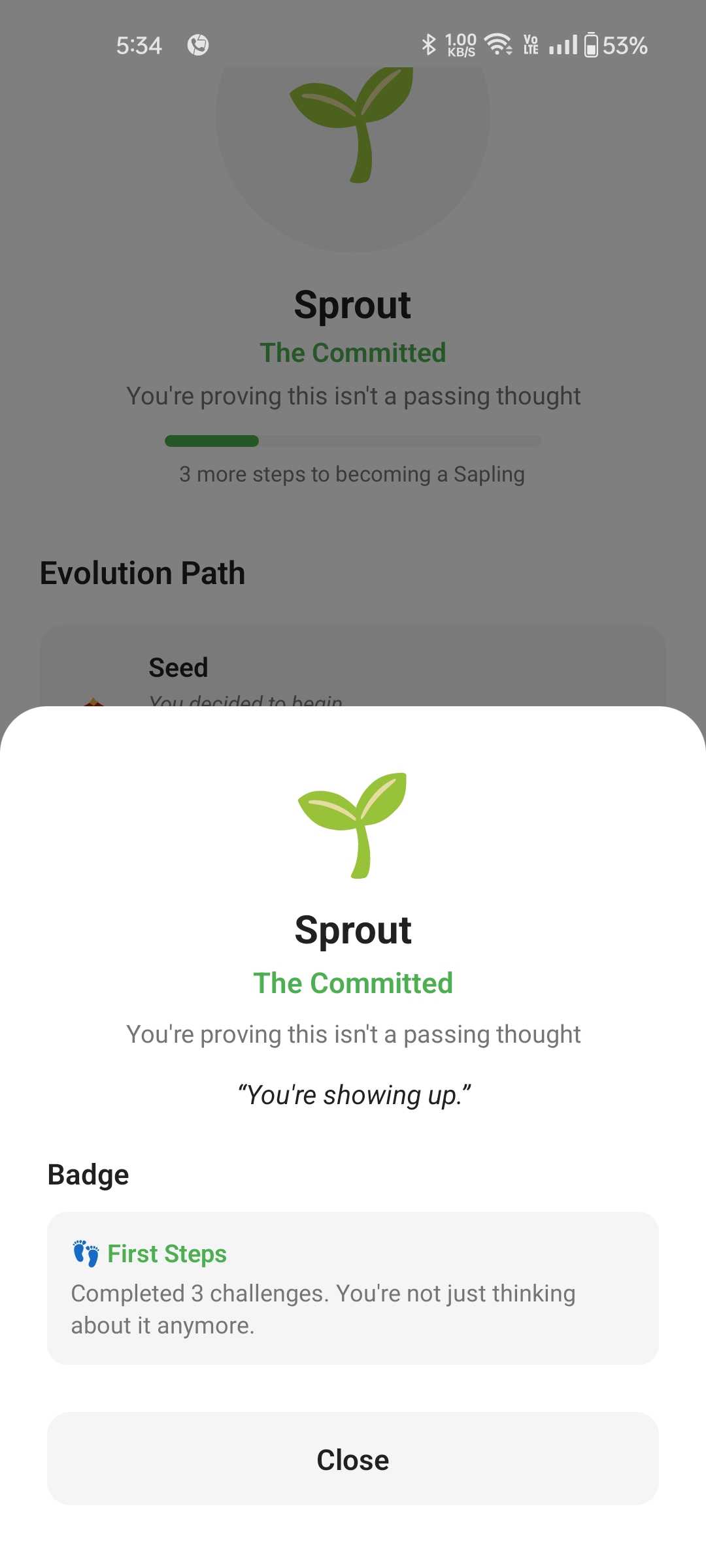
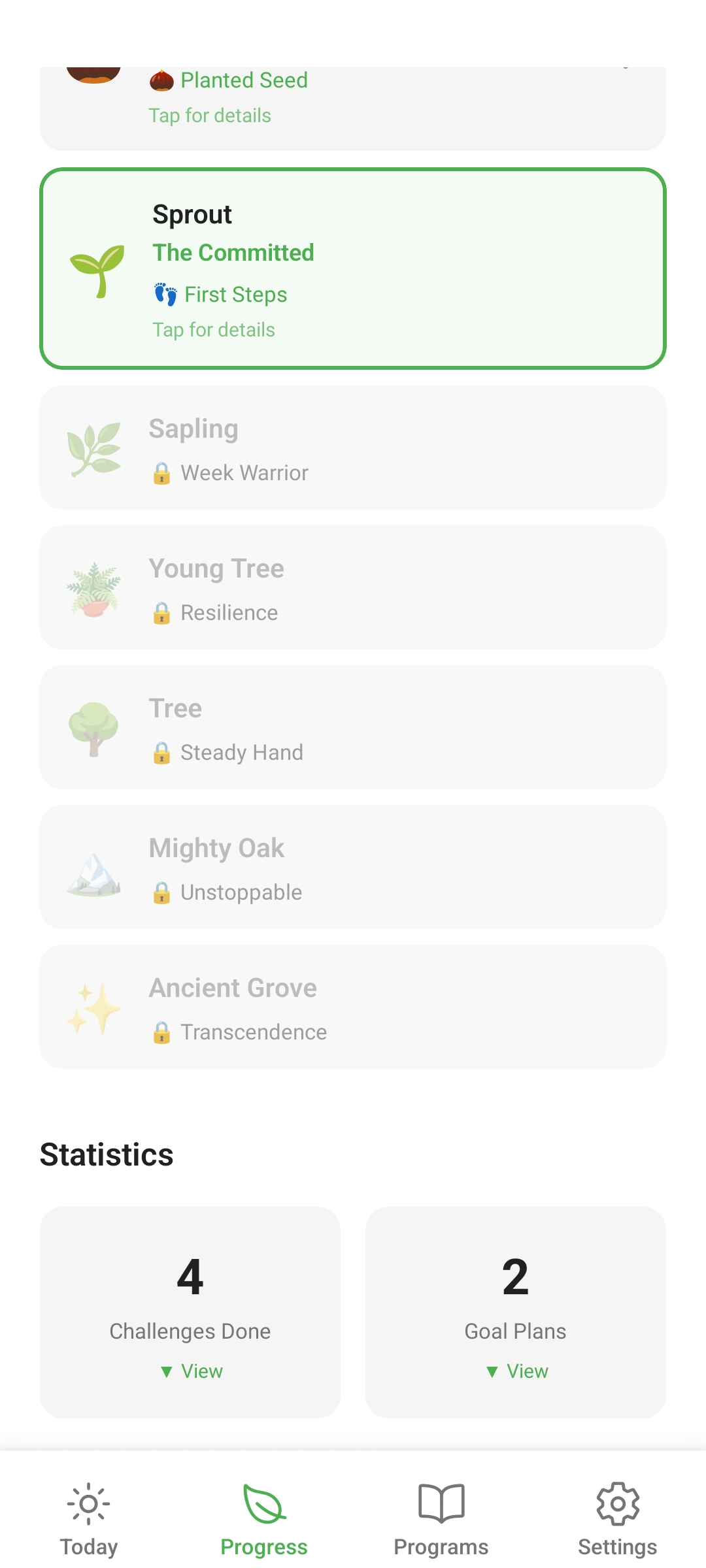
Users watch a personal character evolve through seven stages — from Seed to Ancient Grove — as they complete challenges. This visual representation reinforces identity ("I am becoming someone who takes action") rather than guilt or pressure. There is no streak decay, no punishment for missed days. Only forward progress.
AI-Powered Adaptation
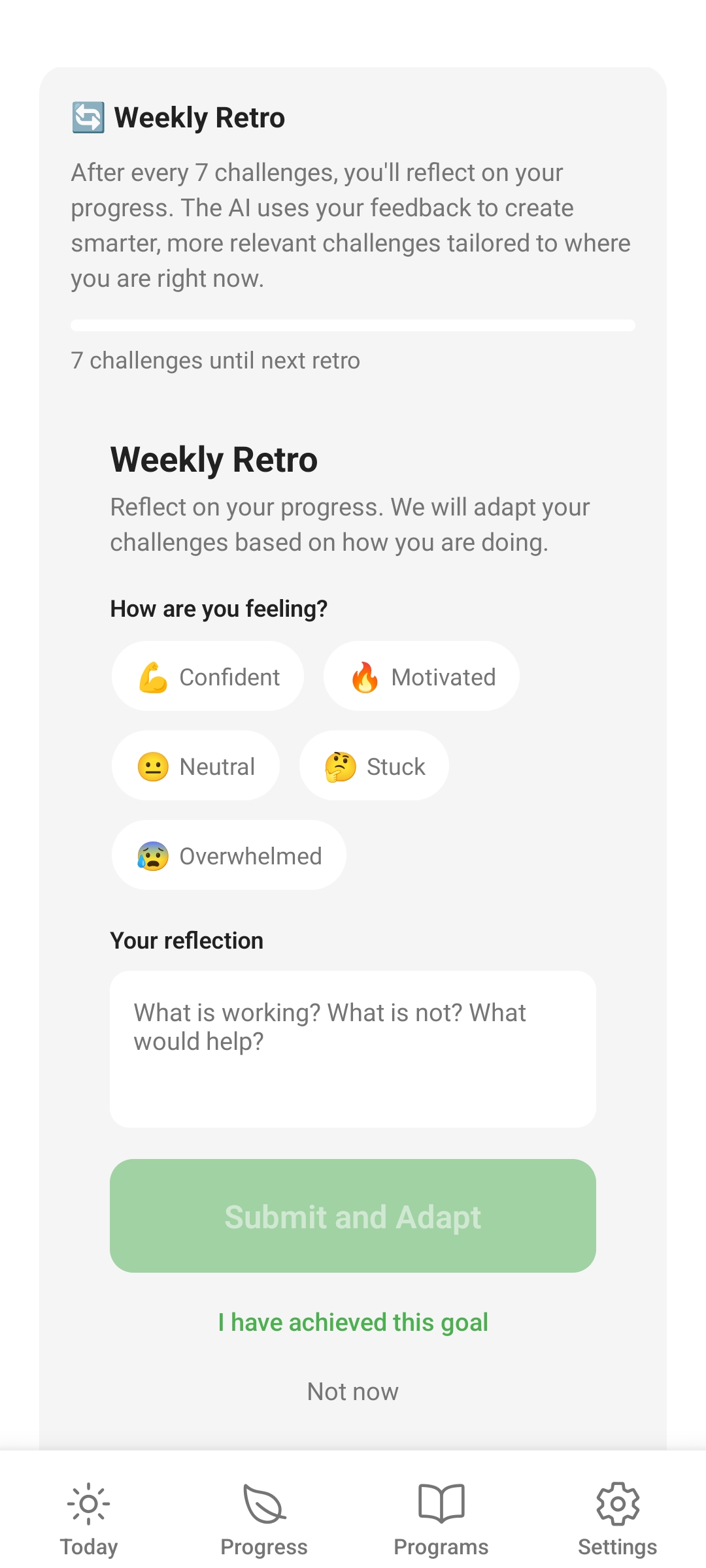
Using Google Gemini, Momentum generates personalized challenge plans and adapts them based on weekly retrospectives. If a user feels overwhelmed, the AI makes challenges easier and more encouraging. If they are feeling confident, it gently increases the difficulty.
Weekly Retrospectives
After completing a batch of challenges, users reflect on their progress. The app uses this reflection to regenerate remaining challenges, adapting to how the user is feeling and what is working for them.
Gamification and Achievements
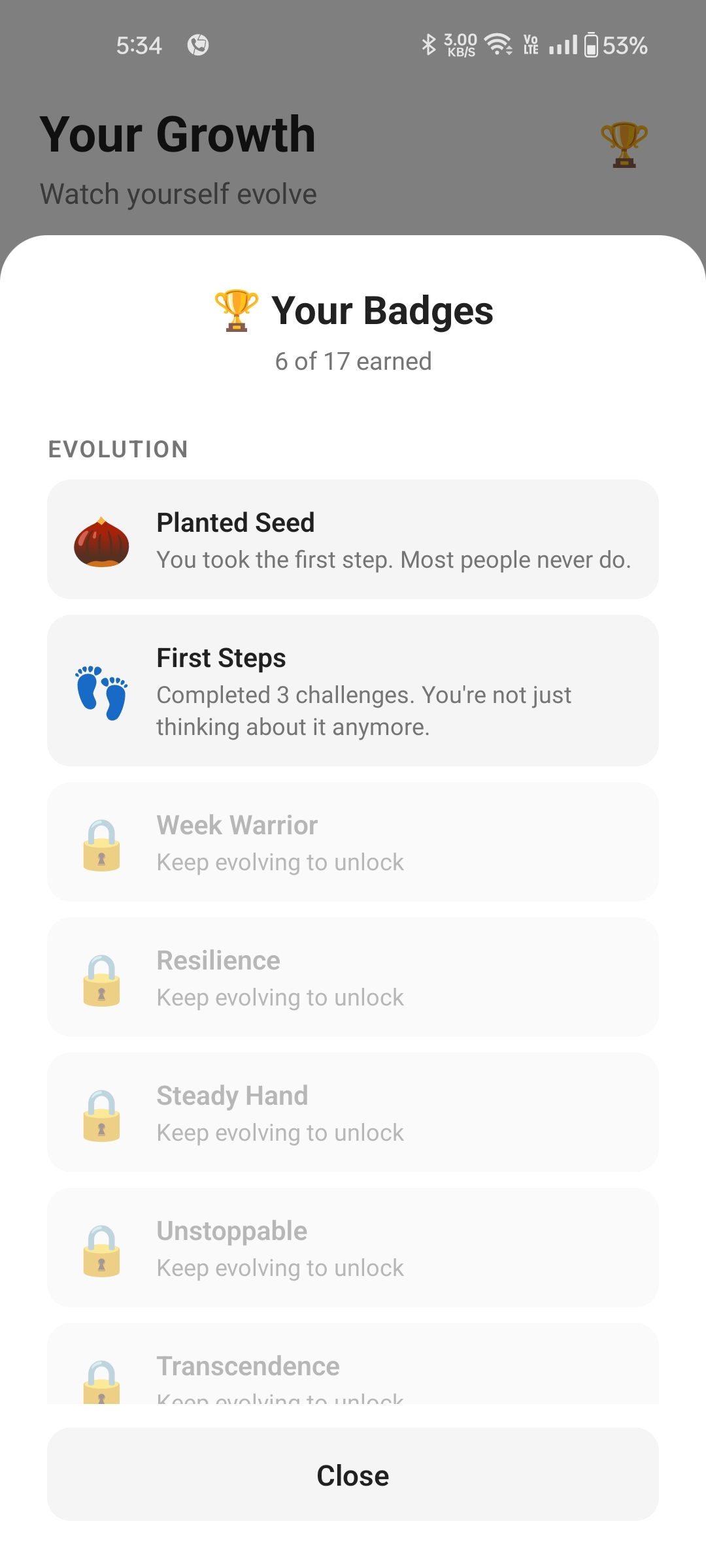
Users earn badges for milestones like completing their first challenge, finishing a goal plan, or writing reflection notes. Evolution stages unlock new character appearances, creating a sense of progression and accomplishment.
Premium Monetization
The app includes a subscription model (Momentum Plus) that unlocks:
- Multiple simultaneous goal plans
- Advanced character evolution stages
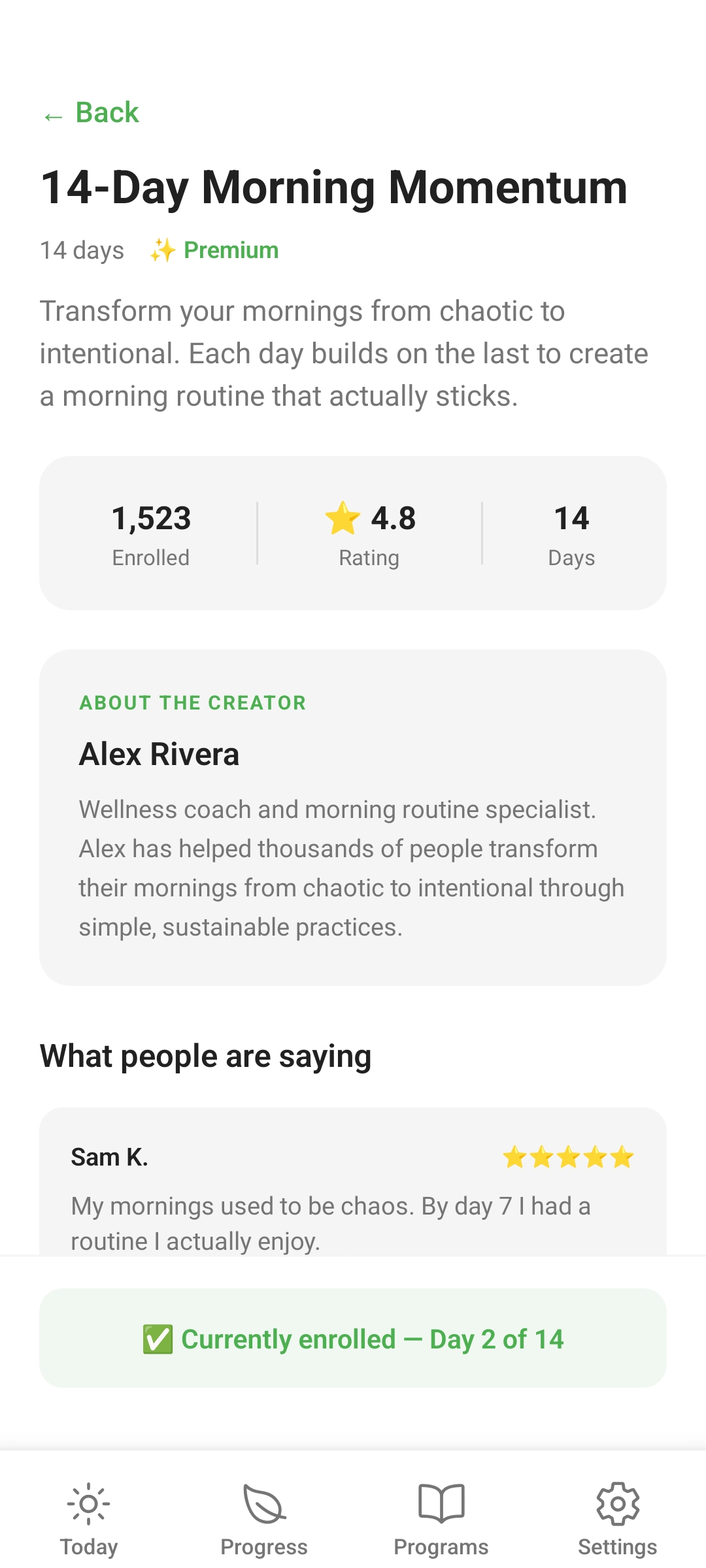
- Premium creator-led challenge packs
- AI-powered challenge regeneration
Free users still get core value. Premium users unlock depth and personalization.
How We Built It
Tech Stack
- Framework: Expo (React Native) for cross-platform mobile development
- Language: TypeScript for type safety and better developer experience
- Navigation: Expo Router for file-based routing
- State Management: Zustand for lightweight, performant domain state; React Context for global concerns
- AI Integration: Google Gemini for challenge generation and adaptive regeneration
- Subscriptions: RevenueCat SDK for cross-platform subscription management
- Storage: AsyncStorage for local persistence, Expo Secure Store for sensitive data
- Animations: React Native Reanimated and Lottie
- Charts: Victory Native for progress visualization
- IDE: Kiro
Architecture
The codebase is organized by domain rather than by type, keeping related code together:
src/
├── features/
│   ├── challenges/    # AI generation, Zustand store, types, storage
│   ├── character/     # 7-stage evolution engine (pure functions)
│   ├── badges/        # Badge definitions and computation
│   ├── premium/       # Subscription gating logic
│   ├── programs/      # Creator-led programs
│   └── debug/         # Debug date utilities
├── components/        # Reusable UI components
├── state/             # React Context (user, subscription)
├── services/          # External integrations (RevenueCat, auth)
├── hooks/             # Custom React hooks
└── config/            # Constants, environment config
This structure made it easy to iterate quickly during the hackathon while maintaining clean separation of concerns.
Key Implementation Highlights
AI Challenge Generation — A robust system with fallback to static challenges when API calls fail. Prompt engineering focuses on creating actionable, encouraging, and personalized micro-challenges.
Retro-Aware Regeneration — Adaptive AI that analyzes user reflections and adjusts challenge difficulty, duration, and guidance based on how they are feeling.
Character Evolution System — A 7-stage progression system (Seed, Sprout, Sapling, Young Tree, Tree, Mighty Oak, Ancient Grove) with milestone-based unlocks and identity-driven messaging. The character never regresses.
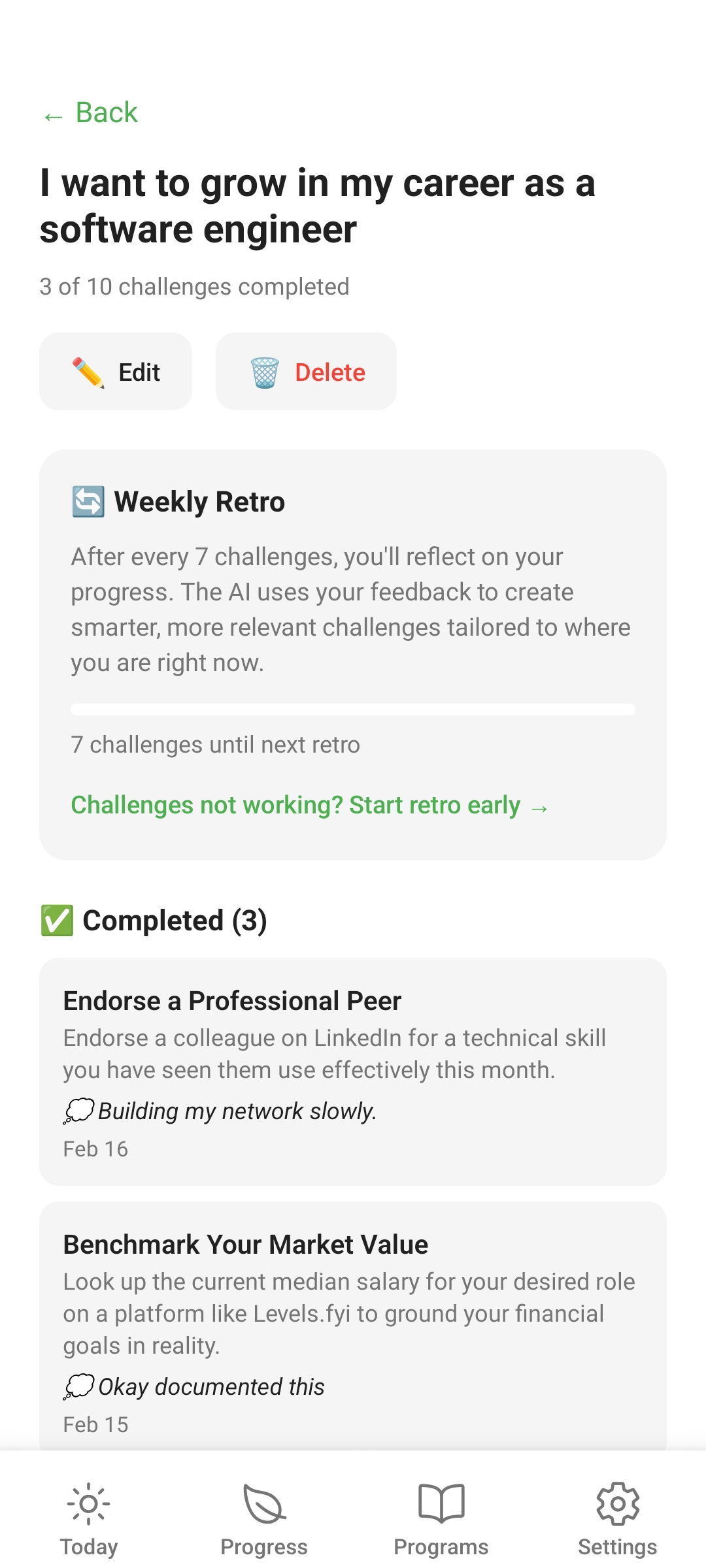
Goal Carousel — A horizontal swipe interface for managing multiple goals, with visual indicators for new challenges and completion status.
Badge System — A comprehensive achievement system with both evolution-based and action-based badges.
Premium Gating — RevenueCat integration with proper entitlement checks and paywall flows.
Development Process
We followed an iterative approach:
- Started with the core loop: goal creation, challenge display, completion
- Added AI generation with proper error handling
- Built character evolution and gamification
- Implemented weekly retros and adaptive regeneration
- Added premium features and monetization
- Polished UI/UX with animations and celebrations
Challenges We Ran Into
AI Prompt Engineering
Getting Gemini to consistently generate high-quality, actionable micro-challenges was harder than expected. We iterated through multiple prompt versions, learning to be extremely specific about output format (JSON only, no markdown), include clear rules about challenge length and actionability, add examples of good versus bad challenges, and handle edge cases where the AI returns malformed responses.
State Management Complexity
Managing state across multiple goal plans, challenges, retros, and character evolution became complex. We initially used React Context but hit performance issues with frequent updates. Migrating to Zustand for domain-specific state while keeping Context for global concerns significantly improved performance.
Date Handling for Daily Challenges
Determining "today's challenge" across different timezones and handling edge cases like midnight transitions required careful thought. We built a debug date system that allows time travel for testing without breaking production logic.
Subscription Integration
RevenueCat integration required understanding entitlements, offerings, and proper error handling. Setting up the Google Service Account and subscriptions on Google Play Console, then linking them with RevenueCat for the first time was a learning curve. Once configured, it simplified the entire subscription flow considerably.
Accomplishments
Shipped a Complete Product — Not just a prototype. A fully functional app with real monetization, ready for users.
AI That Works — The Gemini integration generates genuinely helpful, personalized challenges with proper fallback handling.
Delightful UX — Confetti celebrations, smooth animations, and encouraging messaging create an emotional experience that feels supportive rather than demanding.
Adaptive Intelligence — The weekly retro system that regenerates challenges based on user reflection is genuinely innovative and useful.
Clean Architecture — Despite the time pressure, we maintained clean code organization that is easy to understand and extend.
Monetization-Ready — Built-in subscription system with proper gating, paywall flows, and entitlement checks.
What We Learned
Technical
- Prompt Engineering: Crafting effective prompts for consistent, structured AI output is an iterative discipline.
- Mobile State Management: Understanding when to use Context versus Zustand versus local state is critical for performance.
- Subscription Systems: RevenueCat abstracts a lot of complexity, but understanding the underlying entitlement model is essential.
- React Native Performance: Optimization techniques for smooth animations and minimal re-renders matter at scale.
Product
- Simplicity Wins: Our initial design was more complex. Stripping it down to one daily challenge made it more powerful.
- Identity Over Discipline: Framing progress as "who you are becoming" rather than "what you did" resonates more deeply.
- Emotional Design Matters: Small touches like confetti, encouraging messages, and character growth create real emotional connection.
- Monetization from Day One: Building premium features early, not as an afterthought, creates better product architecture.
Process
- Domain-Driven Organization: Organizing code by feature rather than by type made iteration faster.
- Documentation as You Go: Writing docs during development kept us aligned and made onboarding easier.
- Debug Tooling Early: Building time-travel debug tools (date offset) early saved hours of manual testing.
Roadmap
Immediate
- User testing and feedback collection
- Analytics integration for behavioral insights
- App Store submission (iOS) and Google Play production release
Short-Term (1-2 months)
- Advanced character customization and additional evolution stages
- User-selectable characters
- Premium challenge packs (themed collections)
- Social proof (anonymous stats, not social feeds)
- Improved onboarding flow
Medium-Term (3-6 months)
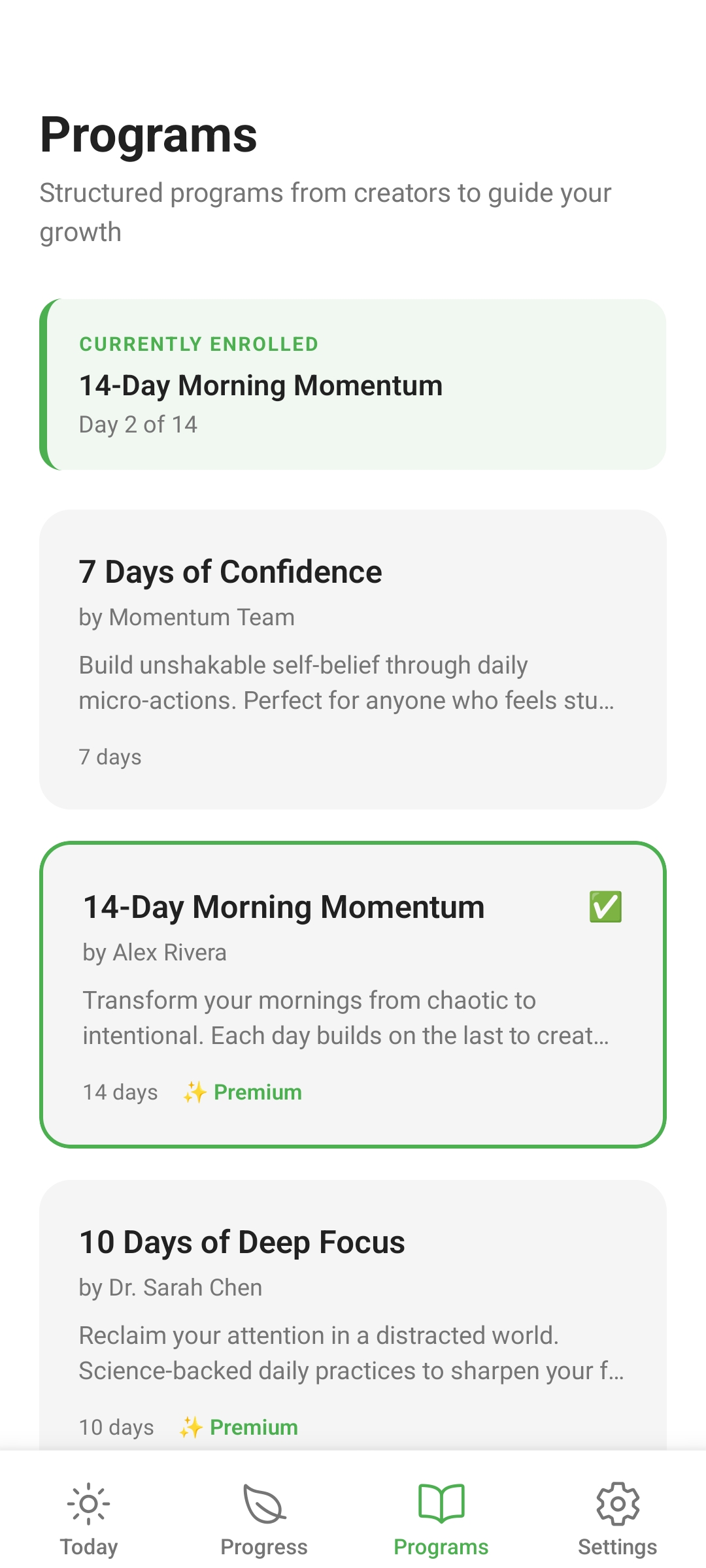
- Creator-led programs with monetizable courses
- Creator dashboard and creator-specific pricing
- Voice notes for reflections
- Habit stacking (link challenges to existing habits)
- Weekly and monthly progress reports
- Calendar app integration
Long-Term (6+ months)
- Community features (optional, privacy-first)
- Accountability partners
- Custom challenge creation
- API for third-party integrations
- Web companion app
Business Goals
- 1,000 active users in the first 3 months
- 5% free-to-paid conversion rate
- Creator program with 10+ published courses
- Partnerships with coaches and content creators
Acknowledgments
Built with Google Gemini AI for intelligent challenge generation, RevenueCat for subscription infrastructure, Expo for cross-platform development, and the React Native community for excellent open-source libraries.
Momentum — Because the hardest part is not finishing. It is starting.
Built for RevenueCat Shipyard: Creator Contest
Built With
- expo.io
- gemini
- react-native
- revenuecat
- typescript

