-
-
Momentum - Providing Presence-Based Support
Project Overview
Momentum reimagines how people with ADHD approach daily tasks by replacing shame-based productivity tools with campus-grounded body doubling.
For neurodivergent students, the hardest part of any task is rarely the task itself. It is the 10 seconds before starting it. Existing productivity apps respond with streaks, alarms, and rigid tracking, which actively worsen the "Wall of "Awful"—the emotional barrier built from repeated failure that makes even small tasks feel impossible.
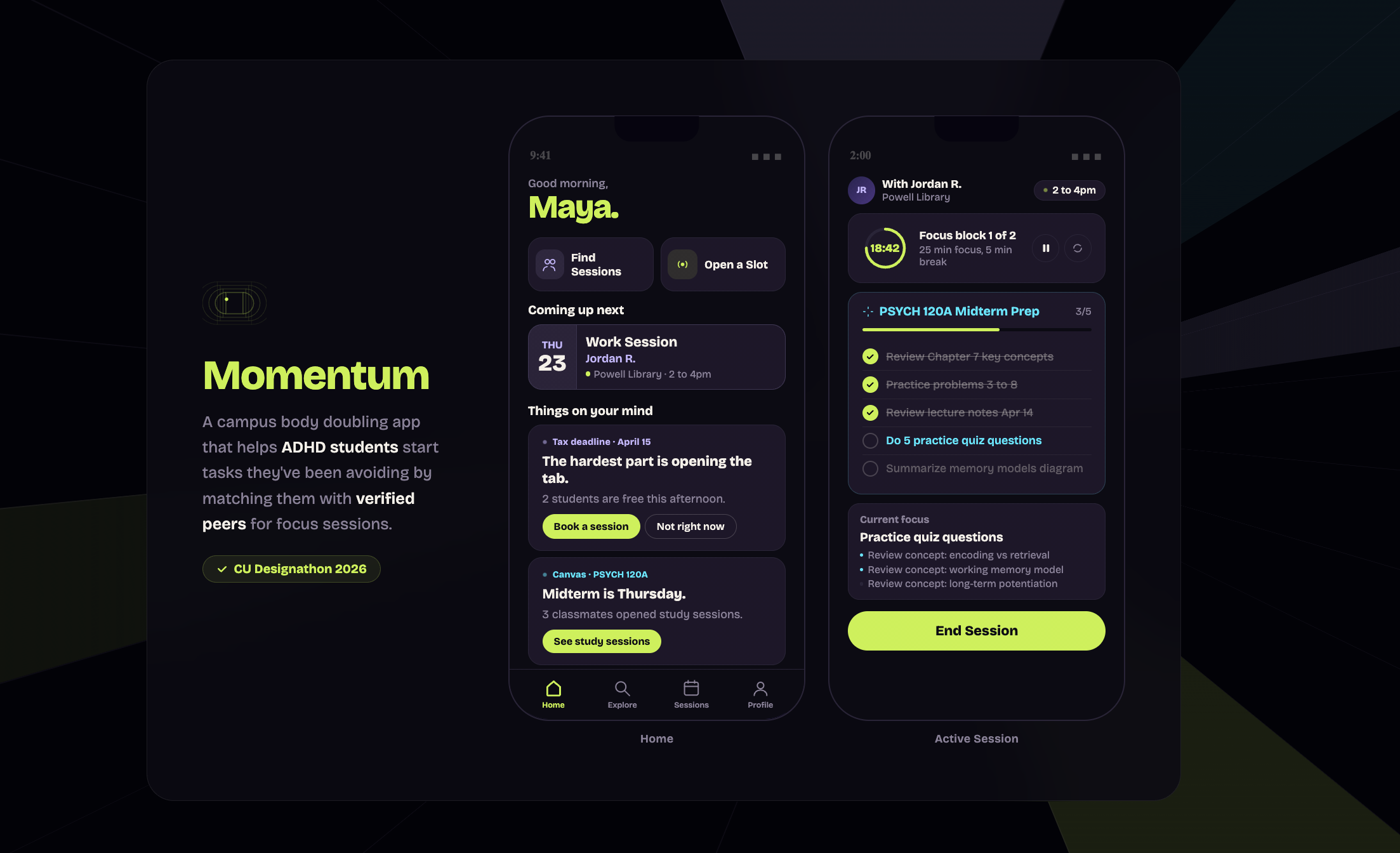
Momentum is a body doubling app for college students that matches you with verified campus peers for in-person focus sessions. It surfaces sessions proactively based on your schedule, classes, and deadlines. An AI layer breaks tasks into one non-threatening first step. And instead of punishing absence, it builds something that grows over time: real relationships with people who show up alongside you.
Designed for ADHD brains. Built for anyone who has ever felt stuck alone.
Research Process and Findings
Research began with secondary synthesis across clinical literature, ADHD community forums, and existing body doubling platforms including Focusmate, Flow Club, and dubbii.
The most grounding framework came from ADHD coach Brendan Mahan's concept of the Wall of Awful, which describes how the emotional weight of repeated failure accumulates around specific tasks, making initiation feel physically impossible over time. This reframed the problem from "people lack motivation" to "people carry compounding shame around tasks they genuinely want to start." Clinical sources including the Cleveland Clinic, CHADD, and Understood confirmed that body doubling works not by adding pressure but by reducing the internal activation load required to begin.
Forum research on Reddit communities including r/ADHD and r/ExecutiveDysfunction surfaced raw emotional accounts. One post described the experience as "I want to do the work. I know what I need to do. But I just cannot convince myself to do it. It feels like pushing magnets." This became the north star for the entire product voice.
Competitive analysis revealed a consistent gap: existing tools require scheduled sessions and reliable follow-through—all things ADHD brains struggle with most. The market is strong at structured synchronous accountability and weak at spontaneous, low-barrier, shame-free support. Key findings that shaped design direction: task initiation is the primary failure point, not task completion. Presence alone (not instruction or monitoring) is what body doubling provides neurologically. And every existing retention mechanic in productivity apps (streaks, badges, daily check-ins) actively harms the users who need support most.
These findings led to three core decisions: campus verification as a trust layer, AI micro-steps as an initiation bridge, and a retention model built on relationships rather than metrics.
Key Design Decisions
Campus verification as the foundation, not a feature.
Research showed that camera-on, stranger-matching platforms create social anxiety that compounds ADHD paralysis. The decision to anchor Momentum in verified campus identity (UCLA .edu email, shared org memberships, mutual connections) solved safety and trust simultaneously. It also made the social proof mechanic feel real: seeing that three people you know are attending an Innovative Design session is meaningfully different from seeing that 13 strangers are.
Proactive intelligence over reactive reminders.
Standard notification design tells users what they already know ("don't forget your task"). Momentum's home feed surfaces connections the user hasn't made themselves: a 2-hour gap after DESMA 101 lines up with Jordan being free at Powell Library, or a Canvas midterm syncs with classmates who already opened study sessions. This decision came directly from the research finding that ADHD brains struggle most with initiation, not execution. Reducing the cognitive work of connecting an available moment to a relevant person removes the single biggest friction point in the cycle.
No streak mechanics, anywhere.
Every traditional retention tool was explicitly excluded. Streaks reset on failure. Badges feel performative. Daily prompts become noise. Instead, the retention model was rebuilt around two things the research showed actually work for ADHD users: relationships (the buddy bond level that only accumulates) and evidence (the memory card and semester momentum bar that document what you did, not what you missed). The emotional framing of "you showed up, that's real" on the post-session screen was a direct response to research showing ADHD users chronically underestimate their own output and need evidence, not scores.
Built With
- claude
- figma
- vercel


Log in or sign up for Devpost to join the conversation.