Inspiration

Most productivity tools are designed to answer one question: "What tasks do I have?"

I wanted to solve a harder problem:

"What should I work on next?"

When working across coursework, software projects, certifications, and personal goals, the challenge is often not creating a task list. The real challenge is deciding which task deserves attention when deadlines, dependencies, urgency, and impact are constantly competing.

That decision-making overhead creates decision fatigue and often results in people spending more time planning work than actually completing it.

That inspired Momentum AI, an intelligent project prioritization assistant designed to transform goals into actionable work and help users continuously identify their next highest-impact action.


What it does

Momentum AI is powered by an AI reasoning engine called M1 — Momentum Intelligence.

Instead of requiring users to manually build a detailed project plan, a user provides:

  • A project name
  • A project objective
  • A target deadline

M1 analyzes this context and generates an actionable execution plan containing tasks, suggested deadlines, logical sequencing, and explanations of how each task contributes to the overall objective.

Momentum then evaluates tasks using contextual information including:

  • Project objectives
  • Project deadlines
  • Individual task deadlines
  • Task descriptions
  • Dependencies
  • Previously completed work

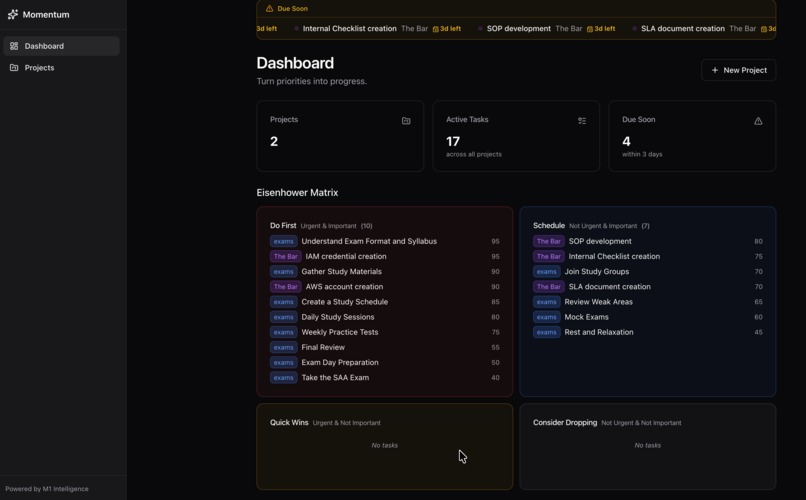
The application combines this reasoning with the Eisenhower Matrix, classifying work across urgency and importance.

Conceptually, each task can be evaluated as:

$$ Priority = f(Urgency, Importance, Deadline, Dependencies, Context) $$

Rather than exposing only a numerical score, Momentum provides an explainable recommendation containing the priority, Eisenhower quadrant, recommended next action, reasoning, and confidence score.

The goal is simple: users should spend less time deciding what to do and more time actually doing it.


How I built it

Momentum AI uses a fully serverless AWS architecture.

Frontend

The user interface is built with:

  • React
  • TypeScript
  • Vite
  • Tailwind CSS

The frontend is deployed using AWS Amplify Hosting.

Backend

The application backend uses:

  • Python
  • FastAPI
  • AWS Lambda
  • Amazon API Gateway

FastAPI provides the application API while Lambda allows the backend to operate without managing dedicated servers.

Data

Projects and tasks are persisted using Amazon DynamoDB, providing a scalable NoSQL data layer suitable for the serverless architecture.

AI Intelligence

The core reasoning capability is powered by Amazon Bedrock Nova Lite.

Rather than implementing every prioritization rule directly in application code, the backend acts as an orchestration layer.

It:

  1. Retrieves project and task context.
  2. Constructs structured prompts.
  3. Sends the context to Amazon Bedrock.
  4. Receives structured AI recommendations.
  5. Validates the generated JSON using Pydantic.
  6. Returns explainable recommendations to the frontend.

This allows M1's reasoning strategy to evolve without requiring the entire application architecture to be redesigned.

Monitoring

Amazon CloudWatch provides backend logging and operational visibility.


Challenges I ran into

Making AI output predictable

The largest technical challenge was turning generative AI responses into reliable application data.

A production interface cannot depend on inconsistent conversational responses. Momentum requires predictable fields such as priority scores, classifications, recommended actions, reasoning, and confidence values.

I addressed this through structured prompting and schema validation, ensuring that Bedrock responses could be safely consumed by the frontend.

Keeping the project focused

There were many possible extensions, including authentication, collaboration, notifications, calendar integration, voice interaction, and external project management tools.

The challenge was resisting unnecessary scope expansion.

I focused the MVP on one core experience:

Given everything I need to accomplish, tell me what deserves my attention next.

Making AI explain itself

A priority score alone is not particularly useful.

Momentum therefore emphasizes explainable AI, requiring M1 to communicate why a task has been prioritized rather than simply returning an opaque ranking.


Accomplishments I'm proud of

I am particularly proud that Momentum AI uses generative AI as a reasoning system rather than simply another chatbot.

The project demonstrates:

  • AI-generated project decomposition
  • Context-aware task prioritization
  • Explainable AI recommendations
  • Eisenhower Matrix visualization
  • Structured LLM output validation
  • A complete serverless AWS architecture
  • An interactive web-based dashboard
  • A working end-to-end AI workflow

The application moves beyond storing tasks and begins assisting with the decision-making process itself.


What I learned

Building Momentum reinforced an important lesson: generative AI becomes significantly more useful when it is embedded inside a workflow rather than added as a standalone chat interface.

I learned how to structure Bedrock prompts for predictable machine-readable responses and how to validate AI-generated output before using it within an application.

I also gained deeper experience designing serverless systems where Amplify, API Gateway, Lambda, DynamoDB, CloudWatch, and Bedrock work together as one application architecture.

Most importantly, I learned that effective AI products require more than model integration. The AI must solve a clearly defined user problem and communicate its reasoning in a way users can trust.


What's next for Momentum AI

The next phase is to evolve M1 from an intelligent recommendation engine into an autonomous project execution agent.

Future capabilities include:

  • Automatic reprioritization as project conditions change
  • GitHub integration
  • Jira integration
  • Slack integration
  • Google Calendar synchronization
  • Multi-user workspaces
  • Authentication and collaboration
  • Daily AI project briefings
  • Proactive deadline notifications
  • Voice-driven project planning
  • Persistent project memory
  • Long-running project monitoring agents

The long-term vision is for Momentum to become an intelligent teammate that continuously understands project state, identifies risks, adapts plans, and recommends the most valuable action to take next.

Momentum doesn't just organize your work. It helps you move it forward.

Built With

Share this project:

Updates