-
-
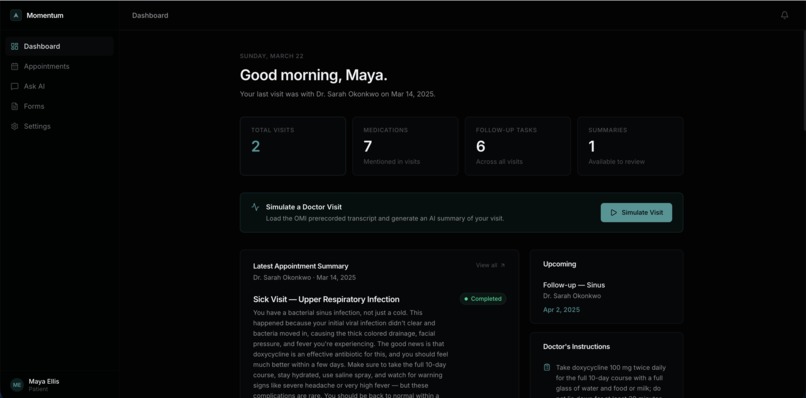
Home
-
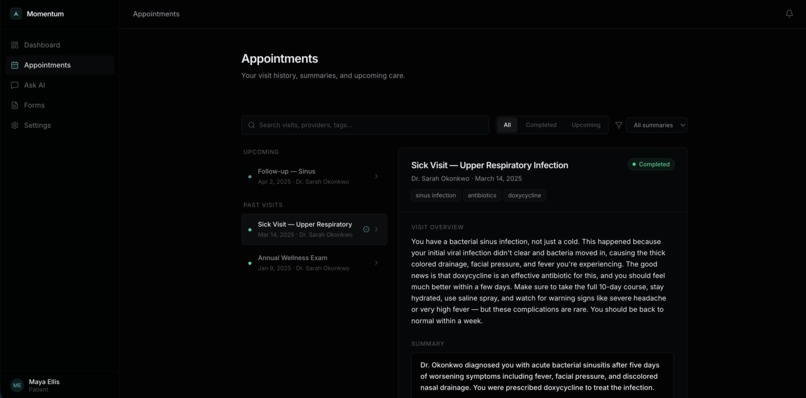
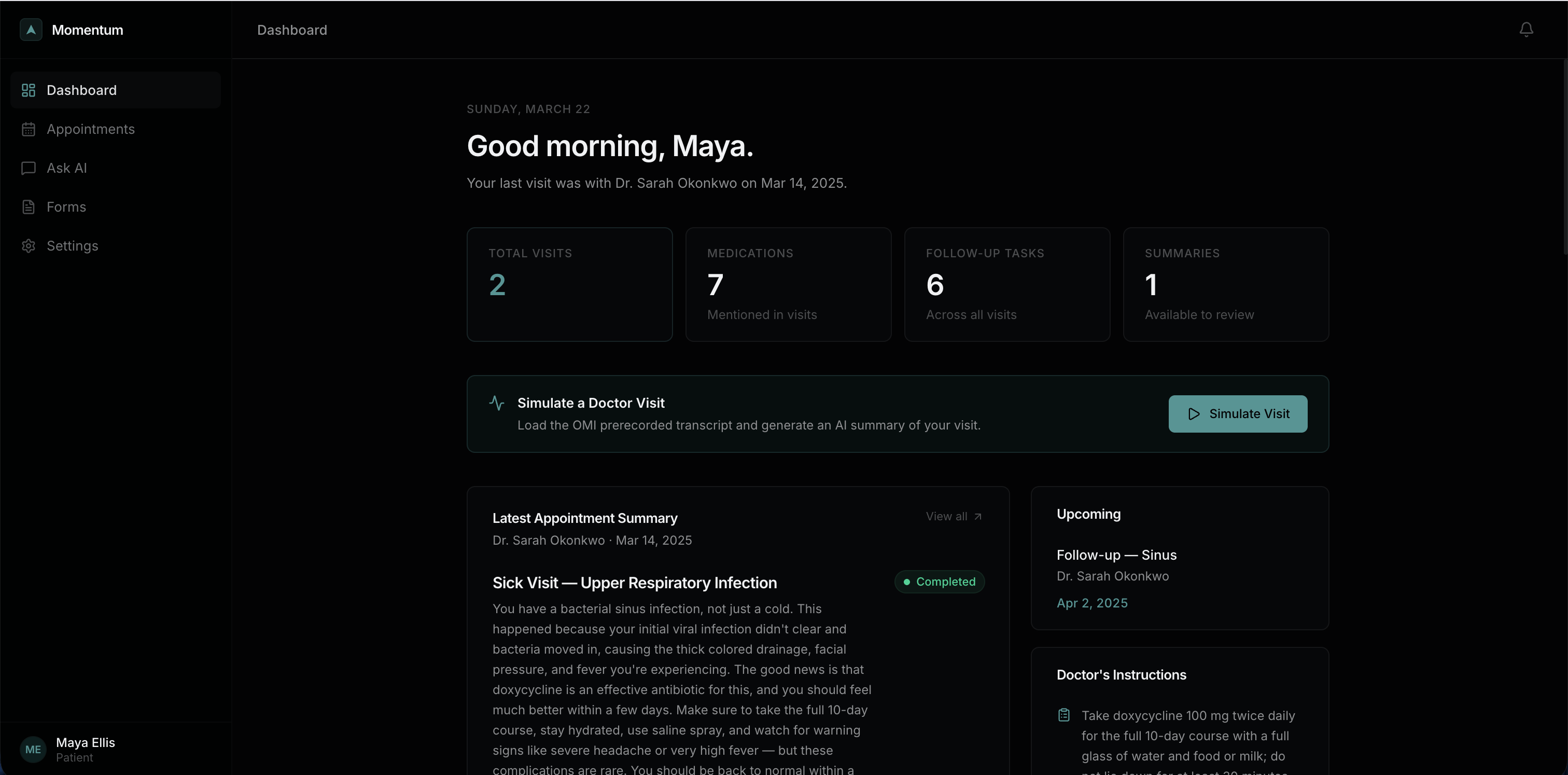
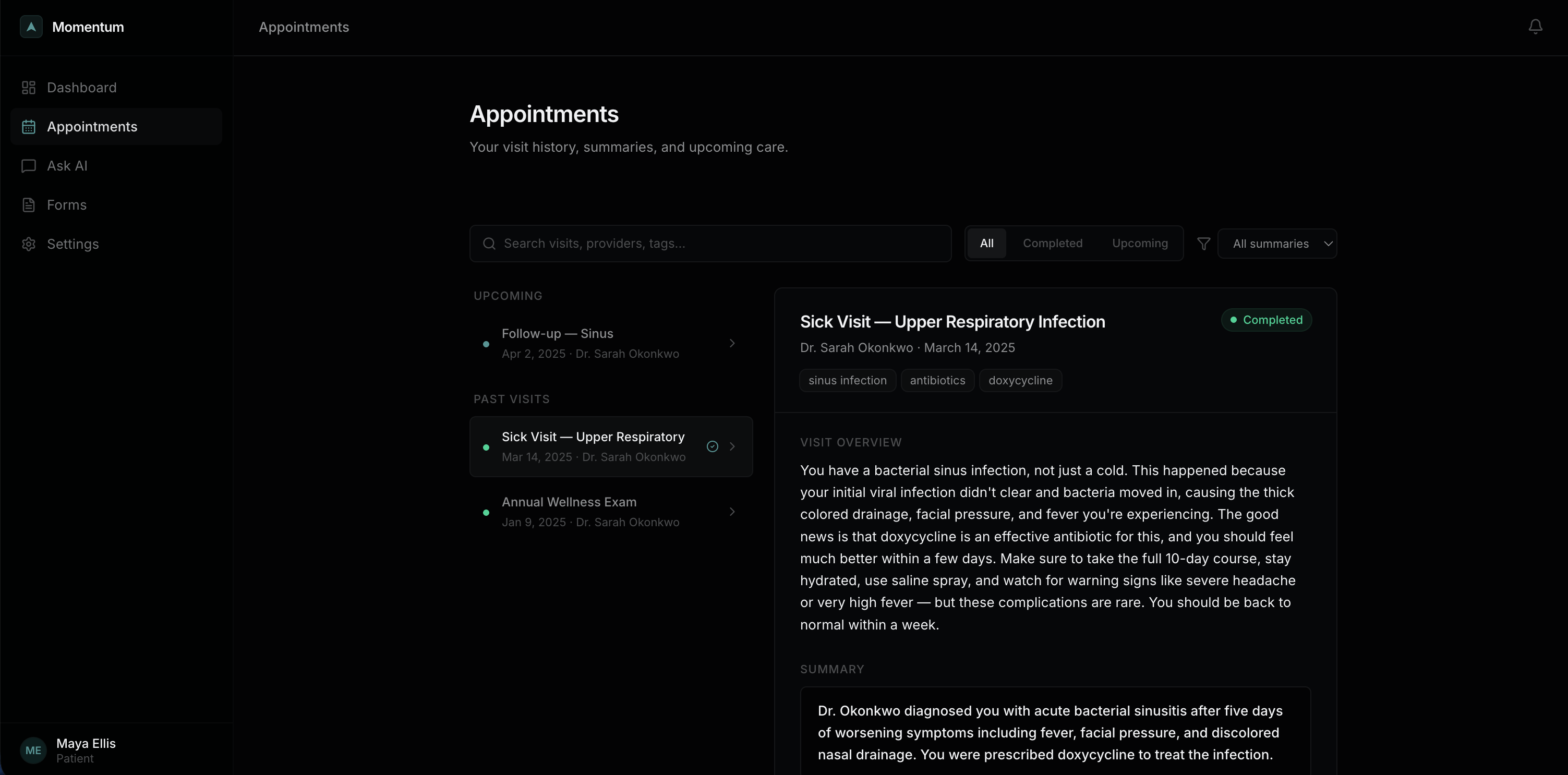
Appointment Summary
-
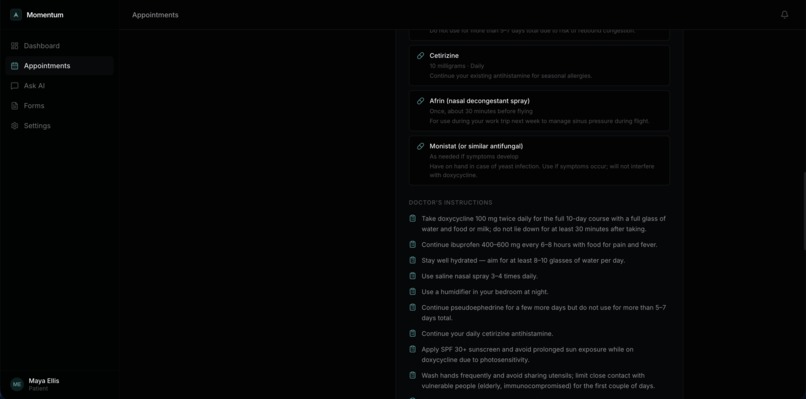
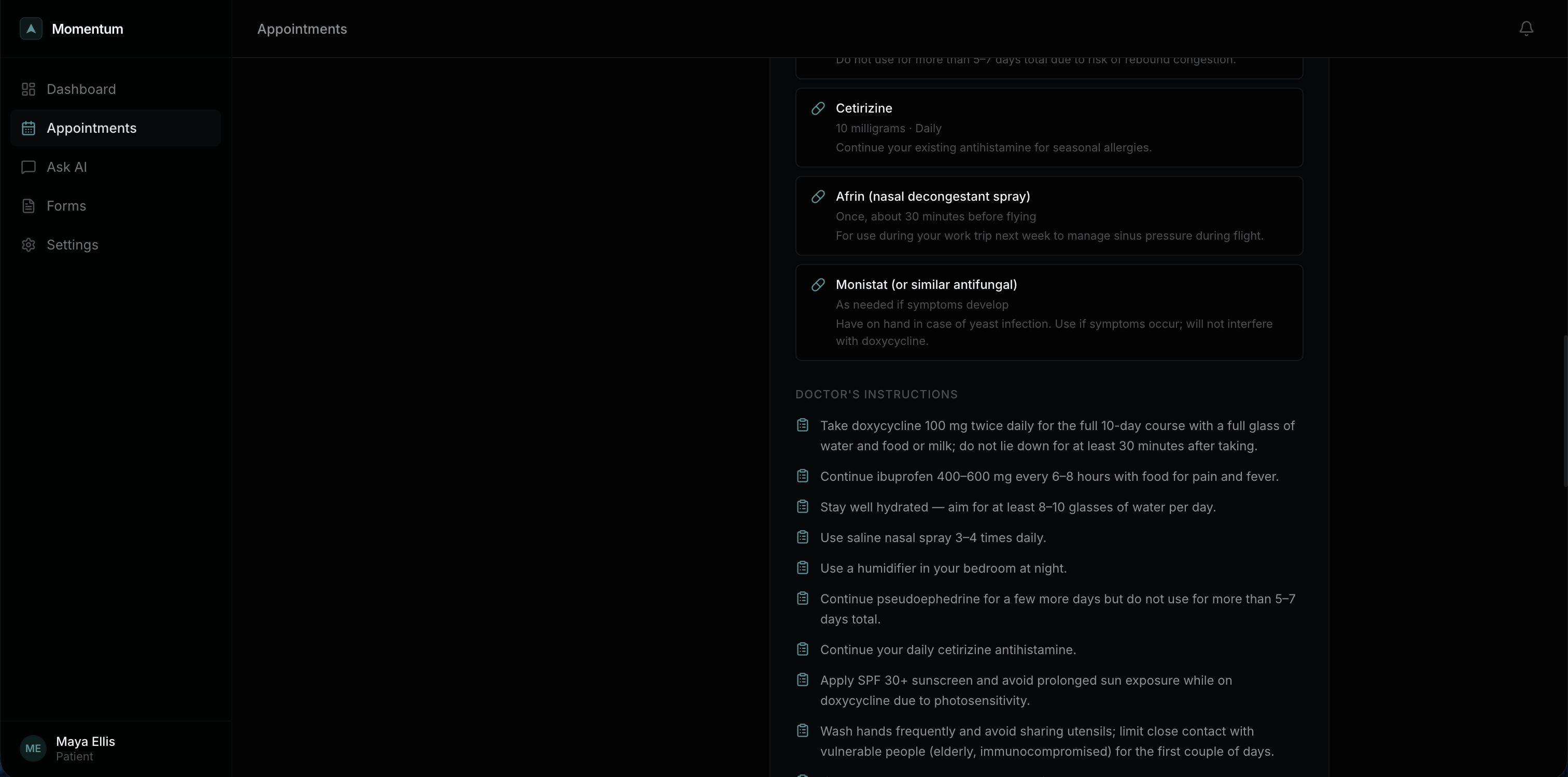
Appointment Summary (cont.)
-
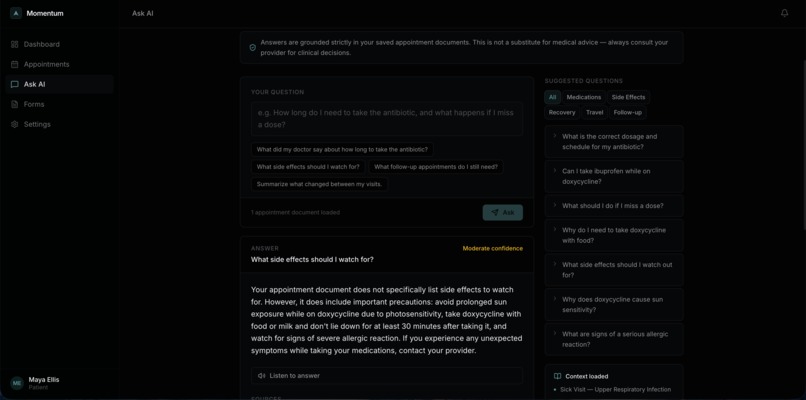
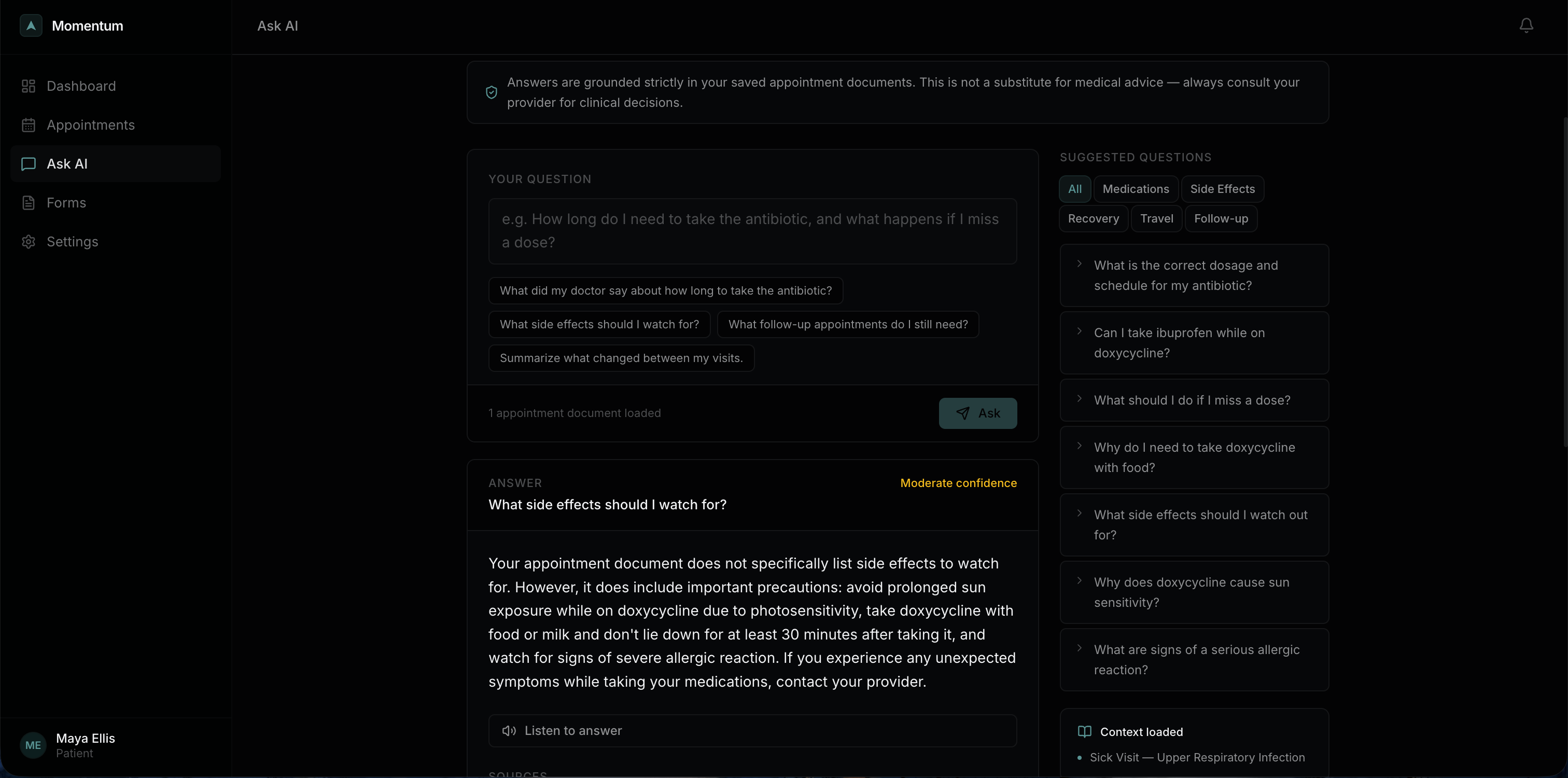
"Ask AI"
-
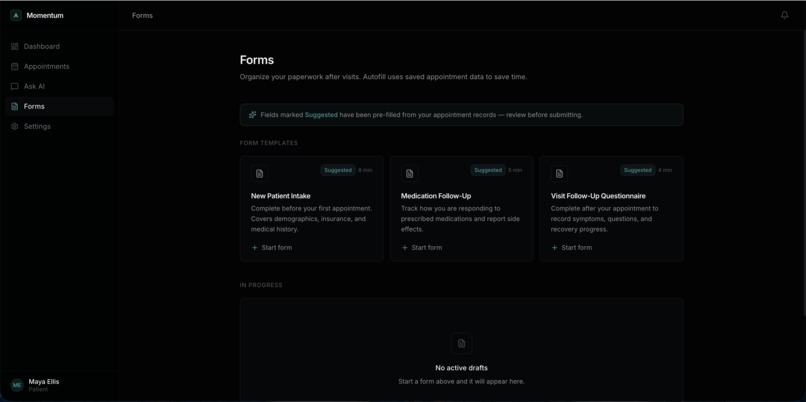
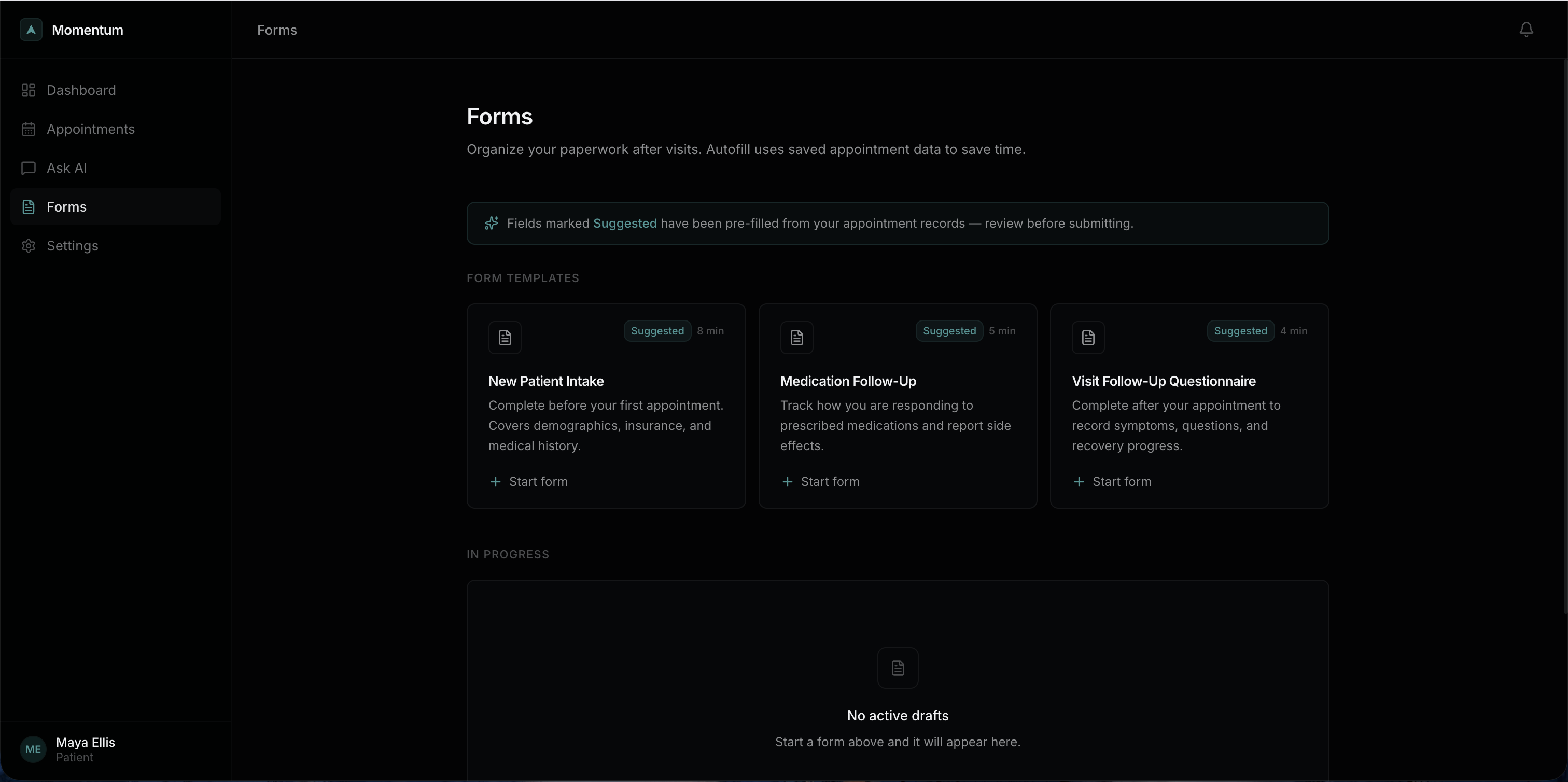
Forms
-
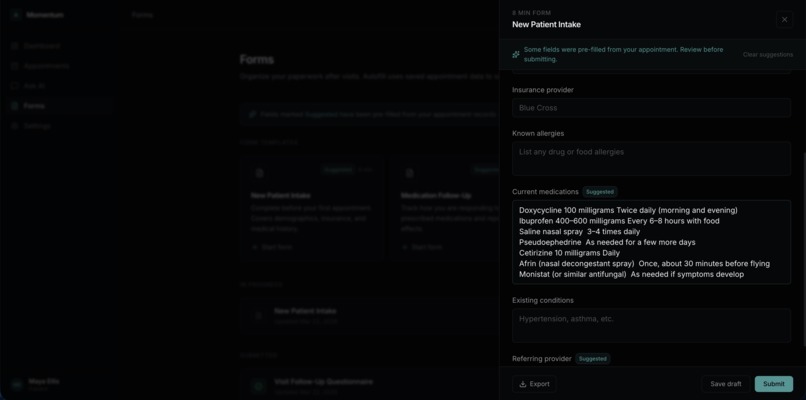
Forms (cont.)
-
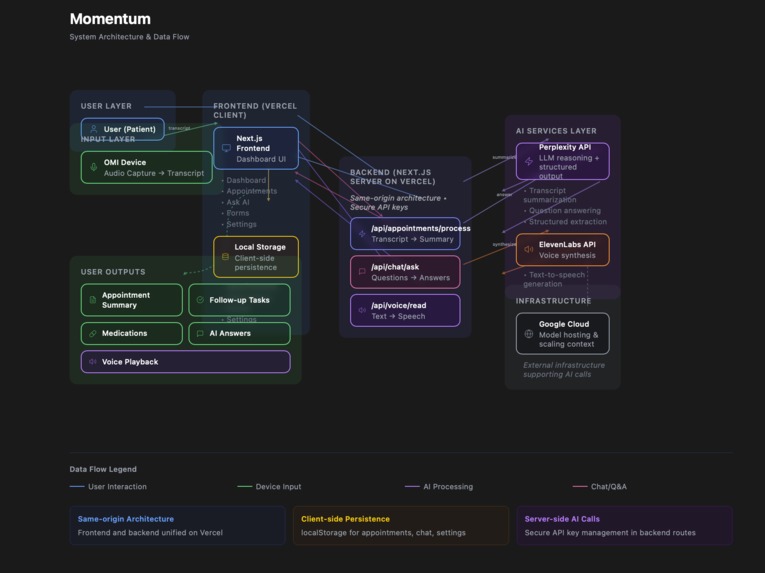
flow chart
Inspiration
Momentum.AI was inspired by family and by seeing healthcare up close through people we trust, especially a brother working in the medical field. Watching that world from both sides made one thing obvious: even when care is thoughtful and professional, patients often leave appointments overwhelmed, unsure what mattered most, and unable to easily carry that context forward.
That personal connection shaped the project. We wanted to build something that supports patients with more clarity, continuity, and control without adding more stress. Momentum.AI is our attempt to turn each appointment into part of a private, growing health memory so important instructions, medications, follow ups, and questions do not get lost between visits.
What it does
Momentum.AI turns doctor visits into a private, searchable health memory.
A patient records an appointment using an OMI wearable device, which sends audio and transcript data into the platform. Momentum.AI then:
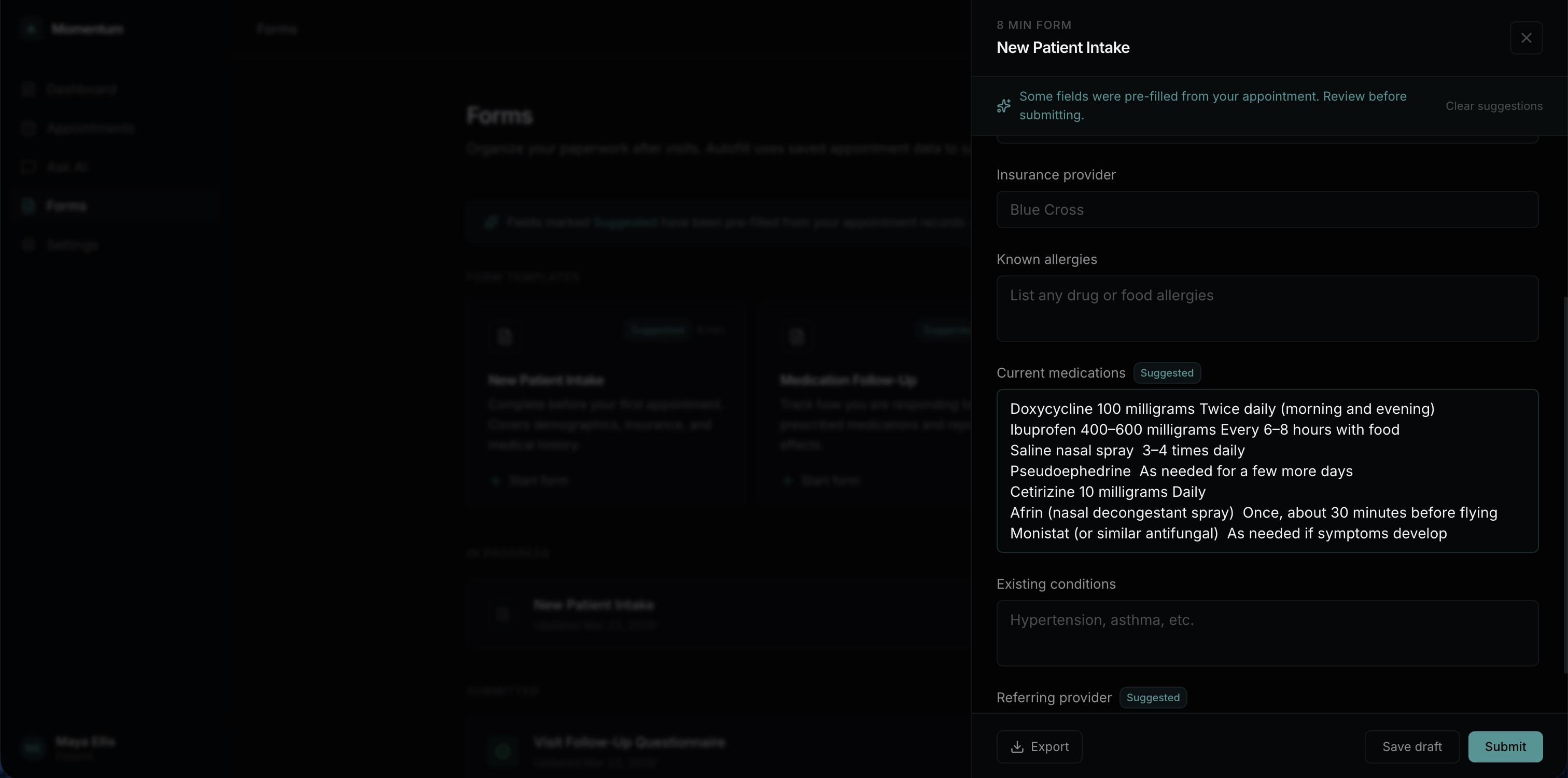
generates a clean summary of the appointment extracts key instructions, medications, follow ups, and warning signs lets the patient ask questions across all past visits using retrieval augmented generation reads answers aloud for accessibility helps autofill paperwork and medical forms using the patient’s own record
Over time, the system becomes more useful because each new visit strengthens the patient’s personal health context.
How we built it
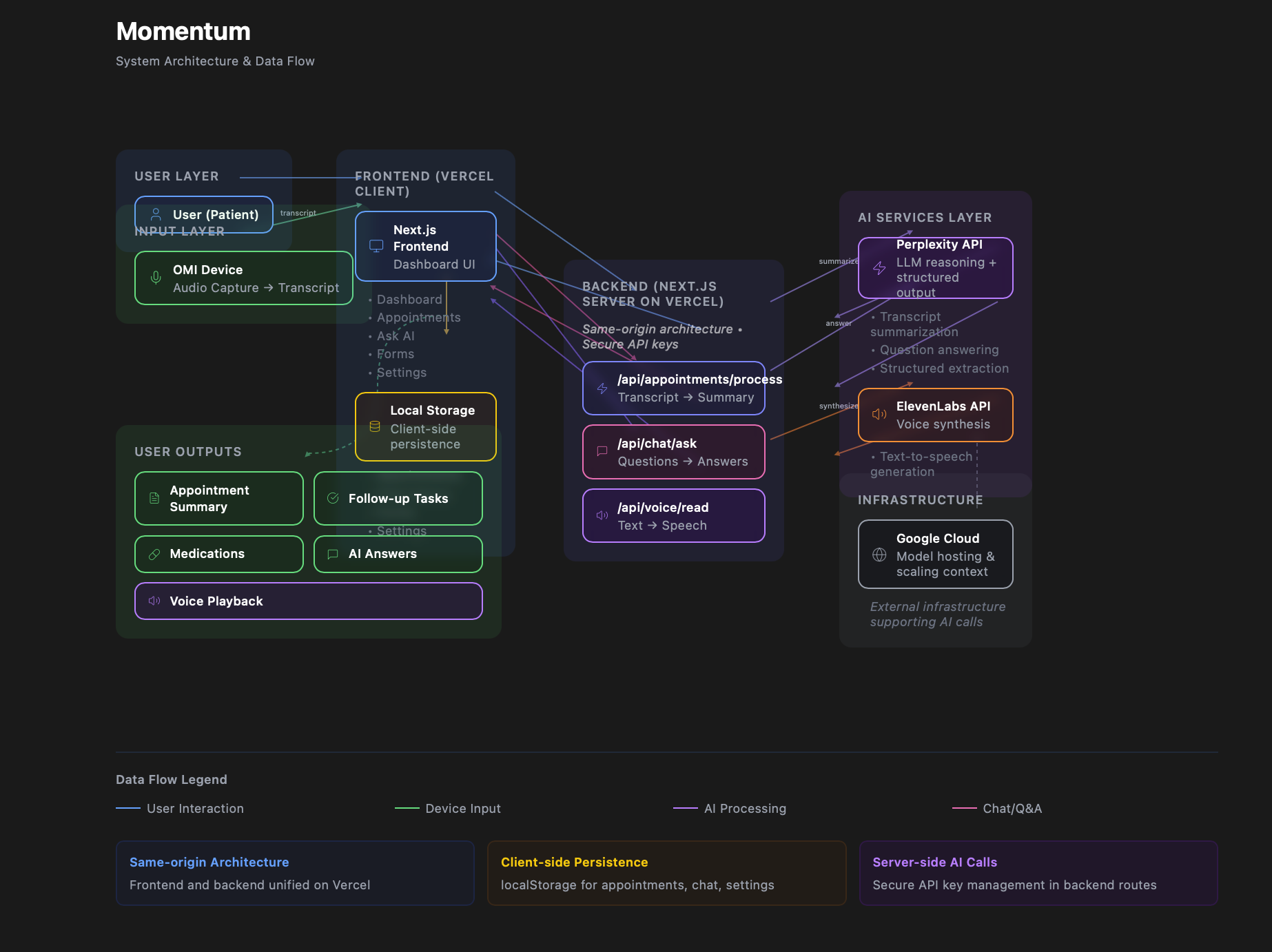
We built Momentum.AI as a modern full stack web app focused on privacy, clarity, and long term usefulness.
Frontend
Next.js 15 Tailwind CSS shadcn/ui a minimalist medical design system inspired by premium consumer software
AI stack
Perplexity for appointment summaries, retrieval augmented generation over transcripts, summaries, and uploaded documents ElevenLabs for text to speech accessibility
Infrastructure
Google Cloud for secure storage and AI infrastructure encrypted object storage for transcripts, summaries, documents, and audio private patient scoped data access webhook ingestion pipeline for OMI transcript events
We designed the system so each patient’s data stays logically isolated, each record is traceable, and every answer is grounded in the patient’s own history rather than generic medical advice.
Challenges we ran into
One of the biggest challenges was balancing intelligence with trust. In healthcare, the system cannot just be fast or impressive. It has to be careful, grounded, and reliable.
On the technical side, we ran into real infrastructure challenges. We initially spent time working through cloud architecture decisions, especially around secure storage, permissions, and handling sensitive patient data. As we refined the project, we switched from AWS to Google Cloud, which meant reworking parts of our storage and deployment approach while still keeping privacy and security at the center. That slowed us down early on, but it ultimately gave us a cleaner foundation for the MVP.
We also explored the role of hardware in the longer term product vision. Part of our broader thinking was around sovereign, local first AI systems, but bringing that kind of hardware driven approach into a hackathon setting introduced practical constraints. We had to balance that long term vision with the short term need to ship a polished cloud based product that people could actually use and demo.
Beyond infrastructure, we also had to solve product challenges quickly:
turning raw appointment transcripts into structured, patient friendly summaries building retrieval that stays scoped to one patient’s record only designing form autofill without hallucinating missing information creating a calm, trustworthy interface for a stressful domain
In the end, those challenges helped sharpen the product. They pushed us to be more intentional about privacy, architecture, and what it really means to build AI that patients can trust.
Accomplishments that we're proud of
We are proud that Momentum.AI feels like a real product, not just a demo.
Some highlights:
a working flow from recorded appointment to searchable patient memory AI summaries that make visits easier to understand grounded health Q and A over previous appointments and records accessible voice playback for generated answers paperwork assistance that uses context from the patient’s own history a cohesive design language built around privacy, clarity, and trust
Most importantly, we built something that points toward a better patient experience: one where your health history becomes more useful over time instead of more fragmented.
What we learned
We learned that in healthcare, restraint is a feature. The most important part of the product was not making the AI sound smart, but making it understandable, grounded, and transparent.
We also learned that patient trust comes from system design as much as interface design. Security boundaries, citations, clear provenance, and uncertainty handling matter just as much as beautiful UI.
On the product side, we learned that patients do not just want summaries. They want continuity. They want to ask, "What did my doctor tell me last time?" or "Was I supposed to follow up on this?" That longitudinal memory is where the real value starts to compound.
What's next for Momentum.AI
Next, we want to make Momentum.AI even more useful as a long term patient companion.
Our roadmap includes:
deeper form and paperwork automation better document ingestion for lab results, visit notes, and discharge instructions stronger citation and provenance tools inside every answer medication and follow up timelines across visits family care and caregiver access controls tighter privacy controls and export options so patients can truly own their record
Our long term vision is to make Momentum.AI the private operating layer for personal healthcare memory: a system that helps patients understand their care, stay organized, and carry forward the full context of their health over time.
Built With
- elevenlabs
- gemini-1.5-pro
- google-cloud
- next.js-15
- node.js
- omi
- omi-webhook-integration
- perplexity
- perplexity-api
- pgvector
- postgresql
- react
- shadcn/ui
- tailwind-css
- typescript


Log in or sign up for Devpost to join the conversation.