-
-
How it works
-
Discovery page
-
Landing Page
Inspiration
We didn't start with a product idea — we started by walking into Nepal's "party palaces," the halls where families host weddings, receptions, and bratabandhas. The same three problems came up every time. First, cost: many were paying up to Rs 16,000/month (~US$120) for booking software — and still surrendering a cut of every lead that software sent them. Second, reach: their market ended at the city limits, while the Nepali diaspora — the people most likely to spend on an event back home — was completely out of reach. Third, friction: turning an inquiry into a booking meant endless WhatsApp back-and-forth — questions, quotes, revisions — most of it manual, much of it lost.
The deeper inspiration was a realization about timing: AI has collapsed the cost of building software and the cost of operating a business at the same moment. A two-person team can now build what used to need a funded company, and a small palace that could never afford a sales, marketing, and design department can rent all three as one AI concierge — for less than it already pays for software that does none of it.
What it does
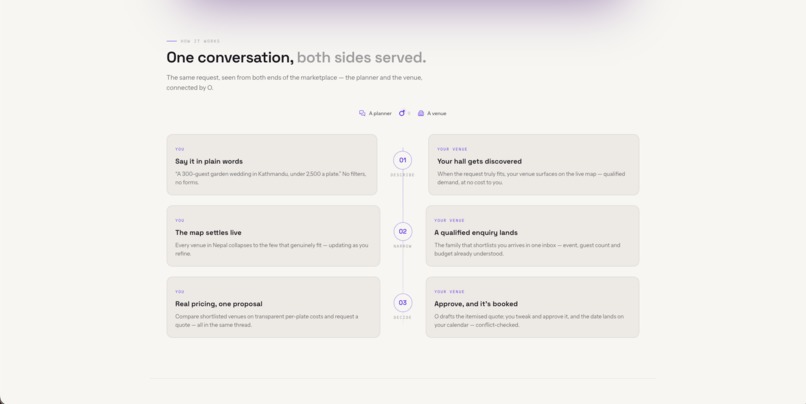
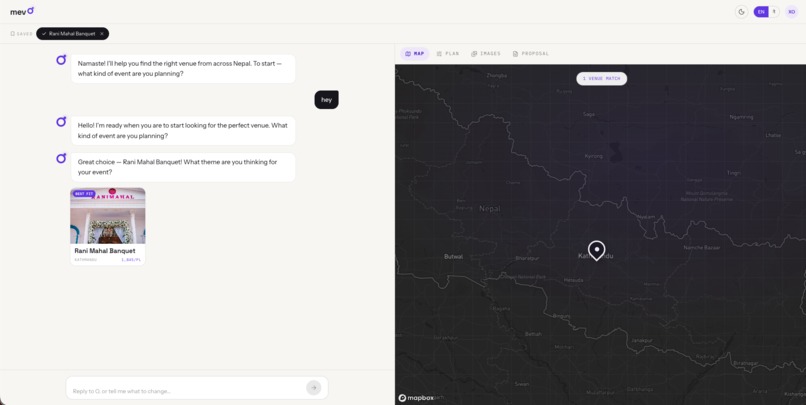
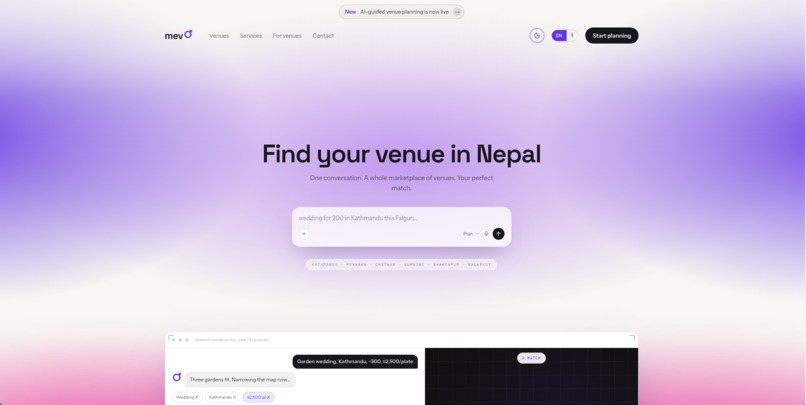
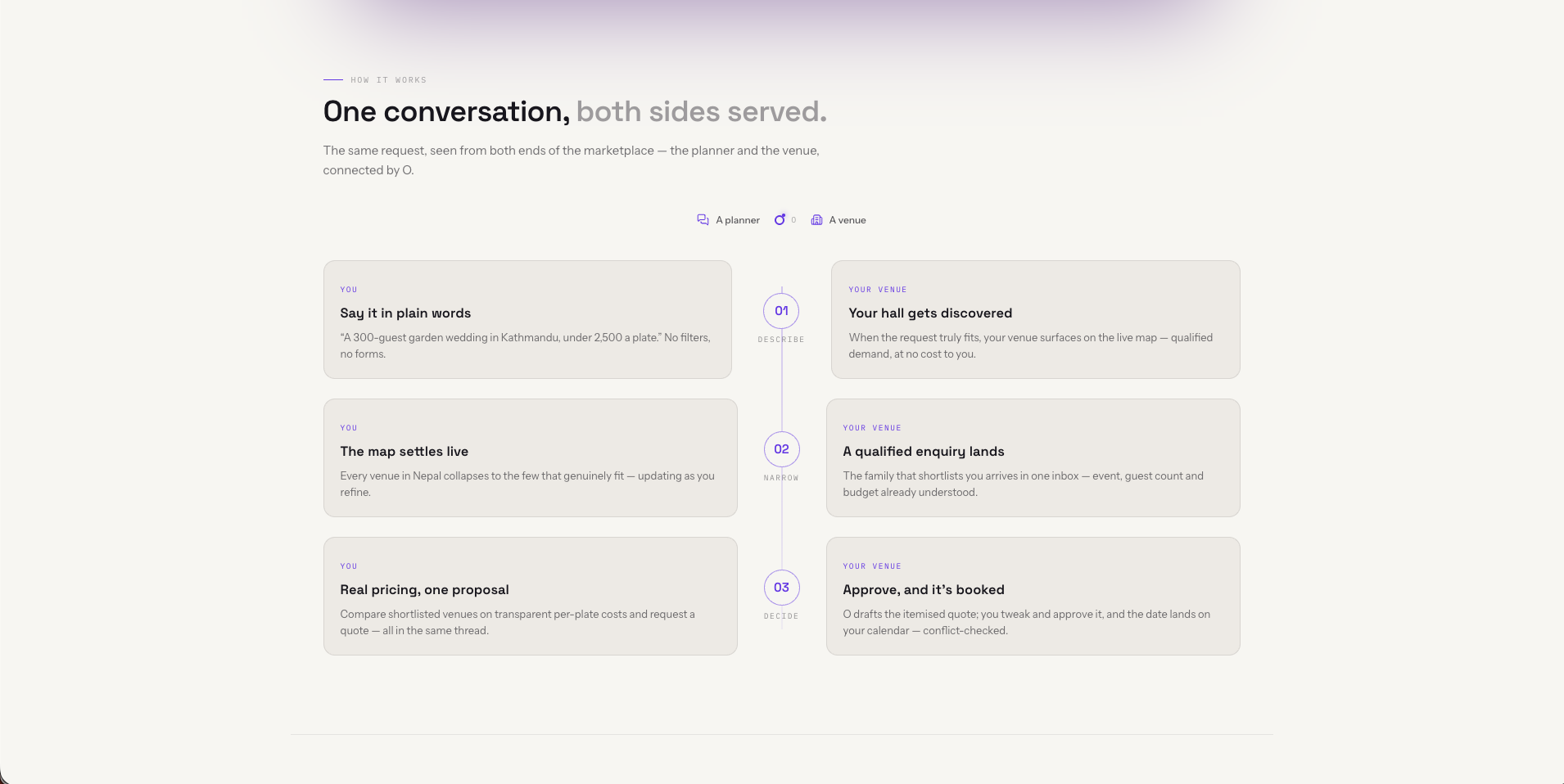
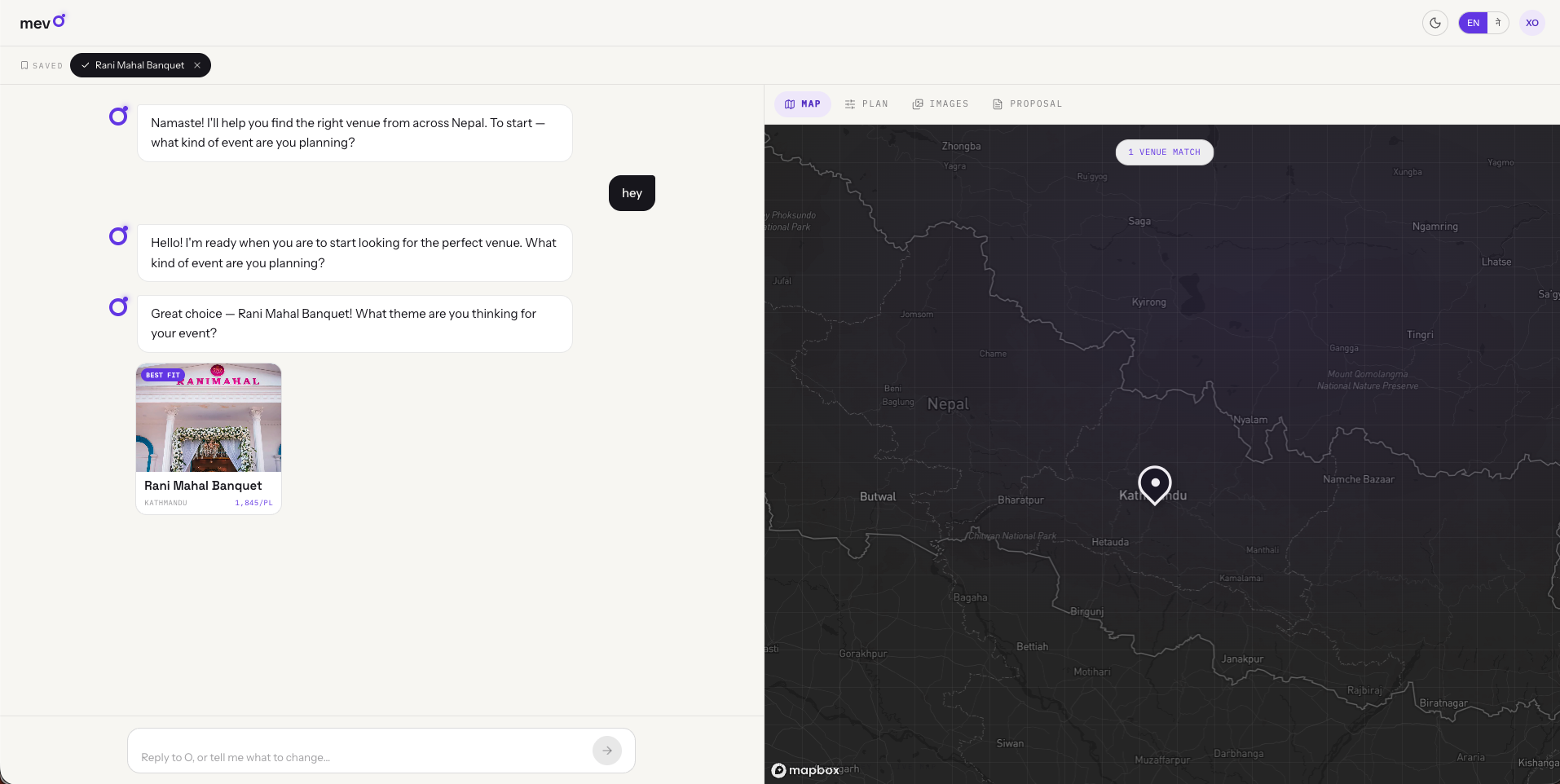
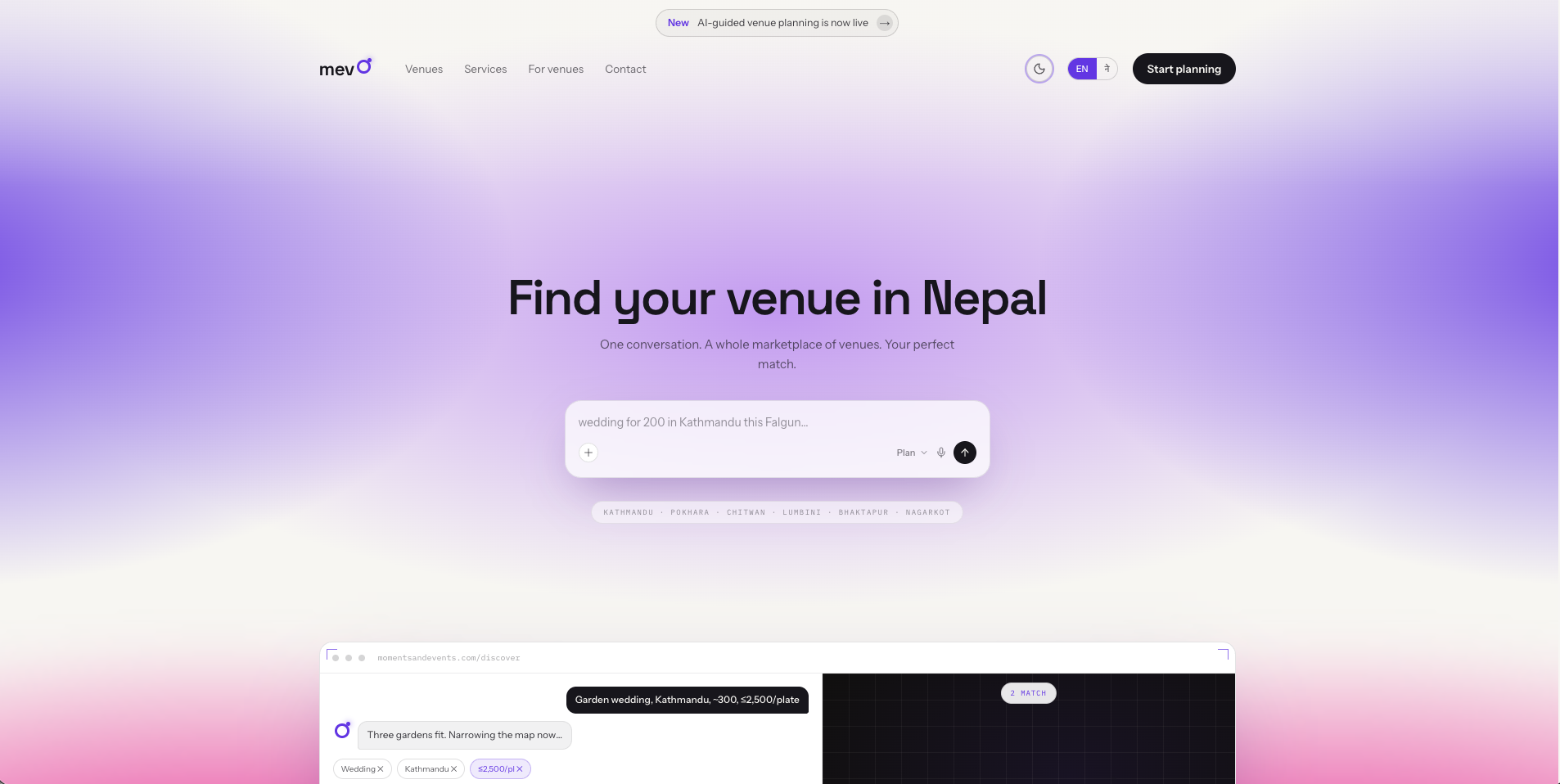
Mevo is a bilingual (English/Nepali) AI concierge for event venues, fronted by a live-narrowing map. A customer describes their event in natural conversation; the map narrows to matching venues in real time; and they walk away with an AI-drafted, priced proposal and concept images of their event inside that specific hall.
Three Gemini agents do the daily work of an events team:
- Intake holds a natural bilingual conversation to collect the brief — date, headcount, budget, vibe — collapsing the endless WhatsApp back-and-forth into one guided chat. It runs in two modes: open discovery (no venue chosen yet, feeds the matcher) and venue (a single hall in focus).
- Proposal turns the brief plus the venue's own packages into a structured, schema-validated, priced proposal.
- Concept writes scene prompts and renders images of how the event could look in that exact space.
The unbreakable rule: AI drafts, a human decides. Every outbound message, quote, and confirmation is approved by a real person on the venue's side before it reaches the customer. In Nepal — as across much of Asia — a wedding is a high-trust, relationship-driven purchase; nobody books a hall from a bot. The AI is the fastest employee the palace has ever had. The human is still the host.
How we built it
We're a two-person team — one developer, one on marketing and legal — and AI is the reason two people can run what used to take a small company. Gemini and Claude Code write, review, and refactor most of the code, so one developer designs, builds, and deploys in a single day. On the business side, AI drafts our outreach, venue pitches, and the first pass of the legal work — terms, policies, and the data/payment compliance a startup normally pays a firm for. What we keep for ourselves is judgment: architecture and the trust model on one side, positioning and what's safe to sign on the other.
The stack:
- Backend: FastAPI (async SQLAlchemy) on Cloud Run, with Cloud SQL Postgres. Three agents on Gemini 2.5 (
profor proposals,flashfor concept prompts) plus Imagen 4 for renders, all on Vertex AI. - Frontend: Next.js 16 App Router, a Mapbox live-narrowing map, Firebase Auth with three role tiers (system admin / venue staff / customer).
- Cost safety, built in from day one: every single model call is wrapped by an
audited_callthat writes one audit row — tokens, latency, USD — and a cost guard enforces a global daily kill-switch plus per-user and per-event caps. Every check trips before the paid Vertex call, because uncapped AI spend is the one real financial risk in a lean business. - No vector DB — on purpose: matching is a SQL prefilter plus in-context LLM ranking over a small candidate set, with venue knowledge injected deterministically so there's no cross-venue contamination, and a relaxation ladder that guarantees the map is never empty.
Challenges we ran into
- The trust line. The hardest engineering decision was not automating. It would have been easy to let the AI send and confirm on its own — but that breaks the cultural reality of the market. We made "human approves every outbound" structural in the product, not a policy we could quietly drop.
- Bleeding-edge framework. We're on Next.js 16, which has breaking changes that don't exist in any model's training data (
middleware.ts→proxy.ts, async route params). We had to learn to make the AI read the actual current docs rather than trust its memory. - Cloud-native gotchas. Real production bugs, like image signed-URL signing failing under Cloud Run's default credentials — the kind of thing that only shows up once you're actually live, not on localhost.
- Matching without a vector DB. Getting relevant, never-empty results from a small, real venue set took a relaxation ladder and careful prompt design instead of an easy embeddings shortcut.
- Being honest about stage. We're live with one pilot venue and no real customer traffic yet. The challenge was building the whole trust-and-cost architecture first, so that when traffic comes, the guardrails are already load-bearing.
Accomplishments that we're proud of
- Two people shipped a production system. Mevo is live on Cloud Run, not a prototype in a folder.
- Cost governance is structural, not aspirational. Every model call is metered and capped before it spends a rupee.
- The map never lies. The backend owns the match, so the AI's spoken venue count and the pins on the map can never drift apart.
- It genuinely works in two languages, and it visualizes the event inside the customer's chosen hall — not a stock ballroom.
- The economics are real. For that first venue, the math is simple:
$$ \text{Annual software saved} = \text{Rs } 16{,}000 \times 12 = \text{Rs } 192{,}000 \; (\approx \text{US\$}1{,}440) $$
…on top of no longer surrendering a cut of every lead. That money stays in the business.
What we learned
- AI collapsed two costs at once — the cost of building and the cost of operating — and that's the whole thesis: give an everyday business the tools to compete like a big one.
- In a high-trust market, the winning design keeps a human in charge. "AI drafts, human decides" isn't a limitation; it's the product.
- Deterministic beats clever. Injecting venue knowledge directly and ranking in-context was more reliable — and cheaper — than reaching for a vector database on a small candidate set.
- New tools demand new habits. With frameworks moving faster than training data, the skill is teaching the AI to read the current source of truth.
What's next for Moments and Events
- Real traffic. Move from one pilot venue to a first cohort, and get actual customers through the funnel.
- A distributed local workforce. The operator role needs no coding, English fluency, or design skill — the AI supplies all three — so it's a real job for people usually shut out of "tech" work: women, older staff, anyone outside the English-speaking, computer-literate minority. We'll extend that into part-time operators and onboarding agents who sign up and manage venues in their own towns.
- The diaspora bridge. Let a Nepali family in Sydney or Doha plan and pay for an event at home, in their own language — so foreign earnings land as revenue for a small local business and everyone it hires for the day: decorators, caterers, cooks, photographers, sound crews, tent-and-chair suppliers.
- A public venue directory as the next growth lever, and venue-real concept imagery so every render is grounded in the actual hall.
- Payments and compliance hardened for real bookings at scale.
Built With
- cloud-run
- cloud-sql
- fastapi
- firebase
- gemini
- google-cloud
- mapbox
- nextjs
- postgresql
- python
- typescript


Log in or sign up for Devpost to join the conversation.