Inspiration
Identity theft and account compromise rarely happen because users are careless all the time. They usually happen during short, high-risk moments — especially while traveling. Airports, hotels, and cafés force users onto public networks, where they still need to access banks, email, or work systems.
Existing security tools like VPNs, password managers, and identity protection services work well individually, but they operate in isolation. None of them answer a critical question at the right moment: “Is this a bad time to log in right now?”
Nexora was inspired by this gap — not a lack of tools, but a lack of timing-based intervention.
What the project does
Nexora is a moment-based digital threat interceptor that focuses on preventing risky login attempts before damage occurs.
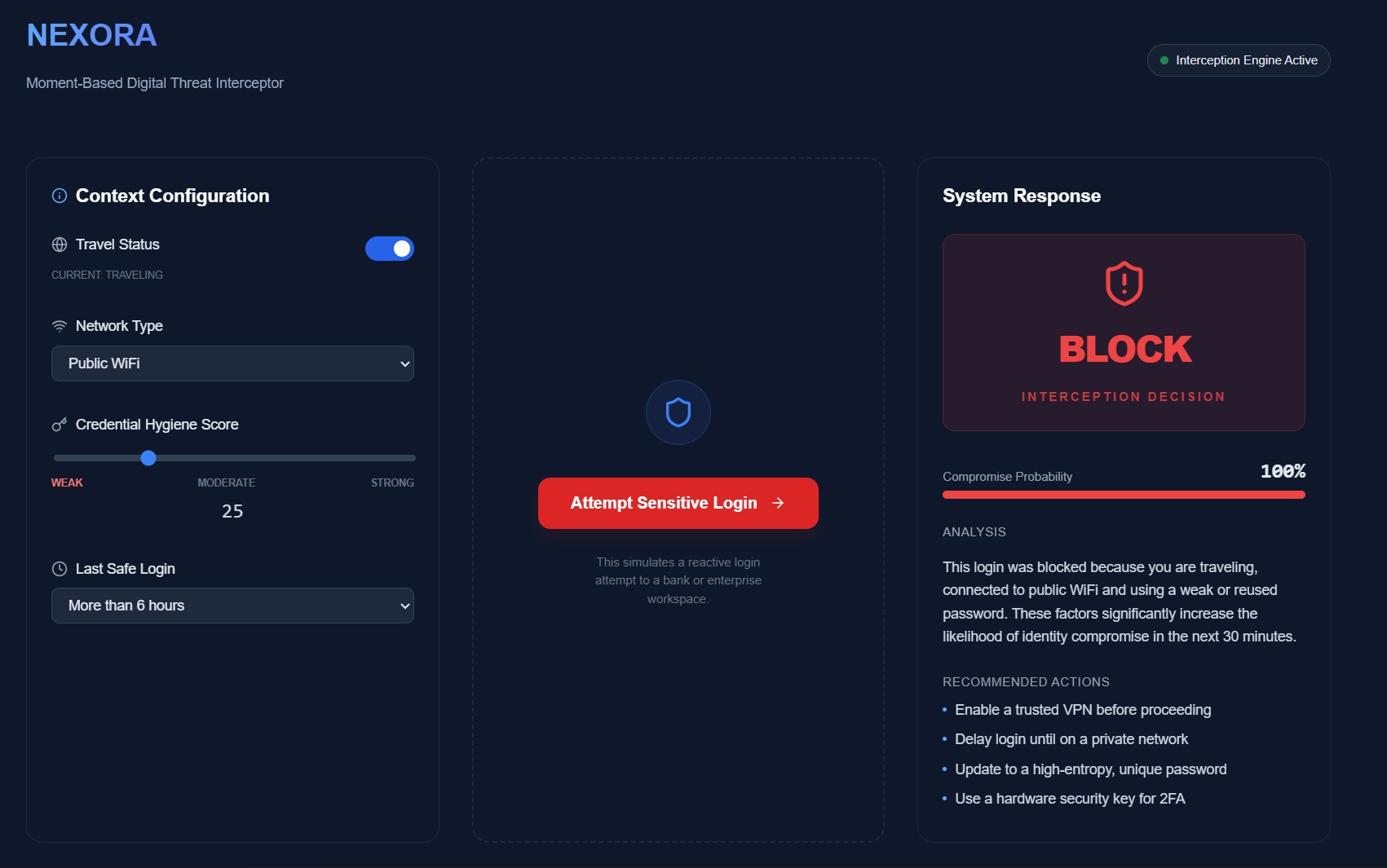
Instead of monitoring users continuously, Nexora activates only when a sensitive login event is detected. At that moment, it evaluates contextual signals such as:
- Network safety (e.g., public vs private networks)
- Credential hygiene (password reuse, strength, exposure risk)
- Travel status
- Time since the last safe login
Using these signals, Nexora predicts the likelihood of identity compromise in the next 30 minutes and makes an immediate intervention decision:
- ALLOW – low risk
- WARN – elevated risk
- BLOCK – high-risk moment
The system then explains the decision in plain language and recommends concrete next steps, such as enabling a trusted VPN or delaying the login until a safer network is available.
How we built it
This hackathon MVP was built as a client-side interception simulation to demonstrate system behavior and decision logic.
The frontend acts as a controlled simulation console where external security signals are represented as inputs. These inputs mirror what real-world systems would provide:
- Network context (VPN / connectivity tools)
- Credential hygiene signals (password managers)
- Identity risk indicators (identity protection services)
- Travel connectivity context (eSIM or roaming status)
The backend implements a risk inference engine that combines these signals using a temporal, weighted risk model to estimate near-term compromise probability. The focus was not on blocking real websites, but on proving when and why an interception should occur.
Challenges we faced
The biggest challenge was avoiding a generic “security dashboard.” Many tools show risk scores, but few act at the exact moment a user is about to make a dangerous decision.
Another challenge was designing AI logic that felt justified rather than cosmetic. We addressed this by focusing on context correlation and timing, ensuring the system reacts only when multiple risk factors converge within a short window.
Finally, clearly communicating that this is a simulation of a real interception layer — not a replacement for existing tools — was critical for technical honesty and judge clarity.
What we learned
We learned that the most valuable security interventions are not continuous or noisy, but precise and well-timed. Preventing a single bad login at the wrong moment can be more impactful than thousands of passive alerts.
Nexora demonstrates how existing security products can be amplified through an intelligent decision layer that focuses on when to act, not just what to monitor.
Built With
- ai-assisted-development-(antigravity-ai)
- client-side-simulation
- context
- css
- fastapi
- html
- javascript
- python
- risk-modeling
- security

Log in or sign up for Devpost to join the conversation.