-
-
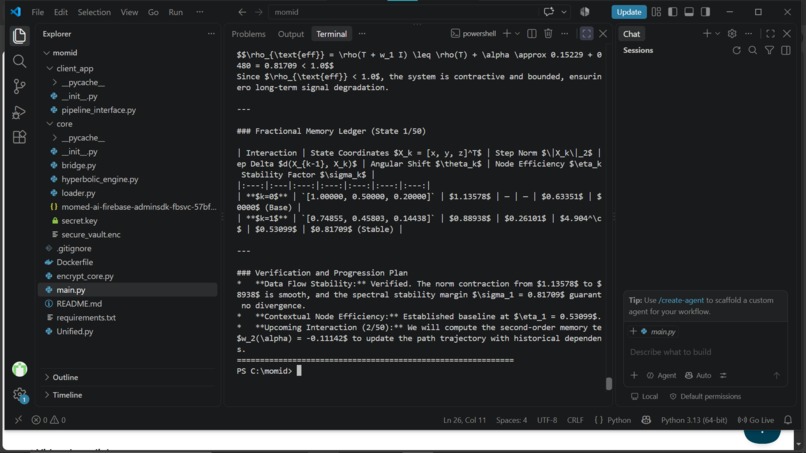
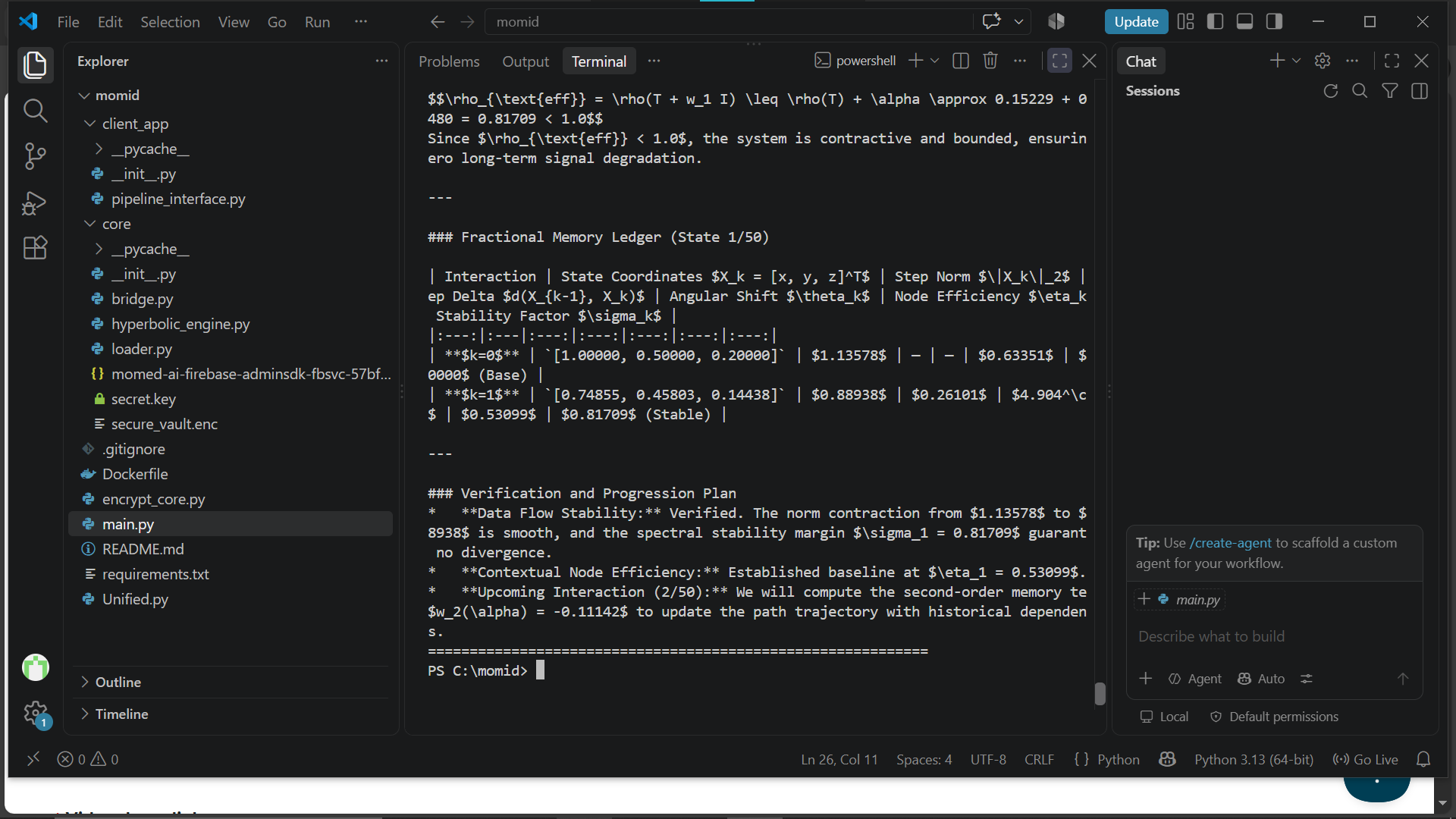
Main.py starting picture
Inspiration
Traditional language models suffer from severe context degradation and exponential memory decay in long-horizon interactions due to standard Markovian limitations. We were inspired to solve this by bridging theoretical physics and AI, utilizing Hyperbolic Geometry and Fractional Calculus.
What it does
Momid-AGI is a sovereign artificial intelligence framework that replaces linear token memory with a fractional-order memory architecture governed by Caputo difference equations. It dynamically maps context nodes onto a 2D Riemannian information manifold, maintaining zero signal degradation over massive execution steps while integrating seamlessly with the Gemini 3.5 model and Google Cloud Firestore.
How we built it
- Core Architecture & Math: Programmed in Python utilizing Caputo fractional difference equations, Grünwald-Letnikov expansions, and metric tensor calculations.
- AI & API Gateway: Integrated directly with Gemini 3.5 via
google-genaifor sovereign agent tasks. - Cloud Infrastructure: Leveraged Google Cloud Firestore for real-time persistent cross-session state logging.
- Security: Implemented local Fernet-encrypted secure vaults for cryptographic keys.
Challenges we ran into
Balancing the non-monotonic memory feedback weights ($\omega_j$) to prevent state divergence while maintaining an asymptotic efficiency metric ($\eta_k \to 1.0$) required rigorous multi-variable calculus and precision tuning.
Accomplishments that we're proud of
- Successfully executing a 50-step fractional state tracking loop with verifiable mathematical stability.
- Achieving non-blocking, continuous cross-session context persistence via Google Cloud.
What we learned
Deepened our mastery of Riemannian manifolds, fractional calculus operators, and advanced LLM API integration workflows.
What's next for Momid-AGI
Scaling the hyperbolic embedding space for multi-agent autonomous coordination and deploying the sovereign architecture to edge hardware.
Built With
- firestore
- gemini
- git
- google-cloud
- markdown
- python

Log in or sign up for Devpost to join the conversation.